Templo Mayor
Templo Mayor, Mexico
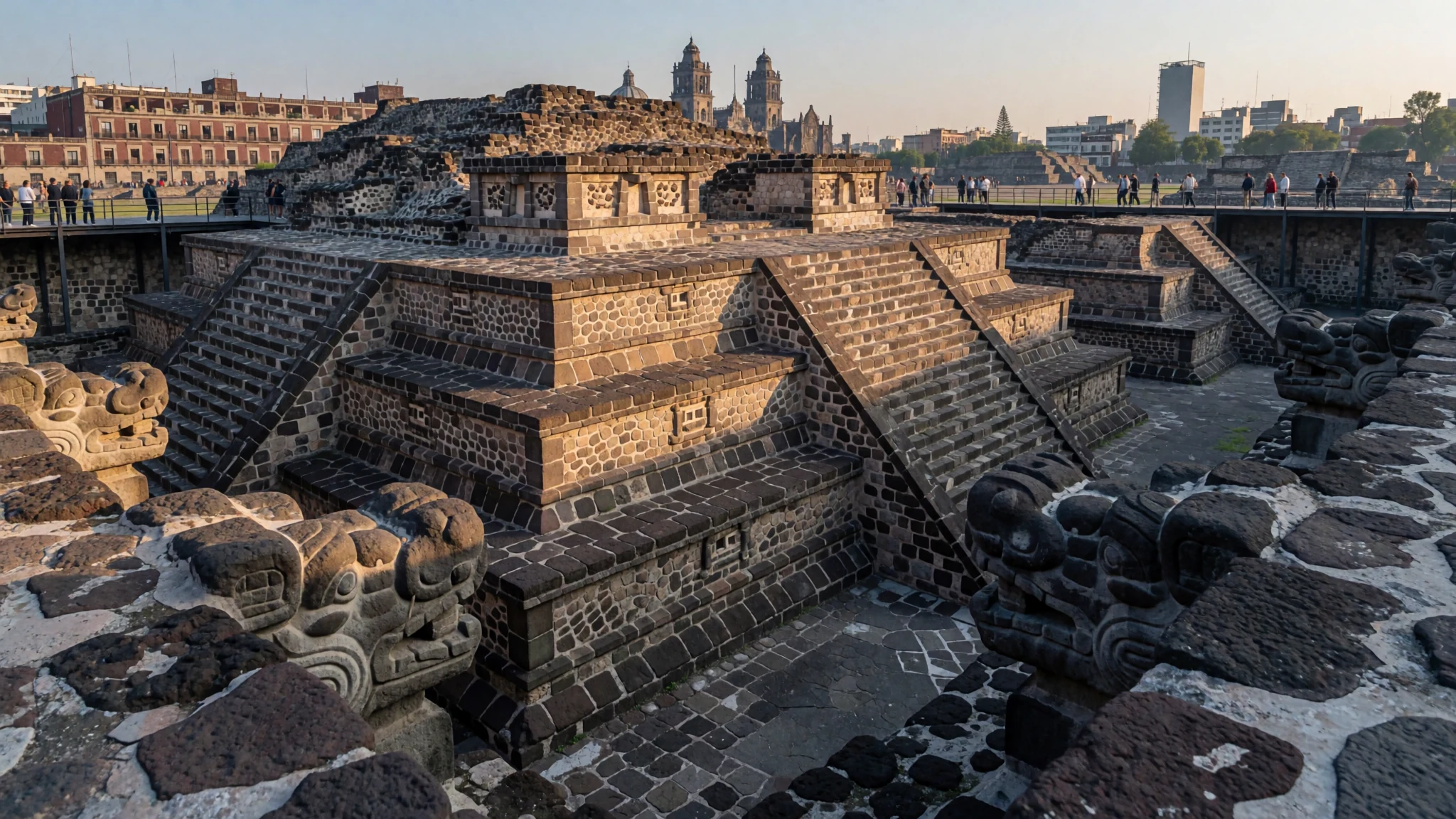
Templo Mayor is the excavated heart of Mexica Tenochtitlan, still open to the sky in Mexico City.
The place
Templo Mayor is the excavated Mexica pyramid under the historic centre of Mexico City, the ceremonial heart of what had been Tenochtitlan. Speakers of Spanish still call it the chief temple; the Nahuatl alias in the record is Huei Teocalli. The city treated this footprint as the point where its world was anchored, the place that kept the sun's fight and the coming of rain in one ritual map. Battle and the Mexica patron belonged to Huitzilopochtli. Storms, water and the fields belonged to Tlaloc. They did not share a chapel: the summit held a sanctuary for each, and each sanctuary was reached by its own stair. Wind had a marker too, in Ehecatl, a guise of Quetzalcoatl. Roughly 100 by 80 metres of base carried that double shrine and faced the walled ceremonial district around it. The year 1325, when Tenochtitlan was founded, is the year the earliest temple here went up, and later rulers enlarged that same spot instead of shifting it. Spanish troops demolished the finished building in 1521. The cathedral stands beside the cleared ground, and Plaza de la Constitución, the Zócalo, opens on the southwest side. Seminario and Justo Sierra are the streets on either side of the dig. What remains for a visitor is a pit of stacked building stages, not a complete pyramid against the sky. In 2020 the surrounding metropolitan area held 22 million people, and in 2017 the ruins recorded 801,942 visits.
Its story
Templo Mayor grew by swallowing its own earlier walls. The earliest of the seven temples on the site went up in 1325, alongside the founding of Tenochtitlan, and each later project enlarged what was already there, which is why models show several outlines and the open dig reads as one shell inside another. By 1375 a second stage had already overtaken that first building. The greatest growth on record belongs to 1454, when Moctezuma I directed the expansion. Conquistador writings of 1519 are the earliest outside notice of the seventh stage, by then the temple Spaniards actually saw. Mexica hands altered that seventh stage once more in 1520. In 1521 the same invaders sacked the precinct and demolished the pyramid as Tenochtitlan fell. Earlier phases lay under colonial paving, with the cathedral later rising beside them and the Zócalo eventually spreading to the southwest. Read as a sequence, the seven stages say the capital preferred to renew one ritual centre rather than move it: the cults of battle and of rain kept their stairs while the masonry spread. Sculpture pulled from the layers, above all the round stone of Coyolxauhqui, still ties state rite to this spot. Johann Georg Heck's printed plate shows sacrifice at a Mexican temple; that violence belonged to the working pyramid.
What to see
- Excavated double pyramid — Centro, between Seminario and Justo Sierra
The excavated pyramid at Templo Mayor is a set of nested platforms rather than a finished peak. Two stair lines still show that Huitzilopochtli and Tlaloc each had a way up to a separate sanctuary. Walkways ring the pit so visitors can read those stages without stepping onto the masonry. A base of about 100 by 80 metres still sets the scale. Seminario and Justo Sierra bound the Centro block.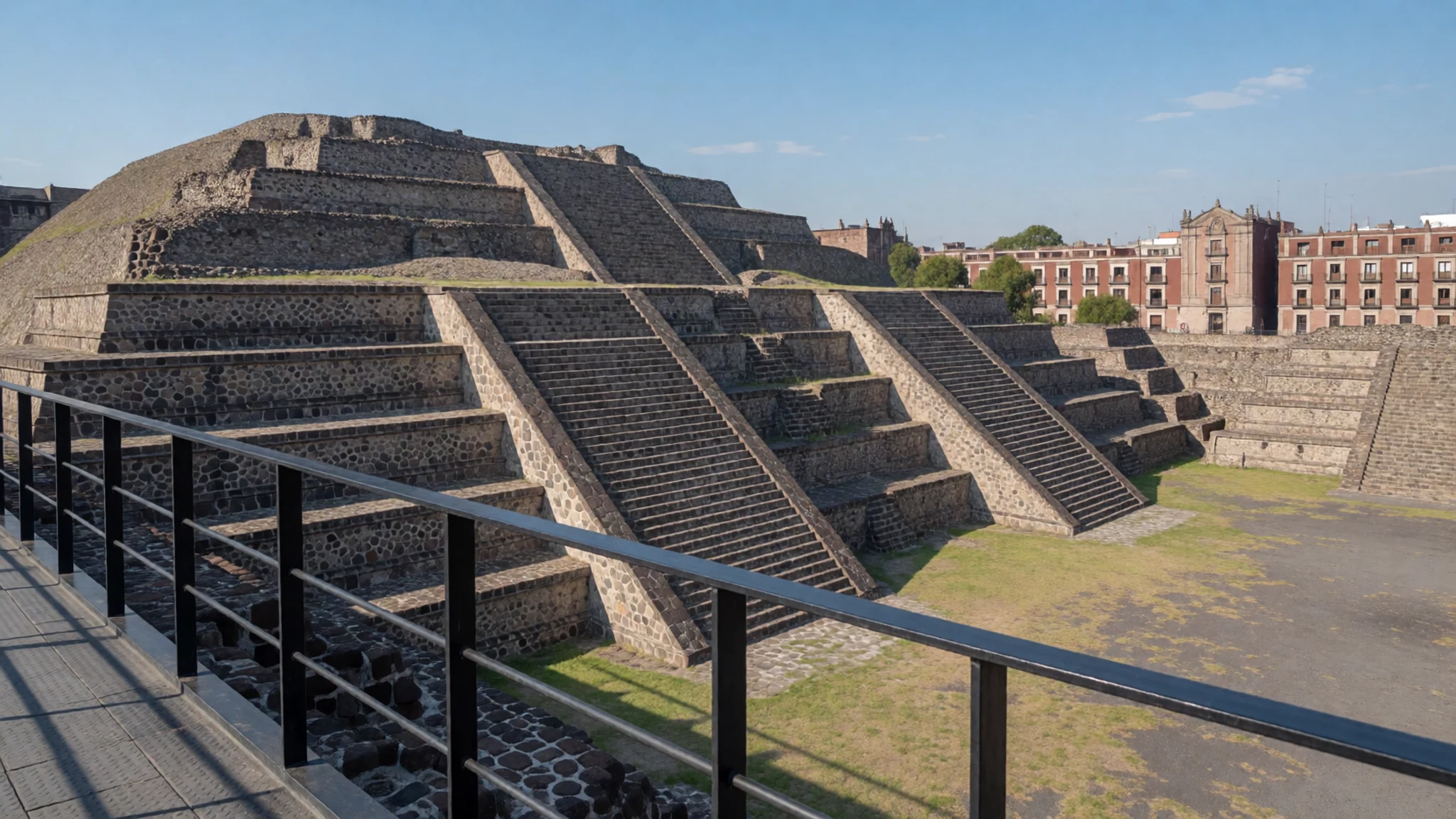
- Coyolxauhqui stone — Templo Mayor site, Centro
The Coyolxauhqui stone at Templo Mayor is a large round relief kept with the ruins. It belongs with the pyramid stair in the same sacred precinct, and the carving was made to be read from above as well as from the side. Visitors leave the surface untouched and stay off the stone. The relief is shown in the Centro with the excavated platforms.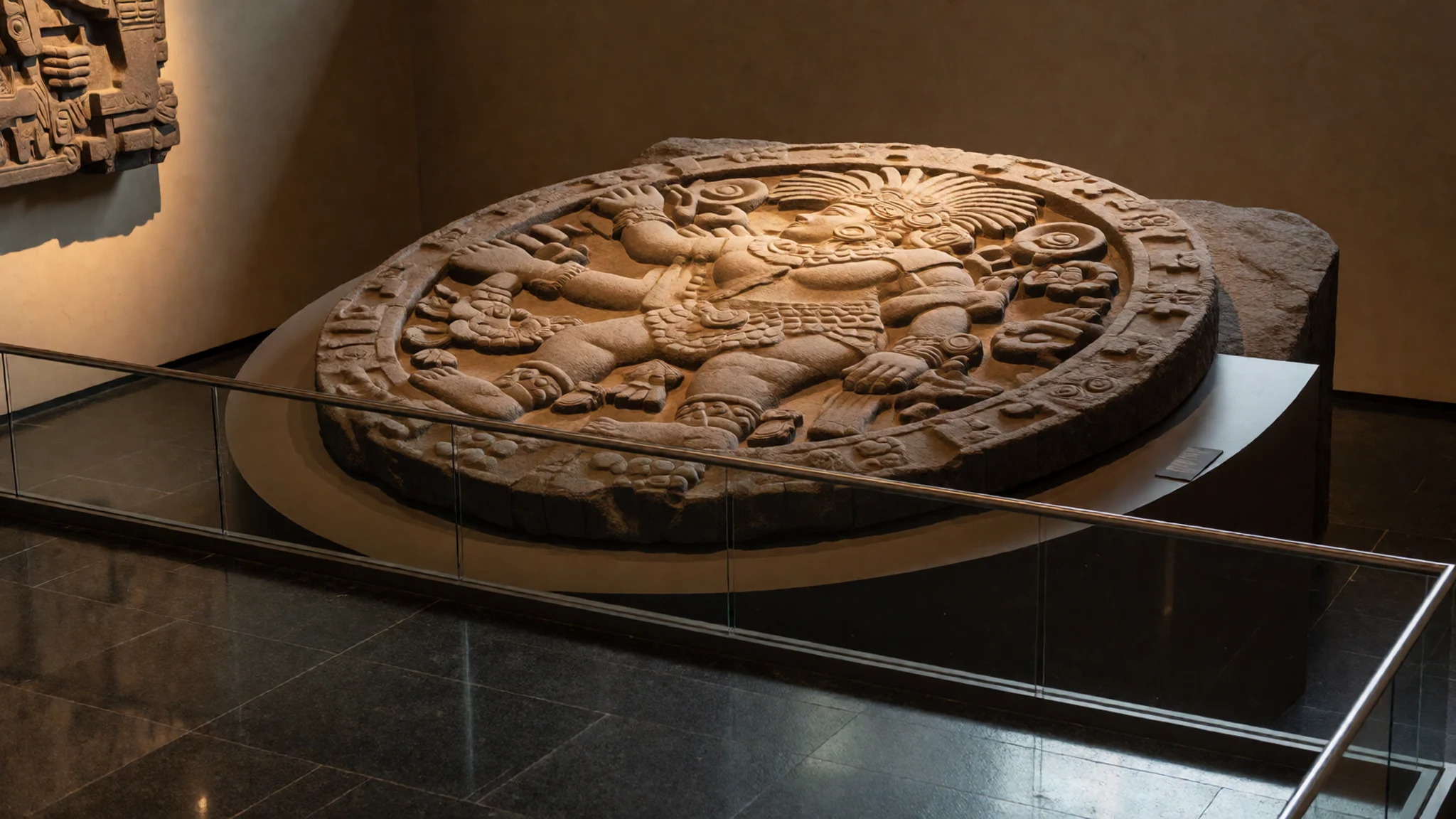
- Scale model of the building stages — Templo Mayor, Centro
A scale model of Templo Mayor shows the pyramid at several sizes at once, each outline a later enlargement. Seven stages, from the 1325 original to the version still in use in 1520, share one footprint, which is why the outdoor ruin looks nested. Twin stairs and the walled precinct are easier to follow on the model than in the broken masonry.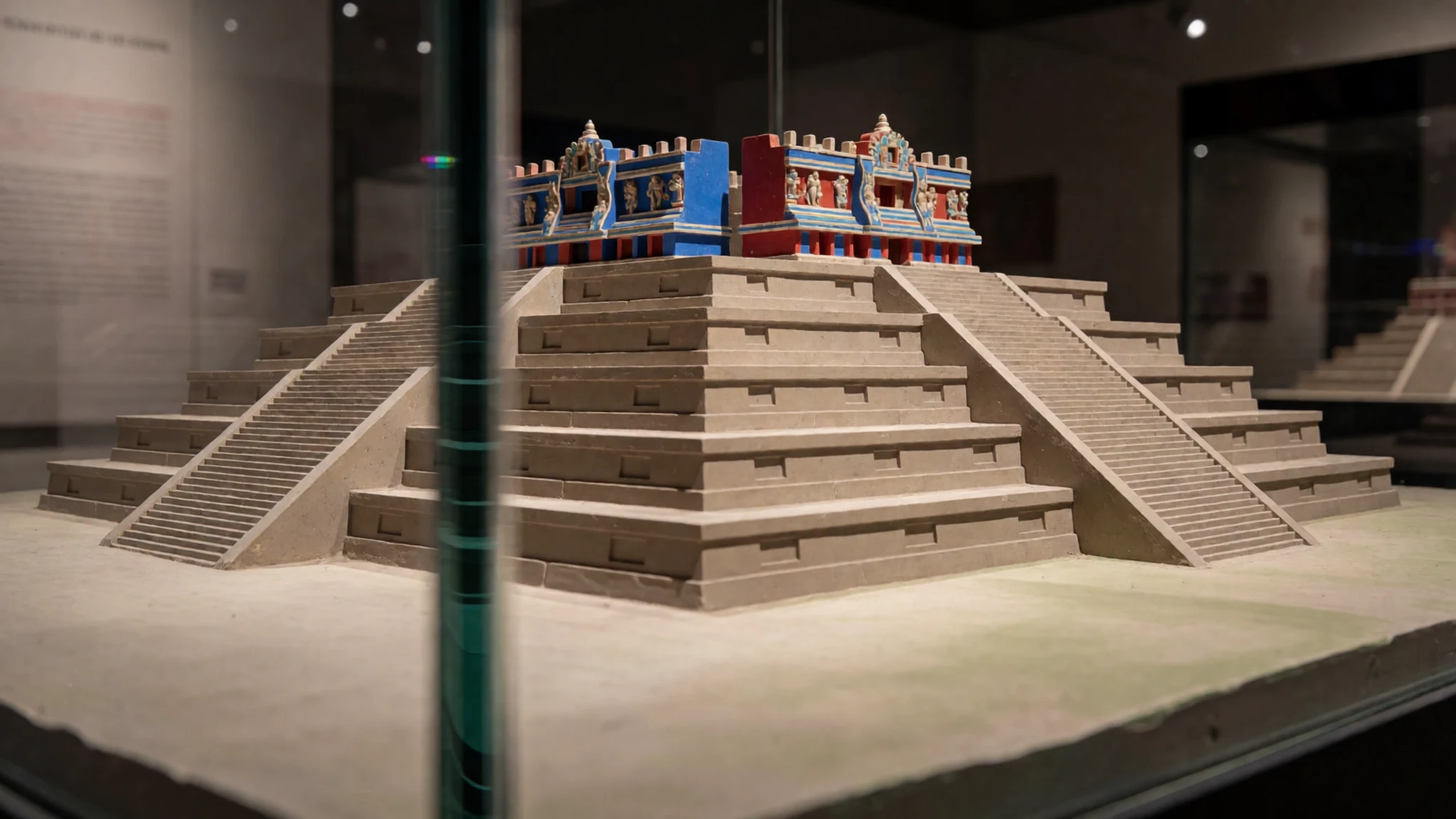
- Ceremonial-centre model — National Museum of Anthropology
The National Museum of Anthropology displays a model of the ceremonial centre with Templo Mayor in the middle, helpful when the ruin feels fragmentary. The late-1960s galleries were designed by Pedro Ramírez Vázquez. Treat the model as a map of neighbour shrines the Centro dig only partly uncovers. The museum is a separate stop from the excavation.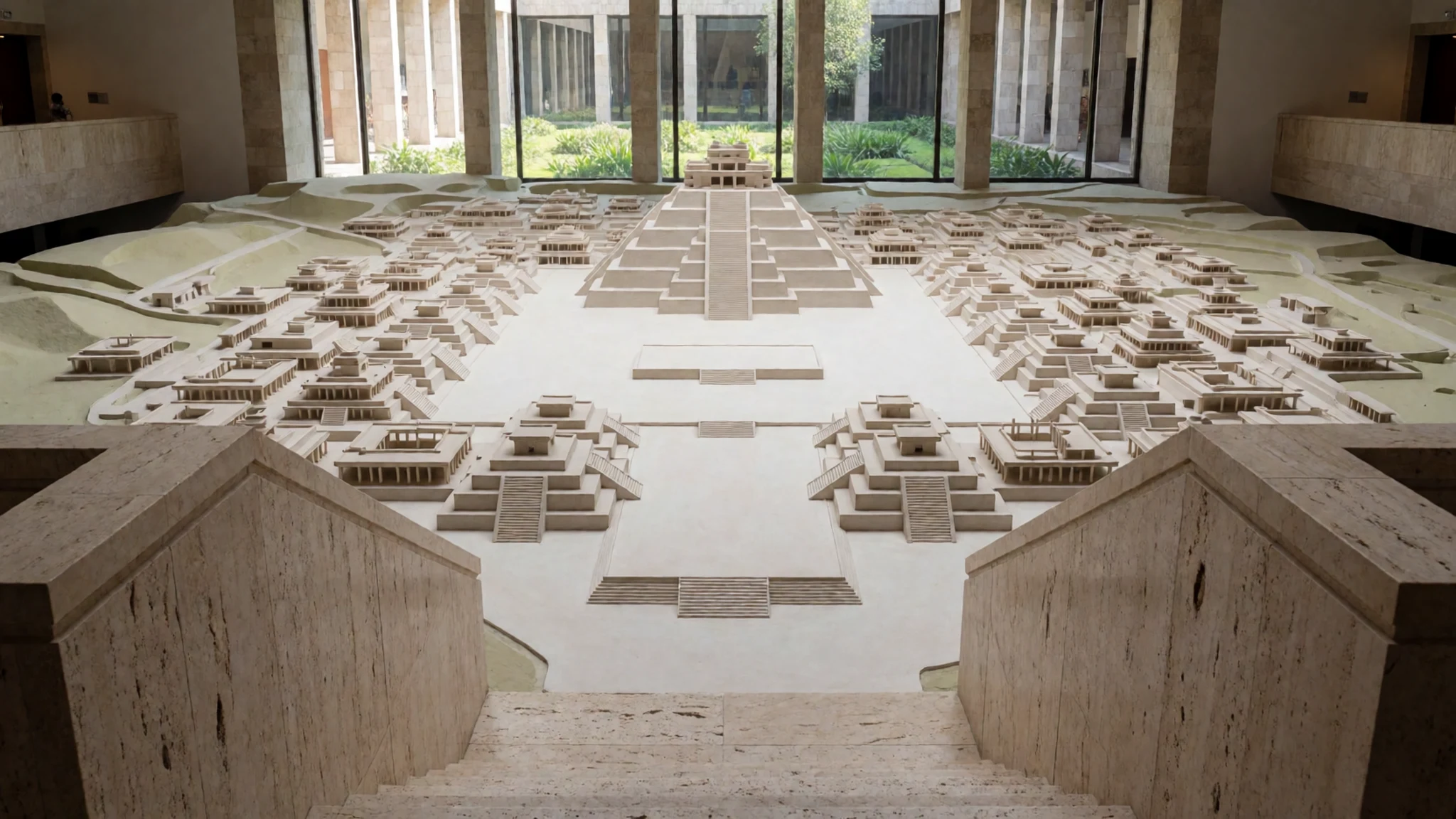
- Zócalo — Plaza de la Constitución, southwest of the ruins
Plaza de la Constitución, called the Zócalo, lies just southwest of Templo Mayor and is the centre's main open square. The cathedral and the city government building stand along its edges, so the ruins and the later city make one short walk from the Seminario side. Colonial fronts now hold the ground around the old precinct. Early morning is when the pavement is calm enough to look slowly.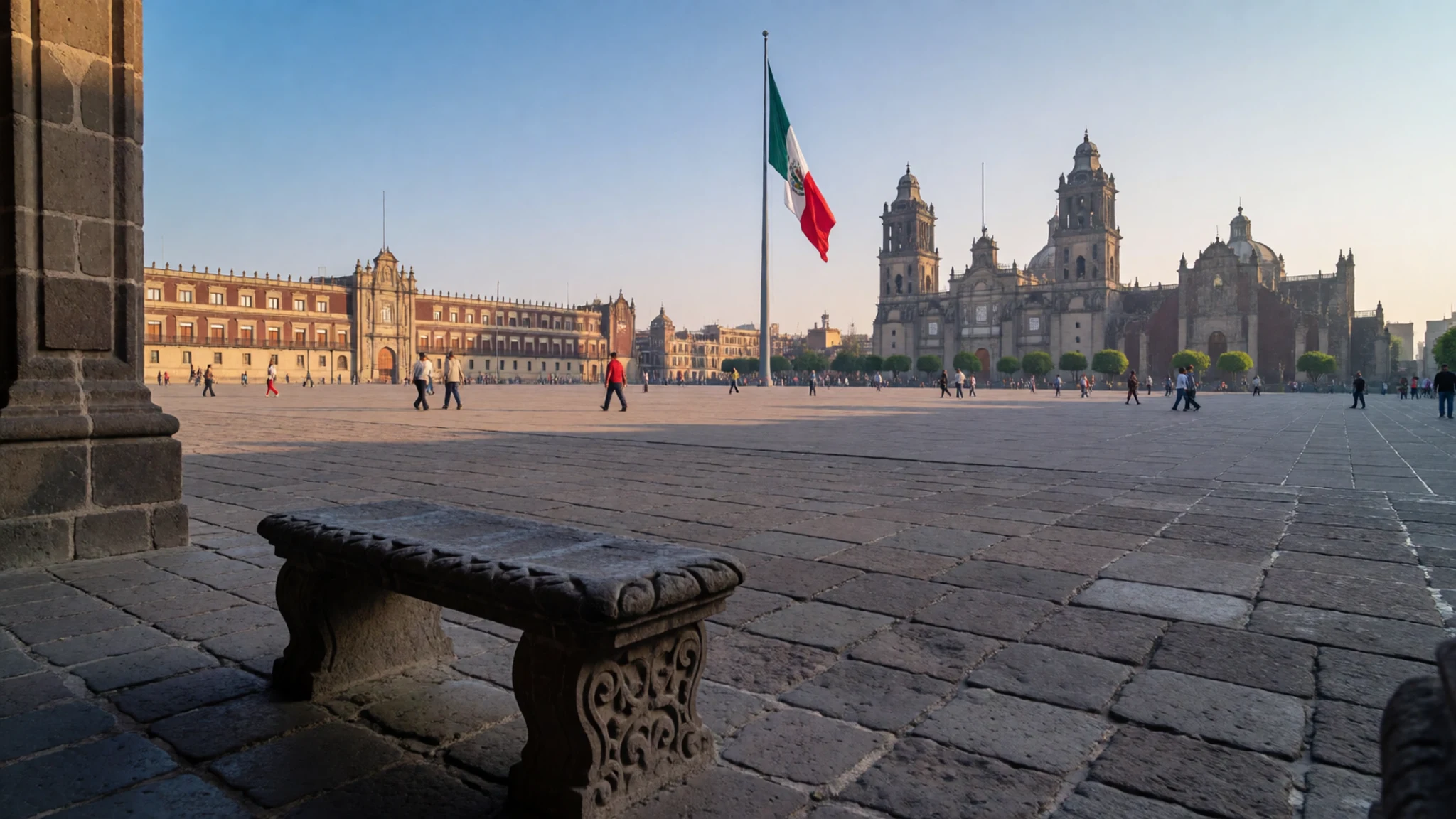
Culture
Templo Mayor remains a sacred story set in a working capital, not a monument exiled to the outskirts. The Mexica raised it as Tenochtitlan's ritual centre. Huitzilopochtli's cult of battle and Tlaloc's cult of rain each kept a summit sanctuary, while Ehecatl, wind guise of Quetzalcoatl, had a place on the precinct skyline. Offerings went into the body of the pyramid as later stages were dedicated, so faith was built into the fill, not only performed on the stairs. That ritual city was broken in 1521, when Spanish forces destroyed the temple and, in time, a cathedral rose beside the hole. Catholic Mexico and the older precinct now share a few Centro streets. Families and school groups cross from the Zócalo to the railings as they would to any other plaza. The Nahuatl name Huei Teocalli still belongs beside the Spanish one. Carvings such as the Coyolxauhqui stone are cult objects on display, not only artefacts. At Templo Mayor, speak quietly, keep to the walkways, and do not touch, climb or sit on the exposed stone.
What to wear
Templo Mayor was a stage for Mexica court dress as well as for rite. Elite cloth was cotton, coloured and often embroidered; coarser maguey fibre was the everyday stuff of lower rank. Men wore the maxtlatl, a loincloth, with a tilmatli cloak knotted at one shoulder, and rank showed in fibre, length and the feathers or jade a person was allowed. Women wore a wrap skirt and a huipil, the straight tunic still woven in many indigenous communities. Featherwork and turquoise mosaic signalled ceremony and images of deities, not an ordinary errand. Mexico City today dresses in a practical urban way: jeans, shirts, sports shoes and a jacket once the evening cools, while huipiles and rebozos appear at festivals, in performance and on people who wear them as daily clothes. Around the Zócalo the midday crowd is full of office dress, and weekends bring football shirts. A visitor to the ruin needs a hat, sun cream, a light layer and shoes with a firm grip, because the stone is open and thinly shaded. Shoulders and knees may stay informal on the dig; the cathedral beside the Zócalo expects them covered. Loose heels fight the uneven walkways.
What to eat
- Tacos al pastor — street stalls in the Centro and toward the Zócalo
Tacos al pastor, eaten near Templo Mayor, are pork shaved from a vertical spit onto a small corn tortilla with onion, coriander and pineapple. Stalls set up through the Centro and on the streets that feed the Zócalo. The hotter salsa is optional.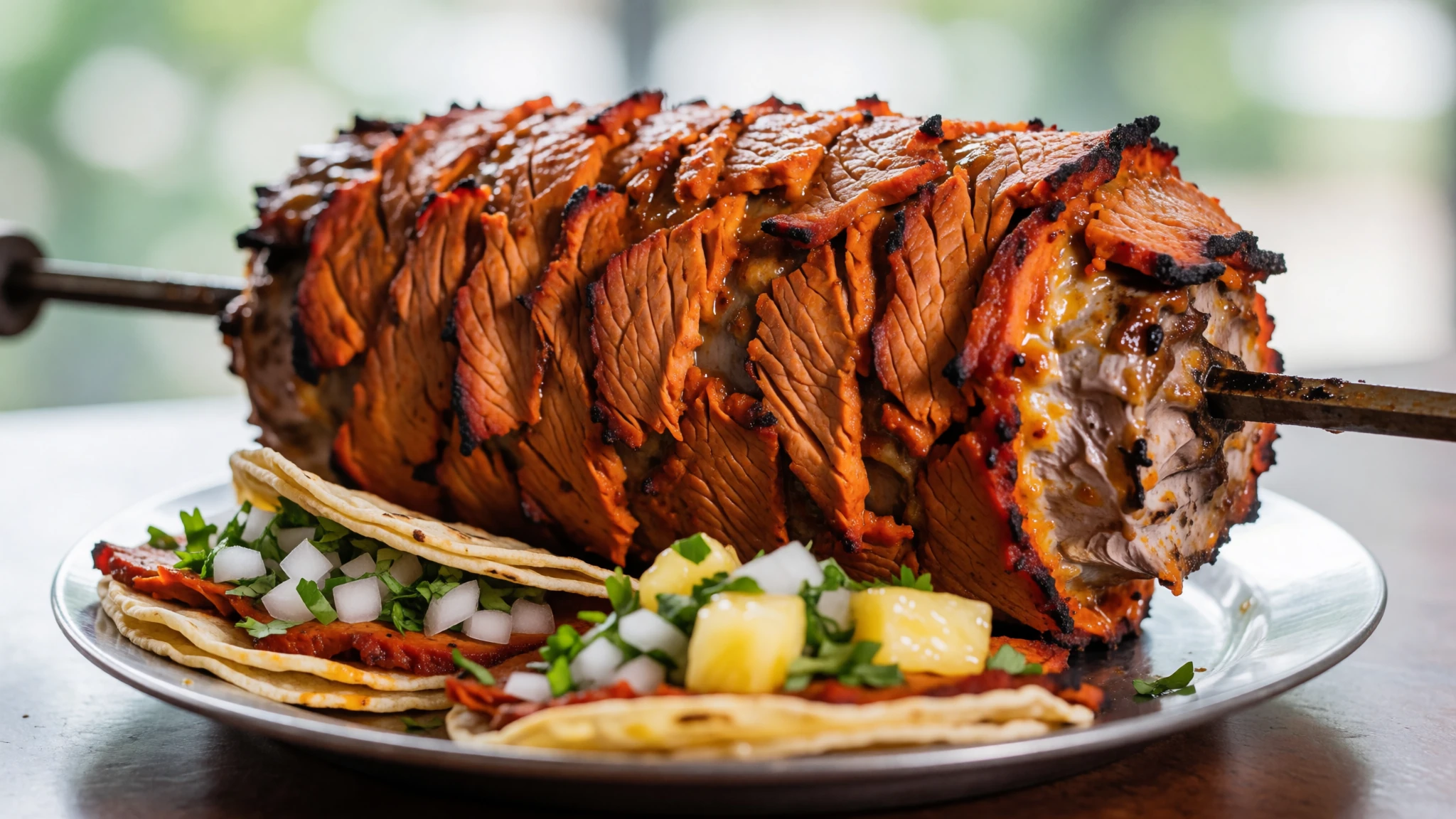
- Tlacoyos — market stalls and corners in the Centro
Tlacoyos near Templo Mayor are thick oval cakes of masa, griddled and opened around beans, fava beans or requesón, then topped with salsa, cheese and nopales. Market stalls and street corners in the Centro sell them from morning onward. One of them will outlast a single taco.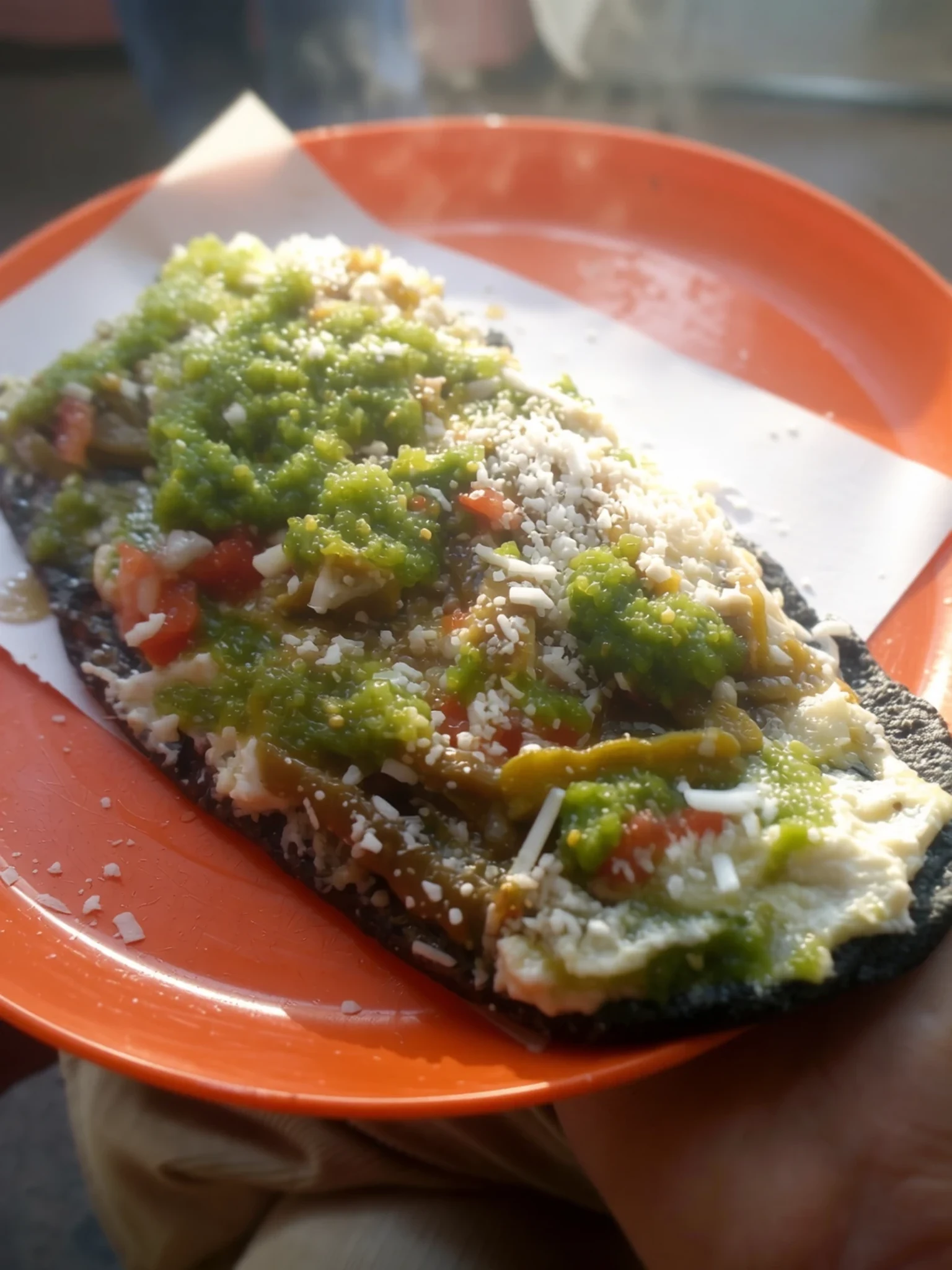
- Chilaquiles — breakfast eateries in the Centro
Chilaquiles are fried tortillas soaked in green or red salsa and finished with cream, onion and cheese. Breakfast eateries in the Centro, a short walk from Templo Mayor, serve them with eggs or shredded chicken. Of the two sauces, the green is usually the sharper.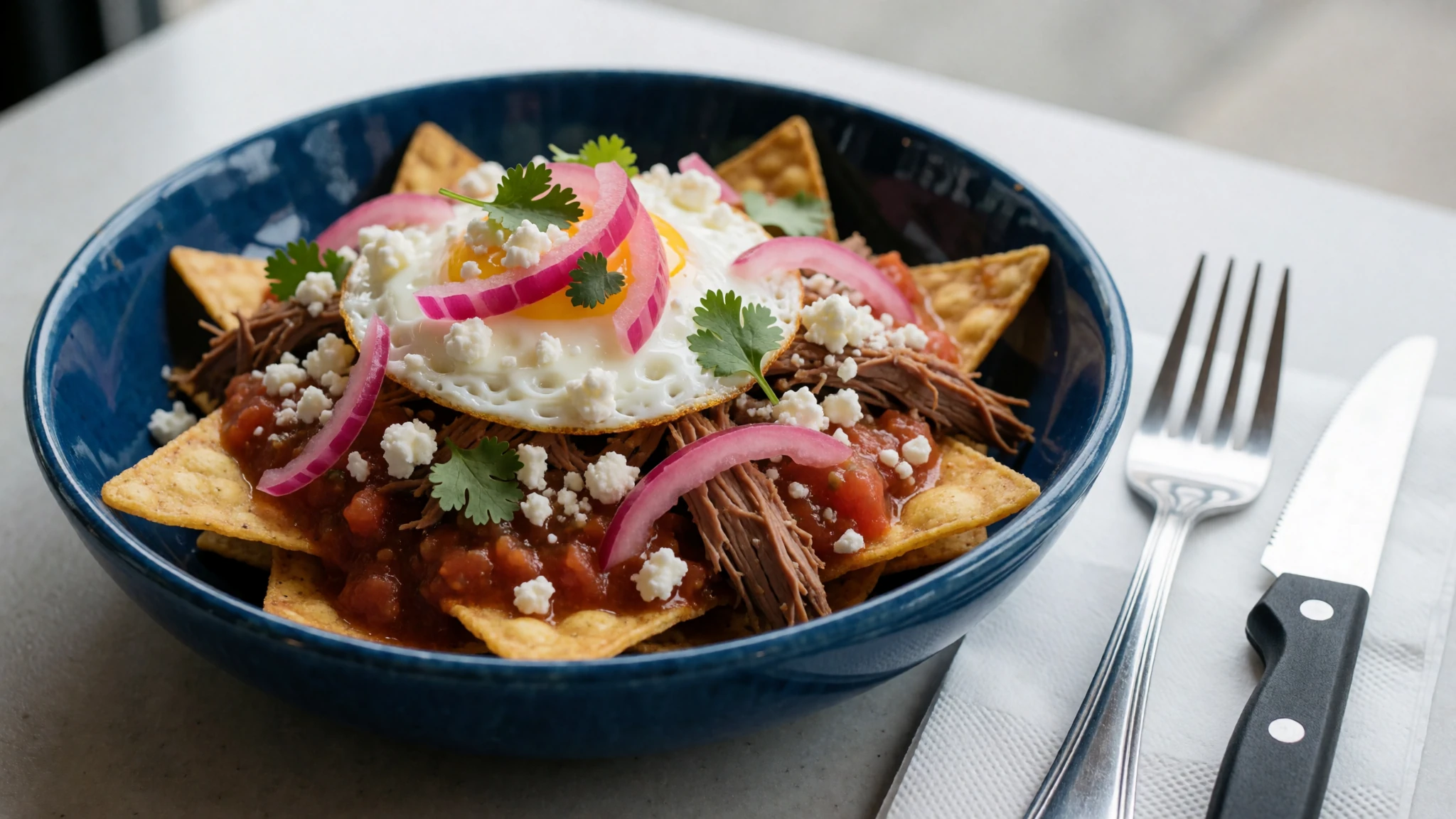
- Elote and esquites — street carts around the Zócalo
Elote is street-cart corn on the cob, boiled or grilled, then rolled in mayonnaise, cheese and chile powder, while esquites serve the same corn loose in a cup. Carts work the Zócalo's edges and the streets around Templo Mayor. - Orejas and pan dulce — bakeries in the Centro
Orejas are ear-shaped pan dulce sold in Centro bakeries near Templo Mayor, shelved with empanadas and other sweet breads that mix Mexican custom and French-style pastry. A ring-shaped rosca joins those counters around New Year. A piece eaten out in the square needs no famous shop.
Plan it
Best time. Mornings are the comfortable hours at Templo Mayor. The dig is open to the sky in the middle of Mexico City, the pale stone throws heat back later in the day, and in the wetter months showers tend to build over the valley after midday. The Zócalo next door is calmer early, before the square fills.
How long. 1–2
Getting there. Fly into Benito Juárez International Airport, on the east side of Mexico City, then take a taxi or an airport bus toward the historic centre; allow extra time, because cross-town traffic is often slow. Felipe Ángeles, also called AIFA or Santa Lucía, opened in 2022 and is mainly a domestic airport, with a longer last leg into the Centro. Templo Mayor stands between the streets Seminario and Justo Sierra, with the Zócalo on its southwest side. Confirm routes on the official site, https://www.templomayor.inah.gob.mx/.
Budget. mid
Tips
- Check opening days and tickets at https://www.templomayor.inah.gob.mx/ before setting out; they are not fixed in this guide.
- Arrive near opening time so the exposed pit is cooler and the Centro is quieter.
- Wear shoes that grip. Walkways are stone and can be uneven.
- Carry some cash for stalls around the Zócalo. Cards are usual in sit-down eateries and less so at a cart.
- The excavation is compact. Time goes on the building stages and the museum route, not on a long hike.
- If the ruin feels fragmentary, add the ceremonial-centre model at the National Museum of Anthropology on the same trip.
Etiquette
- Keep to the walkways and do not touch, climb or sit on the excavated stone.
- Speak quietly beside offerings and sculpture. The site was a temple and is still treated as sacred ground.
- Ask before you photograph people. The masonry is a public archaeological display.
- Cover shoulders and knees if you go into the cathedral by the Zócalo.
- Do not eat or drink while leaning over the dig.
Nearby
Sources
- Wikidata Q774021 (CC0)
- Wikipedia (rev 1380659019) (CC BY-SA 4.0)
- Wikivoyage (rev 5398238) (CC BY-SA 4.0)
- Photo photos/01-templo-mayor-50.jpg (CC BY 3.0)
- Photo photos/02-model-of-tenochtitlan-ceremonial-center-great-temple-9755406.jpg (CC0 1.0)
- Photo photos/03-templo-mayor-2015-001.jpg (CC BY-SA 4.0)
- Photo photos/04-coyolxauhqui-4095977415-b89d64f008-2.jpg (CC BY-SA 2.0)
- Photo photos/05-scalemodeltemplomayor.jpg (Public domain)
- Photo photos/06-granpyramidedetenochtitlan.jpg (CC BY 3.0)
- Photo photos/07-zocalo-temple-mayor-metro.jpg (CC BY 2.5)
- Photo photos/08-mexican-sacrifice-by-johann-georg-heck.jpg (Public domain)


