Tayma
Tayma, Saudi Arabia
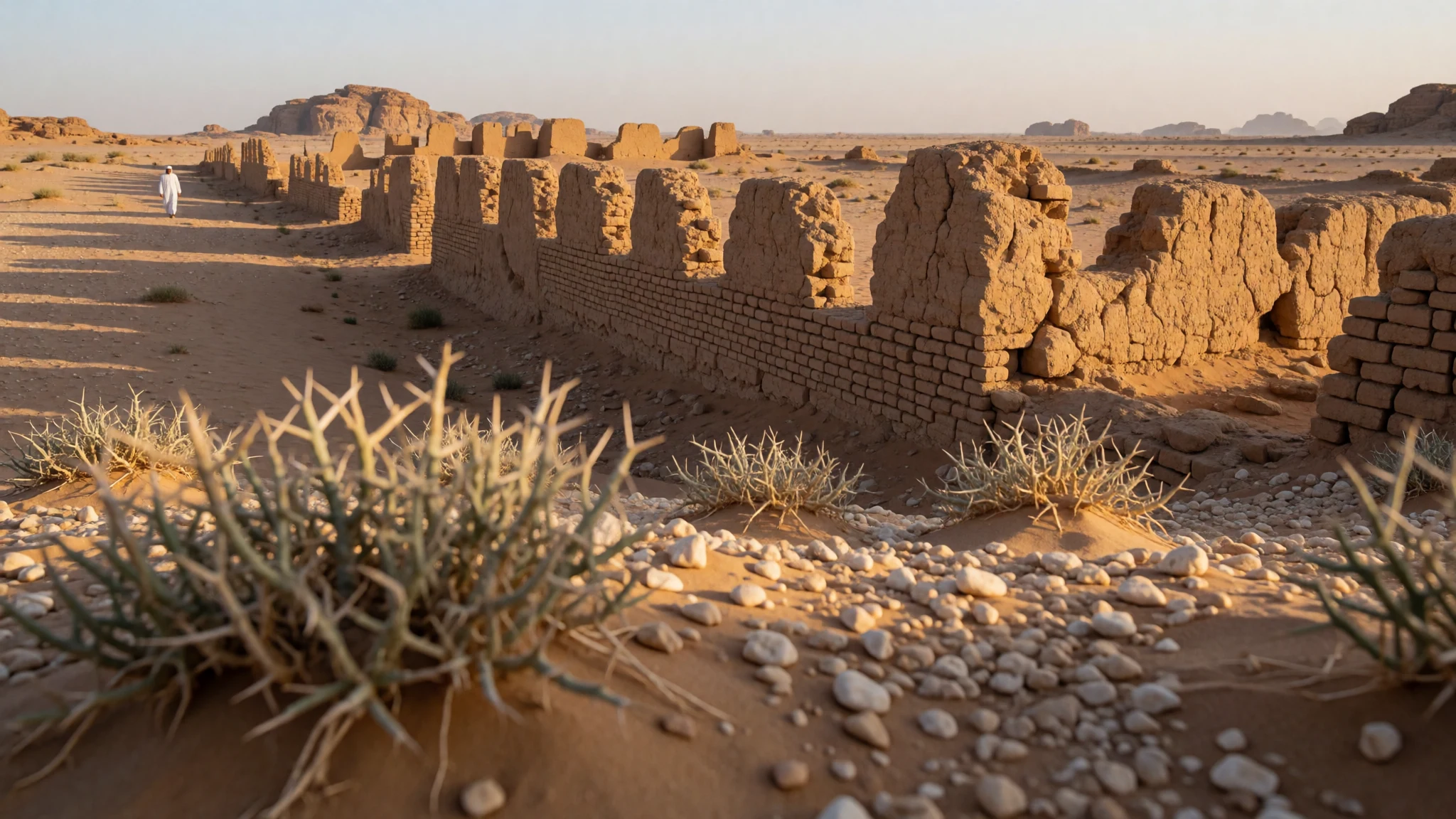
Tayma is an ancient northwestern oasis settlement where desert trade routes met, preserving millennia of Middle Eastern history in sandstone and mudbrick.
The place
Tayma sits in the northwestern sweep of Saudi Arabia, positioned in the Tabuk Province where the historical trade route linking Medina with Dumah begins its crossing into the western reaches of the Nafud desert. As a major natural oasis, it has drawn human settlement for millennia by offering reliable water in an arid environment. The landscape here is defined by stark desert expanses meeting ancient agricultural wells and crumbling mudbrick architecture. Travellers approaching Tayma encounter a quiet governorate that feels worlds away from the bustling modern metropolises further south. The surrounding terrain transitions from flat, sandy stretches to rocky outcrops that have sheltered travellers, merchants, and nomadic communities since antiquity. Because it stands at the crossroads of ancient paths connecting the Levant, Mesopotamia, Egypt, and southern Arabia, the oasis developed a unique character shaped by diverse cultural influences. Today, visitors exploring the settlement find an extraordinary density of archaeological remains scattered across the desert floor, offering a direct window into the early civilisations of the Arabian Peninsula. The rhythm of daily life here remains unhurried, grounded in the quiet endurance of desert agriculture and local hospitality.
Its story
Tayma is one of the most significant archaeological locations in the Arabian Peninsula, boasting a history of sedentary human habitation that reaches back to the early fourth millennium BC in the Bronze Age. Over the course of the second millennium BC, the settlement grew steadily in economic and strategic importance, culminating in a substantial expansion that included the construction of a massive defensive barrier built from mudbrick and sandstone. By the end of that millennium, Tayma had evolved into an influential hub, participating actively in a regional political and religious confederation. Its geography made it an ideal stopover for caravans traversing the ancient trade networks that bound South Arabia to the Eastern Mediterranean. While it did not sit directly on the Frankincense Road, its abundant water supply ensured it remained an irresistible refuge for exhausted travellers. Digs and ancient writings show that well before Islam, this place had deep money, political, and spiritual links with every major ancient Middle Eastern civilisation. Artefacts discovered in the area, including inscribed stelae and monumental masonry, testify to centuries of cultural exchange between local populations and visiting merchants from neighbouring empires.
What to see
- Old Town of Tayma
Explore the atmospheric mudbrick ruins of the historic quarter, where abandoned earthen houses and narrow lanes bear witness to traditional desert architecture and centuries of local craftsmanship. - Tayma Archaeological Site
Wander among extensive ruins that span multiple epochs, revealing ancient defensive walls, foundations, and remnants of the oasis settlement that once anchored regional trade routes. - Hegra (Madain Saleh)
Venture south to this spectacular Nabataean archaeological site in northern Saudi Arabia, renowned for its monumental rock-cut tombs carved into sandstone outcrops, echoing the grandeur of Petra. - Masmak Fort
Journey to Riyadh to walk through this historic clay and mudbrick fortress, built during the fourteenth century and famously transformed into a museum chronicling the nation's foundational history.
Culture
The cultural fabric of Tayma shares deep roots with traditions found across Saudi Arabia and the wider Middle East, characterised by profound hospitality, respect for family, and community-oriented social customs. Visitors are often struck by the genuine warmth of locals who are eager to share stories of their homeland and ensure guests feel welcome. Traditional etiquette follows established regional norms of modesty and politeness, where greetings are unhurried and conducted with grace. While the written laws of the country are strictly enforced and must be respected by all travellers, everyday interactions are guided by gentle courtesy and mutual regard. If you find yourself uncertain about local customs, simply ask; residents are typically happy to explain nuances without hesitation. Businesses and public life adjust rhythmically around the daily prayer times, creating natural pauses in the day's schedule. Always remember to use your right hand when eating, greeting others, or passing items, as the left hand is traditionally considered unclean.
What to wear
Traditional dress in Saudi Arabia is designed to provide practical comfort against the desert climate while reflecting deeply held cultural and religious values. For men, this traditionally means the thawb—a loose-fitting, long-sleeved ankle-length garment, usually white for summer to reflect the sun, paired with a traditional headscarf secured by an agal. Women traditionally wear an abaya, a loose black cloak worn over everyday clothing, accompanied by a head covering. In everyday modern settings across the country, younger generations often blend traditional garments with contemporary casual wear, though modesty remains universal. For visitors exploring Tayma and its surrounding heritage sites, clothing should be loose-fitting and lightweight to cope with desert temperatures while covering shoulders and knees out of respect for local norms. Sturdy, closed-toe walking shoes or boots are essential for navigating dusty archaeological paths and uneven terrain, and a wide-brimmed hat or sunglasses will provide vital protection against the intense sun.
What to eat
- Shawarma — Any local sandwich shop or street-side eatery
A ubiquitous Middle Eastern favourite consisting of spiced meat wrapped in flatbread with garlic sauce and pickles, easily found in dedicated local sandwich joints across the country. - Kudu Sandwich — Kudu outlets nationwide
A popular home-grown fast-food chain serving hearty grilled meat and chicken sandwiches, popular across Saudi Arabia since its founding. - Herfy Burger — Herfy restaurants across the country
A fully Saudi-owned fast-food institution offering classic burgers, fries, and quick meals for travellers on the move.
Plan it
Best time. March to April and October to November offer pleasant temperatures for exploring the desert oasis, while summer months bring intense heat.
How long. 2–3
Getting there. Fly into Tabuk Regional Airport, then arrange a private car or taxi for the road journey southeast across the desert to Tayma.
Budget. mid
Tips
- Carry sufficient cash, as smaller shops and local markets may not accept cards.
- Drink plenty of bottled water throughout the day to combat the dry desert heat.
- Check official websites and opening hours in advance for regional heritage sites.
- Respect prayer times when local shops and eateries pause operations temporarily.
Etiquette
- Always use your right hand for eating, greeting, and passing objects.
- Dress modestly with shoulders and knees covered in public areas.
Nearby
Sources
- Wikidata Q27365 (CC0)
- Wikipedia (rev 1380156308) (CC BY-SA 4.0)
- Wikivoyage (rev 5427162) (CC BY-SA 4.0)
- Photo 01-old-town-of-tayma-2020.jpg (CC BY 2.5)
- Photo 02-teima-stone-louvre-ao1505.jpg (Public domain)
- Photo 03-stele-salm-louvre-ao5009.jpg (Public domain)
- Photo 04-1870-johnson-map-of-turkey-persia-arabia-iran-iraq-afghanist.jpg (Public domain)
- Photo 05-1870-johnson-map-of-turkey-persia-arabia-balochistan.jpg (Public domain)
- Photo 06-aegyptus.jpg (Public domain)
- Photo 07-lihyan-statue.jpg (CC0 1.0)
- Photo 08-lihyanite-stele-psgw-hrw.jpg (CC BY 4.0)


