Sultan Qaboos Grand Mosque
Sultan Qaboos Grand Mosque, Oman
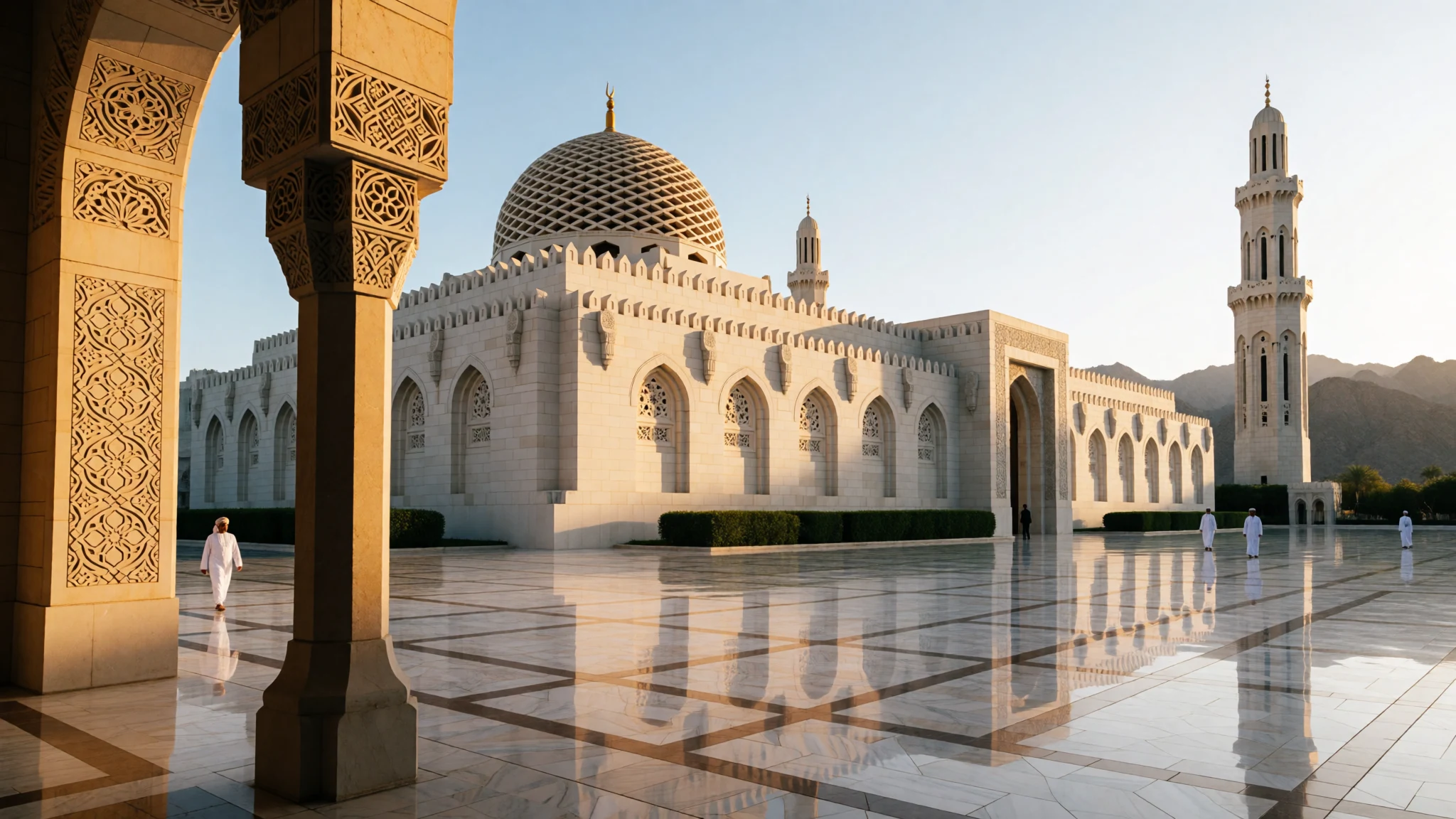
Visit the Sultan Qaboos Grand Mosque to witness a masterpiece of contemporary Islamic architecture housing one of the world's largest hand-woven carpets.
The place
The Sultan Qaboos Grand Mosque stands as the primary house of worship in the Sultanate of Oman, anchoring the metropolitan expanse of Muscat. Situated between the sparkling waters of the Arabian Sea and the jagged, sun-bleached ridges of the Western Hajar Mountains, the city of Muscat is not a single contiguous settlement but rather a collection of distinct historic towns that have gradually merged. These include the old walled enclave of Muscat where the royal palace sits, the historic trading port of Mutrah with its labyrinthine waterfront market, and various commercial districts spread across a wide metropolitan footprint. Unlike several other capitals in the Arabian Gulf region that have chased futuristic skylines filled with towering glass skyscrapers, Muscat maintains a remarkably low-profile urban aesthetic. By royal preference, modern developments must adhere closely to traditional Arabic design codes, preserving a harmonious visual consistency across the capital. Within this carefully governed landscape, the grand mosque occupies a central position, serving as an architectural focal point and an important cultural landmark. The complex covers a vast area of manicured gardens, paved courtyards, and colonnaded walkways crafted from pale Indian sandstone. Visitors stepping inside the peaceful precincts find a deliberate absence of chaotic urban noise, replaced instead by the gentle rustle of courtyard fountains and the quiet reverence of travellers admiring the intricate tilework and carved wooden ceilings.
Its story
The creation of the Sultan Qaboos Grand Mosque began following a royal directive issued in the early final decade of the twentieth century. Construction work commenced in earnest in nineteen-ninety-two, transforming an empty plot in the capital district into a monumental tribute to modern Islamic craftsmanship. Over a construction period lasting nearly a decade, artisans, master builders, and material specialists from around the globe contributed their skills to the project. Stonemasons sourced pale sandstone from quarries abroad, while ceramic artists designed intricate panels of floral mosaic tiles in shades of cobalt blue, turquoise, and gold. The interior of the main prayer hall required extraordinary feats of artistry, most notably the fabrication of a colossal hand-knotted carpet that took hundreds of weavers years to complete. Alongside this textile masterpiece, a towering chandelier adorned with millions of Swarovski crystals was suspended from the central dome, casting a warm illumination over the vast marble floor. When the gates officially opened to worshippers and visitors in two-thousand-and-one, the complex immediately established itself as a pinnacle of contemporary religious design, blending traditional regional forms with engineering excellence. Over the subsequent decades, the site has transitioned from a purely royal and national sanctuary into a welcoming space for international visitors, helping foster intercultural understanding while remaining an active and deeply revered place of daily prayer for the local community.
What to see
- Main Prayer Hall — Central Mosque Complex
Step inside the vast main prayer hall of the Sultan Qaboos Grand Mosque to admire the legendary hand-woven carpet and the towering crystal chandelier suspended beneath the central dome, creating an atmosphere of breathtaking spatial harmony and exquisite decorative detail. - Mutrah Souq — Mutrah
Wander through the covered alleyways of Mutrah Souq, one of the oldest traditional marketplaces in the region, where merchants sell frankincense, silver jewellery, spices, and textiles beneath timber-framed roofs scented with sweet burning woods and traditional perfumes. - Bait Al Zubair Museum — Old Muscat
Explore the private heritage museum of Bait Al Zubair, which showcases extensive collections of traditional Omani weaponry, historical garments, household artefacts, and old photographs illustrating the social evolution of the nation over past centuries. - Mutrah Corniche — Mutrah Waterfront
Take a leisurely stroll along the sweeping curves of the Mutrah Corniche, enjoying views of traditional wooden dhows bobbing in the deep harbour against a backdrop of rugged dark mountains and whitewashed colonial-era fortifications. - National Museum — Old Muscat
Discover the comprehensive exhibits of the National Museum, where carefully curated galleries display archaeological finds, maritime history, and intricate scale models detailing the rich heritage and seafaring traditions of the Omani people from prehistoric times onward.
Culture
Omani culture is rooted in a blend of traditional Islamic values and ancient seafaring hospitality, known locally as 'hafawa', where guests are traditionally welcomed with cardamom-spiced coffee and fresh dates. Social interactions are courteous, and traditional community life revolves around family bonds, neighbourhood gatherings, and Friday congregational prayers. Visitors will find that local residents are exceptionally polite and helpful, often taking time to offer directions or share stories about their homeland. While the capital has embraced modern amenities and global influences, traditional dress remains a visible and proud symbol of national identity for both men and women across the city. When visiting religious sites such as the Sultan Qaboos Grand Mosque, both men and women must dress modestly by covering their arms and legs completely, and women are required to wear a headscarf. Please remove your shoes before stepping onto the plush carpets inside the prayer halls and keep your voice lowered to maintain the peaceful atmosphere.
What to wear
Traditional attire at the Sultan Qaboos Grand Mosque and throughout Muscat remains remarkably well-preserved in daily life. Omani men typically wear the 'dishdasha', a simple, ankle-length, collarless robe with long sleeves, usually crafted from crisp white cotton, though pastel or darker shades are also worn during cooler months. The dishdasha is traditionally accessorised with a tasselled cord called a 'tarboosh' and accompanied by either a woven wool cap known as a 'kuma' or a finely wrapped turban called a 'sarir'. On formal occasions or during religious holidays, men add a woollen cloak called a 'bisht' and wear a curved silver dagger known as a 'khanjar' tucked into an ornate belt. Omani women wear loose-fitting, beautifully embroidered dresses over trousers, topped with a black outer cloak called an 'abaya' and a matching headscarf ('shayla') when out in public. Modern western clothing is common among younger generations and expatriate workers in private spaces, but public modesty standards remain strictly observed. Travellers visiting the city should pack lightweight, breathable linen or cotton garments that cover the shoulders and knees, keeping a light scarf handy for entering religious buildings.
What to eat
- Shuwa — Traditional Omani restaurants
Omani festive slow-cooked lamb marinated in a rich paste of dates, garlic, chilli, and spices, wrapped in banana leaves and roasted in an underground sand pit for up to two days. - Majboos — Local eateries across Muscat
A fragrant rice dish flavoured with saffron, cardamom, cloves, and cinnamon, served with tender chunks of spiced mutton, chicken, or fresh fish from local waters. - Halib and Sulaimani — Mutrah Corniche tea shops
Wayside tea stalls along the waterfront offer sweet milk tea or spiced black tea infused with cardamom and cloves, enjoyed alongside simple sandwiches by the sea breeze. - Fresh Fruit Juices — Local cafes and juice bars
Refreshing beverages pressed from tropical fruits such as mango, pomegranate, and sweet melon, served chilled from neighbourhood juice stalls found on almost every busy street corner. - South Indian Thali — Al Khuwayr neighbourhood
Platters of spiced vegetable curries, lentils, pickles, and rice served on banana leaves, reflecting the deep culinary ties between Oman and the coastal communities of India.
Plan it
Best time. October to April offers pleasant daytime temperatures and cooler evenings, whereas the summer months from May to September bring intense, humid heat.
How long. 2–3
Getting there. Arrive via Muscat International Airport, then take an official airport taxi or use the OTaxi ride-hailing app to reach the city centre in about twenty minutes.
Budget. mid
Tips
- Visit the Sultan Qaboos Grand Mosque during morning visiting hours for non-Muslims, which typically run Saturday through Thursday.
- Dress conservatively with shoulders and knees covered before attempting to enter any religious buildings.
- Download the OTaxi app for reliable, pre-determined fares on all city journeys.
- Carry bottled water and sunscreen when exploring outdoor sights during the warmer months.
- Keep some small notes of local currency handy for purchases in traditional souqs and small roadside shops.
Etiquette
- Remove your shoes before entering mosque prayer halls.
- Always ask permission before photographing local residents.
- Avoid public displays of affection as they are considered disrespectful.
Nearby
Sources
- Wikidata Q1548443 (CC0)
- Wikipedia (rev 1371803332) (CC BY-SA 4.0)
- Wikivoyage (rev 5411106) (CC BY-SA 4.0)