Stobi
Stobi, North Macedonia
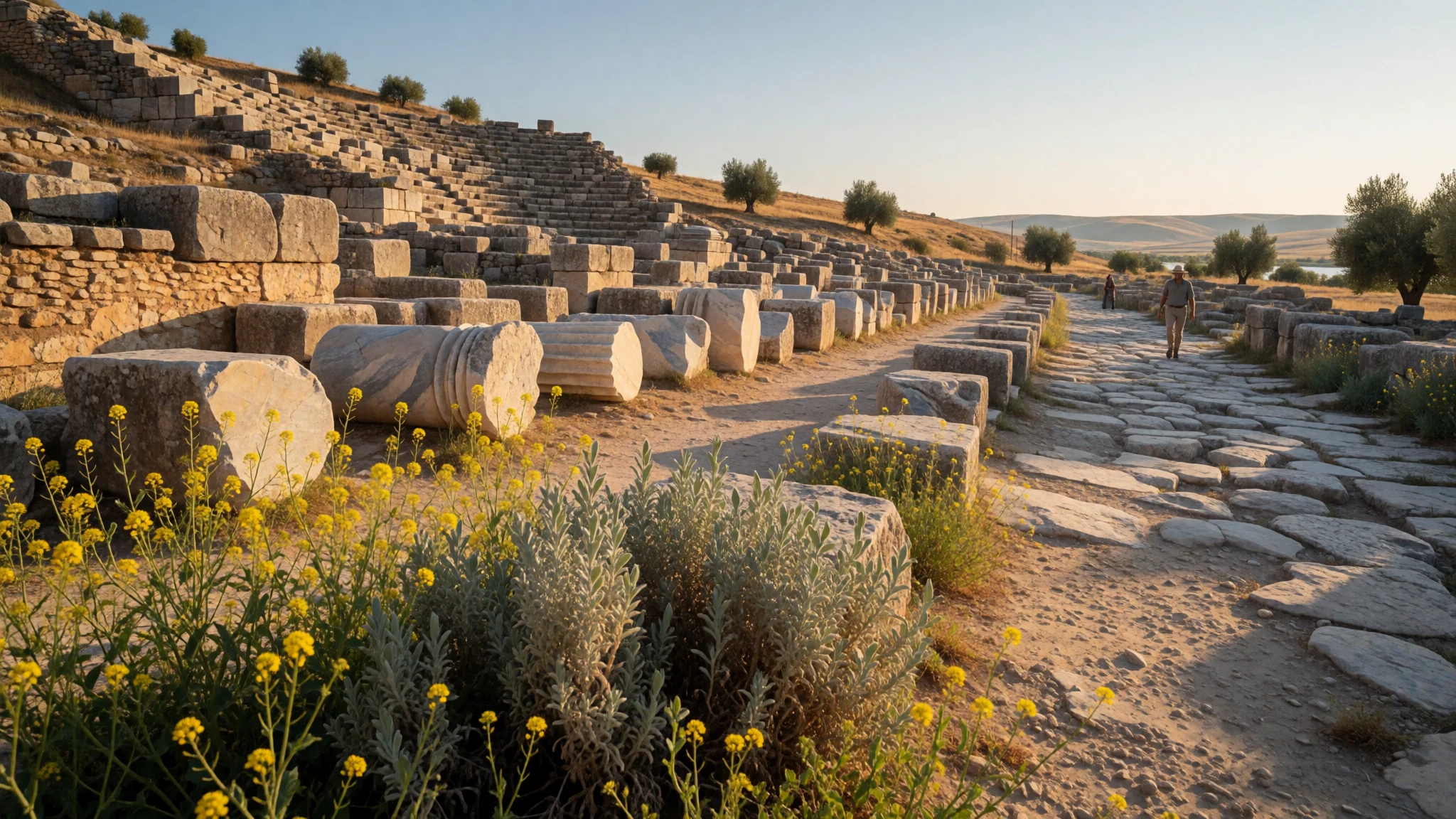
Stobi offers a rare journey through ancient Paeonian, Hellenistic and Roman layers, crowned by remarkably preserved mosaics right above the confluence of two rivers.
The place
Stobi stands as one of the most famous archaeological destinations in North Macedonia, positioned where the Erigon River joins the Axios. This strategic confluence turned the settlement into a natural crossroads for both commerce and military campaigns along the route connecting the Danube to the Aegean Sea. Originally a chief centre for the Paeonian kings before Macedonian rule transformed its fortunes, the site later flourished as the capital of the Roman province of Macedonia Salutaris. Today, the ruins lie within the municipality of Gradsko, spreading across a quiet valley where fragments of marble columns, paved streets, and grand administrative quarters rise against the dry landscape. Visitors wander through a sprawling open-air museum without the suffocating crowds found at more famous Mediterranean sites, tracing the ancient ruts left by chariot wheels on the stone slabs of Via Principalis. The vast scale of the excavations reveals a densely planned urban centre equipped with sophisticated public buildings, opulent private villas, and early Christian basilicas adorned with intricate floor mosaics. Walking across the site, one feels the stark transition from pagan antiquity to early Christian worship, all preserved within a landscape shaped by sun-baked earth, sparse grasses, and the distant murmur of the surrounding river valleys.
Its story
The unearthing of Stobi began through systematic investigations led by the Museum of Belgrade, which uncovered the civic theatre, public squares, and religious structures. Work halted before mid-century, but post-war decades brought new discoveries, including late Hellenistic burials hidden beneath later construction phases and diverse medieval graves. International collaborations between local and foreign researchers in subsequent decades revealed an extensive network of streets, the Casa Romana, and the elaborate water systems that once sustained the urban population. Excavations of the Episcopal Basilica confirmed the town's early importance as an ecclesiastical seat, evidenced by records of its bishops attending foundational church councils. Among the archaeological finds, researchers have identified rare artefacts ranging from archaic bronze statues to ancient Greek inscriptions that mention local names through the centuries. These layers of discovery paint a picture of a resilient city that absorbed multiple cultural shifts, surviving earthquakes, invasions, and political reorganisations while continuously rebuilding its civic and religious identity over generations.
What to see
- The Roman Theatre
Built into a natural slope, this ancient entertainment venue once hosted dramatic performances and later gladiatorial games, featuring stone seating tiers and remnants of a dedicated temple structure. - Northern Basilica and Baptistery
An expansive early Christian church complex featuring a marble atrium, colonnaded walkways, and a baptistery adorned with surviving floor mosaics alongside adjacent medieval burial grounds. - The House of the Psalms
A luxurious late antique residence positioned near the central basilica, featuring colonnaded courtyards, a large ornamental pool, and rooms paved with detailed mosaic floors. - Via Principalis
The grand paved thoroughfare that cuts through the heart of the ancient settlement, flanked by the foundations of shops, public porticoes, and monumental administrative buildings.
Culture
During its peak centuries, Stobi was a vibrant melting pot of religious and civic traditions, shifting from classical pagan cults dedicated to deities like Nemesis and Apollo to becoming an influential early Christian bishopric by the fourth century. The town's elite expressed their status through lavish architectural decoration, commissioning intricate floor mosaics featuring geometric patterns and wildlife scenes for their private villas and civic basilicas alike. Modern life in the surrounding rural area retains traditional Macedonian warmth and agricultural rhythms, closely tied to the vineyards and orchards of the Vardar river basin. Local communities take immense pride in preserving the heritage of the region, welcoming visitors with quiet hospitality and traditional crafts. When exploring archaeological stones and sacred church floors, maintain a respectful quiet and avoid touching delicate mosaics.
What to wear
Traditional attire in the wider Vardar region historically featured heavy woollen garments, embroidered linen shirts, and layered vests designed for both agricultural work and festive celebrations, often decorated with geometric motifs that signalled regional identity. Today, local residents in nearby settlements wear standard contemporary European casual clothing. For visitors exploring Stobi, practical considerations are paramount due to the exposed nature of the site. Sturdy walking shoes with good grip are essential for navigating uneven stone pathways, loose gravel, and ancient marble steps. Because the archaeological area lacks shade, lightweight, breathable fabrics, a wide-brimmed hat, sunglasses, and high-factor sun protection are necessary during warmer months.
What to eat
- Macedonian Vranec Wine — Stobi Winery & Restaurant
A robust, deep red wine produced from indigenous grapes grown across the sun-drenched valley vineyards near Gradsko. - Traditional Tavche Gravche — Restaurant Exclusive in Gradsko
A hearty baked bean dish cooked in earthenware pots with onions, peppers, and paprika, representing a staple of regional comfort food. - Local Grilled Pastrmajlija — Local eateries along the main road in Gradsko
An oval-shaped bread pie topped with seasoned cubes of pork or chicken, baked to a golden crisp in traditional ovens. - Fresh River Catch — Traditional restaurants in nearby Veles
Locally sourced fish prepared simply with olive oil, garlic, and herbs, reflecting the culinary traditions of the river valleys.
Plan it
Best time. April to May and September to October offer pleasant daytime temperatures for walking among the ruins, avoiding the intense summer heat.
How long. 1–2
Getting there. By car along the major A-1/E-75 highway with well-marked exits, or by train to the station directly at Stobi or nearby Gradsko.
Budget. low
Tips
- Check the official website for opening hours before travelling
- Wear sturdy footwear for walking on uneven stones and mosaic floors
- Bring drinking water and sun protection as shade is scarce across the site
- Combine your visit with nearby wine-tasting stops in the valley
Etiquette
- Do not walk directly on fragile mosaic pavements where barriers are present
- Keep noise levels respectful while exploring sacred and basilican ruins
Nearby
Sources
- Wikidata Q1371168 (CC0)
- Wikipedia (rev 1364719624) (CC-BY-SA 4.0)
- Wikivoyage (rev 5418939) (CC-BY-SA 4.0)
- Photo photos/01-stobi.jpg (CC BY-SA 3.0 de)
- Photo photos/02-stobi-theater.png (CC BY-SA 4.0)
- Photo photos/03-stobi-deer-mosaic.jpg (CC BY-SA 4.0)
- Photo photos/04-stobi-baptisterium.jpg (CC BY-SA 4.0)


