Sardinia
Sardinia, Italy
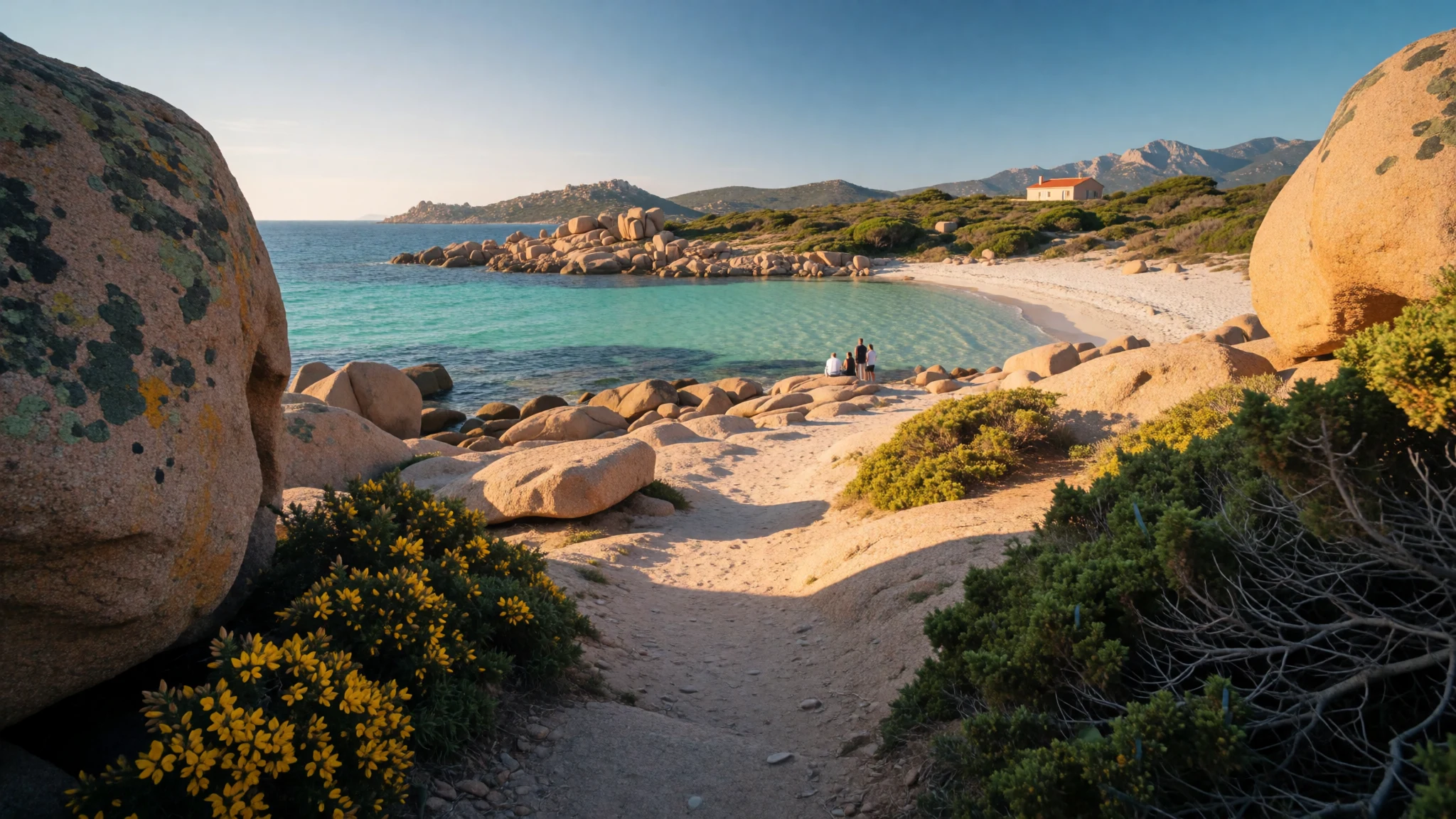
Sardinia pairs a long sandy coast with Bronze Age stone towers and an interior that still feels apart from mainland Italy.
The place
Sardinia (Sardinian: Sardigna; Italian: Sardegna) is a self-governing island region of Italy in the western Mediterranean. Only Sicily is a larger island in this sea. About 16.5 kilometres of water separate Sardinia from Corsica, which lies to the north. Roughly 200 kilometres of open water lie between the island and the Italian peninsula to the east, and a similar stretch lies between it and Tunisia to the south. About 1.6 million people live on Sardinia. Cagliari is the capital and the biggest city; Sassari is the next in size. Administration runs through six provinces plus two metropolitan cities, under a special statute.
The ground changes quickly: mountains and woods, plains and streams, a rocky shore, then beaches of pale sand that run on for long stretches. That mix of ecosystems is why Sardinia is sometimes described as a continent in miniature. The place record gives an elevation of 384 metres. The figure is a reference height for the entry, not a claim about the highest summit inland.
Sardinian, and the Algherese form of Catalan spoken in Alghero, are recognised by regional and national law among the twelve minority languages Italy protects by statute. Both are at serious risk of falling out of daily use. Regional law also extends some protection to Sassarese and Gallurese, varieties with a Corsican colour, and to Tabarchino, a Ligurian variety. The timezone is UTC+01:00. The regional government's own site is https://regione.sardegna.it.
Set well west of the mainland, Sardinia keeps a slower interior behind the holiday shore: sheep pasture, hill towns and stone towers that a week on the beach can miss entirely.
Its story
People have lived on Sardinia since the late Palaeolithic, somewhere between about 20,000 and 10,000 years ago. The ruins that still define the island belong to the Nuragic civilisation. Its rise dates to the 18th century BC. Over much of Sardinia that culture lasted until Rome took the island in 238 BC, and in places into the 2nd century; in the interior district of Barbagia it is traced as late as the 6th century.
Along the coast, Nuragic communities and Phoenician merchants traded and overlapped in power before later empires held the harbours. Carthage took parts of Sardinia in the late 6th century BC. Roman rule began in 238 BC and ran on for 700 years. Towns, roads and shore settlements from those centuries lie over older Phoenician and Carthaginian ground. Nora and Tharros, together with Monte Sirai just off Carbonia, are where that earlier layer can still be seen.
In the early Middle Ages the Vandals and then the Byzantines claimed Sardinia. Byzantine authority barely worked on the ground, and local leaders set up four self-ruling kingdoms, the judicates. Those kingdoms are the medieval hinge of the island. Afterwards, builders from Pisa left churches and castles in the south, among them the Castello di Acquafredda near Siliqua, and names such as Iglesias — Spanish for church — recall a later Iberian presence in the same towns. The rhythm repeats: outside powers came by sea, and the interior, Barbagia especially, kept its own pace.
What to see
- Su Nuraxi — Barumini
Su Nuraxi, outside Barumini, is the Nuragic settlement that introduces most visitors to Sardinia's Bronze Age towers. A central stone keep stands in a tight village of smaller chambers and a later wall. It was inscribed as World Heritage in 1997. It lies inland in the south, and an early arrival leaves the lanes quiet enough to read the plan of a whole community.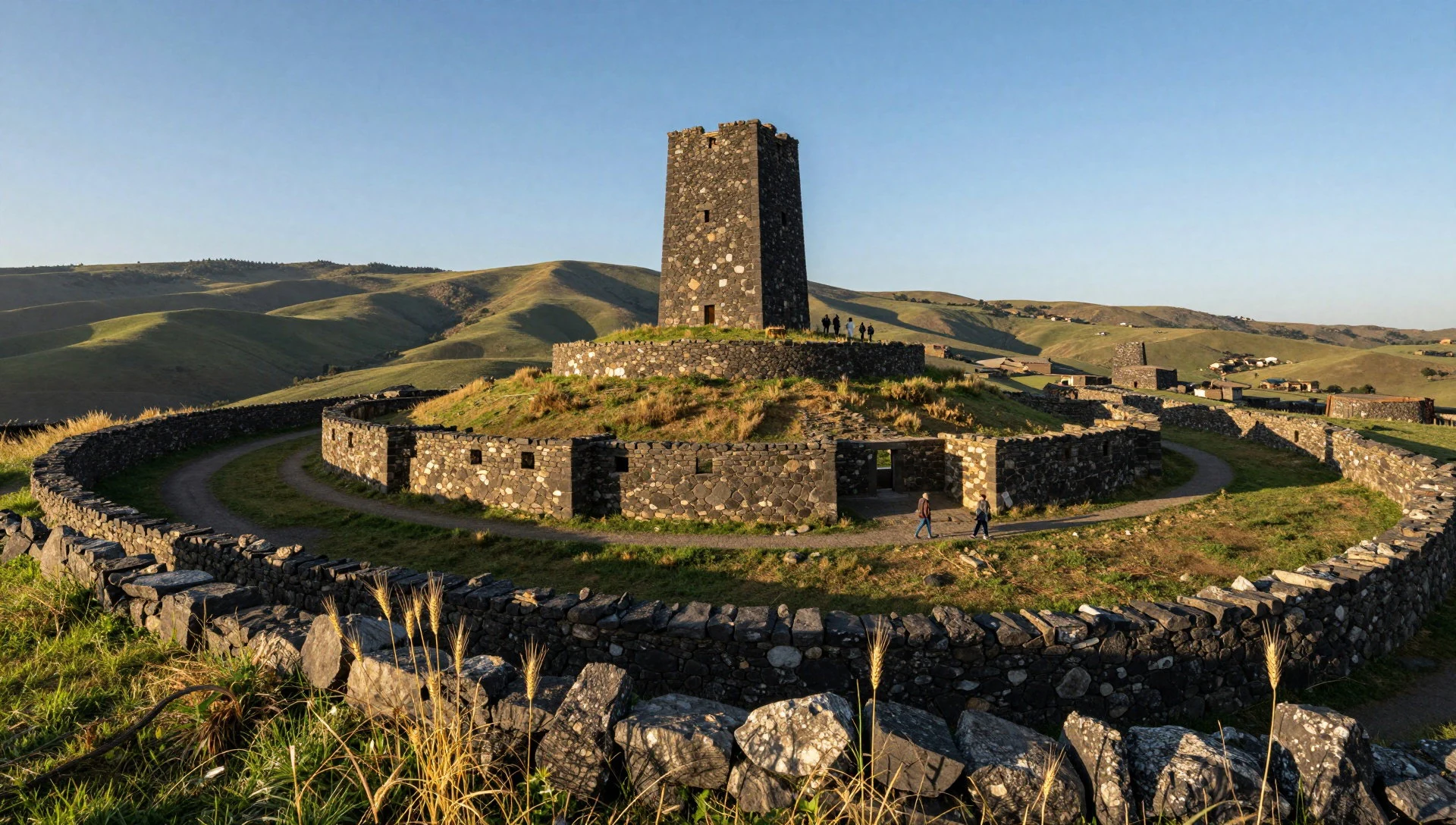
- Nuraghe Losa — Abbasanta
Nuraghe Losa at Abbasanta is a Bronze Age stronghold in west-central Sardinia, still legible as keep, courtyard and outer rampart. Dry-stone walls of great thickness are the sight: passages run through them, and the central tower still holds a clear outline. The monument stands near a main inland road, so it suits a pause between the interior and the western coast rather than a day of its own.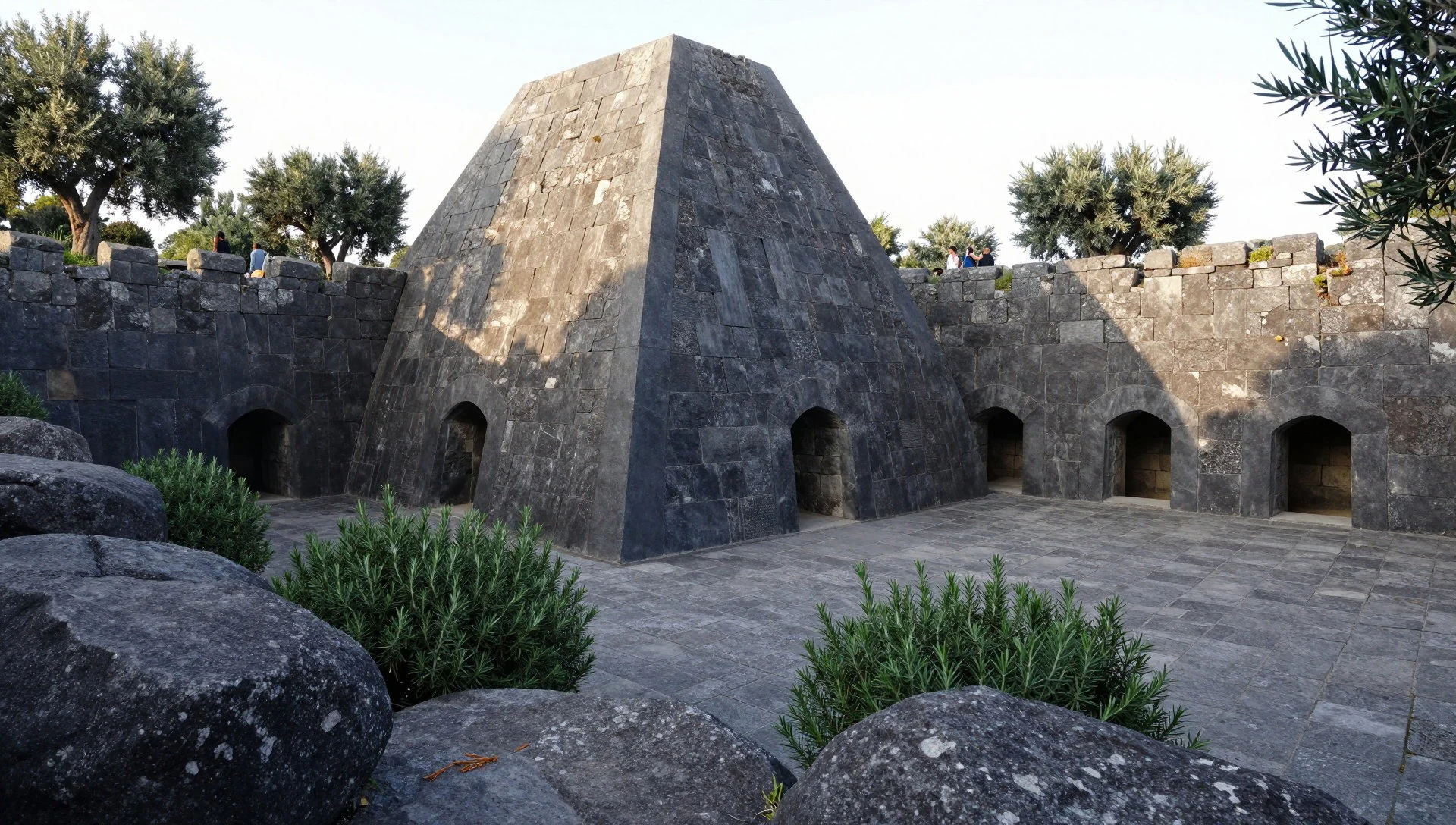
- Sa Ena e Thomes — eastern Sardinia
Sa Ena e Thomes is a giants' grave in the east of Sardinia, one of the megalithic tombs that share the island with the nuraghi. A stone corridor leads into a burial chamber, fronted by a curved line of upright slabs that marks the ceremonial court. The Sardinian name belongs to a type found in many districts, kin to the other giants' graves, dolmens and rock-cut domus de janas.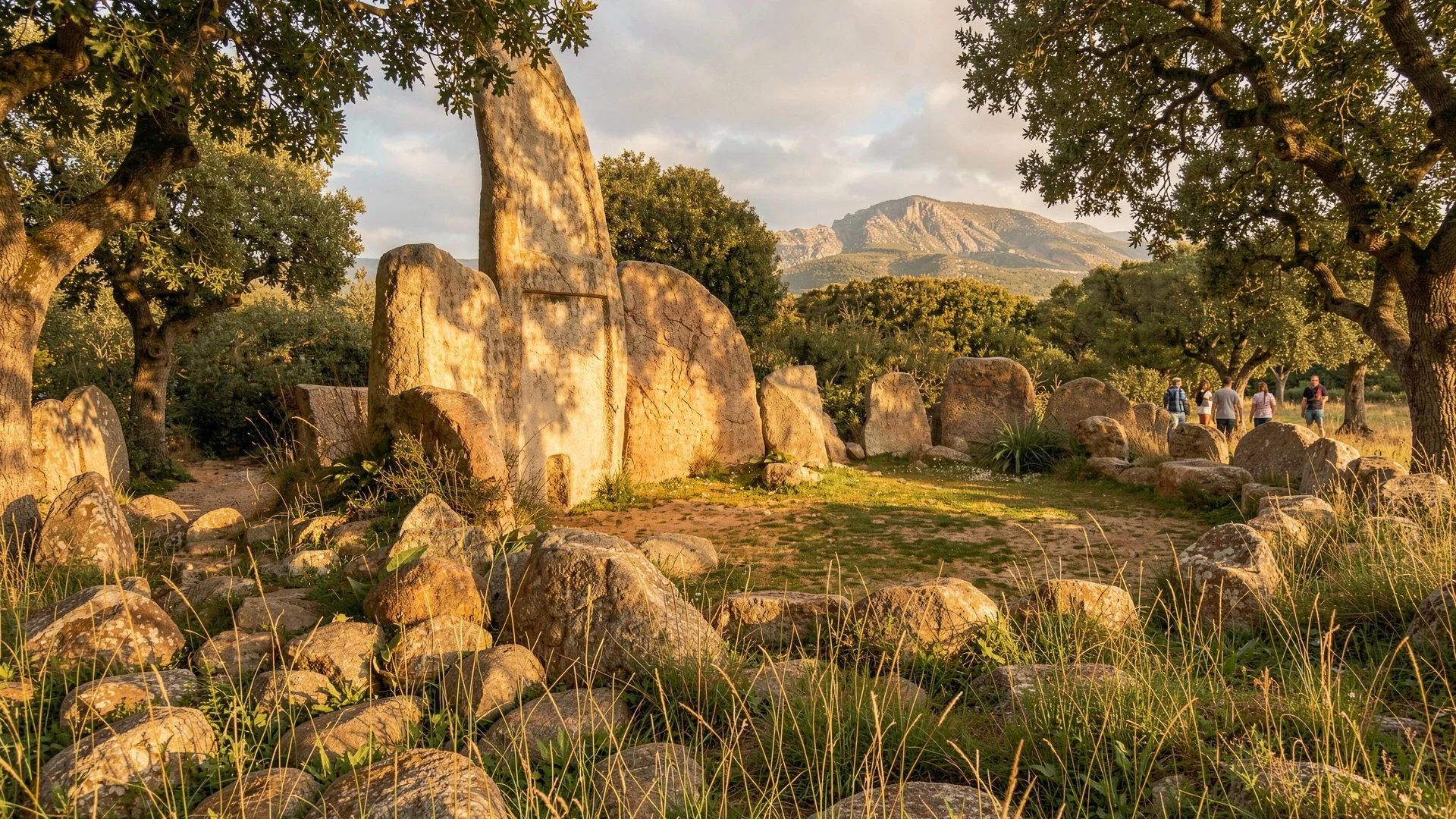
- Monte Prama sculptures — Cabras, western Sardinia
The Monte Prama sculptures are Nuragic stone figures from near Cabras, on the west of Sardinia. Warriors and other human forms are carved in the round, with severe geometric faces. They put people beside the towers: the culture that built in dry stone also cut images of its fighters. Seen up close, the bodies are columnar and the faces are masks of geometry.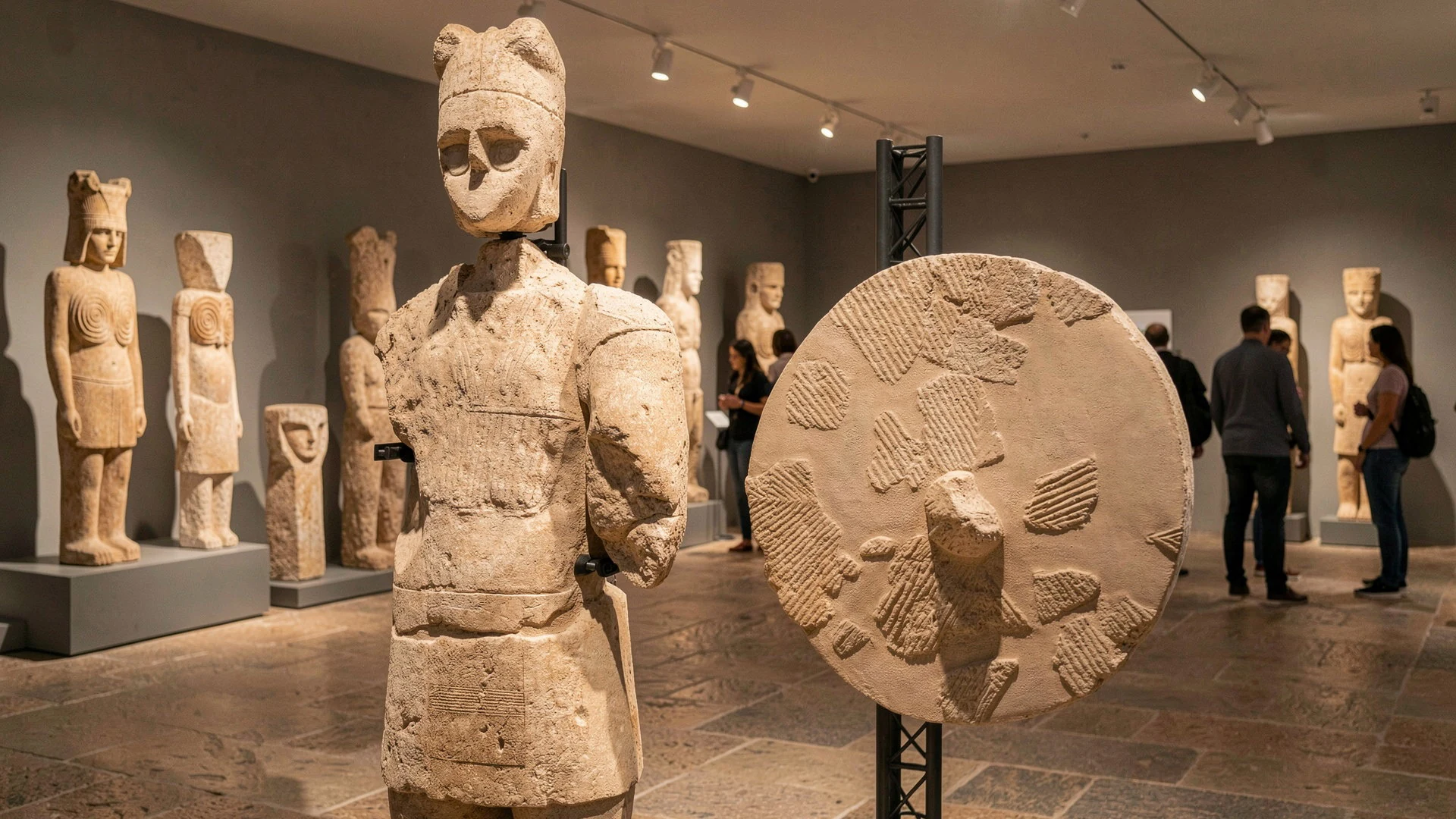
- Monte d'Accoddi — near Sassari
Monte d'Accoddi, near Sassari in the north of Sardinia, is a pre-Nuragic altar rather than a tower. A broad earthen platform rises from flat farmland and is climbed by a long ramp, so the monument reads as a stage set above the plain. It sits with the island's other early stone work — menhirs, dolmens, megalithic circles and well temples — and it is older than the nuraghe towers.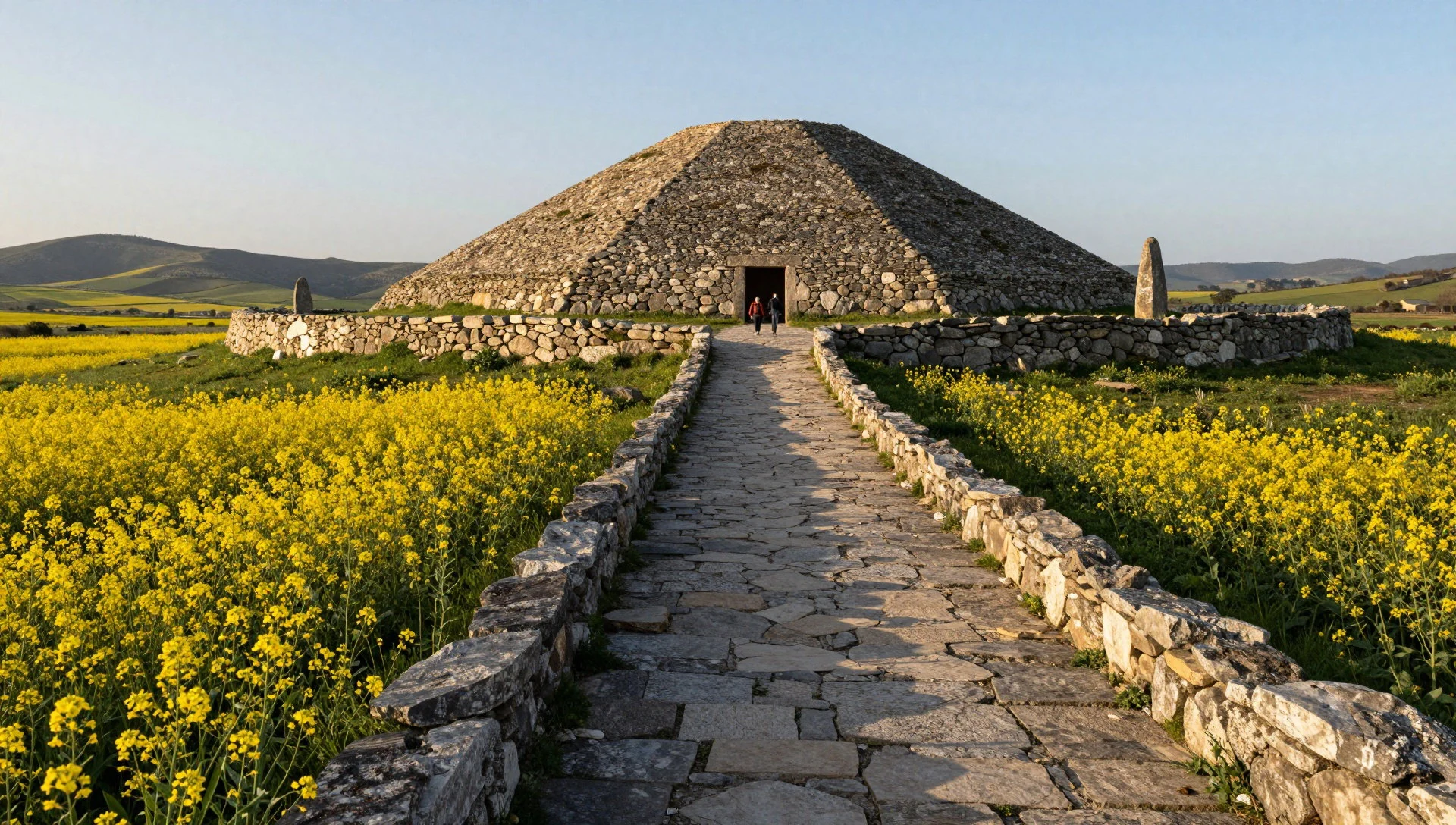
- Nora — southern coast
Nora, on the southern coast of Sardinia, stacks Phoenician, Carthaginian and Roman streets on a low peninsula. Column bases, mosaic floors and a theatre sit close to the water. Tharros, on the western coast, and Monte Sirai, just off Carbonia, belong to the same Phoenician and Carthaginian chapter. At Nora the lanes are still clear enough to follow as a town.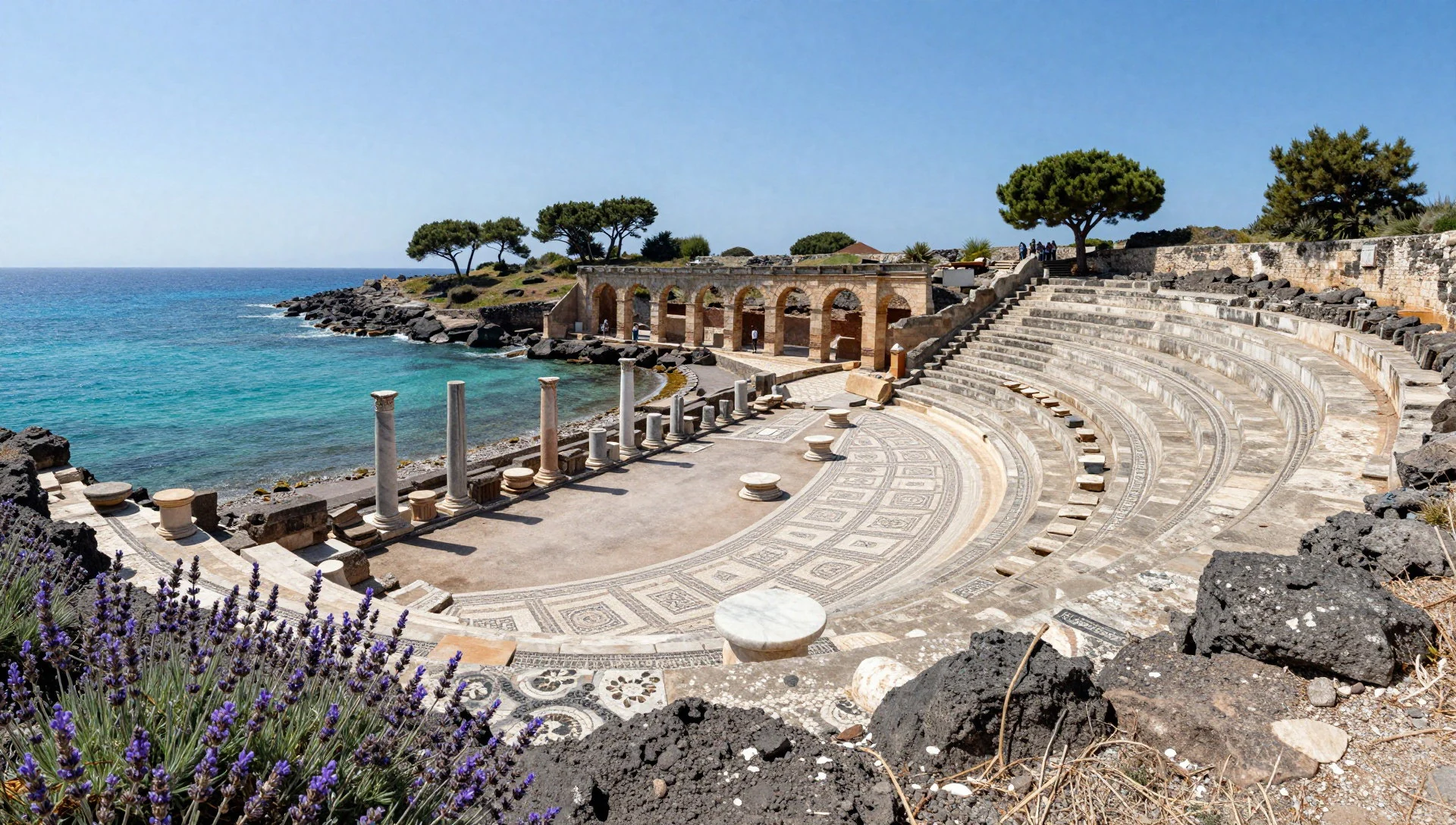
Culture
Sardinia's special statute is the only autonomy charter in Italy that refers to the islanders as a popolo, a people. Veneto uses the same word in an ordinary regional statute; Sardinia's text, by contrast, was passed as constitutional law. Neither wording creates a different citizenship. Sardinians remain citizens of Italy, like everyone else in the country. What the phrase does carry is a felt separateness, audible in the minority languages and visible in festivals that still belong to particular towns.
The landscape of that long memory is mostly prehistoric. Domus de janas, Sardinian for witch houses or fairy houses, are tombs cut into rock. Giants' graves, megalithic circles, menhirs, dolmens and well temples add further types. Nuraghi dominate that prehistoric countryside: the remains of thousands of Bronze Age towers, some a single cone, others a group of towers inside a bastion, still stand in fields and on ridges.
Sheep-rearing in the interior, and the cheese and feast days that go with it, continue beside a coast organised around summer guests. Holding both in view is the useful cultural lesson of Sardinia. At a festival or inside a church or a small tomb, ask before you photograph people, and keep your voice down.
What to wear
Sardinia's traditional dress is village dress, not a single national costume, and it is worn for patron-saint feasts and processions rather than for ordinary days. Women's festive clothes bring together a full skirt, an embroidered bodice, a headscarf and a mass of gold: filigree buttons and chains, often with coral. Men's old formal wear is built on orbace, a dense black wool, cut as jacket and trousers over a white shirt, with a dark cap. The textiles that matter are wool from the island's sheep, linen, and the embroidery and metalwork that mark one town's costume off from the next.
Daily clothes now are ordinary Italian ones. In the cities and on the coast that means light shirts, dresses and linen in the warm months, with a jacket once the wind gets up. Inland towns dress more practically, for work and for weather, and the black-and-white festival costume comes out when the calendar requires it.
A visitor to Sardinia should pack for sun, wind and stone. Swimwear belongs on the beach; a shirt or wrap belongs in town and is expected in churches. Paths at the nuraghi and along rocky coves are uneven, so closed shoes with grip beat new sandals. Evenings on the water can feel cool after a hot afternoon, and a light layer earns its place in the bag.
What to eat
- Culurgiones — village eateries in Ogliastra
Culurgiones are pasta parcels from Ogliastra, in eastern Sardinia, folded around potato, pecorino made from sheep's milk, egg and onion. The pasta itself is the local dough of that district. Look for them in village eateries in Ogliastra, often finished with a plain tomato sauce or melted butter.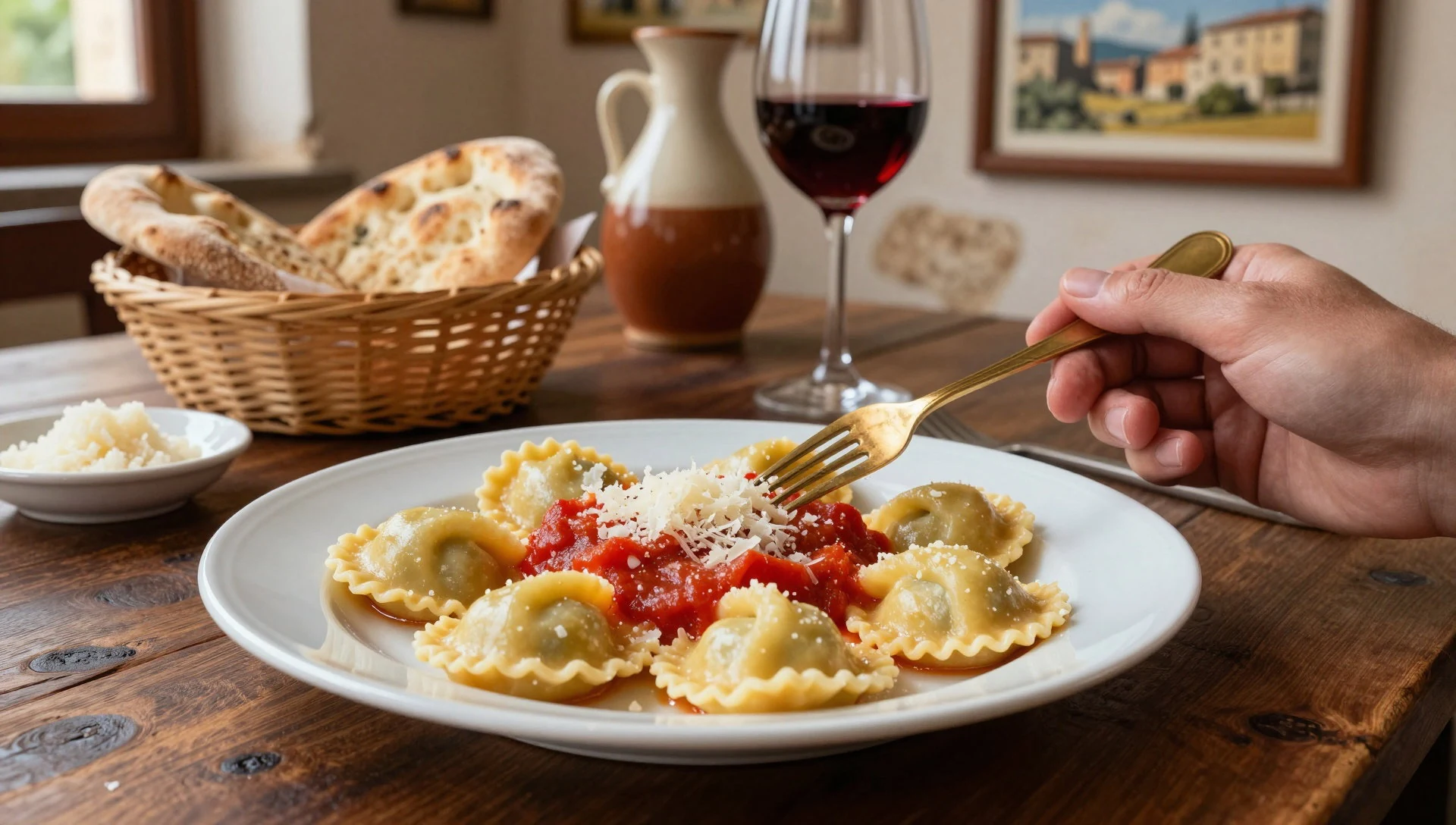
- Malloreddus — ordinary restaurants across the island
Malloreddus are small Sardinian gnocchi, ridged so that sauce clings, and cooked firm. A tomato sauce is the usual partner, with meat or with pecorino on top. Ordinary restaurants across Sardinia serve them, in Cagliari as much as in the hill towns.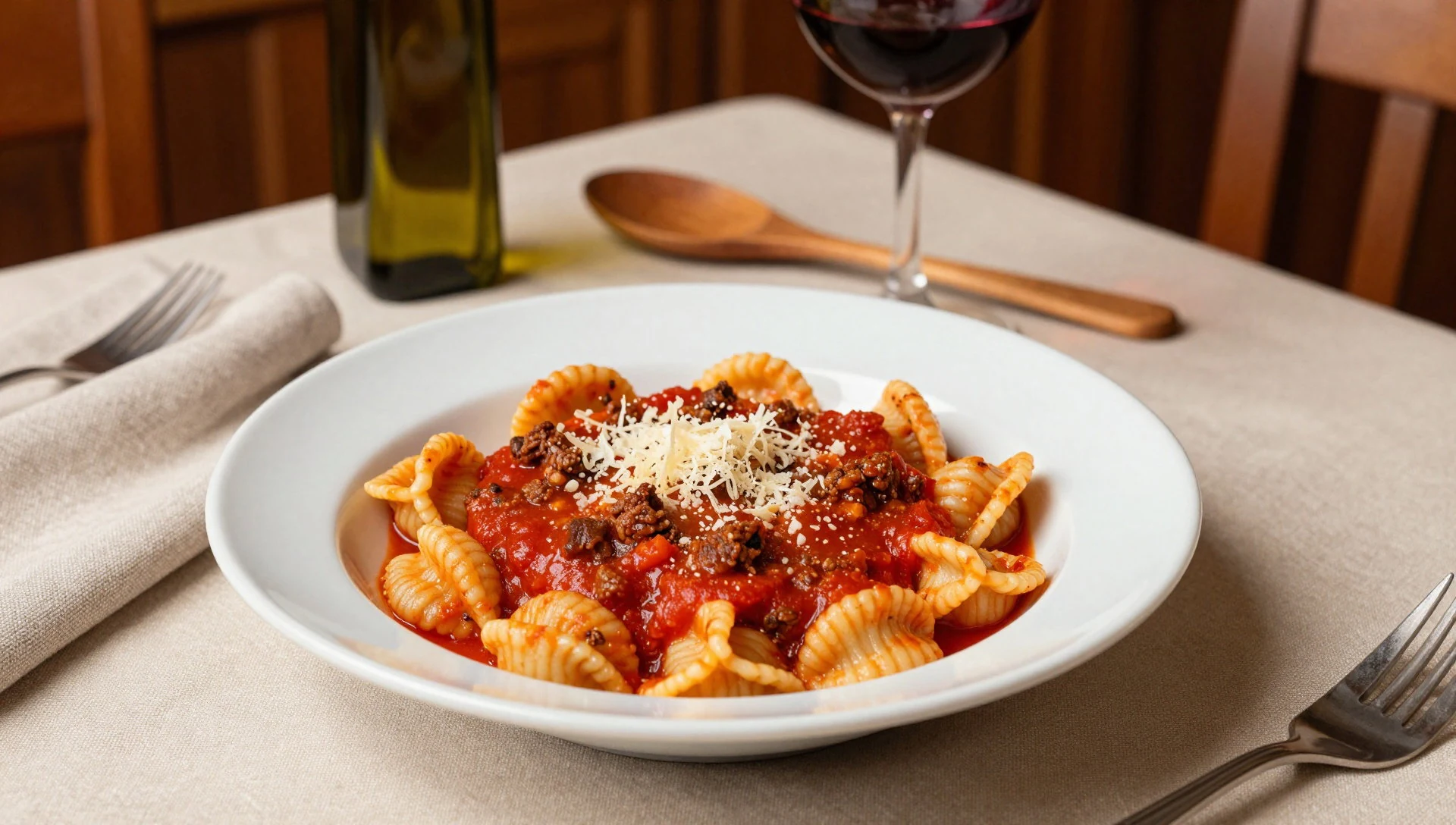
- Porcheddu — country eateries in the interior
Porcheddu is the young pig of inner Sardinia, spit-roasted over wood and perfumed with mirto, the myrtle that grows locally. Ask for it at country eateries inland, well away from the beach towns. Plan on a long lunch; it is not a snack between sights. - Salsiccia di cinghiale — butchers and festival stalls in inland towns
Salsiccia di cinghiale is wild-boar sausage from the interior of Sardinia. It is eaten grilled, or sliced with bread and cheese. Butchers' counters in inland towns, and the food stalls at village festivals, are the straightforward places to find it. The flavour is stronger and gamier than a farm-pork sausage. - Pecorino — town markets in the pastoral interior
Pecorino is Sardinia's sheep's-milk cheese, eaten on its own and used as a filling and a grating cheese. Aged pieces are sharp; milder ones go inside culurgiones and over malloreddus. Town markets and shops in the pastoral interior are the places to taste more than one age of it.
Plan it
Best time. Late spring and early autumn are the practical months for a Sardinia trip that includes both the coast and the interior. July and August are the main beach season, especially around the Costa Smeralda. Winter is quieter, and it suits towns and archaeological sites more than swimming.
How long. 5–7
Getting there. Sardinia has three commercial airports, serving the cities of Cagliari, Olbia and Alghero: Cagliari-Elmas (CAG), Olbia-Costa Smeralda (OLB) and Alghero (AHO). Cagliari takes direct domestic and international flights, and Milan-Linate or Rome-Fiumicino are the usual mainland connections when a direct seat is not available. Olbia is the air gateway for the Costa Smeralda; Alghero serves the north-west. Budget carriers on these routes include Jet2, Wizz Air, Ryanair, Easyjet and Eurowings. Check the airlines for current timetables.
Budget. mid
Tips
- Book rooms on the coast months ahead if travelling in July or August.
- Begin at nuraghi and other archaeological sites when they open, before coach parties arrive.
- A hire car is the practical link between beaches and inland towers.
- Carry some cash for small towns, festivals and rural eateries.
- Many prehistoric sites have little shade, so take water and a hat.
Etiquette
- Cover shoulders and knees inside churches.
- Ask before photographing people at festivals or in village streets.
- Do not climb on nuraghe walls or on the slabs of tombs.
Nearby
Sources
- Wikidata Q1462 (CC0)
- Wikipedia (rev 1383757837) (CC BY-SA 4.0)
- Wikivoyage (rev 5366097) (CC BY-SA 4.0)
- Photo photos/01-sardinia-satellite.jpg (Public domain)
- Photo photos/02-e-u-sardinia.png (CC BY-SA 4.0)
- Photo photos/03-sardegna-italy.jpg (Public domain)
- Photo photos/04-monted-accoddisardegna.png (CC BY 3.0)
- Photo photos/05-mapsardine1779-2523.jpg (CC BY-SA 4.0)
- Photo photos/06-abbasanta-nuraghe-losa.jpg (CC BY-SA 4.0)
- Photo photos/07-sa-ena-e-thomes-2.jpg (CC BY 3.0)
- Photo photos/08-et-nuragica-giganti-di-monte-prama-xiii-ix-secolo-ac-ca-da-c.jpg (CC BY 3.0)


