Pula Arena
Pula Arena, Croatia
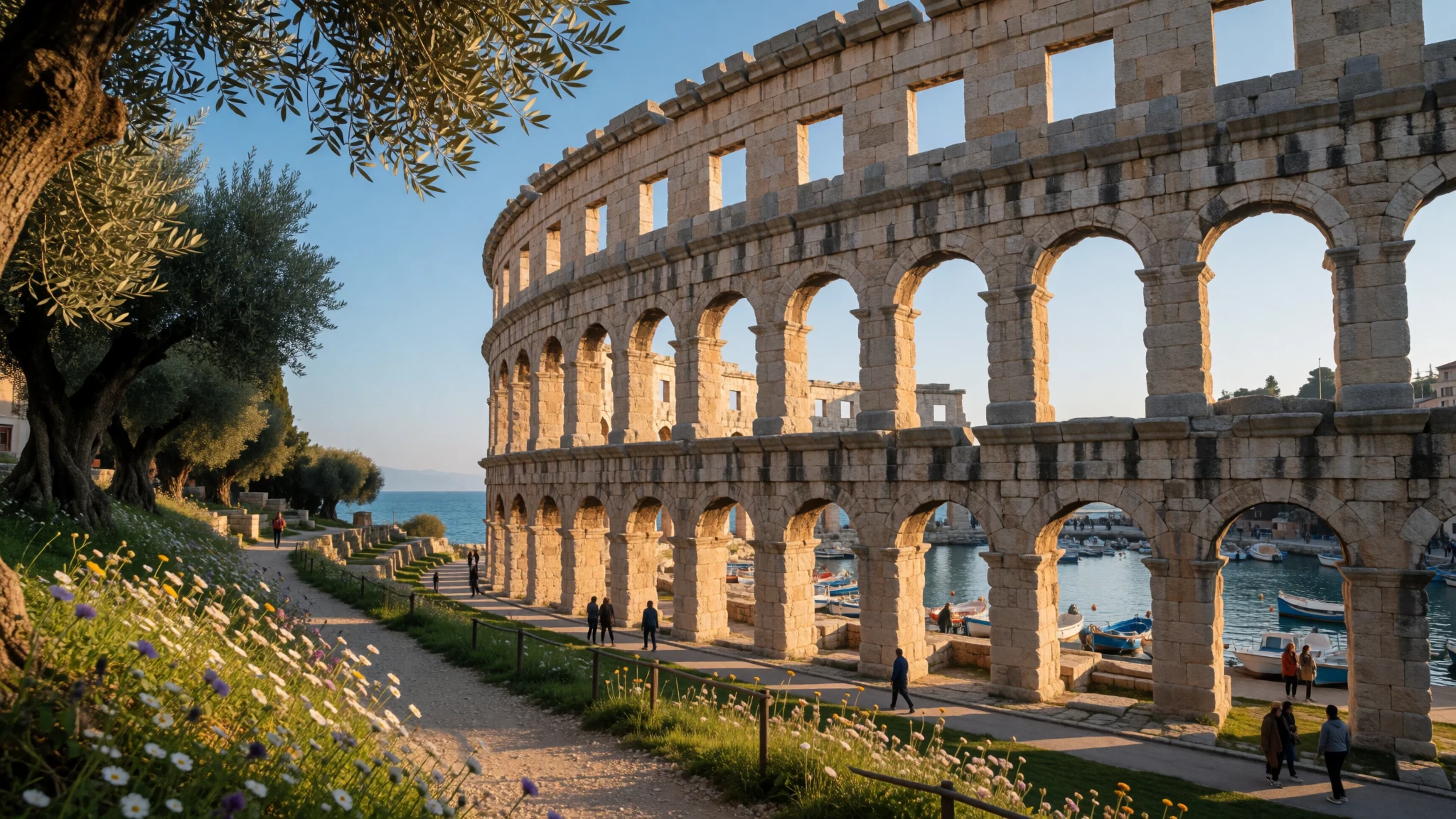
Pula Arena stands on Istria's coast as one of antiquity's most intact Roman amphitheatres, retaining its complete circular outer limestone wall.
The place
Pula Arena dominates the northern harbour of the Istrian coastal city, its pale local limestone walls standing against the waters of the Adriatic Sea. Constructed between 27 BCE and the late first century, the monument remains distinct among Roman amphitheatres because its three-tiered exterior ring survives intact across its complete circular perimeter. The structure adapts directly to the natural slope of the coastal hill, resulting in four storeys along the seaward elevation and two along the higher inland slope.
Inside, the open arena floor rests above a subterranean network of stone tunnels, subterranean chambers, and timber hoist shafts. Historically, these passages accommodated gladiators, caged animals, and mechanical stage gear before matches began. Today, the central arena floor hosts open-air concerts, film screenings, and theatrical events, drawing summer crowds into an ancient seating bowl that once held upwards of twenty thousand spectators.
Visiting the monument requires walking along steep limestone stairs, uneven stone slabs, and sun-exposed perimeter walkways. In July and August, midday heat radiates off the pale masonry, and shade within the open ring is scarce. Arriving during early morning or late afternoon yields cooler temperatures and softer light across the outer arcades. The underground galleries stay remarkably cool year-round, displaying ancient amphorae and traditional press machinery from Istria’s olive-growing history.
Its story
Pula Arena originated during the reign of Augustus, when the surrounding Roman settlement of Pietas Julia grew into a strategic Adriatic administrative centre. Initial timber and stone building efforts around 27 BCE established the basic footprint outside the urban defensive walls, alongside the main road leading toward Aquileia. Under Emperor Claudius, workmen enlarged the site into a permanent stone venue, before Emperor Vespasian expanded the complex further in the late first century to host large-scale gladiatorial contests and public spectacles.
The arena derived its name from harena, the fine sand spread across the wooden arena floor to absorb blood and combat fluids during games. Spectators filled four tiered levels to witness combat between trained fighters, exotic animal hunts, and public staged events. Following the prohibition of gladiatorial contests in the fifth century, the monument entered a prolonged period of repurposed use. Local inhabitants quarried stone from the interior seating banks to construct houses and civic defensive works, though the massive outer ring remained largely untouched.
During Venetian rule in the Middle Ages and Renaissance, several proposals were floated to dismantle the stone walls and transport the materials across the sea to Venice. City magistrates resisted these schemes, keeping the shell in place. Modern conservation work began under Austrian administration in the nineteenth century, clearing centuries of debris from the underground vaults and stabilizing the exterior arcades to preserve the structural frame.
What to see
- Subterranean Galleries — Beneath the arena floor
Located directly below the arena floor, these underground stone passages once held gladiators and wild animals before combat. Today, the cool subterranean vaults host a permanent exhibition detailing ancient Istrian olive oil production and viticulture, featuring preserved amphorae, wooden press reconstructions, and historic storage vessels. - The Forum — Old Town Pula
Pula's primary public square occupies the original site of the Roman civic forum. Anchored by the well-preserved Temple of Augustus and the tenth-century Communal Palace, the stone plaza is lined with outdoor café seating, making it a natural gathering point after exploring the nearby amphitheatre. - Arch of the Sergii — Portarata Square
Erected in the late first century BCE, this elegant Roman triumphal arch was commissioned by the powerful Sergii family. Originally built into the city gate, the stone monument features carved Corinthian capitals and detailed reliefs, standing at the entry to Pula’s pedestrian shopping precinct. - Istrian Olive Oil Museum — Central Pula
Situated a short walk from the amphitheatre, this museum traces the centuries-old history of olive cultivation in Istria. Interactive displays cover traditional pressing techniques, regional soil types, and quality testing, concluding with guided tastings of local extra virgin olive oils. - Pula Castle and Fortress — Central Hill
Perched on the highest hill above the harbour, this seventeenth-century star-shaped Venetian fortress provides wide panoramic views across Pula's tiled roofs and bay. Inside, the Historical and Maritime Museum of Istria displays regional naval artifacts, ancient weaponry, and administrative history.
Culture
Pula Arena sits at the cultural heart of Istria, where Italian and Slavic traditions have intersected for centuries. The surrounding region of Istria maintains a distinct bilingual heritage, with Croatian and Italian recognised across public signage, regional literature, and local conversation. Modern life around the amphitheatre reflects a relaxed coastal rhythm, with residents gathering in nearby squares for late-afternoon espresso or evening promenades along the harbour front. Throughout the summer months, the venue resumes its ancient role as an entertainment hub, hosting international concerts, opera performances, and the annual Pula Film Festival beneath the open sky. Local pride in this classical architecture runs deep, and residents view the monument not merely as an archaeological site, but as a living symbol of their city’s endurance. When attending evening concerts or performances inside the amphitheatre, wear sturdy closed-toe shoes to navigate the uneven ancient stone steps safely.
What to wear
Pula Arena is located in a region with rich textile traditions influenced by Istrian folk heritage. Traditional Istrian folk dress features linen shirts, heavy woollen vests, and hand-embroidered waistcoats decorated with geometric patterns. Women historically wore multi-layered dark wool skirts accompanied by linen headscarves, while men favoured white linen trousers, dark leather belts, and felt waistcoats during festival days and cultural celebrations. Today, these traditional garments appear primarily during regional folklore gatherings and summer cultural festivals. In daily life, residents of Pula dress in smart-casual Mediterranean style, preferring lightweight cotton shirts, linen trousers, tailored shorts, and comfortable leather footwear suited to warm summer weather. Visitors to the amphitheatre should wear light, breathable fabrics during summer, as sunlight reflects heavily off the open stone arena floor. Supportive flat footwear or sturdy walking sandals are essential, as the site features loose gravel paths, steep stone steps, and worn limestone steps that become slick underfoot.
What to eat
- Fuži with Truffles — Taverns and traditional eateries in the Old Town
Hand-rolled quill-shaped Istrian pasta tossed in a rich butter cream sauce and finished with shaved local black or white truffles. This classic regional specialty highlights Istria's world-renowned woodland truffle heritage. - Pljukanci with Boškarin — Convivial seafood and meat taverns near the harbour
Spindle-shaped hand-twisted pasta served with a slow-cooked ragù made from Boškarin, the indigenous long-horned Istrian cattle. The tender, savoury meat sauce pairs perfectly with a glass of local Teran red wine. - Istrian Maneštra — Family-run eateries around the city centre
A hearty, slow-simmered vegetable soup made with sweetcorn, beans, potatoes, and smoked pork. Traditionally cooked in homes across Istria during cooler months, it offers a comforting, rustic taste of countryside cooking. - Grilled Adriatic Calamari — Harbourside seafood restaurants and konobas
Fresh local squid seasoned with garlic, parsley, and Istrian olive oil, then seared over hot charcoal grills. Served alongside blitva—a classic Croatian side dish of Swiss chard and boiled potatoes. - Ćevapi — Grill houses and casual eateries near the bus station
Grilled skinless minced meat sausages served inside warm flatbread alongside diced raw onions and ajvar, a savoury roasted red pepper spread. A popular, satisfying bite throughout Istria.
Plan it
Best time. May to June and September to October offer pleasant temperatures, manageable crowds, and ideal sightseeing conditions; July and August bring heavy summer heat and peak visitor numbers.
How long. 1–2
Getting there. Fly into Pula Airport, followed by a direct 15-minute shuttle bus or taxi to the city centre. Direct long-distance buses also run to Pula from Zagreb, Rijeka, Trieste, and Ljubljana.
Budget. mid
Tips
- Visit early in the morning to avoid summer heat and tour groups
- Bring a hat and sunscreen as there is little shade inside the open arena ring
- Purchase combined admission tickets if planning to visit other Roman sites in Pula
- Check official event listings for summer film festivals or open-air concerts inside the arena
Etiquette
- Refrain from climbing on unrestored wall sections or ancient masonry
- Keep noise levels respectful when exploring the underground gallery exhibits
- Dispose of all rubbish in designated bins before leaving the arena grounds
Nearby
Sources
- Wikidata Q474998 (CC0)
- Wikipedia (rev 1371167367) (CC BY-SA 4.0)
- Wikivoyage (rev 5415533) (CC BY-SA 4.0)
- Photo photos/01-the-new-old-amphitheater-in-pula-istria-19629095974.jpg (CC BY-SA 2.0)
- Photo photos/02-pula-arena-2024-10-10-1.jpg (CC BY-SA 4.0)
- Photo photos/03-pola-the-arena-istria-austro-hungary.jpg (CC BY-SA 2.0)
- Photo photos/04-pula-arena-1.jpg (CC BY-SA 4.0)
- Photo photos/05-exhibition-of-viticulture-and-olive-growing-pula-arena-under.jpg (CC BY-SA 2.0)
- Photo photos/06-kroatien-pula-amphitheater-innenraum-01-blick-nach-s-den.jpg (CC BY-SA 4.0)
- Photo photos/07-arena-pula-inside.jpg (Public domain)
- Photo photos/08-official-arena-light-postcard-photo-guinness-world-record-in.jpg (CC BY-SA 4.0)


