Larabanga Mosque
Larabanga Mosque, Ghana
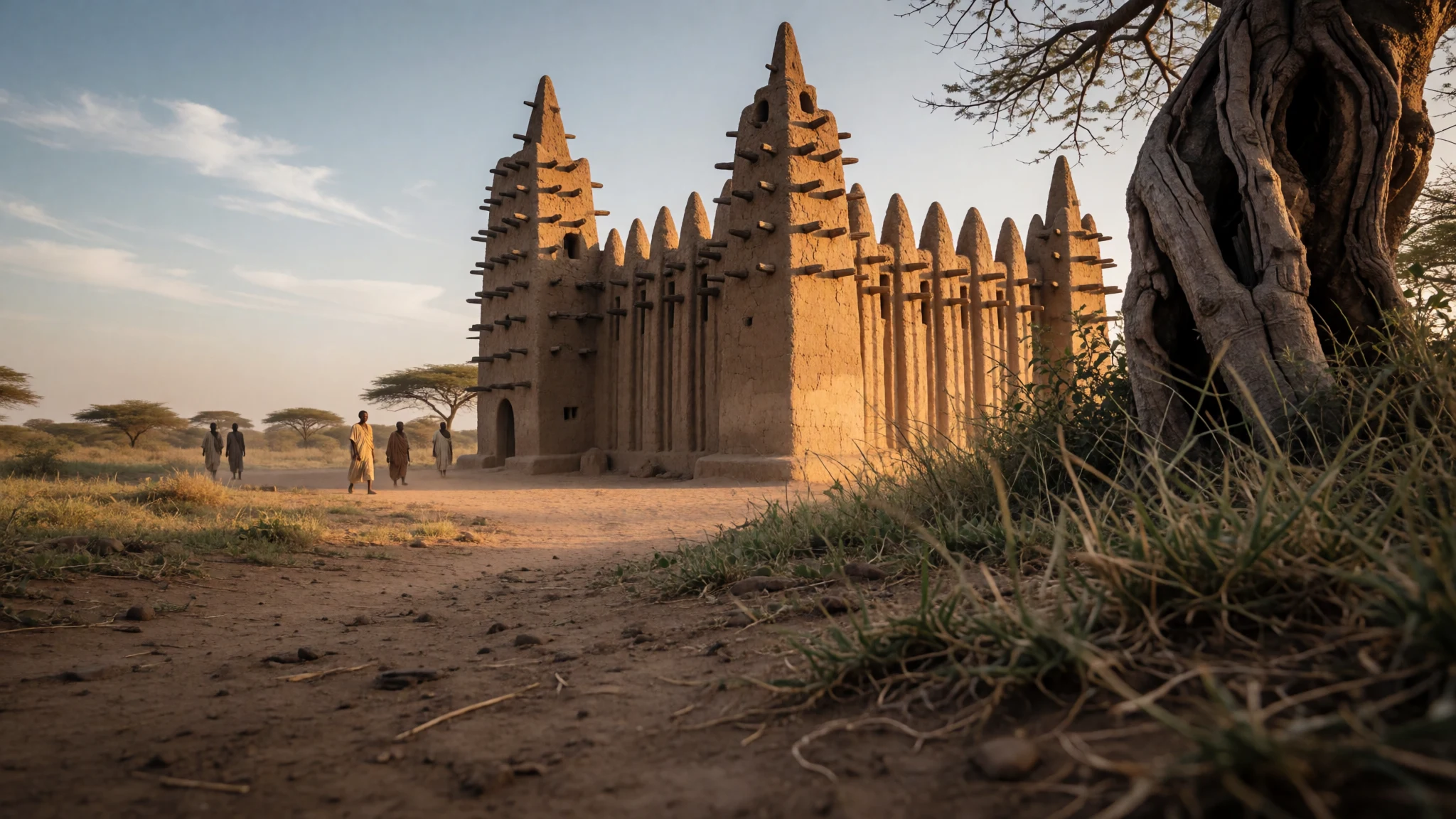
Visit Larabanga Mosque to witness West Africa's oldest standing adobe sanctuary, a marvel of Sudanese architectural heritage nestled in the savannah.
The place
The Larabanga Mosque stands as an extraordinary landmark in the Savannah Region of Ghana, anchoring a small Islamic settlement in West Gonja. Built in the distinctive Sudanese architectural tradition, the structure is crafted entirely from sun-dried West African adobe earth. Its striking exterior silhouette is defined by two prominent pyramidal towers: one housing the mihrab oriented towards the east, and another serving as a minaret at the northeastern corner. Twelve robust, bulbous buttresses reinforce the main walls, tied together with protruding horizontal timber elements that give the building its instantly recognisable ribbed texture.
Surrounding the mosque, the landscape opens into typical West African savannah vegetation, flat and scrubby under an open sky. The settlement itself maintains a quiet, traditional atmosphere, positioned just south of the Mole National Park entrance. Life here moves at an unhurried pace, attuned to the rhythms of agriculture and local trade. Because the building relies on raw earth rather than modern masonry, it requires constant maintenance to withstand seasonal downpours and strong winds. The ongoing preservation work draws on traditional earth-building techniques passed down through generations, ensuring the fragile structure continues to stand against the elements.
Its story
According to local oral tradition, the origins of the Larabanga Mosque date back to an Islamic trader named Ayuba who rested near a large stone in the area. During his stay, a dream instructed him to construct a place of worship. When he awoke, the foundational outlines were miraculously already in place, inspiring him to finish the building. Folklore holds that Ayuba was buried nearby, and a massive baobab tree grew from his gravesite, which local residents still revere and turn to for traditional healing properties.
For centuries, the mosque has served as a vital spiritual focal point, earning the moniker of the 'Mecca of West Africa' among regional pilgrims. Inside rests a treasured, ancient Quran preserved through generations, believed by the community to have descended directly from the heavens as a divine gift to a former imam. Over the decades, the mosque has faced severe environmental threats. In the 1970s, well-intentioned attempts to coat the exterior walls in a sand-and-cement render tragically sealed moisture inside the adobe, causing internal termite infestations and partial structural collapse. Later, severe storms damaged the surviving towers. Through interventions by international heritage bodies and local craftspeople, restorative efforts have stripped away damaging modern materials, returning the shrine to its breathable mud-brick origins and safeguarding its place in architectural history.
What to see
- The Mud-Brick Exterior Walls — Main courtyard, Larabanga village
Marvel at the textured mud-brick exterior walls of the Larabanga Mosque, which showcase the characteristic application of West African adobe. The thick earthen plaster absorbs the intense heat of the savannah while giving the structure its organic, sculptural form, shaped entirely by hand and renewed annually before the rainy season arrives. - The Prayer Hall Facade — Eastern facade, Larabanga village
Observe the intricate prayer hall facade facing east towards Mecca, featuring deep vertical ribbing and protruding wooden scaffolding poles. These horizontal beams are not merely decorative; builders use them as structural scaffolding during regular mud-coating maintenance sessions, allowing workers to scale the fragile earthen towers safely without damaging the soft exterior walls. - The Minaret Tower — Northeastern corner, Larabanga village
Look up at the soaring minaret tower positioned at the northeastern corner of the compound. Its slender pyramidal profile tapers toward the sky, crowned with wooden finials that project outward. This architectural feature mirrors ancient stylistic traditions found across the Sahel, adapted carefully here to suit local materials and regional engineering techniques. - The Mystic Stone — Village outskirts, Larabanga
Visit the revered mystic stone located just outside the village settlement, which local legend connects directly to the founding vision of trader Ayuba in 1421. Pilgrims and curious travellers often stop by this geological landmark to hear local guides recount the foundational folklore that has protected the sacred site for centuries.
Culture
Larabanga operates as a deeply traditional Islamic community where religious customs and communal life remain tightly intertwined. Hospitality is a cornerstone of village etiquette, and visitors are generally welcomed by local youth acting as guides, who share stories of the mosque's founding and maintenance. Daily life is shaped by prayer times, agricultural cycles, and traditional governance led by local elders and the imam. When walking through the village, modest dress is essential out of respect for local Islamic values, covering shoulders and knees. Photography of community members should always be preceded by a polite verbal request, and entering the mosque interior is restricted to practitioners or visitors granted specific permission by local custodians. Always remove your shoes before stepping onto the sacred prayer mats or approaching the immediate threshold of the mosque.
What to wear
In Larabanga and throughout the wider Savannah Region of Ghana, traditional attire reflects both Islamic heritage and practical adaptation to the hot, dry climate. Local men frequently wear flowing, embroidered grand boubous or lightweight tunic sets paired with loose trousers, often complemented by traditional caps. Women typically wear vibrant, locally printed wax cloth wrappers matched with tailored blouses and headwraps crafted from breathable cotton fabrics designed to handle high temperatures.
Modern everyday wear in the village blends easily with traditional styles, with younger residents opting for simple t-shirts, casual shirts, and durable trousers suitable for dusty paths and outdoor work. For international travellers visiting Larabanga, dressing respectfully is vital. Lightweight, loose-fitting clothing made from natural fibres like cotton or linen is ideal for beating the heat while maintaining cultural modesty. Visitors should pack breathable trousers or long skirts, shirts that cover the shoulders, and comfortable walking shoes or sandals that can be slipped off easily when visiting sacred compounds or community thresholds.
What to eat
- Banku and Tilapia — Local roadside eateries and market stalls in Larabanga
A staple dish across Ghana consisting of fermented corn and cassava dough cooked into a smooth, hot ball, served alongside grilled fresh river tilapia and a fiery, raw tomato and pepper relish. - Jollof Rice — Village food stalls and community cooking spots
A beloved one-pot dish of rice simmered in a rich, seasoned blend of tomatoes, onions, peppers, and local spices, often accompanied by fried plantains and chicken or beef. - Tuo Zaafi — Traditional home kitchens and local gathering spots in Damongo
A popular regional northern specialty made from cooked millet or maize flour, served soft and paired with a rich, nutritious green soup flavoured with local herbs and tender meat. - Red Red — Local market stalls near the transport station
A comforting vegetarian dish of black-eyed peas cooked in a rich, red palm oil stew with onions and tomatoes, served alongside sweet, golden fried ripe plantains.
Plan it
Best time. Visit between November and February during the dry season when the weather is warm and roads are clear of heavy seasonal mud.
How long. 1–2
Getting there. Fly into Tamale Airport, then take a shared taxi or hire a vehicle for the drive west toward Damongo and Larabanga village.
Budget. low
Tips
- Hire a registered local youth guide in the village to learn accurate history and support community preservation efforts
- Carry sufficient physical cash in Ghanaian cedis, as card payment facilities are unavailable in the village
- Bring a wide-brimmed hat, sunglasses, and high-factor sunscreen to cope with intense sunshine and heat
- Respect all local photography boundaries, especially around elders and active prayer spaces
- Combine your trip with a morning safari at the nearby Mole National Park
Etiquette
- Always remove your shoes before stepping onto the threshold or prayer mats of the mosque
- Cover your shoulders and knees out of respect for the village's Islamic traditions
- Always ask permission before taking photographs of local residents or children
Nearby
Sources
- Wikidata Q490898 (CC0)
- Wikipedia (rev 1366938863) (CC BY-SA 4.0)
- Wikivoyage (rev 5344144) (CC BY-SA 4.0)