Kyushu
Kyushu, Japan
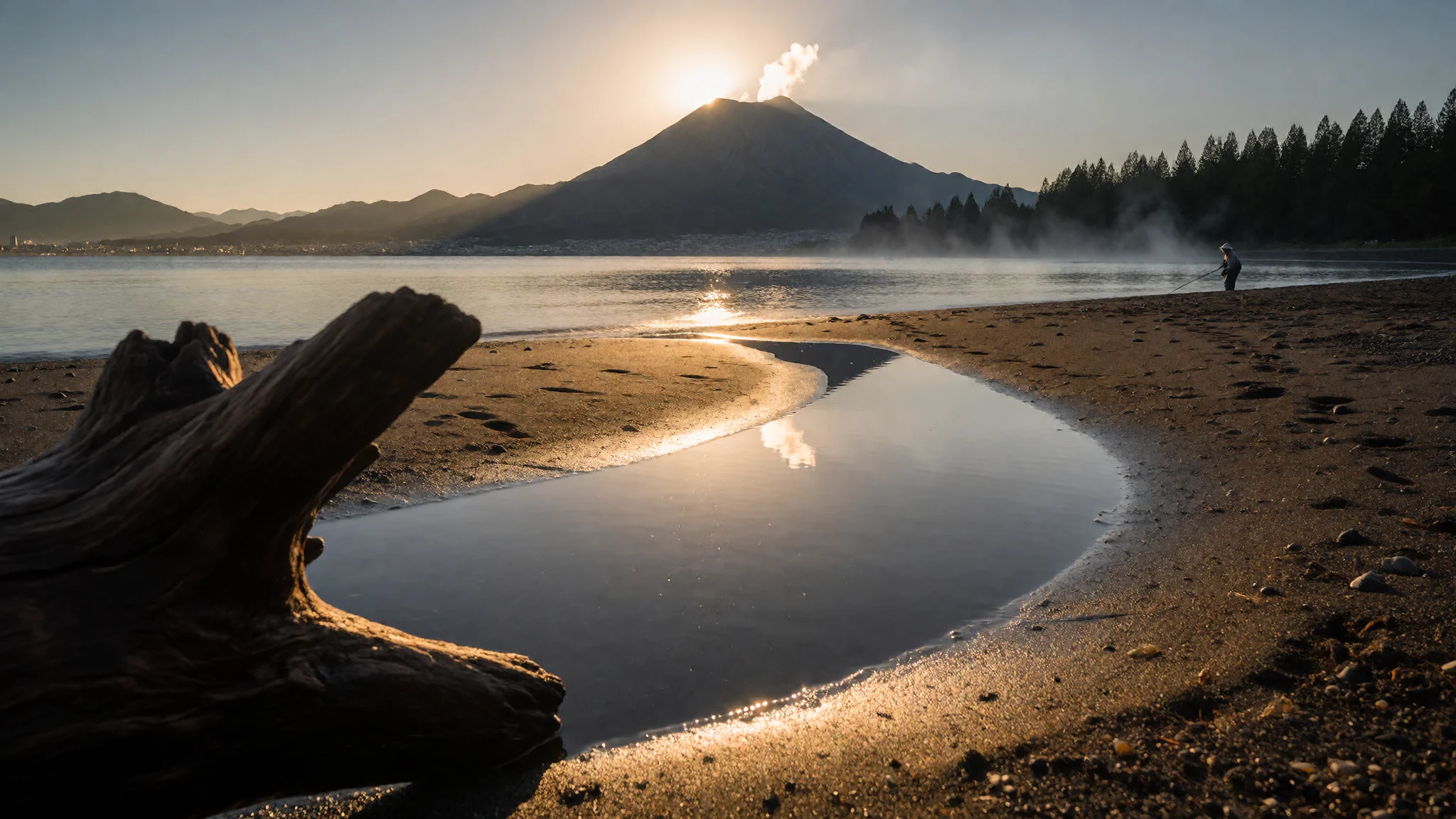
Kyushu offers volcanoes, steaming hot springs, ramen-filled riverside stalls and a long history as Japan's front door to the Asian mainland.
The place
Kyushu is the southwesternmost of Japan's four main islands and the third largest, home to roughly 13 million people. Its name (九州) is usually glossed as "nine provinces", a trace of an older administrative map. The island lies closest to the Asian mainland, which made it the natural landing point for traders, envoys and new ideas for many centuries. A narrow strait separates it from Honshu, and road bridges, a road tunnel and the bullet train all cross it today.
The ground here is restless. Mountains fill much of the interior, volcanoes still smoke, and the same tectonic energy feeds hot springs from Beppu on the east coast to the slopes around Mount Aso in the centre. Towns and cities gather along the coast and in the lowlands between the ranges: Fukuoka in the north-west, Kumamoto and Saga inland, Nagasaki facing the western sea, Kagoshima in the south under its own smoking volcano.
The climate is warm and humid. Summers are heavy, the early-summer rains can be intense, and late summer brings typhoon risk. Spring and autumn are the comfortable seasons. The island is easy to travel by rail and road, but it is big enough that most visitors pick a loop rather than trying to see everything. Fukuoka is the usual starting point, with the southern volcanoes and the eastern spa towns as natural extensions.
Its story
Kyushu's story is largely one of position. As the island nearest to the Asian continent, it was where Japan met its neighbours first, and it earned a reputation as the country's gateway. Some historians suggest that in ancient times it even sustained its own dynasty, with a southern-flavoured culture distinct from that of Honshu, though this remains a theory rather than settled fact.
When the imperial court reorganised the country under the Taihō reforms of the eighth century, it placed a regional headquarters at Dazaifu, in the north of the island, to oversee Kyushu and its offshore islands. The old name Saikaidō, the "West Sea Circuit", comes from that system. Earlier labels such as Kyūkoku, "nine countries", and Tsukushi-no-shima show how many names the island has carried.
Contact with outsiders left lasting marks. Portuguese traders arrived by sea, and their influence survives in the kitchen: Miyazaki's chicken nanban takes its name from the "southern barbarians" of that era and from a sauce of Portuguese origin. Ties with the Ryukyu islands to the south have run deep for as long as records go back, visible in folk-song scales, language and food.
The island has also been shaken physically. The 2016 earthquake at Kumamoto damaged the castle badly, and its long restoration is a reminder that this landscape gives hot springs and fertile volcanic soil, and takes things back from time to time. Warships and aircraft also reached Kyushu's waters in the last months of the Second World War, a chapter still remembered in local museums.
What to see
- Mount Aso — Aso, Kumamoto Prefecture
Mount Aso is an active volcano in central Kyushu, ringed by a huge caldera with farms and villages on its floor. Visitors walk or drive along the rim and, when the gas level permits, look toward the crater. Access can close at short notice, so check the local tourist office first. - Beppu hot springs — Beppu, Oita Prefecture
Beppu on the east coast is the best known of Kyushu's spa towns, with steam rising from vents across the hillside and public bathhouses in many neighbourhoods. Some springs are for viewing, with colours that look painted, while others are for soaking. Mornings are quietest, and many baths are cheap and local. - Kumamoto Castle — Kumamoto city
Kumamoto Castle was once regarded as one of the most faithfully rebuilt castles in Japan, with its keep and many surrounding structures reconstructed. The 2016 earthquake caused severe damage, and restoration continues in stages. Check the official site for which areas are open, and expect scaffolding and construction views. - Saga Castle — Saga city
Saga Castle is notable for its palace, rebuilt at full scale in authentic wooden form, which needed special permission because of building-size rules. Inside, the long timber halls and wide tatami rooms show how a feudal lord's administration worked. It is a calm contrast to Kyushu's busier sights. - Dazaifu — Dazaifu, near Fukuoka
Dazaifu, inland from Fukuoka, was the court's regional headquarters for Kyushu after the eighth-century reforms. Today it is a quiet town where the layout and the surrounding countryside hint at that administrative past. It makes an easy half-day from Fukuoka, best done on a weekday morning to avoid tour groups.
Culture
Kyushu has long-standing cultural ties with Okinawa, the old Ryukyu kingdom to the south. The links show up in folk songs that use Okinawan scales, in similar words and in overlapping cooking habits. The island's own traditional instrument, the gottan, looks like a cousin of the Okinawan sanshin and the shamisen, and local makers still craft it by hand.
Crafts are part of everyday identity. Hakata-ori is a woven textile from Fukuoka, Kurume kasuri is an indigo-dyed cloth, Beppu is known for bamboo ware, and Satsuma kiriko is faceted glass from the south. Visitors will find these in craft shops and regional museums rather than in souvenir stalls alone.
Kyushu people have a reputation for being conservative, even by Japanese standards, and men from the island are often called "Kyushu danji", a phrase that evokes strength and a slightly wild spirit. The term is old, and was once used to rally soldiers. Many locals take real pride in being from Kyushu, and a visitor who shows interest in local food, shōchū and festivals is usually welcomed warmly.
Bathing is also part of the culture, because hot springs are woven into daily life across the island, from grand ryokan baths to small neighbourhood ones. Visitors to Kyushu's onsen should wash thoroughly at the shower stool before getting in, keep towels out of the water, and never photograph other bathers.
What to wear
Kyushu's traditional dress is the kimono, and the island has its own textiles to go with it. Hakata-ori, woven in Fukuoka, is a firm, patterned silk best known for obi sashes. Kurume kasuri is an indigo-dyed cotton with a softly blurred pattern, used for kimono, work clothes and now bags. Kimono are worn for weddings, coming-of-age days and festivals, while the lighter cotton yukata is common at summer fireworks and in spa towns.
Everyday dress now is much like the rest of urban Japan: neat, understated and practical. Fukuoka's young crowd leans fashionable and street-influenced, office workers favour suits in the cities, and rural areas are more casual. Rubber boots and long sleeves against the sun are common sights in farming districts.
For visitors, climate is the main guide. Summers are hot and humid, so light, quick-drying cotton or linen works best, with a compact umbrella or rain jacket for the early-summer rains. Winters are mild on the coast but cold in the mountains, so layers are useful. Sturdy shoes are worth bringing for volcano rims and castle grounds, and slip-on footwear helps because shoes come off at temples, ryokan and many restaurants. Shoulders and knees need not be covered everywhere, but modest clothing is appreciated at shrines and temples. Pack socks without holes, as they will be seen. Near active volcanoes, a light scarf or mask helps if gas drifts.
What to eat
- Tonkotsu ramen — Fukuoka, riverside yatai stalls and neighbourhood ramen counters
Fukuoka's signature bowl is ramen in a rich, milky pork-bone broth with thin noodles. It is the city's pride, and locals will argue endlessly over the best shop. Try it at a small ramen counter, or at a riverside yatai stall in the evening. - Mentaiko — Fukuoka station food halls and specialist shops
Mentaiko is cod roe marinated with chilli, a Fukuoka speciality that is only mildly hot. It is eaten with rice, stuffed into rice balls or tossed through spaghetti. Department-store food halls and station shops sell it in neat boxes, which also make easy gifts. - Nagasaki chanpon — Nagasaki, in Chinatown and casual noodle restaurants
Chanpon is a hearty noodle soup with thick noodles, pork, seafood and vegetables in a creamy broth. It reflects Nagasaki's long contact with Chinese traders and is filling enough for a main meal, often with plenty of vegetables. - Chicken nanban — Miyazaki, in local set-meal eateries
Chicken nanban is a Miyazaki dish of fried chicken dipped in a sweet-sour sauce and topped with tartar sauce. The name refers to the Portuguese "southern barbarians" of the sauce's origin. It is usually served with shredded cabbage and rice. - Karukan manju — Kagoshima, in traditional confectionery shops
Karukan manju is a soft steamed cake of yam and rice flour wrapped around sweet bean paste, a traditional sweet of the south. It is light, slightly springy and not too sugary, and works as a mid-morning snack with green tea. - Shōchū — Izakaya pubs across Kyushu, and local liquor shops
Shōchū (焼酎) is Kyushu's distilled spirit, made from ingredients such as sweet potato or barley. Order "sake" in many Kyushu bars and shōchū may arrive instead. It is often served with hot water, or on the rocks, and goes well with grilled food.
Plan it
Best time. March–April and October–November are the most comfortable months, with mild, drier weather suited to volcano walks and castle visits. June brings heavy rain, July and August are hot and humid, and late summer carries typhoon risk.
How long. 5–7
Getting there. Fukuoka airport is the main gateway and has international connections around Asia; other prefectural capitals have smaller airports. By rail, the Sanyō Shinkansen runs from Osaka to Fukuoka (Hakata), and the Kyushu Shinkansen continues down the west side to Kagoshima. Road links cross the Kanmon strait from Honshu. Check current timetables and fares on the official JR Kyushu site.
Budget. mid
Tips
- Pick a loop, for example Fukuoka, Nagasaki, Kumamoto and Aso, rather than trying to cover the whole island
- Check volcano access for Mount Aso before setting out, as gas levels can close the rim at short notice
- Check the official site for Kumamoto Castle, where restoration continues and some areas may be closed
- Carry some cash for small eateries, yatai stalls and local baths, though cards work in cities
- Avoid the June rains and late-summer typhoon period if the schedule is flexible
Etiquette
- Wash and rinse fully before entering any onsen bath, and keep towels out of the water
- Take off shoes where there is a step up or slippers are set out
- Queue quietly at yatai stalls and do not linger long when others are waiting
Nearby
Sources
- Wikidata Q13987 (CC0)
- Wikipedia: Kyushu (rev 1382385702) (CC BY-SA 4.0)
- Wikivoyage: Kyushu (rev 5279675) (CC BY-SA 4.0)
- Terra's satellite picture of Kyushu (NASA) (Public domain)
- View of Earth, ISS Expedition 65 (Public domain)
- JMSDF Fleets (Public domain)
- Gansonagahamaya.jpg (CC BY 3.0)
- 明石屋 かるかん饅頭 (毒島みるく) (CC0 1.0)
- Gottan photo (上牧正輝) (CC BY-SA 4.0)
- Western Japan under wet clouds, Terra MODIS (NASA) (Public domain)
- Grumman F6F-5 Hellcat attacks Japanese ships off Kyushu (U.S. Navy) (Public domain)


