Kizil Caves
Kizil Caves, People's Republic of China
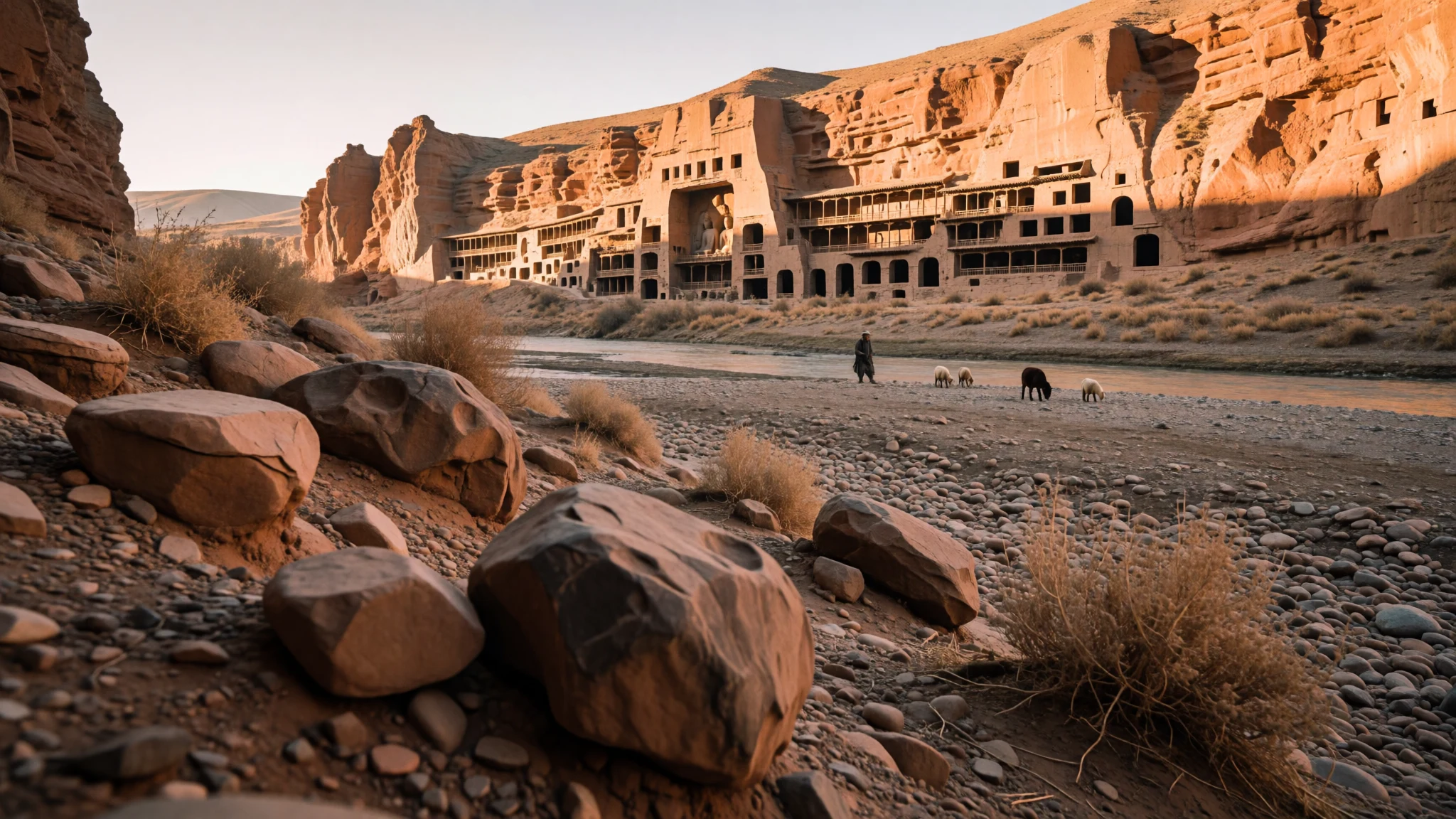
Explore the earliest major Buddhist rock-cut grottoes in China, carved into spectacular red sandstone cliffs along the ancient Silk Road.
The place
The Kizil Caves occupy a striking stretch of reddish sandstone cliffs rising above the northern bank of the Muzat River in western Xinjiang. Positioned in Baicheng County within Aksu Prefecture, this dramatic site sits away from major metropolitan density, surrounded by the vast and arid landscapes of the Taklimakan fringe. Centuries ago, this section of the river valley functioned as a crucial commercial crossroads on the northern branch of the Silk Road, funsembling travellers, merchants, monks and diplomats journeying between eastern Asia and the wider Eurasian continent. The geological setting is austere and raw; sparse vegetation clings to the dry earth beneath expansive skies, while the carved rock openings punctuate the canyon wall like dark eyes looking out over the dry riverbed. Because the surrounding terrain remains remote and lightly developed compared to coastal eastern hubs, visiting the caves involves travelling through grand, open geography defined by stark light, mountain runoff rivers and deep desert winds. The dry climate of the region has preserved mineral pigments and organic materials inside the grottoes far better than would be possible in humid environments, creating a rare window into an ancient architectural and artistic heritage that once anchored oasis civilization along the northern Tarim Basin.
Its story
The Kizil Caves represent a monumental chapter in the transmission of Buddhism along the Silk Road, serving as the earliest major cave complex of its kind in China. Developed across multiple centuries, construction and artistry flourished during a lengthy window between the third and eighth centuries. During this era, caravans and religious pilgrims traversed the northern and southern routes around the Taklimakan Desert, exchanging spiritual doctrines alongside silk, jade, spices and glassware. The architectural model pioneered at Kizil—featuring distinct central pillar layouts designed for devotional circumambulation—subsequently served as a blueprint for later Buddhist cave complexes built further east across China. Artists and craftsmen working within these walls blended artistic idioms from Gandhara, Persia, India and native Central Asian traditions, illustrating Jataka tales and Buddhist sutras with mineral pigments, including prized lapis lazuli and crushed malachite. As regional trade routes shifted and religious demographics evolved over subsequent dynasties, the active monastic community gradually dwindled, leaving the grottoes abandoned to the desert winds and passing caravans. In the modern era, the historical significance of the site was officially recognised when it was inscribed on the UNESCO World Heritage List as part of the transnational Silk Roads corridor network, drawing researchers and curious travellers eager to study its surviving murals and subterranean architecture.
What to see
- Central Pillar Caves
Walk through the architectural hallmark of the site, where a massive rectangular column of rock stands in the middle of the shrine room. Devotees would walk around this central core to complete ritual circumambulation while viewing faded murals along the curved walls and side corridors. - Muzat River Valley Overlook
Gaze out from the elevated cliff walkways across the broad, stony bed of the Muzat River and the surrounding arid basin. This vantage point reveals the same expansive desert horizon that ancient merchants and wandering monks looked upon as they approached the oasis. - Baicheng County Oasis Settlements
Experience rural life in the farming communities near the caves, where local canals feed orchards and fields of grain against a backdrop of dust-hued hills. It provides a quiet glimpse into traditional agrarian rhythms in western Xinjiang. - Kucha Regional Crossroads
Explore the nearby historic town of Kucha, situated sixty-five kilometres east of the caves. Once a powerful Buddhist city-state on the Silk Road, it preserves bustling local markets and historical connections to the wider Tarim Basin trade network.
Culture
The cultural fabric of the Aksu Prefecture and broader Xinjiang is deeply rooted in traditions shared with Central Asia and the Turkic world. The Uyghur population, a sedentary Turkic ethnic group, maintains a rich heritage expressed through intricate musical modes, community gatherings and vibrant folk dance. Throughout towns and villages, public squares frequently come alive with traditional dancing during festive occasions, weddings and religious holidays such as Eid. Visitors will often find that locals are warm, hospitable and eager to share tea or invite bystanders into celebratory circles. In the wider region, diverse minority groups—including ethnic Kazakh and Kyrgyz herders who frequent pastures between towns—preserve nomadic customs, handicrafts and traditional equestrian skills. Respect local sensitivities by dressing modestly, asking permission before photographing residents at close range, and remaining mindful of the heightened security infrastructure present across public spaces in the region. Always remove your sunglasses and maintain a respectful, quiet demeanour when entering preserved heritage zones or sacred spaces.
What to wear
Traditional Uyghur dress reflects centuries of practical adaptation to continental extremes and vibrant artistic expression. Men often wear embroidered four-panel caps known as duppa alongside long, striped cotton coats called chapan, while women traditionally wear colourful silk dresses over trousers, complemented by delicate headscarves and silver jewellery. In daily life across contemporary Xinjiang cities and towns, most residents dress in practical modern clothing, blending casual Western styles with regional garments. For visitors exploring the dusty trails around the caves and regional towns, sensible clothing is essential. Wear lightweight, breathable layers that protect against intense sun and dry dust, accompanied by sturdy walking shoes suitable for uneven sandstone paths and dry river terrain. Modest attire—covering shoulders and knees—is strongly advised out of respect for local cultural norms and when visiting religious or traditional community spaces.
What to eat
- Kǎo bāozi — Street-side clay ovens and local markets
A savoury cousin of the samosa, these small parcels are stuffed with minced lamb and onions, then baked inside a wood-fired clay tannur until the crust is crisp and golden. Find them at street-side stalls and bakery windows across every local town. - Chuànr — Night markets and roadside charcoal grills
Tender pieces of mutton threaded onto metal skewers, heavily dusted with cumin and red chilli flakes, and grilled over hot coals. They are the quintessential street food of the region, perfuming evening air in town squares and night markets. - Náng — Bakers and street corners in every town
Staple flatbread baked in round discs inside clay ovens, stamped with patterns in the centre. Some varieties are plain, while others are enriched with onions or spring onions. Tear off pieces to accompany stews or eat them warm on the go. - Xinjiang Yoghurt — Local dairy stalls and traditional tea houses
Thick, tart, and traditionally served in bowls or clay pots, often drizzled with local honey or grape molasses. It offers a refreshing, cooling contrast to rich, spiced meat dishes. - Oasis Watermelon — Roadside fruit carts and town markets
Renowned throughout China for their exceptional sweetness and juiciness, these small, round watermelons are harvested locally in the arid basin. Vendors slice them fresh at roadside stalls on almost every street corner.
Plan it
Best time. Spring (March to April) and autumn (September to November) offer the most pleasant weather, avoiding the scorching summer heat and freezing winter temperatures of the desert basin.
How long. 2–3
Getting there. Fly into Urumqi Diwopu International Airport, then take a domestic flight or train onward to Kucha, followed by a local vehicle journey west along the Muzat River valley to the caves.
Budget. mid
Tips
- Check official site guidelines and ticketing rules before setting out
- Carry cash for small vendors, market purchases, and rural transport
- Bring plenty of drinking water and sun protection for arid desert excursions
- Keep your passport and travel documents readily accessible for security checkpoints
- Wear comfortable footwear suitable for sandy paths and uneven stone stairs
Etiquette
- Dress modestly with covered shoulders and knees out of respect for local norms
- Always ask permission before photographing local residents or security personnel
- Observe all rules regarding flash photography bans inside ancient cave grottoes
Nearby
Sources
- Wikidata Q1234019 (CC0)
- Wikipedia (rev 1382804261) (CC BY-SA 4.0)
- Wikivoyage (rev 5394920) (CC BY-SA 4.0)
- Photo 01-kizil-caves-2006-10-01.jpg (CC BY 3.0)
- Photo 03-kizil-caves-overview.jpg (Public domain)

