Igel Column
Igel Column, Germany
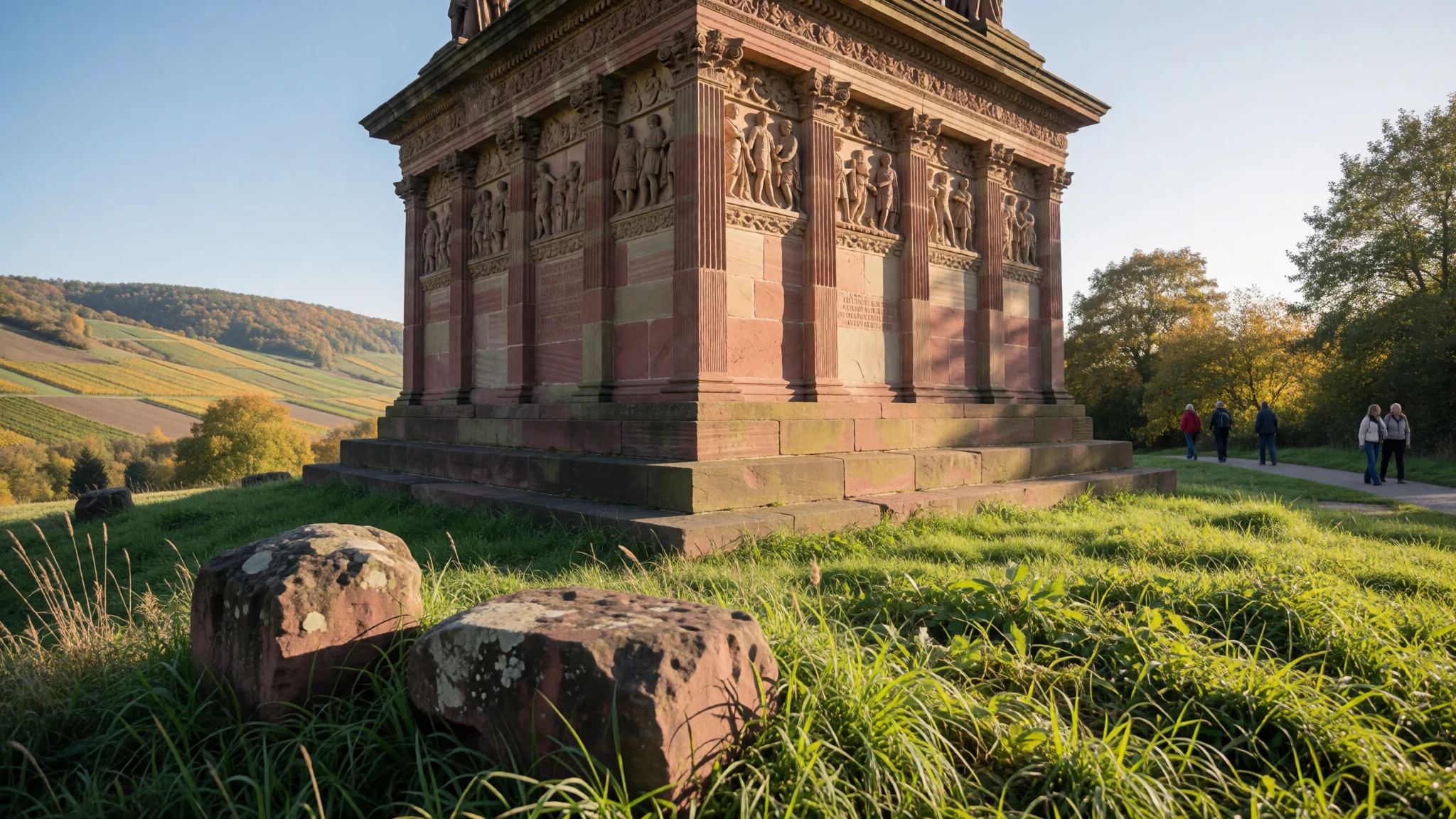
Marvel at the towering Igel Column, an exceptionally preserved Roman funerary monument displaying exquisite classical masonry and ancient merchant reliefs.
The place
The Igel Column stands in the municipality of Igel near Trier, Germany, as an extraordinary survival of provincial Roman architecture. Rising above a four-stepped base and a compact podium, this multi-storeyed monument features flat Corinthian pilasters, detailed decorative shafts, and an ornate architrave carrying a heavy cornice. Sculpted friezes adorn the sandstone blocks, depicting intricate scenes of daily life, agricultural tribute, and mythological figures, all crowned by a sculptural group representing Jupiter and Ganymede. Originally crafted from red and red-grey sandstone with polychrome painted highlights, the column reflects the classical aesthetic adapted by affluent provincial communities near the Moselle river. Its survival offers rare insight into the region's historic landscape during antiquity, capturing the ambition of local magnates who chose to celebrate their commercial achievements in stone rather than transient materials. Visitors arriving in the municipality find the landmark positioned along the local street network, where modern village life brushes directly against centuries-old stonework. The surrounding countryside features rolling green hills, vineyard terraces lining the river valleys, and quiet rural lanes that invite unhurried exploration on foot or bicycle. While the monument itself can be viewed directly from the street, weather conditions shift across the river valley throughout the year, bringing bright summer warmth and crisp autumn air that alters the appearance of the red stone under changing light.
Its story
Commissioned during the mid-third century around the year two hundred and fifty, the Igel Column served as the final resting place and dynastic marker for the Secundinii family. The monument was erected through the efforts of two family members, Lucius Secundinius Aventinus and Lucius Secundinus Securus, who had amassed significant wealth through the textile trade. Rather than building a conventional subterranean vault with a simple marker, these merchant brothers invested in an ambitious architectural statement designed to broadcast their commercial success and civic integration within the Roman provincial administration. The carved reliefs tell the story of their enterprise through realistic depictions of estate management and commerce. Among the sculpted panels, a procession of six estate workers or coloni approach the master's household bearing various tributes and donations. Carved into the stone are offerings of a rooster, a basket of fruit, and a hare, two fish, a kid, and an eel, which show the diverse harvest from the family's vast farmlands. Over subsequent centuries, as the Roman administration receded and medieval settlements grew along the Moselle, the monument remained an enduring landmark, drawing the attention of antiquarians, cartographers, and artists who documented its fading paint and weathering reliefs in drawings and early copperplate engravings. Its formal inclusion in the modern era as a UNESCO World Heritage component secured its preservation, linking the rural municipality of Igel permanently to the broader historical narrative of Roman Trier.
What to see
- Speyer Cathedral — Speyer
Discover this monumental Romanesque basilica featuring vast vaulted crypts and centuries of imperial history along the Rhine valley corridor. The foundation stone was laid in the early eleventh century, establishing a massive footprint that remains an architectural anchor for the region. - Castle Trifels — Landau in der Pfalz
Explore the historic hill fortress where medieval English royalty was once held captive and imperial regalia were safely stored. Perched above the forest canopy, the site provides sweeping views across the sandstone crags of the southern Palatinate landscape. - Burg Eltz — Treis-Karden
Wander through a remarkably intact medieval castle that has remained in the possession of the same noble family for centuries. Tucked away in a secluded side valley, its timber-framed gables and stone towers rise dramatically above the surrounding forest stream. - Rheinfels Fortress — St. Goar
Wander among the sprawling stone ruins of a once-mighty stronghold that commanded the strategic middle Rhine river trade routes. Visitors can explore deep underground tunnels, vaulted defensive chambers, and high stone ramparts overlooking the valley below.
Culture
The cultural fabric of the Rhineland-Palatinate region is deeply rooted in agricultural traditions, winemaking heritage, and community festivals that mark the changing seasons. Local customs celebrate the harvest through autumn wine fairs, seasonal markets, and historic village gatherings where regional dialects and traditional hospitality take center stage. Visitors interacting with local residents will find an open, straightforward manner coupled with a strong pride in local craftsmanship, viticulture, and architectural preservation. When visiting historic churches, rural parishes, or archaeological sites across the region, maintain a respectful demeanor and keep noise levels moderate. Always check signage before entering enclosed sacred spaces or museum grounds, and respect designated barriers around fragile ancient masonry like the Igel Column.
What to wear
Traditional attire in the Rhineland-Palatinate countryside reflects historical working garments, regional woollen textiles, and festival dress historically worn during harvest celebrations and church feast days, though these are now largely reserved for heritage events and cultural parades. Modern daily dress across the region is practical, contemporary, and weather-appropriate, favouring comfortable jackets, durable denim, and sensible footwear suitable for changeable European weather. Visitors exploring the municipalities, vineyard trails, and historic monuments should pack layers including a windproof outer shell, breathable shirts, and sturdy walking shoes or boots capable of handling uneven cobblestones, forest paths, and stone staircases. Modest, casual attire is entirely appropriate for visiting local churches and historic sites, but comfortable footwear remains essential for navigating cobblestone lanes and outdoor terrain.
What to eat
- Regional Wines — Local wine taverns and vineyards across the region
Sample crisp white wines and aromatic vintages cultivated along the steep slate slopes of the Moselle, Ahr, Pfalz, and Rheinhessen river valleys. - Bitburger Beer — Traditional pubs and country inns throughout the area
Enjoy a refreshing Pilsner brewed locally in the western uplands, representing one of the most famous brewing traditions in the federal state.
Plan it
Best time. May to September offers pleasant weather for outdoor exploration, hiking, and vineyard visits, while autumn brings vibrant foliage and harvest wine festivals.
How long. 2–3
Getting there. Fly into Frankfurt Airport or Luxembourg Airport, then take regional train connections or rental transport toward Trier and the Moselle valley.
Budget. mid
Tips
- Check regional bus schedules in advance as rural transit services run less frequently on weekends
- Wear sturdy shoes for exploring uneven stone monuments and surrounding hillside walking paths
- Carry some cash for small village bakeries, farm stands, and local wine taverns
- Visit early in the morning for peaceful viewing conditions around the monument
Etiquette
- Maintain a respectful distance from ancient stonework and never touch fragile carvings
- Obey local parking and pedestrian guidelines in residential village streets
Nearby
Sources
- Wikidata Q338834 (CC0)
- Wikipedia (CC BY-SA 4.0)
- Wikivoyage (CC BY-SA 4.0)