Faroe Islands
Faroe Islands, Kingdom of Denmark
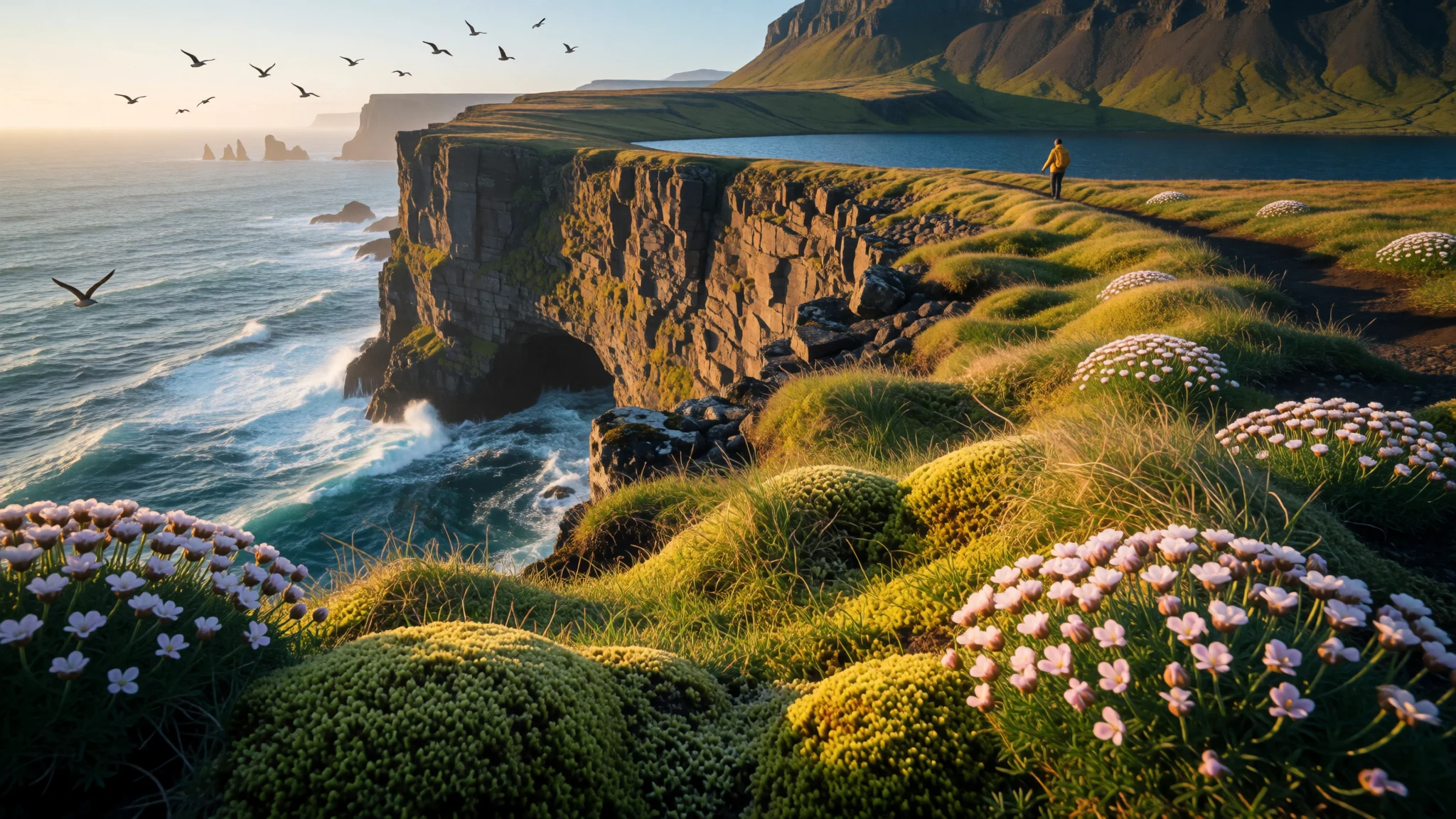
The Faroe Islands are cliffs, fjord villages and changeable sea weather, mild in temperature and hard on plans.
The place
Set in the North Atlantic between Iceland, Norway and Scotland's northern isles, the Faroe Islands are an autonomous country inside the Kingdom of Denmark. 55,466 people live across the islands, with Tórshavn as the capital. The ground is steep and bare: fjords cut the coastline, cliffs face the open sea, and trees are scarce because grazing cleared the native woods, a cooler wetter climate making that worse. Faroese is the official language. It sits close to Icelandic, and a speaker of one can often follow the other in part. Clocks follow UTC+00:00.
The climate is subpolar oceanic. The Gulf Stream takes the edge off the latitude, so the year is mild rather than arctic, and the memorable weather is rain, low cloud and wind rather than deep cold. In summer the nights do not become fully dark. Winter reverses that, and daylight shrinks to a short grey interval. Clear sun is the exception. Anyone planning photographs around blue sky should treat a bright hour as a gift, not as the normal day.
Villages sit along the fjords, small and close to the water, joined by roads, ferries and tunnels. Sheep graze the slopes above the houses. The sea is both the view and the old livelihood: fishing shaped the modern islands, and almost every settlement still faces a harbour. Tórshavn is the practical base, compact enough to walk. Beyond it the roads feel quieter, ending at a headland, a cliff path or a turf-roofed hamlet.
Its story
People were on the Faroe Islands before the Norse settlement that the sagas put first. Research set out in 2021 turned up burnt domesticated barley and peat ash from a pair of early periods, the first running from the middle of the fourth century to the middle of the sixth, the next from late in the sixth century to late in the eighth. Sheep DNA in lake mud points to the year 500. Neither the grain nor the animals could have arrived on their own. Sail among Scandinavians is reckoned from about 750, which is too late for this trace, so the work points to farmers from Scotland or Ireland rather than from Norway.
The later Norse settlement is the tale Færeyinga saga tells, with support from the Irish monk Dicuil, and it sits in the early 9th century. Grímur Kamban is recorded as the first settler who stayed. Dicuil wrote of islands north of Scotland whose character fits this archipelago. Norwegian rule came after that medieval arrival, and the islands later sat within the Kingdom of Denmark, carrying a language and a stock of poems that continental literary fashions did not replace.
The writing was what failed. Up to the 15th century, Faroese spelling had stayed near Icelandic and Norwegian. Once the Reformation was in force in 1538, officials would not allow Faroese in teaching, worship or state papers. For about 300 years the poems and stories lasted because they were spoken. The facts date the Faroe Islands, as the autonomous country they are now inside the Kingdom of Denmark, to 1948.
What to see
- Slættaratindur — Eysturoy
Slættaratindur, on Eysturoy, is the highest mountain in the Faroe Islands and rises to 880 metres. The walk crosses open hillside, and the summit is often inside cloud, so a clear view is luck as well as effort. Wind above can be fierce when the valley is only breezy. The sensible choice is to turn back if the peak stays hidden.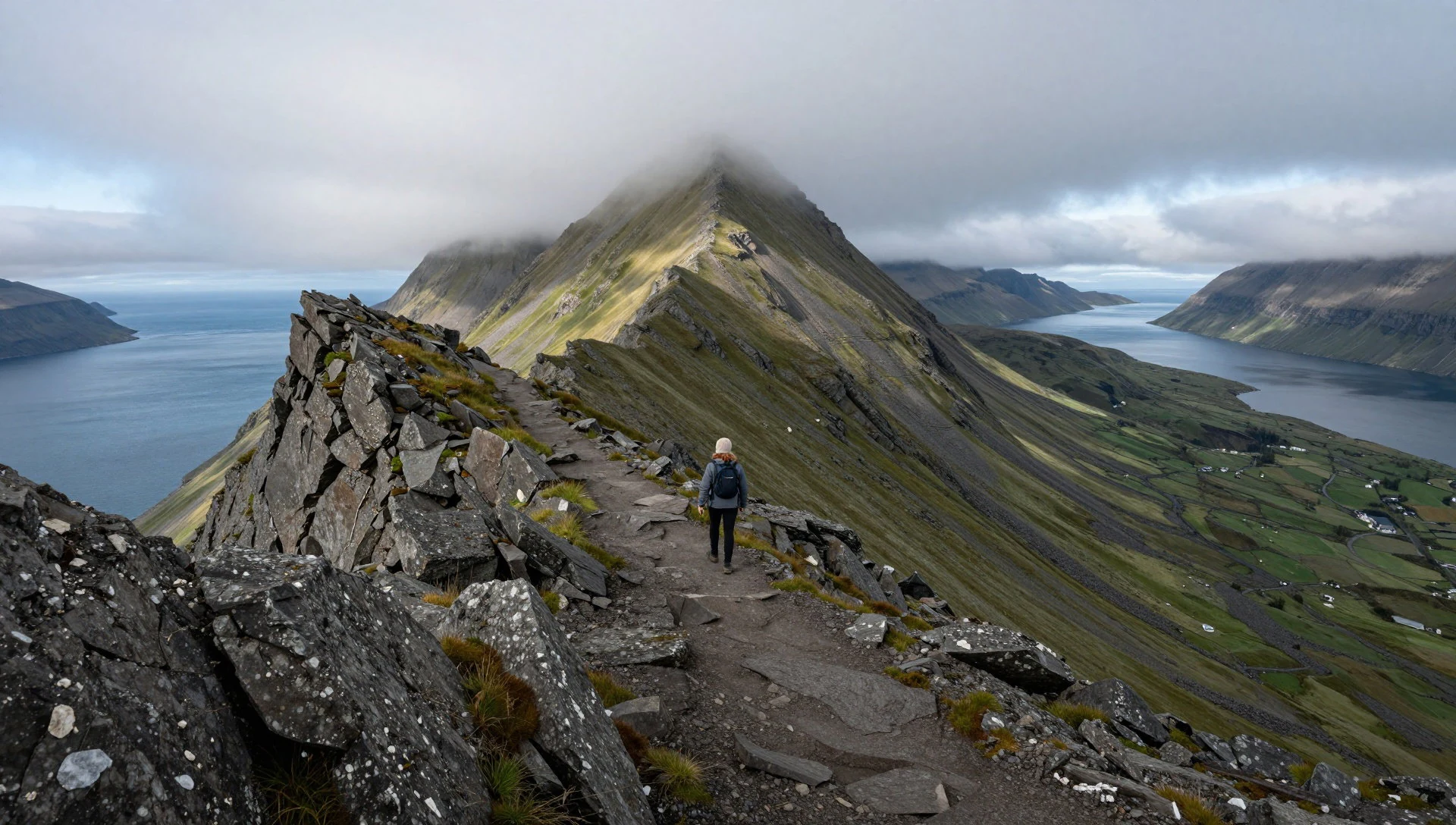
- Beinisvørð — Suðuroy
Beinisvørð is the highest sea cliff on Suðuroy and the second-highest in the Faroe Islands, at 470 metres. The old road between Lopra and Sumba reaches a high point where the grass soon stops, with no ramp and no rail. The edge finishes at once. Looking north, the west coast of Suðuroy runs on as a wall of rock.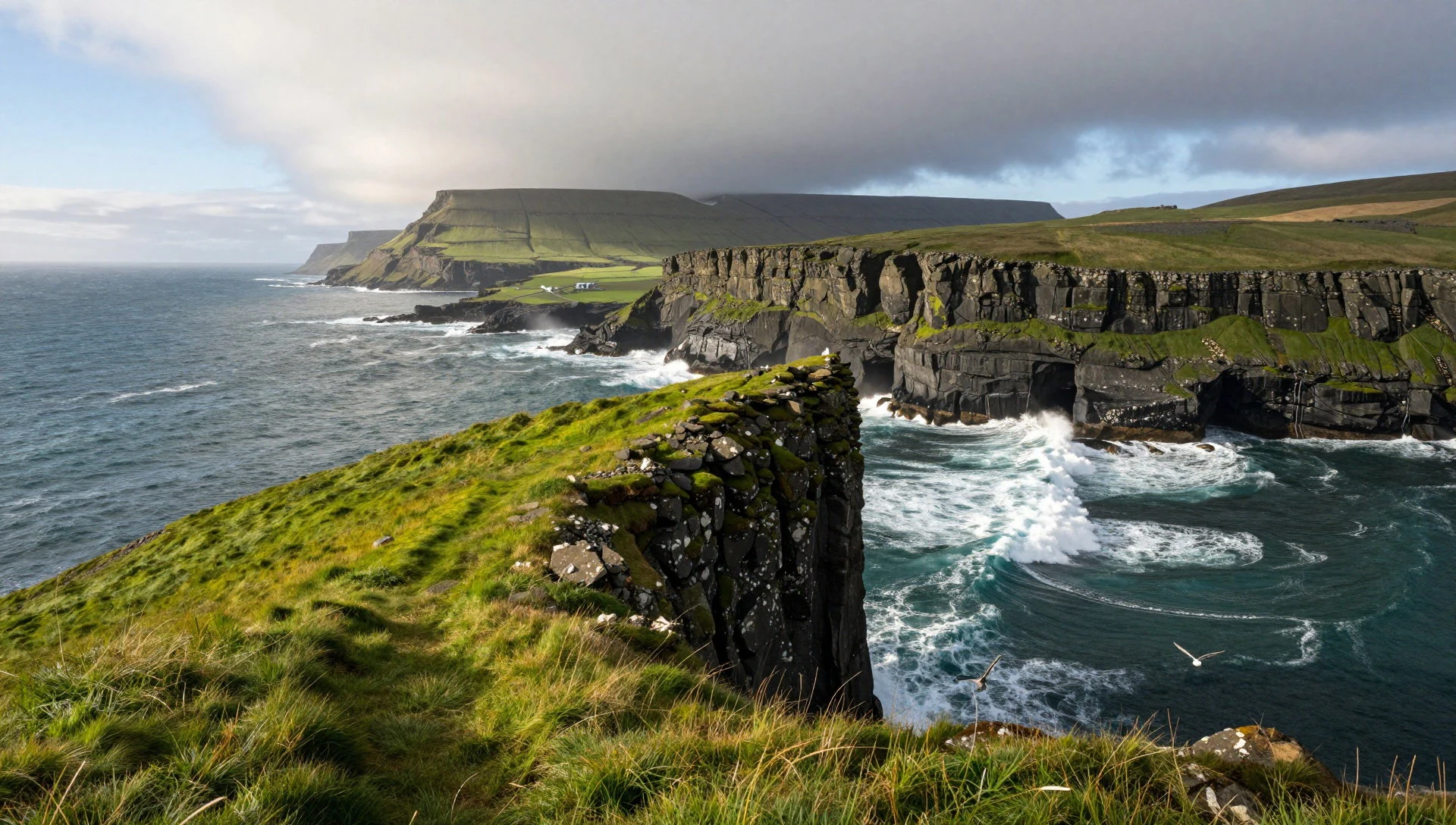
- Rinkusteinar — Oyndarfjørður, Eysturoy
Rinkusteinar, near Oyndarfjørður on Eysturoy, are large twin stones sitting just off the shore in the Faroe Islands. They shift in the water and do not come to rest. People there have known the motion for as long as memory runs. Nothing built explains it; the sea supplies the movement. Rain hides them easily.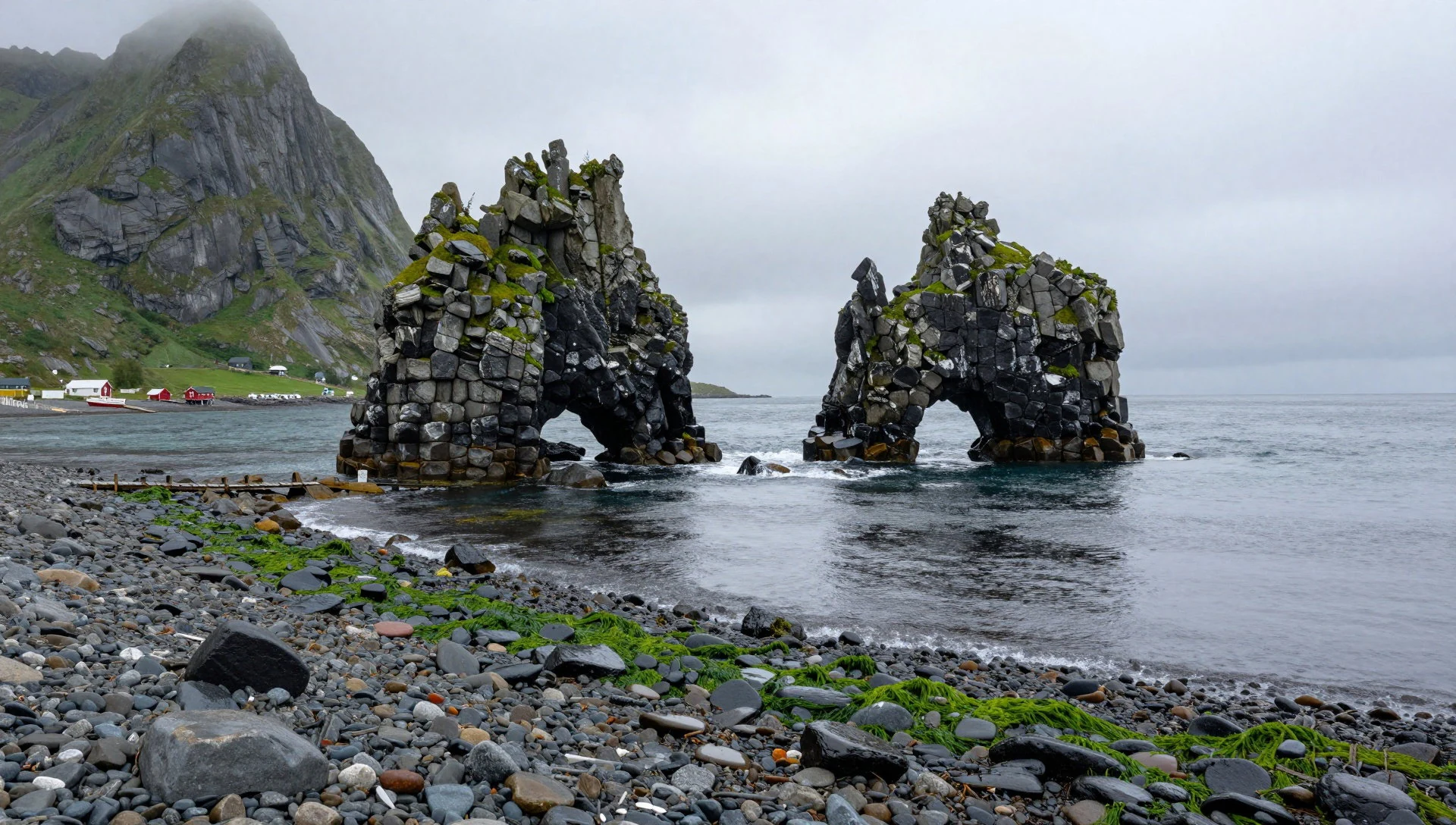
- Risin og Kellingin — Eiði, Eysturoy
Risin og Kellingin, the Giant and his Wife, are a pair of basalt sea stacks off the northern tip of Eysturoy, close to Eiði. From the headland they stand in the water like figures, which is how the name accounts for them. The rock matches the dark cliffs behind. The stacks are offshore, so the view is from the path, not from the stones themselves.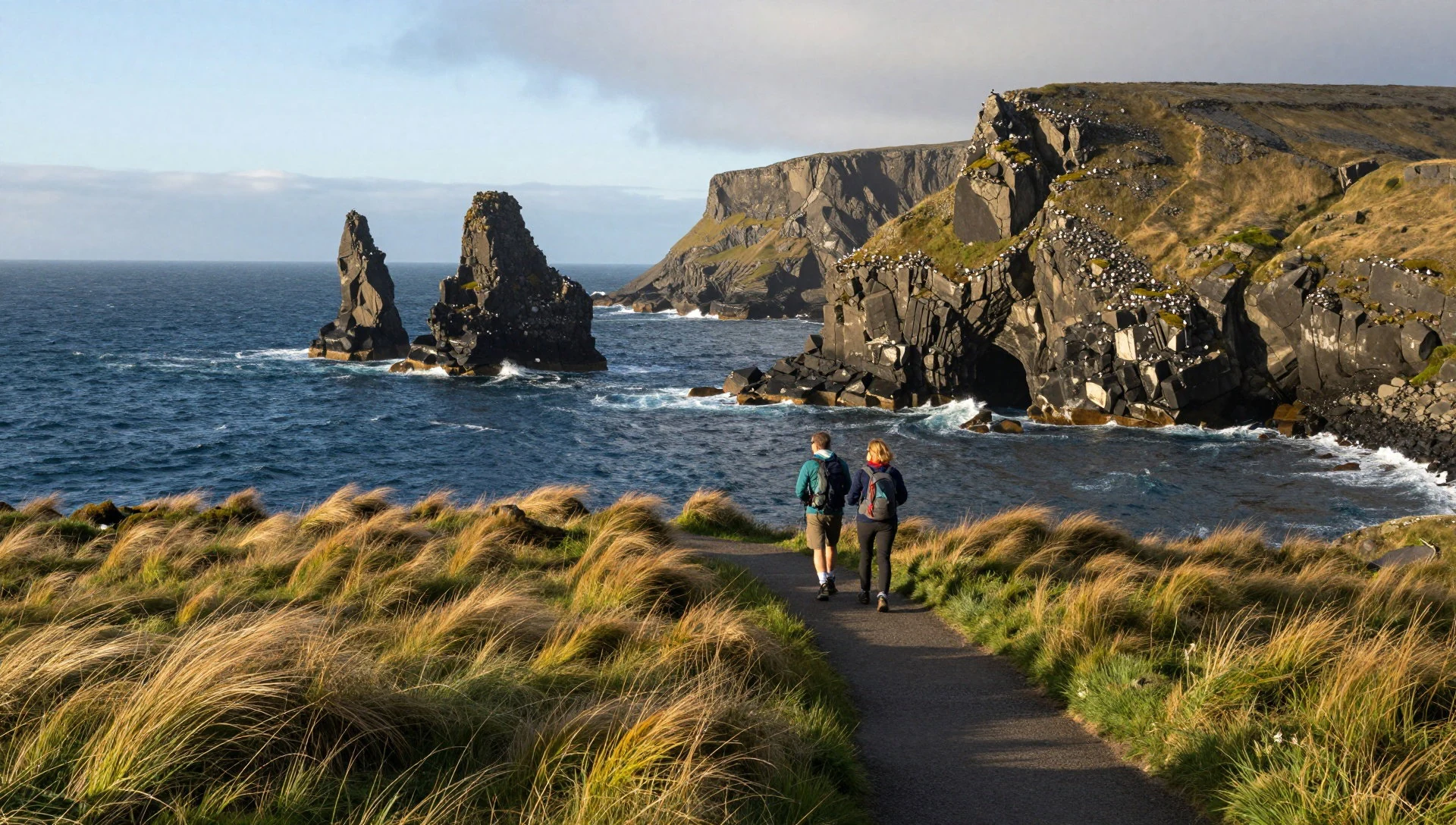
- Skipanes and Undir Gøtueiði — Skálafjørður, Eysturoy
Skipanes and Undir Gøtueiði, on Eysturoy, are villages that have grown together along Skálafjørður. From the slope above they read as a single line of houses following the fjord, roofs and harbours with little gap between them. This is ordinary life in the Faroe Islands: a road, a shore and settlements close enough to merge. Sheep and small boats share the same view.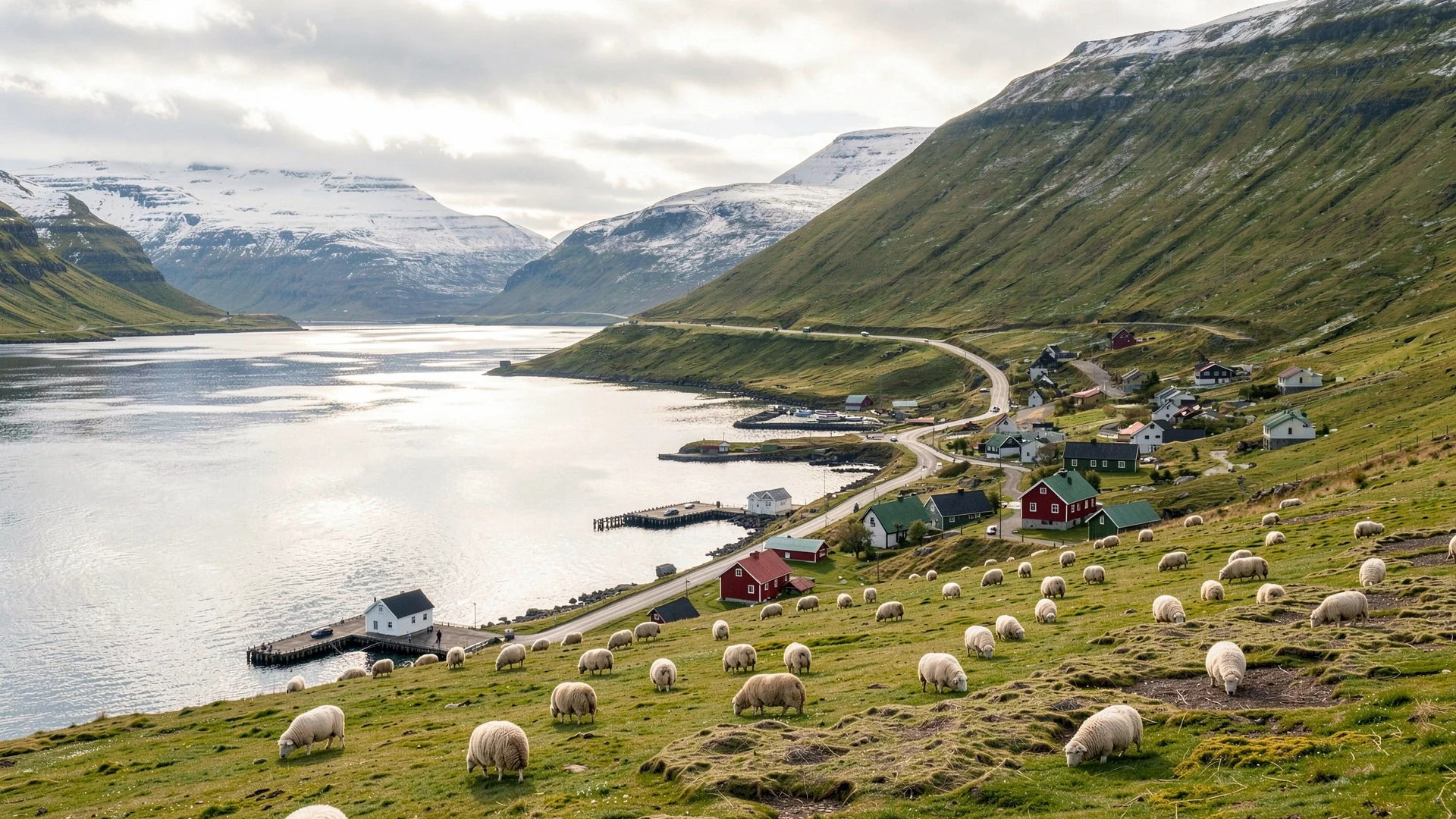
Culture
On the Faroe Islands, Faroese nearly vanished from the written page. From the Reformation year 1538, the authorities kept Faroese out of the classroom, the church service and the written business of government, and for about 300 years poems and stories passed from voice to voice. Before that break, up to the 15th century, written Faroese had sat close to Icelandic and Norwegian. The tongue is one of three island North Germanic languages grown from Old Norse, together with Icelandic and with Norn, the lost speech of the northern Scottish isles, which seems to have been mutually intelligible with Faroese. Distance from the cultural waves of mainland Europe left much of that older Nordic life standing, including the ballads people still knew by heart.
Daily links are different now. Flights join Tórshavn to Scandinavia and the continent, and Danish is widely understood beside Faroese. What remains marked is the standing of the language, the weight of the village, and the habit of treating the sea as work rather than as a view.
When you enter a Faroese home, take your shoes off at the door, and ask before you photograph anyone.
What to wear
Fashion in the Faroe Islands starts with wool. The traditional costume, worn for weddings, confirmations and festivals rather than for work, is cut from the fleece of local sheep. Women wear a long dark skirt, a fitted embroidered bodice and a shawl; men wear knee-length breeches, a waistcoat and knitted stockings that reach the knee. On an ordinary day the same wool shows up as a patterned jumper, still knitted on the islands and still useful in a wet wind.
What people wear now follows the weather more than the costume. In Tórshavn a waterproof jacket over a wool layer, with shoes that can take a wet pavement, is the real uniform. Younger clothes follow other Nordic capitals, with the practical coat never far away, because a dry morning is not a promise about the afternoon. Colour appears, but it is usually under a shell that can take spray.
A visitor should pack for that, not for a parade. The useful kit is a windproof waterproof outer layer, a warm mid-layer, trousers that still work when damp, and boots with a grip for grass slopes and cliff paths. The Gulf Stream keeps the air mild, so heavy arctic kit is less useful than clothes that survive rain. In a village church, ordinary neat dress is enough; there is no rule about covering the hair. Light shoes suit indoor floors in town; boots take over once a path turns to mud.
What to eat
- Skerpikjøt — traditional eateries in Tórshavn
Skerpikjøt is wind-dried mutton, hung in the air until it firms and ferments, then sliced thin. The Faroe Islands' old lamb dish tastes salty and strong, closer to cured meat than to a fresh roast. It is not on every menu. Try traditional eateries in Tórshavn.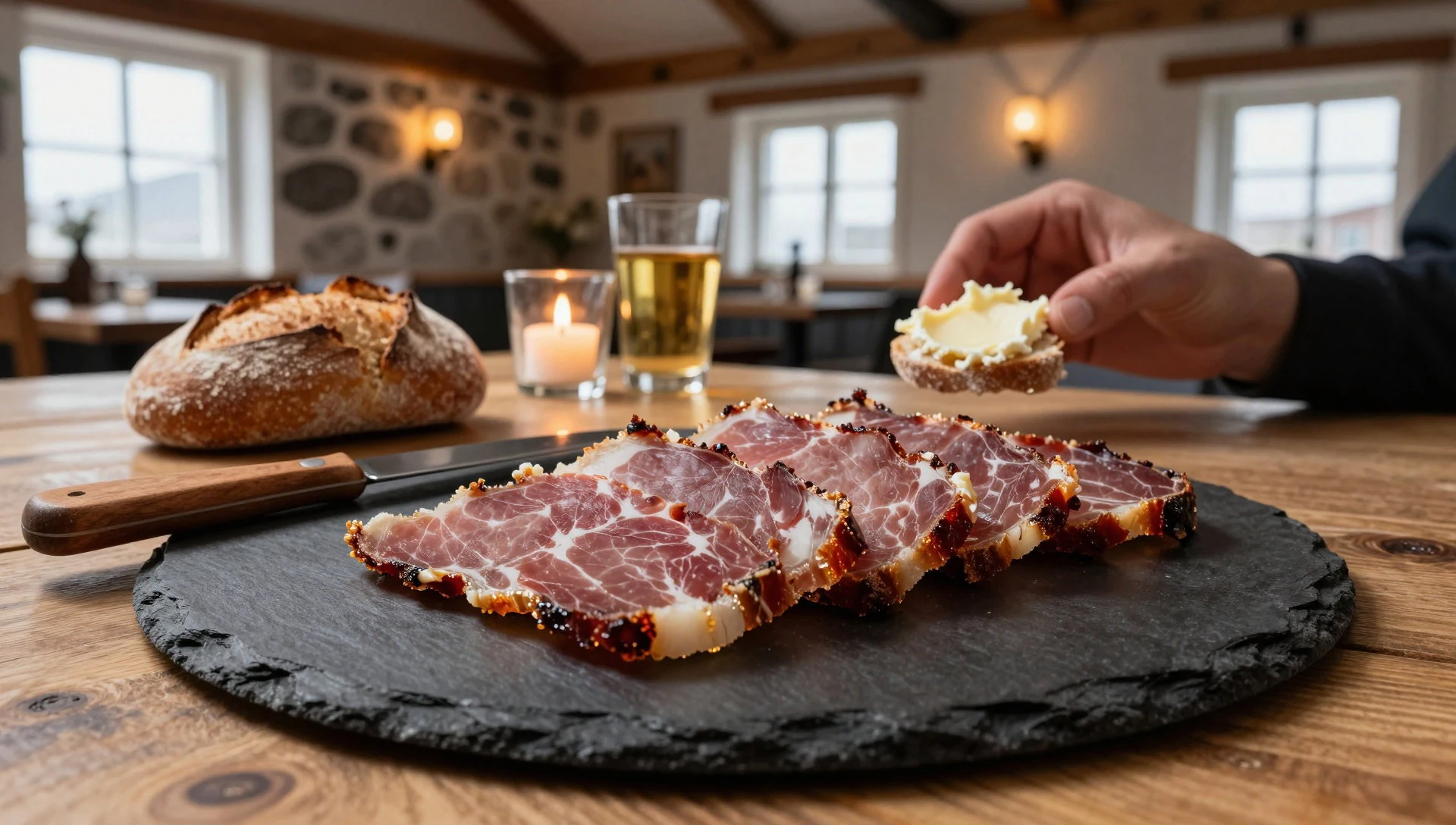
- Ræstur fiskur — Tórshavn restaurants serving Faroese cooking
Ræstur fiskur is fish, often cod or haddock, dried in the wind until it ferments. The Faroe Islands developed this method because the climate made fresh storage difficult and salt was not always the answer. The smell is forthright and the portion is usually small. It is a specialist plate.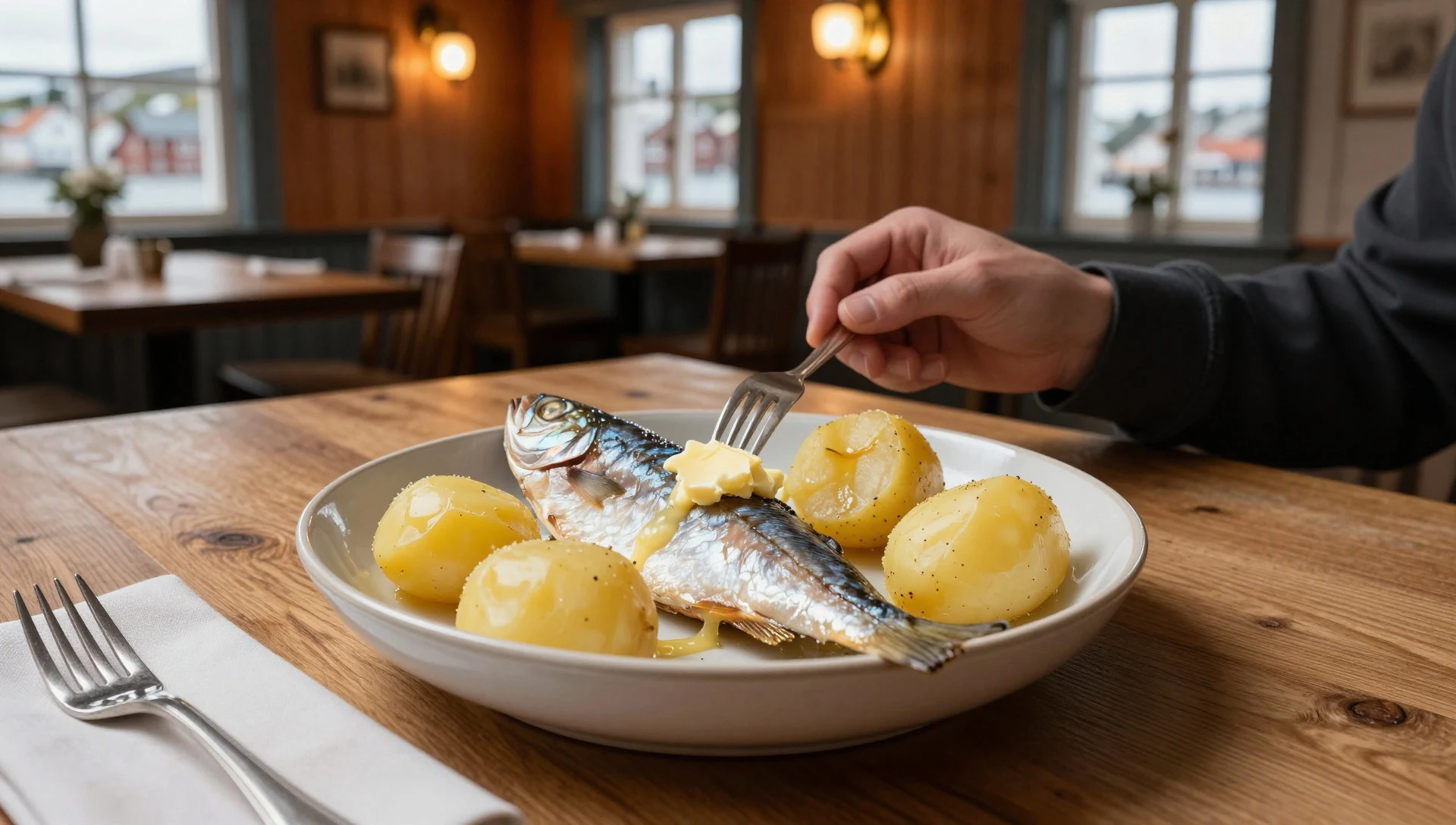
- Fresh lamb — village eateries and Tórshavn restaurants
Fresh lamb is the everyday face of the same sheep tradition that produces skerpikjøt. In the Faroe Islands the sheep graze open slopes, and the meat is served roasted or stewed more often than it is dried. It is the easier dish to like on a first night. - North Atlantic fish — harbour-side eateries and restaurants in Tórshavn
Fish is the other pillar of cooking in the Faroe Islands, and a dish a visitor is likely to be offered. Cod, haddock and their neighbours arrive simply cooked: grilled, baked or set in a soup, with the catch doing more work than the sauce. - Wild seabirds — Tórshavn eateries cooking traditional Faroese food
Wild seabirds, puffins among them, are an older food in the Faroe Islands, taken from cliffs rather than from farms. They are not a standard café dish, and many kitchens never serve them. If they appear, it is usually a traditional course at a Tórshavn eatery cooking Faroese food.
Plan it
Best time. June to September is a practical time to visit the Faroe Islands, because daylight runs late. The climate is subpolar oceanic, and the Gulf Stream keeps temperatures gentle in every season, but winter days are very short and summer nights stay in twilight instead of real dark.
How long. four to six
Getting there. The Faroe Islands lie outside the European Union and the Schengen Area, though they belong to the Kingdom of Denmark. Atlantic Airways, the national carrier, flies from Scandinavia and continental Europe to the islands' airport, and the last stretch into Tórshavn is by road. Visitors who do not need a visa for Denmark can generally stay 90 days if the passport is valid for 3 months after departure. A Schengen visa for mainland Denmark does not cover the islands. Carry a passport even if an identity card would do for Denmark, because a flight can be diverted to Scotland.
Budget. high
Tips
- Keep your passport to hand even if an identity card would do for Denmark, in case the flight is diverted to Scotland.
- Expect cloud on high summits; Slættaratindur is often hidden.
- Stay back from sea cliffs such as Beinisvørð, where grass and the drop meet.
- Book Atlantic Airways early for summer, when the long days draw more people.
- Ask which eateries serve Faroese dishes; many menus never list them.
Etiquette
- Take your shoes off when you enter a home.
- Ask before you photograph people.
- Do not step out to a cliff edge for a photograph.
- Let sheep on the road move in their own time.
Nearby
Sources
- Wikidata Q4628 (CC0)
- Wikipedia (CC BY-SA 4.0)
- Wikivoyage (CC BY-SA 4.0)
- Faroe Islands by Sentinel-2 (CC BY-SA 3.0 igo)
- Faroese stamp, Everyday life in the Viking Age (Public domain)
- The Faroe Islands as seen by Yves de Kerguelen Trémarec (Public domain)
- Engelske tropper ankommer til Thorshavn (Public domain)
- Skipanes and Undir Gøtueiði (CC BY 3.0)
- Puffins on Mykines (CC BY 3.0)
- Faroese sheep, Sumba (CC BY-SA 4.0)
- West coast of Suðuroy, Beinisvørð (CC BY-SA 2.5)


