Darwin
Darwin, Australia
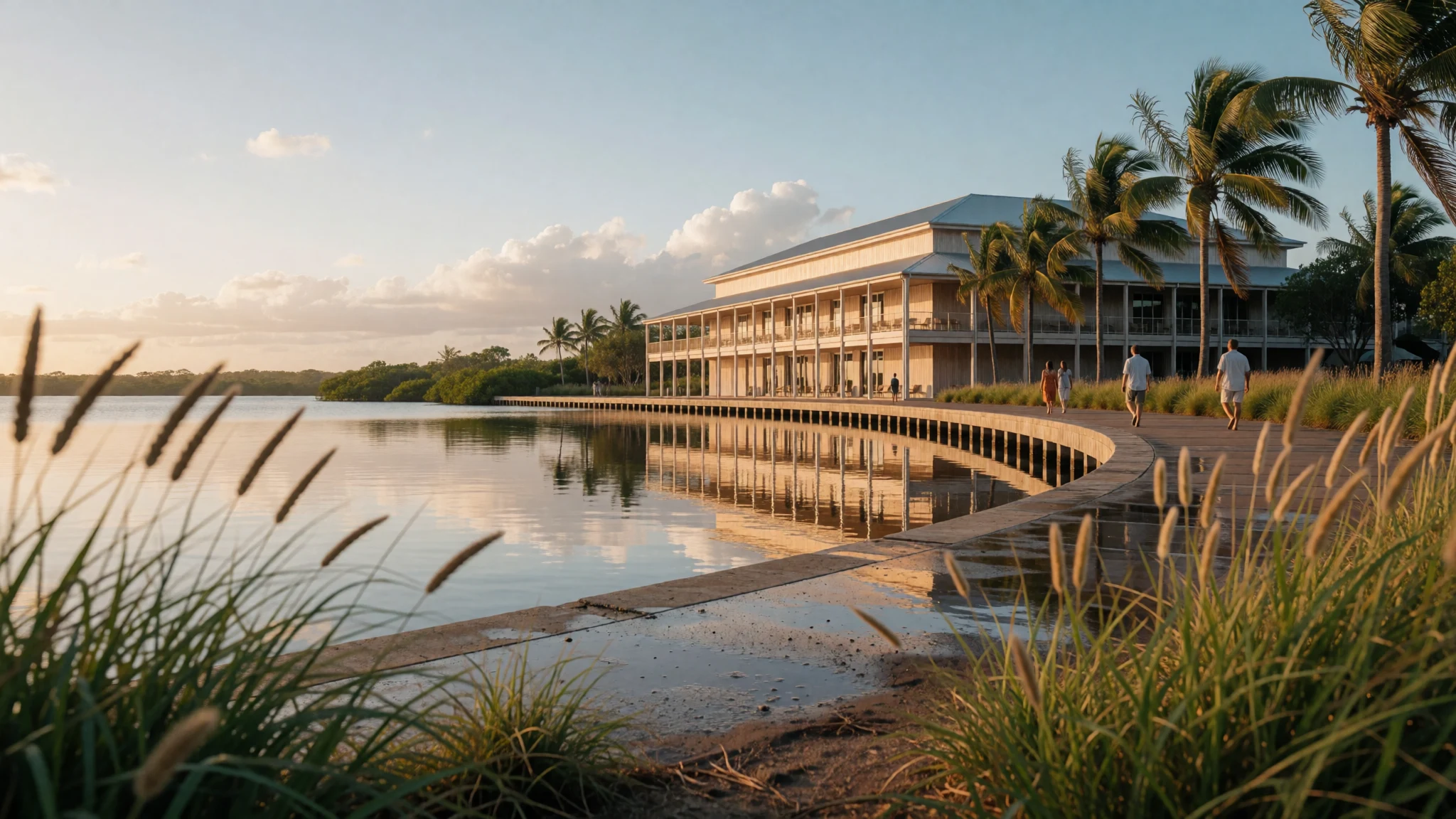
Darwin is Australia's tropical northern gateway: a relaxed harbour city of sunset markets, deep Larrakia roots, wartime history and easy access to Top End wilderness.
The place
Darwin sits on a low bluff above its harbour on the Top End coast of Australia, nearer to Indonesia and Timor-Leste than to most Australian cities. About 122,000 people live in the city, and it serves as the regional centre for the northern part of the Northern Territory, with the hospitals, airline links and government offices that role brings. The Stuart Highway starts here and runs south across the continent through Tennant Creek and Alice Springs, so Darwin marks the northern end of the country's great overland road. Suburbs spread north towards Lee Point and east to Berrimah, and the satellite city of Palmerston follows the highway beyond them. The climate has two seasons rather than four. The dry season is sunny and comfortable by tropical standards. The wet brings monsoon downpours, dramatic lightning and a higher risk of cyclones. In the weeks before the rains, locals talk about 'the build-up', when heat and humidity climb day after day and tempers shorten. The city itself is low-rise and shaped by its weather: verandahs, ceiling fans, open-air evening markets and long dinners outdoors. Its Larrakia name is Garramilla. Many travellers use Darwin as a base for national parks and Arnhem Land, but it rewards a couple of days of its own, with the waterfront, museums, markets and harbour sunsets.
Its story
Darwin stands on the country of the Larrakia people, who are its traditional custodians and earliest known inhabitants. Their name for the place, Garramilla, means 'white stone' and refers to the pale rock and sea cliffs around the harbour. Larrakia networks stretched far beyond the coast. Trade routes linked the area with Southeast Asia, including contact with Macassan visitors, and goods travelled across the continent along established songlines, which carried stories and histories as well as objects. Dutch ships explored the northern coast in the seventeenth century and produced the first European maps of the region, which is why names such as Arnhem Land and Groote Eylandt are Dutch. At one stage the Dutch used 'Van Diemen's Land' for this northern coast, a name later attached to Tasmania. Lieutenant John Lort Stokes of HMS Beagle was likely the first British person to spot the harbour, and subsequent survey teams from vessels like HMS Myrmidon mapped the inlets. A European settlement was founded here in 1869. The town that followed was isolated, tropical and repeatedly tested. Japanese air raids in the Second World War struck the wharf, and Cyclone Tracy later devastated the city. Much of present-day Darwin is therefore a rebuilt place, and its museums and historic sites are careful about telling those chapters.
What to see
- Darwin Wharf Precinct — Harbour edge, city centre
The wharf was a target during the Japanese air raids of the Second World War, and many service personnel and waterside workers died here. Several historic structures survive, and a slow walk with the interpretive signs gives a clear sense of how exposed the harbour was. It is also a pleasant spot at the end of the day. - Fannie Bay Gaol — Fannie Bay, north of the centre
Darwin's main prison for almost a century, now a museum. Two maximum-security wings were added in the mid-twentieth century, and the gallows remain as a reminder of the executions carried out until the early 1950s. The site is sobering but well interpreted, and it shows the harshness of life in the early territory. - Burnett House — Myilly Point
This house was designed by the architect B.C.G. Burnett to suit the Top End climate. Lightweight materials, raised floors and natural ventilation keep it cooler than a conventional house. It is a useful lesson in tropical design and an easy stop on a walk through the leafy residential streets of Myilly Point. - Browns Mart — Smith Street, city centre
Browns Mart is a stone building that opened in the nineteenth century as a trading store called Solomon's Emporium. Its thick walls survived when many timber buildings did not. It is now a small piece of early Darwin among newer buildings, and a good prompt for wondering what the frontier town looked like. - Museum and Art Gallery of the Northern Territory (MAGNT) — Fannie Bay
MAGNT gives a broad overview of the region's history, with displays on Cyclone Tracy and on the boats of the Pacific Islands. It also runs the annual Telstra National Aboriginal and Torres Strait Islander Art Award, so Indigenous art features strongly. It suits a hot or wet afternoon, being air-conditioned and unhurried.
Culture
Darwin has a cultural life that is bigger than its size suggests, shaped by Larrakia heritage, Southeast Asian links and a population that has arrived from many places. The Darwin Symphony Orchestra was assembled in 1989 and performs throughout the Territory, and the Darwin Theatre Company is a locally run professional company that tours at home and nationally. The Darwin Entertainment Centre is the main concert venue for theatre and orchestral work, and the Darwin Convention Centre, part of the wider waterfront redevelopment, also hosts events. Indigenous art is central to the city's cultural identity. The Museum and Art Gallery of the Northern Territory shows work from across the Territory, and its annual national Aboriginal and Torres Strait Islander art award draws artists from many communities. Markets are the everyday social calendar: stalls selling food from across Asia, coffee, crafts and music, usually in the cooler evenings or on dry-season weekends. Public life is informal, with shorts and sandals acceptable in most places, and the weather dictates plans, so outdoor events cluster in the dry season. Darwin is also a place where history is spoken of openly, from Larrakia custodianship to wartime bombing and cyclone recovery. Visitors who ask questions and listen will usually get friendly, knowledgeable answers. When looking at Indigenous art or visiting cultural sites, ask before photographing people or artworks, and follow any signs or guidance about restricted places.
What to wear
Darwin's traditional dress belongs first to the Larrakia and other Aboriginal and Torres Strait Islander peoples of the Top End. Ceremonial dress traditionally used body paint, feathers and plant fibres, and everyday items such as baskets and mats were woven from materials like pandanus. Such pieces are worn or shown at ceremony, and meanings differ between communities, so they are not costume. Printed fabrics from the nearby Tiwi Islands, bold with ochre-toned and geometric patterns, are a well-known contemporary textile tradition. What people wear in Darwin now is shaped almost entirely by heat and humidity. Expect light cotton and linen shirts, short sleeves, shorts, sundresses, flip-flops and sandals. Work dress is relaxed, and a short-sleeved collared shirt often counts as smart. Hats and sunglasses are part of the daily outfit. In the wet season, locals carry a light rain jacket or an umbrella, and clothes dry quickly. Visitors should pack breathable, loose, quick-drying clothing, a wide-brimmed hat and strong sun protection, since the tropical sun burns fast even on cloudy days. Closed, grippy shoes are better than sandals for bush tracks and rocky shorelines, and insect repellent helps at dusk. No special dress is needed in the city, but covering shoulders and knees is polite when visiting Indigenous communities or when invited to cultural events. Bring one slightly smarter outfit for restaurants or theatre evenings.
What to eat
- Laksa — Parap Markets, Saturday mornings in the dry season
A coconut-based noodle soup with prawns or chicken, lime and chilli, reflecting the city's Southeast Asian links. Market stalls are the traditional place to try it, with a strong coffee afterwards. It is rich and spicy, so it suits a morning start. - Barramundi — Waterfront and harbour-side eateries
Barramundi is the Top End's signature fish, with firm white flesh and a mild flavour. It is served grilled, pan-fried or battered with chips and salad, often with a harbour view. Ask whether it is wild-caught or farmed if that matters to you. - Thai, Malaysian and Indian curries — Restaurants around Mitchell Street and the city centre
Darwin's food scene leans towards Asian and South Asian cooking, using local ingredients where possible. Curries, stir-fries and noodle dishes are easy to find in the central streets, and many places can adjust the spice level. - Pub-style meals — Mitchell Street pubs and bars
Burgers, steaks, fish and chips and salads are served in lively pubs, often with live music. The portions are generous and the atmosphere is casual, which makes it a good option after a long day outdoors or a hot afternoon. - Chinese banquet dishes — Chinese restaurants in the city centre
Chinese cooking has a long history in the Territory, and city restaurants serve sizzling plates, steamed fish, dumplings and set-menu feasts. Groups can share several dishes, and many restaurants have a bar and wine list as well.
Plan it
Best time. May to September is the dry season, with sunny days, lower humidity and the most comfortable sightseeing weather. From about October the build-up brings heat and humidity, and the wet season from late November to early December onwards brings heavy monsoon rain, storms and a higher cyclone risk.
How long. 2–3
Getting there. Darwin International Airport lies in the northern suburbs. An airport shuttle bus meets flights, taxis are available, and limited public buses run between the airport and the city. By road, the Stuart Highway runs north from Alice Springs; check conditions before long drives.
Budget. mid
Tips
- Visit in the dry season for outdoor markets, waterfront evenings and day trips
- Carry water, a hat and sunscreen, and plan outdoor walks for early morning or late afternoon
- Check cyclone and weather warnings before travelling in the wet season
- Book national park tours and rental cars ahead in the dry season, when demand is high
- Take insect repellent for dusk and for any time near water
Etiquette
- Ask before photographing people, art or sacred places, especially in Indigenous communities
- Respect signs about restricted areas and cultural sites, and do not enter without permission
- Never swim in tropical waters unless signs say it is safe, since crocodiles and marine stingers are real hazards
Nearby
Sources
- Wikidata Q11568 (CC0)
- Wikipedia — Darwin, Northern Territory (rev 1384258975) (CC BY-SA 4.0)
- Wikivoyage — Darwin (rev 5424941) (CC BY-SA 4.0)
- Photo: 00_2474 Darwin (Northern Territory, Australien) — W. Bulach (CC BY-SA 4.0)
- Photo: Darwin, Northern Territory, AU — Hagai Agmon-Snir (CC BY-SA 4.0)
- Photo: Darwin Waterfront — eGuide Travel (CC BY 2.5)
- Photo: Aerial view of the Darwin Convention Centre — eGuide Travel (CC BY 2.5)
- Photo: Northern Territory Legislative Assembly, Darwin, 2021 — Kgbo (CC BY-SA 4.0)
- Photo: Government House, Darwin — Ken Hodge (CC BY 2.5)
- Photo: Admiralty Chart No 18, Port Darwin — United Kingdom Hydrographic Office (Public domain)
- Photo: Port Darwin — Walter Spinks (Public domain)


