Chongqing
Chongqing, People's Republic of China
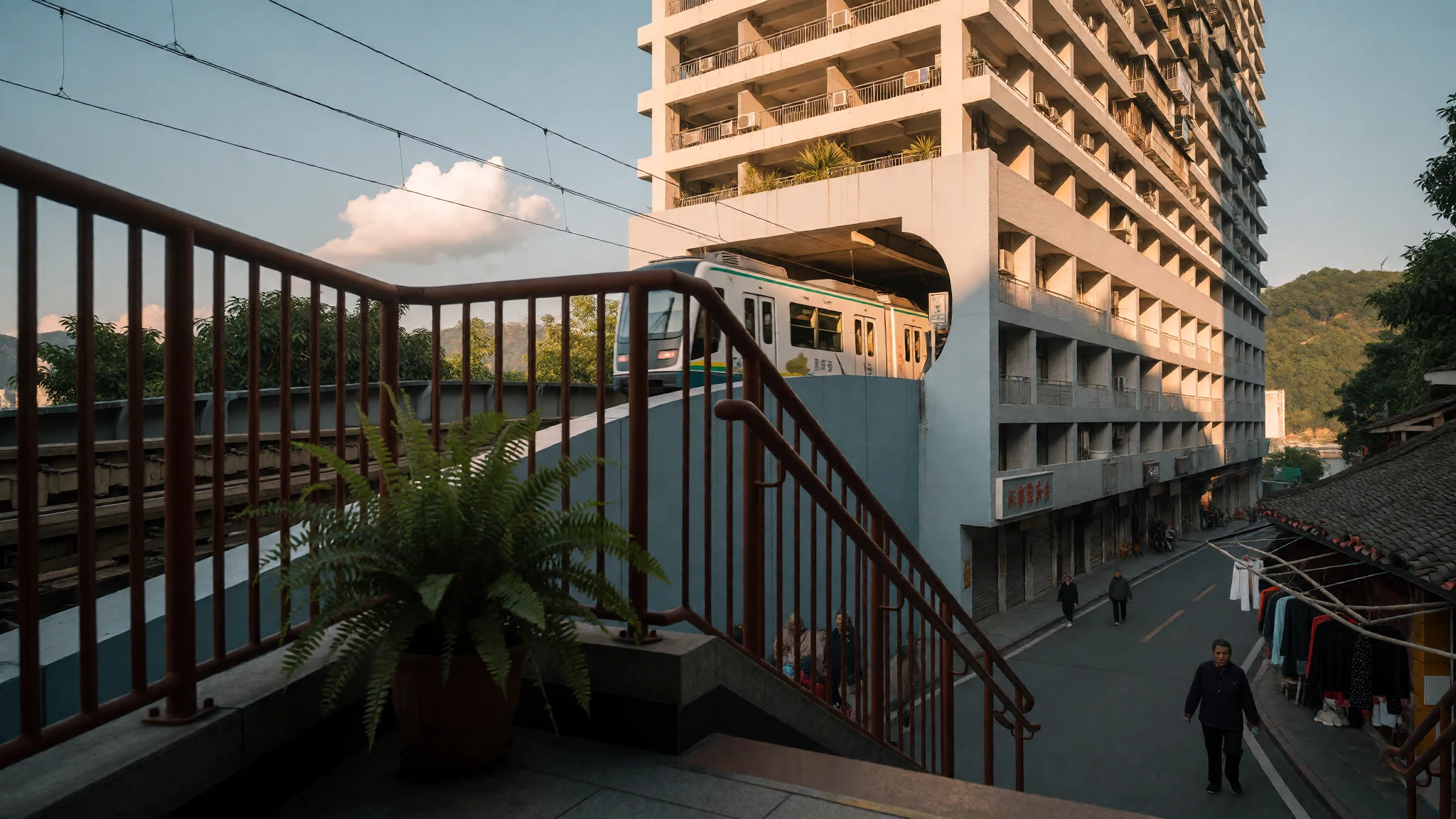
Chongqing is a vertical river city of stacked streets, fog and fiery hotpot, where a working megacity matters more than any single monument.
The place
Chongqing is a municipality in south-western China, governed directly by the central government and the only one of that kind that lies inland. Its official population is about 32 million, but that figure covers a territory roughly the size of Austria, with farmland, gorges and small towns around several separate urban areas. The dense city most visitors mean is far smaller. Its heart is the Yuzhong peninsula, a spur of hill between the Yangtze and Jialing rivers, recorded at an elevation of 237 m. Everything here is vertical. Streets stack on cliffs, a ground floor on one road can be the roof of a building on another, and escalators, lifts and cable cars do the work of staircases. Metro and light-rail trains run through and between apartment blocks, which is why photographs of a carriage sliding through a tower have travelled so widely. Fog and haze sit in the river valleys on over a hundred days a year, thickest in spring and autumn, so the skyline often appears in layers and glows from within after dark. The local speech is Southwestern Mandarin of the Sichuanese family, quick, blunt and funny, heard in markets and on buses. Industry is part of the picture too: cars, heavy engineering and electronics, with barges and container ships working the rivers. Visitors expecting a theme park of neon find a working city where people play mahjong in the shade, eat hotpot on low stools and climb long stairways without comment. Summers are hot and humid, winters damp and grey rather than bitter. Walking is slower than the map suggests because of the gradients, and satellite navigation often loses its way among multilevel roads.
Its story
Chongqing's recorded past begins with the Ba people, who held the river country around the meeting of the Yangtze and Jialing before Qin armies arrived. A Qin general gave the settlement the name Jiangzhou, and it remained a garrison and river port through the Han dynasty and the centuries of division after it. Names changed often. Under the Sui it became Yu Prefecture, and Yu survives today as the city's one-character abbreviation and in Yuzhong, the old peninsula centre. Late in the Southern Song dynasty, a prince named Zhao Dun was first made king and then emperor, and he called this a double celebration, shuangchong xiqing. The district was renamed to match, and Chongqing is the short form. During the Ming and Qing dynasties, settlers from Hunan and Hubei were moved into the Sichuan basin, and their influence is still felt in dialect, guild halls and cooking. Modern municipal status dates from 14 March 1997, when the city was separated from Sichuan. The city's great moment on the world stage came when the Republic of China moved its wartime government here during the struggle against Japan, and foreign embassies and Allied officers followed. Bombing and a swelling refugee population pushed daily life into tunnels and hillside shelters. Later, a state programme shifted factories and engineers inland during the Cold War, laying the base for the heavy industry of today. In the closing years of the last century, Chongqing was separated from Sichuan province and made a municipality in its own right, to speed up growth across the western interior.
What to see
- Jiefangbei and the Liberation Monument — Yuzhong district
Jiefangbei is the central pedestrian square of Chongqing, built around a monument first raised to mark victory over the Axis armies. Tall shopping centres now crowd it, so the column looks small, but it remains the city's symbol. Come after dark, when screens and lights turn the whole district into a lively evening promenade.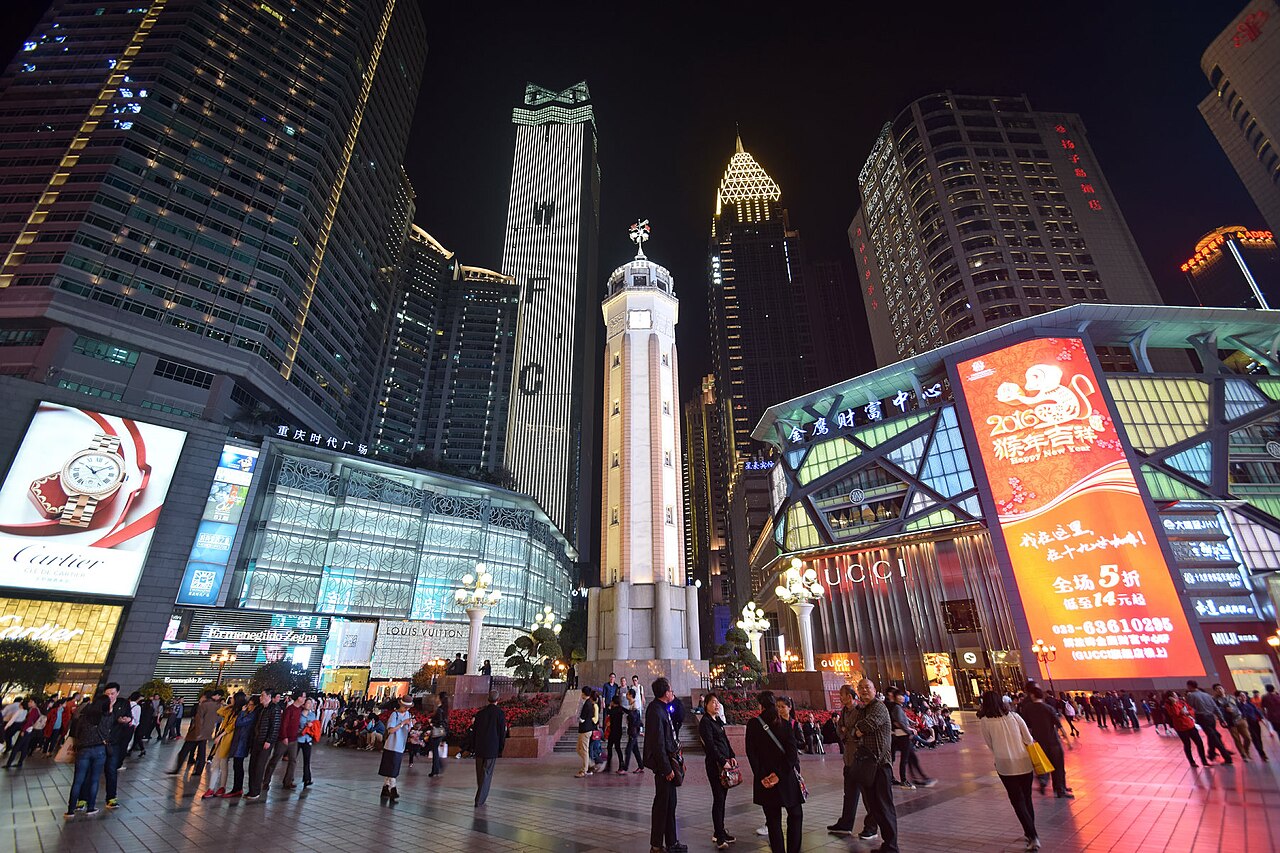
- Hongyadong riverside — Yuzhong district, Jialing riverfront
Hongyadong is a cluster of timber-style towers stepping down a cliff to the Jialing river, in the manner of older stilted riverside houses. It is crowded and commercial, and it is best seen from the bridge or opposite bank at dusk, when every level is lit and the river reflects it. - Liziba station and the train through the tower — Yuzhong district, near Liziba
At Liziba, a light-rail line passes straight through the body of a residential block, and the station platform sits several floors up. A viewing area across the road lets passers-by watch carriages emerge from the walls. It takes a few minutes, but it explains the city's three-dimensional layout at a glance.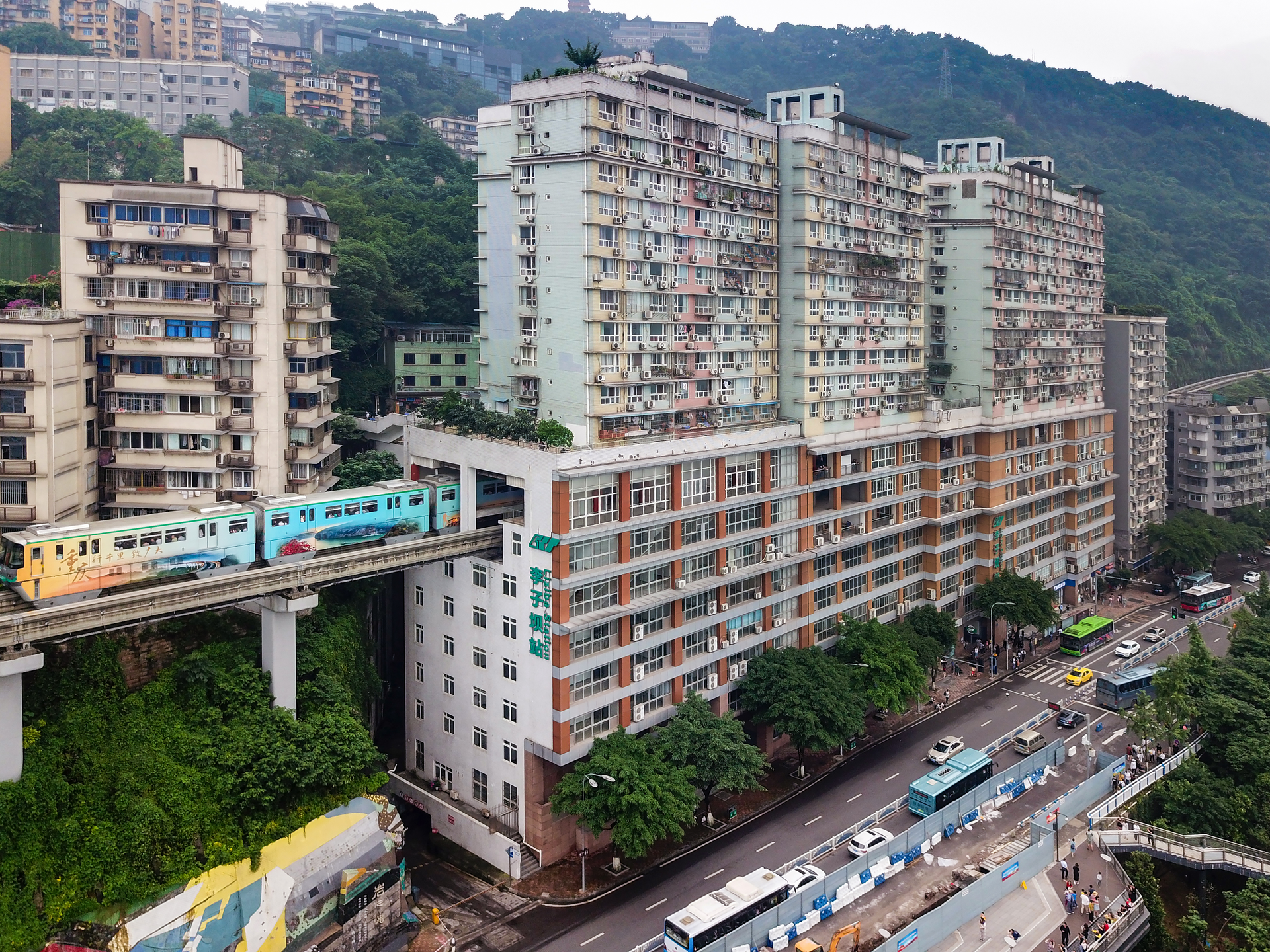
- Huguang Guild Hall — Yuzhong district, old town
Huguang Guild Hall is a restored complex of courtyards, carved wooden halls and stage buildings, put up by migrants from Hunan and Hubei who settled the Sichuan basin. It gives a quieter, older picture of the city, with detailed roof carving and ornate beams, and sits well alongside the modern towers.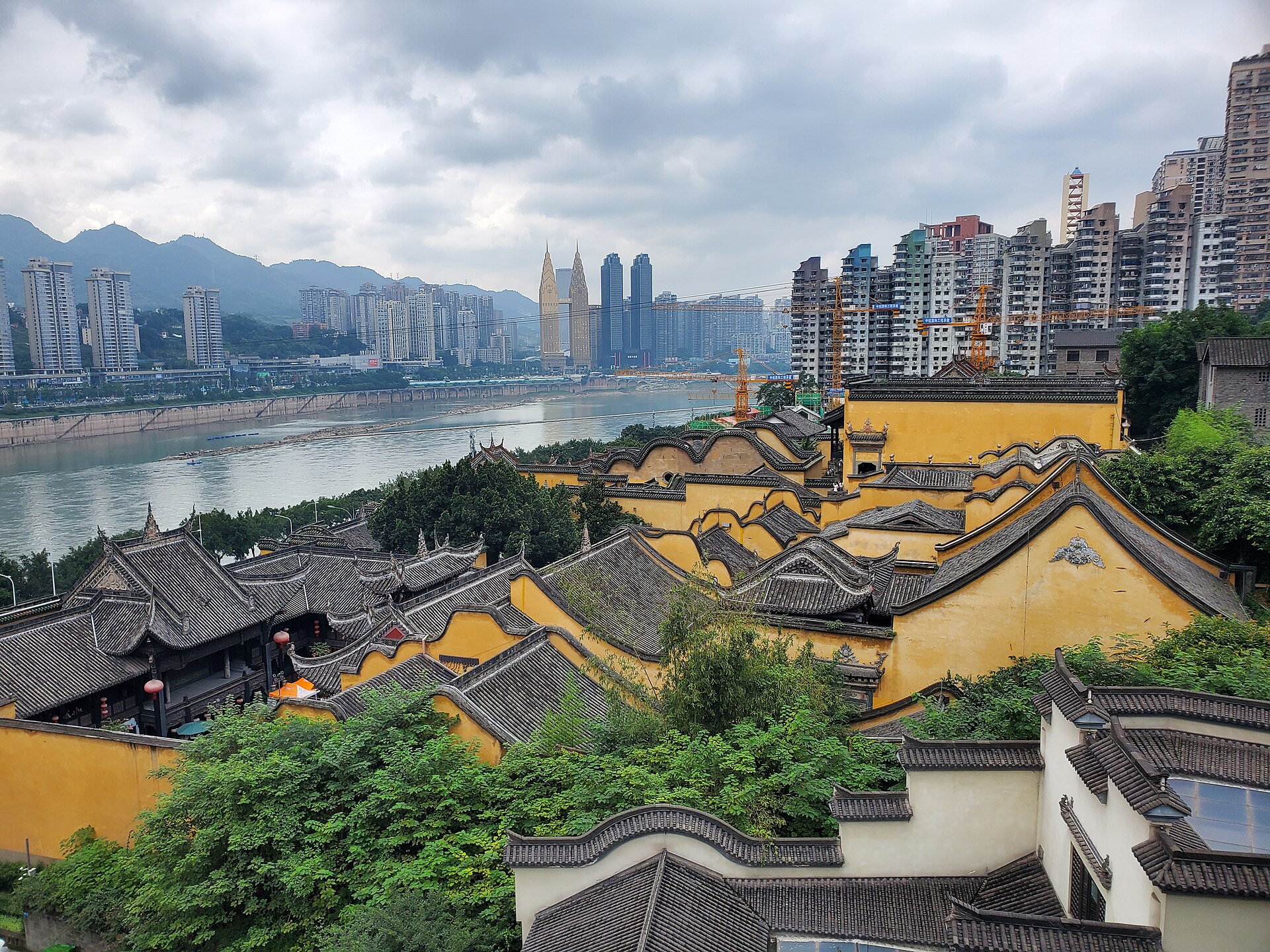
- General Stilwell Museum — Yuzhong district
This small museum is dedicated to the American general Joseph Stilwell, who served as an Allied commander in China during the war. It is housed in a wartime residence and shows how the city worked as a base for diplomats and officers, and it pairs well with an afternoon exploring other wartime sites.
Culture
Chongqing's character comes from migration, river trade and wartime pressure, and it shows in how people talk and eat. The everyday language is Southwestern Mandarin in its Sichuanese form, and the local manner is direct, teasing and warm once a conversation gets going. Settlers from Hunan and Hubei arrived in waves during the Ming and Qing dynasties, and a few speakers of Xiang and Hakka remain. In the south-east of the municipality, Miao and Tujia communities keep their own languages, festivals and crafts, so the countryside is more varied than the city suggests. The social centre of the city is food, above all hotpot, and sharing a boiling pot is how friendships and business deals are sealed. Tea houses and street corners with bamboo chairs are where older residents play cards and mahjong for hours. The memory of the war years is strong. Chongqing was a capital under siege, and sites such as the Liberation Monument, the Stilwell Museum and old air-raid shelters are treated as civic history, not only as attractions. Locals are proud of the city's toughness and of its cooking, and they will happily tell a visitor which is the better noodle stall. Hills and humidity shape the rhythm of the day, with long lunches, evening promenades along the rivers and plenty of sitting in the shade. When photographing people at tea houses, mahjong tables or riverside steps, ask first with a smile and a gesture, and never step into a game to get your shot.
What to wear
Chongqing has no single regional costume, but its surrounding hills carry some of the best-known textile traditions of south-western China. The Miao people of the south-east wear embroidered jackets and pleated skirts of cotton and hemp, with heavy silver headdresses and necklaces for weddings and festivals. The Tujia are known for their brocade, woven in bold geometric patterns on a loom and used for bedcovers, bags and ceremonial cloth. These outfits appear mainly at festivals, in museums and in tourist performances, and in the city itself they are rare. Earlier city dress followed Han traditions, such as long gowns and, in the twentieth-century cities, the fitted qipao. Today people wear what the weather asks for: light short sleeves in the long hot summer, quilted jackets over jeans in the damp winter, trainers for the endless slopes and a sun umbrella or rain umbrella that does double duty. Younger residents dress in the same streetwear seen across Chinese cities, and nightlife districts see more polish than the daytime markets. A visitor should pack breathable, quick-drying clothes for summer and a warm, waterproof layer for winter, since cold and damp feels sharper than the thermometer suggests. Shoes matter most: choose grippy soles for wet steps and steep lanes. Temples and heritage halls have no strict dress code, but covered shoulders and knees are polite. Bring a small umbrella year-round, sunscreen for summer and a light scarf for air-conditioned trains.
What to eat
- Chongqing hotpot — hotpot restaurants and street-side eateries across Yuzhong and Jiangbei
Chongqing hotpot is a pot of beef-fat broth loaded with dried chillies and Sichuan pepper, into which diners dip tripe, beef, tofu and vegetables. It numbs as much as it burns. Order a milder broth if unsure, and cool down with a sweet drink. - Chongqing small noodles (xiaomian) — small noodle shops and breakfast stalls in residential lanes
A breakfast staple: wheat noodles in a peppery, oily sauce with peanuts, pickles and spring onion, sometimes topped with minced pork or peas. Quick, filling and cheap, it is eaten standing or crouched on a low stool. - Suanlafen — street stalls and snack shops near markets and metro exits
Sour-and-hot sweet-potato noodles served in a dark, vinegary broth with chilli, peanuts and herbs. The noodles are slippery and chewy, and the bowl is a favourite late-morning snack, tangy rather than heavy. - Spicy chicken (la zi ji) — family restaurants in older neighbourhoods
Small pieces of fried chicken are buried in a heap of dried red chillies, and diners hunt through the pile with chopsticks. Most of the chillies are for aroma, not eating. It is a good dish for sharing with beer. - Chuanchuan skewers — night-time eateries and local food streets
Meat, vegetables and tofu are threaded onto bamboo sticks, then cooked in a spicy broth. Diners pick a handful from a fridge, then count the sticks at the end. It is a lighter, more casual cousin of hotpot.
Plan it
Best time. March–April and October–November are the most comfortable months, with milder temperatures and fewer extremes. Summer is hot and humid, and winter is cool, damp and often hazy, though evenings by the rivers remain pleasant in most seasons.
How long. 2–3
Getting there. Fly to Chongqing Jiangbei International Airport, then take the metro or a taxi into the Yuzhong centre; high-speed trains from other Chinese cities arrive at the main railway stations, from which the metro covers the last leg.
Budget. low
Tips
- Allow extra time for walking, as hills and multilevel roads make distances feel longer than the map shows
- Use metro and light rail for most trips, and save taxis for late nights and luggage
- Carry a mobile payment option or some cash, since small stalls may not take foreign cards
- Ask for a mild broth in hotpot restaurants, and keep tissues and water close
- See the riverside and Jiefangbei at dusk, and visit older sites in the morning when crowds are thinner
- For official visitor information, check the city government site at https://www.cq.gov.cn/
Etiquette
- Ask before photographing people at tea houses, mahjong tables or markets
- Queue patiently at metro gates and stairways, and give way to people with luggage
- Share dishes at a table and use the serving spoons or chopsticks provided
Nearby
Sources
- Wikidata Q11725 (CC0)
- Wikipedia: Chongqing (rev 1384515711) (CC BY-SA 4.0)
- Wikivoyage: Chongqing Municipality (rev 5370040) (CC BY-SA 4.0)
- Chongqing in September 2025 — Renek78 (CC0 1.0)
- A train going out from Liziba Station, Line 2 — David290 (CC BY-SA 4.0)
- Night scene of Jiefangbei, Chongqing — Baycrest (CC BY-SA 2.5)
- Chongqing Municipal People's Auditorium Main Entrance — Iswzo (CC BY-SA 4.0)
- Three Gorges Fengjie — anonimerce @ Mapillary.com (CC BY-SA 4.0)
- Chongqing Huguang Guild Hall — 源義信 (CC BY 4.0)
- View of the city, Chungking — Board of Home Missions of the Methodist Episcopal Church (Public domain)
- Church buildings in Chungking — Wilson Edward Manly (Public domain)


