Bolzano
Bolzano, Italy
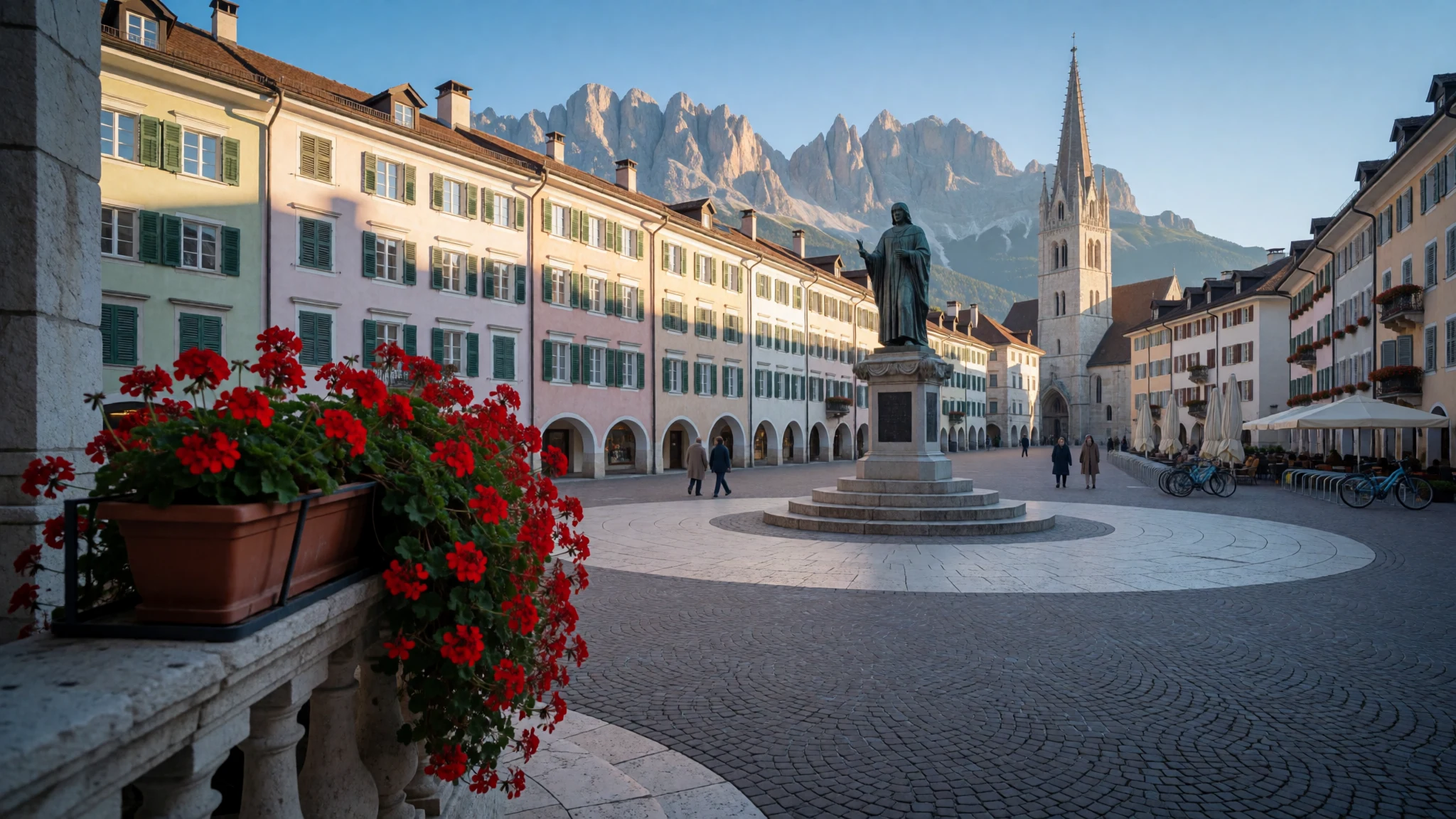
Bolzano unites alpine peaks, Italian warmth, and a distinct Tyrolean heritage at a grand crossroads of European culture.
The place
Bolzano stands as the vibrant capital of South Tyrol within northern Italy, situated directly where deep alpine valleys open into broad agricultural basins. The municipality supports a resident population of over one hundred thousand people, representing the largest urban centre in the province and a crucial economic connector between the southern slopes of the Alps and the Germanic territories to the north. Rivers such as the Talvera flow through the municipal boundaries, carving green corridors that divide the historical core from modern residential quarters and sports complexes. The local community operates through a fascinating linguistic duality where Italian and German are spoken in daily commerce, public administration, and education. Lectures at the Free University are delivered in multiple tongues, reflecting the cross-border identity that defines civic life here. Around the central squares, stone facades display a harmonious blend of medieval arcade design and traditional Tyrolean pitched roofs, framed constantly by the limestone walls of the surrounding mountains that rise sharply on every horizon. The local economy thrives on specialised manufacturing, academic research, alpine tourism, and wine production from the terraced vineyards clinging to the steep hillsides directly above the town streets. Pedestrian zones dominate the historical centre, encouraging residents and visitors alike to stroll beneath arched walkways, browse open-air markets laden with local produce, and gather in public squares for morning espresso or afternoon spritzes while cable cars lift passengers effortlessly from the valley floor up to high alpine plateaus.
Its story
Bolzano carries a profound historical narrative shaped by centuries of shifting borders, imperial ambitions, and mountain commerce. Long before modern municipal boundaries were drawn, the surrounding marshy valley floor was inhabited by ancient Raetian communities, later subjugated by Roman forces under general Nero Claudius Drusus in 15 BC to establish a strategic military post known as Pons Drusi. Archaeological excavations beneath the present cathedral have revealed fourth-century Christian basilicas and Roman burial sites containing inscriptions that confirm ancient settlement layers. Following the decline of Lombard power, Bavarian populations arrived in the seventh century, permanently establishing Germanic linguistic and cultural roots throughout the valley. During subsequent medieval epochs, the settlement flourished as a commercial hub where merchants from Venice and Augsburg met to exchange goods during large seasonal fairs held beneath the protective watch of nearby fortresses. The territory remained under the long administration of the Habsburg monarchy and the Austro-Hungarian Empire until the end of the First World War, when the region was annexed by the Kingdom of Italy. The twentieth century brought rapid industrialisation, the construction of monumental civic architecture under successive regimes, and significant demographic shifts as workers arrived from other Italian provinces. Despite these turbulent political transitions, the populace has carefully preserved its unique dual heritage, balancing centuries-old alpine traditions with modern European integration, a dynamic that continues to define the character of the settlement today.
What to see
- South Tyrol Museum of Archaeology — Museum Street
This prominent cultural institution holds the famous natural mummy known as Ötzi the Iceman, discovered high in the alpine ice. Alongside the prehistoric hunter's remarkably preserved leather garments, copper axe, and everyday tools, permanent galleries present detailed archaeological finds illustrating thousands of years of human habitation across the rugged alpine valleys of South Tyrol. - Messner Mountain Museum Firmian — Sigmundskron
Situated within the historic stone walls of Sigmundskron Castle on a rocky elevation overlooking the valley floor, this striking museum was created by the renowned mountaineer Reinhold Messner. The exhibits explore humanity's complex relationship with towering peaks through art, religion, climbing history, and dramatic architectural interventions that respect the medieval fortifications. - Museion - Museum for Modern and Contemporary Art — Dante Street
Housed in a daring, transparent contemporary building designed by Studio KSV along the riverbank, this dynamic institution showcases experimental contemporary works, international installations, and cutting-edge visual arts. The striking glass structure features large open bridges that connect opposing urban banks, serving as a vibrant cultural gathering point for creative expression and public debate. - Runkelstein Castle — Northern valley approach
Perched on a rocky precipice above the gorge north of the town, this thirteenth-century fortress protects some of the most remarkable secular medieval fresco cycles in Europe. Visitors can explore preserved chambers decorated with vivid scenes of courtly romance, literary legends including Tristan and Isolde, and historic knightly tournaments set against the dramatic backdrop of alpine forests. - Maretsch Castle — Laas Street area
Surrounded by historic vineyards right on the edge of the urban area, this picturesque fortification features four round corner towers and a peaceful inner courtyard. Originally constructed to control the valley approaches, the carefully restored complex now serves as a prestigious venue for international conferences, cultural gatherings, and wine-tasting events celebrating regional vintages.
Culture
Bolzano sustains a vibrant cultural landscape shaped by the intersection of Italian and German-speaking communities, resulting in a bilingual environment where traditions from both worlds thrive side by side. The municipal calendar is punctuated by classical music concerts, alpine folk festivals, wine celebrations, and bustling street markets that occupy the historic public squares. Traditional brass bands, choral societies, and alpine shooting clubs maintain centuries-old customs, wearing authentic regional dress during religious processions and civic holidays. At the same time, the local population engages enthusiastically with contemporary art exhibitions, modern architecture, and international academic conferences held at the Free University. Polite bilingual greetings are customary in shops and restaurants, and locals appreciate visitors attempting a friendly 'Buongiorno' or 'Guten Tag' depending on the language of the interlocutor. When entering churches or quiet residential areas, maintain a respectful tone and modest attire. Always greet shopkeepers when entering a small local business and wait to be seated in traditional dining establishments.
What to wear
Bolzano displays a sartorial blend of alpine practicality and refined Italian elegance that reflects its unique geographic position. Traditional dress, known locally as Tracht, features embroidered leather trousers and wool jackets for men, and intricately detailed dirndls with embroidered aprons for women, worn proudly during village festivals, weddings, and official civic celebrations using durable regional wools, loden cloth, and sturdy leathers. In daily modern life, residents dress with understated sophistication, favouring tailored wool coats, leather boots, structured knitwear, and contemporary urban separates suitable for changing mountain weather. Visitors exploring Bolzano should pack versatile layers, including a lightweight windproof jacket for sudden valley breezes, comfortable walking shoes or sturdy trainers for exploring cobbled streets and gravel paths, and sensible footwear for mountain excursions. Smart-casual attire is perfectly appropriate for evening dining in local restaurants, while modest clothing with covered shoulders and knees is recommended when visiting historic churches and sacred religious sites across the region.
What to eat
- Tyrolean Knödel — Traditional alpine taverns and local eateries near the fruit market
Hearty bread dumplings made with diced speck, fresh herbs, and milk, served either floating in a clear beef broth or tossed in melted butter and grated mountain cheese. - South Tyrolean Speck — Central food markets and historic delicatessens along the arcades
A distinctive dry-cured, lightly smoked ham seasoned with juniper berries, rosemary, and bay leaves, cured in mountain air and sliced paper-thin. - Schlutzkrapfen — Family-run restaurants in the historic town centre
Half-moon ravioli pasta parcels traditionally filled with a comforting mixture of spinach and curd cheese, generously drizzled with brown butter and parmesan. - Apple Strudel — Traditional cafes and pastry shops around Waltherplatz
Thin, paper-delicate pastry wrapped around tart mountain apples, raisins, cinnamon, and toasted breadcrumbs, served warm with a dusting of icing sugar. - Lagrein Wine — Local wine bars and historic cellars throughout the valley
An ancient indigenous red wine variety producing deep ruby-purple wines with rich berry notes, structured tannins, and a velvety finish.
Plan it
Best time. May to June for alpine wildflowers and comfortable walking weather, or September to October for grape harvest season and autumn foliage.
How long. 2–3
Getting there. Fly into nearby regional airports such as Verona or Innsbruck, then complete the journey via direct train connections along the scenic Brenner railway line to Bolzano Central Station.
Budget. mid
Tips
- Purchase a Bolzano Card for free public transport and museum admissions
- Book advance timed-entry tickets online if you plan to visit the archaeological museum to see Ötzi
- Wear comfortable footwear with good grip for exploring both cobbled streets and surrounding hillside trails
- Carry a mix of cash and cards, as some smaller mountain huts and market stalls may prefer cash
- Take advantage of the local cable cars for rapid access to cool alpine plateaus during warm summer afternoons
Etiquette
- Greet shopkeepers and hosts politely using Italian or German depending on the setting
- Keep noise levels low when visiting sacred spaces and historic churches
- Dress respectfully with covered shoulders when entering places of worship


