Bariloche
Bariloche, Argentina
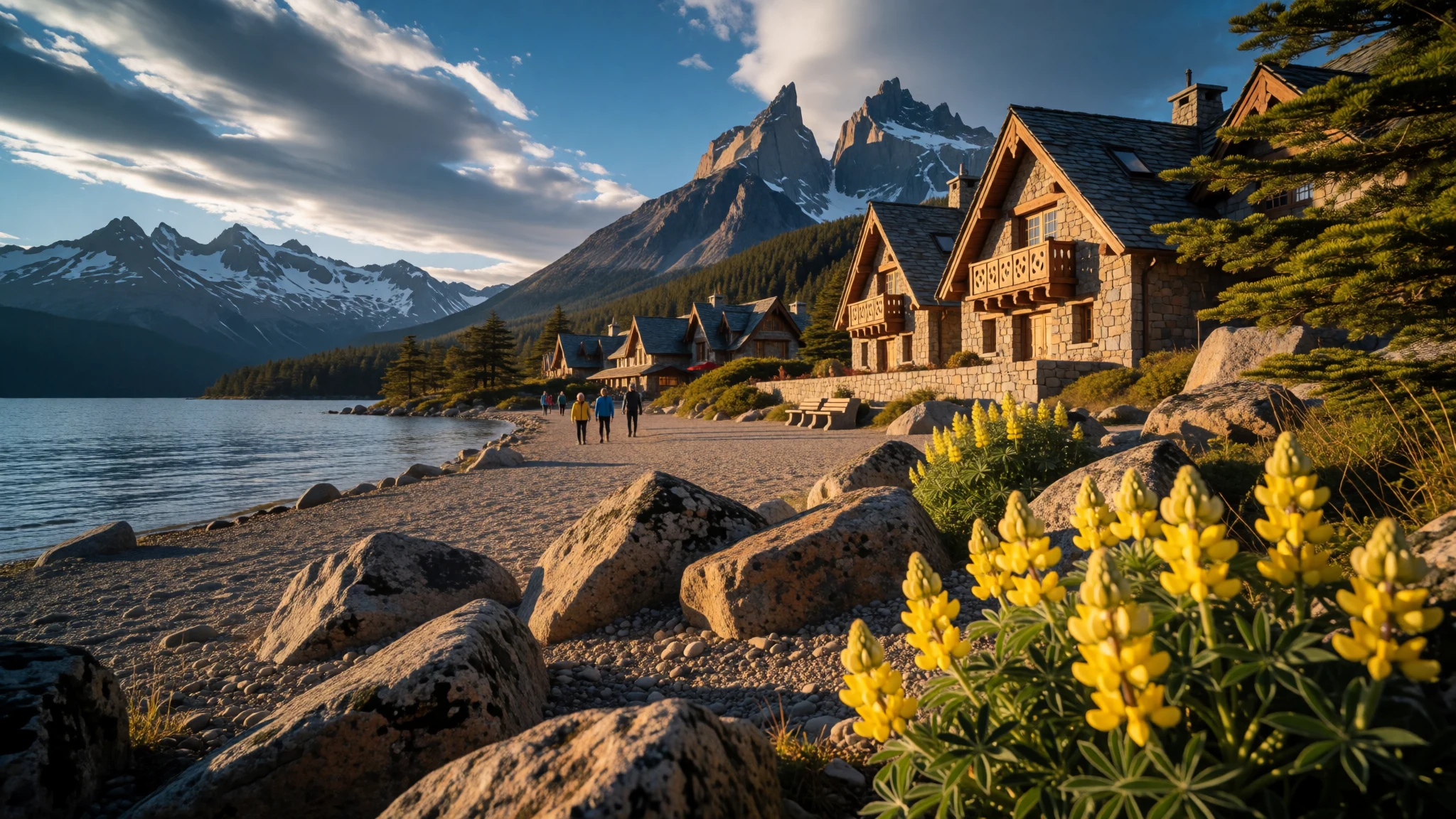
Bariloche puts a glacial lake, Andean forest and a real ski winter within reach of one Argentine mountain town.
The place
Bariloche stands on the Argentine shore of a deep glacial lake, Nahuel Huapi, with the Andes rising behind a town of steep roofs and timber balconies. About 136,000 people live here, at 893 metres, where winter is genuine and summer evenings stay long and cool. The municipality dates from 1902. Visitors meet a resort in Río Negro that still works as an ordinary town: a bus station, schools, a civic waterfront and a main street shared by residents and travellers. The lake sets the shape of a day. Launches pull away from the piers for wooded islands and the far shore, while the road around the water climbs to lookouts and drops to beaches of grey sand and stone. Forest of coihue and lenga clothes the lower ridges; higher basins keep scraps of snow well into the warm months. Nahuel Huapi National Park wraps that shoreline, which is why so many journeys treat the town as a gate rather than a finish. Wind belongs to the place. It spills down the valleys, chops the lake in the afternoon and makes a jacket sensible even in bright weather. Mornings are often the clearer hours. In the cold months the same slopes become a ski town; in the warm months they become a base for walks, boats and the chain of lakes running towards the Chilean border. Crowds gather when Argentine school holidays fill the centre, and the chocolate shops and viewpoint buses feel it first. For practical notices, the municipal site is bariloche.gob.ar.
Its story
Bariloche's recorded life as a municipality begins in 1902, but the lake shore was not empty ground waiting for a town. Mapuche communities knew Nahuel Huapi as a place of travel, fishing and seasonal movement long before a street grid existed, and their names still label the water, the island and several peaks. Trade also crossed the Andes here: passes linked the Argentine lakes with the Chilean side, and goods moved by boat and by pack long before a tourist promenade. What the centre looks like today is a later choice. Settlers from the German-speaking Alps, from Switzerland and from other parts of Central Europe built in timber and stone, opened breweries and made chocolate, and gradually gave the waterfront a village profile that Argentina then leaned into. The civic centre was composed as a set piece — a clock tower, arcades, steep roofs — so that arriving visitors would read mountain town in a single glance. That look is real building, not a false front, and it is also a story the town chose to tell about itself. Later the lake and its forests were set aside as Nahuel Huapi National Park, which kept large stretches of shore and ridge out of ordinary building plots. Bariloche grew as the park's service town: a place to sleep, eat, buy a boat ticket and start a walk. The honest version holds both parts. Bariloche is a working Patagonian town with a staged Alpine face, a chocolate trade built by immigrant families, and a park older than the resort.
What to see
- Centro Cívico — town centre
The Centro Cívico is Bariloche's formal heart, a stone-and-timber square built so the resort would have a public face. A clock tower, arcades and steep roofs frame the open space, with the lake glimpsed down the sloping streets. Municipal offices and a local-history museum sit on the square, so the scene is also the town's official address. School-holiday weeks fill it early. - Nahuel Huapi — waterfront
Nahuel Huapi is the reason Bariloche stands where it does: a long glacial lake, dark under cloud and a hard blue in sun. Launches leave the town piers for island walks and quays on the far shore. Beaches near the centre are pebble and grey sand, a pause rather than a swim. Beyond the piers, the national park holds most of the shoreline. - Circuito Chico — western shore
The Circuito Chico is Bariloche's short loop west of the centre, a road along bays of Nahuel Huapi with lookouts, pocket beaches and a viewpoint over a smaller linked lake. Streets give way to forest and rock within a short ride. Tour buses cover the loop, and so do bicycles when the wind is down; narrow shoulders and gusts make the ride less gentle than a map implies. - Cerro Catedral — ski ridge west of town
Cerro Catedral is Bariloche's ski mountain, the ridge that made winter a season people travel for. Slopes and a small village at the base fill with visitors in the cold months; in summer the same hill offers lifts, lookouts and walks above the trees, often with snow lingering in hollows. Buses run from the centre, and the view back across Nahuel Huapi is the point even without skis. - Llao Llao and Puerto Pañuelo — Llao Llao peninsula
Llao Llao is the wooded peninsula west of Bariloche where a grand lodge, built in the same Alpine spirit as the civic centre, sits above a tangle of lakes and channels. Puerto Pañuelo, the small quay below, is where many boat trips into the park actually start, so the quiet road out to the point is also a working departure. Short walks through the forest start nearby.
Culture
Bariloche lives between two cultures that do not cancel each other. The older one is Mapuche: place-names on the lake and the mountains, a memory of seasonal movement and of trade across the passes, and a presence that is easy for a visitor to miss if they only walk the chocolate street. The later one is immigrant and Alpine. Families from the German-speaking world and from Switzerland brought timber building, brewing and chocolate, and the town made that inheritance its public identity, right down to the clock tower. Everyday life is Patagonian Argentine. Mate is passed in the square and on the bus; asado, grilled meat shared at a long table, marks weekends and any excuse to gather. School parties in matching jackets move through the centre in holiday weeks, a national ritual that treats this lake as a rite of passage. In winter the culture shifts uphill towards early buses, hired gear and a day organised around snow. Craft shows up in wool. Mapuche weaving — geometric bands, thick ponchos, heavy blankets — appears at fairs and in shops that sell more than souvenirs, and rural dress from the wider province, the beret and the loose trousers, still turns up at festivals and on the edge of town. None of this asks a visitor to costume up. On trails and boat decks, keep voices down around wildlife, give people room at the rail, and ask before photographing residents or stallholders.
What to wear
Bariloche has no single costume that the streets wear every day. The textile tradition that belongs here is Mapuche wool work: handwoven ponchos, heavy blankets and bands of geometric pattern, made for warmth and for ceremony and still sold at fairs and specialist shops. The other traditional look is borrowed. Settlers from the Alps did not leave a folk dress in daily use, but the town's identity leans on their knitwear, their boots and the idea of a mountain wardrobe. At festivals on the edge of the province, rural dress appears — a woollen poncho, a beret, loose trousers and sturdy boots — more often than it does on the main shopping street. What people wear now is practical and layered. In town, jeans, trainers and a fleece or a light down jacket cover most of the year, with a waterproof shell when the lake wind picks up. Winter on the ski hill is technical: insulated jackets, ski trousers, gloves and hats, much of it hired at the base. Summer is not beachwear for long; a T-shirt is normal, and so is a jumper tied around the waist by afternoon. Sensible kit is layers, a windproof jacket, and shoes that can take wet roots and pebble beaches, plus a warmer set — hat, gloves, a proper coat — if the trip falls in the cold months. Religious dress codes are not the issue in the centre; comfort, rain and cold are.
What to eat
- Bariloche chocolate — chocolate shops on Mitre and around the Centro Cívico
Bariloche chocolate is the town's edible signature, a craft brought by Alpine immigrant families and now sold in thick bars, with nuts, and as hot chocolate when the wind is up. Shops along Mitre and around the Centro Cívico display it in the window as both souvenir and treat. - Cordero patagónico — parrillas in the centre
Cordero patagónico is the lamb Bariloche serves when a meal is meant to be shared. Parrillas in the centre roast or grill it, often with potatoes and a plain salad, and the taste is stronger than lamb from milder farmland. Weekend grills treat it as ordinary food. - Trucha — lakeside eateries and restaurants in the centre
Trucha, trout from the lakes and rivers around Bariloche, is the fish the town puts on a grill. Lakeside eateries and ordinary restaurants in the centre serve it simply, with lemon, butter or a light sauce. The appeal is fresh fish, not a heavy recipe. - Fondue — winter eateries in the centre and at the ski base
Fondue is the Alpine dish Bariloche adopted along with steep roofs and chocolate, a shared pot of melted cheese that suits a cold night. Winter eateries in the centre and at the ski base serve it, sometimes with raclette or other melted-cheese plates beside it. - Picada — bars along Mitre and the centre
A picada in Bariloche is a shared board of cheeses, cured meats, pickles and bread, the thing to order when no one wants a single plated meal. Bars along Mitre pair it with local craft beer, a serious product in a town that has brewed since Alpine settlers arrived.
Plan it
Best time. Bariloche rewards a visit from December to March, the hottest months, for long days, boat trips and walking, when the lake is at its brightest; June is the wettest, and April, October and November the most comfortable. Shoulder months are quieter and still cold enough for a proper coat. Wind is part of every season.
How long. 3–4
Getting there. San Carlos de Bariloche Airport lies on the eastern side of town, with local buses and taxis covering the last stretch to the centre. Long-distance coaches arrive at the bus terminal from other Argentine cities, and some travellers cross from Chile through the lake district.
Budget. high
Tips
- Book winter beds early; ski weeks and school holidays fill the town.
- Start lake loops and boat trips in the morning, before the wind usually rises.
- Carry a windproof layer in every season, including summer.
- Cards are widely accepted in the centre; keep some cash for small kiosks, markets and minor stops.
- Confirm practical details on the municipal site, bariloche.gob.ar, rather than relying on old forum posts.
Etiquette
- Ask before photographing people, including stallholders and school groups.
- On boat decks, leave space at the rail and step aside for crew.
- Carry rubbish back from trails and beaches; the park begins at the edge of town.
Nearby
Sources
- Wikidata Q47772 (CC0)
- Wikipedia: San Carlos de Bariloche (CC BY-SA 4.0)
- Wikivoyage: Bariloche (CC BY-SA 4.0)