Aleppo
Aleppo, Syria
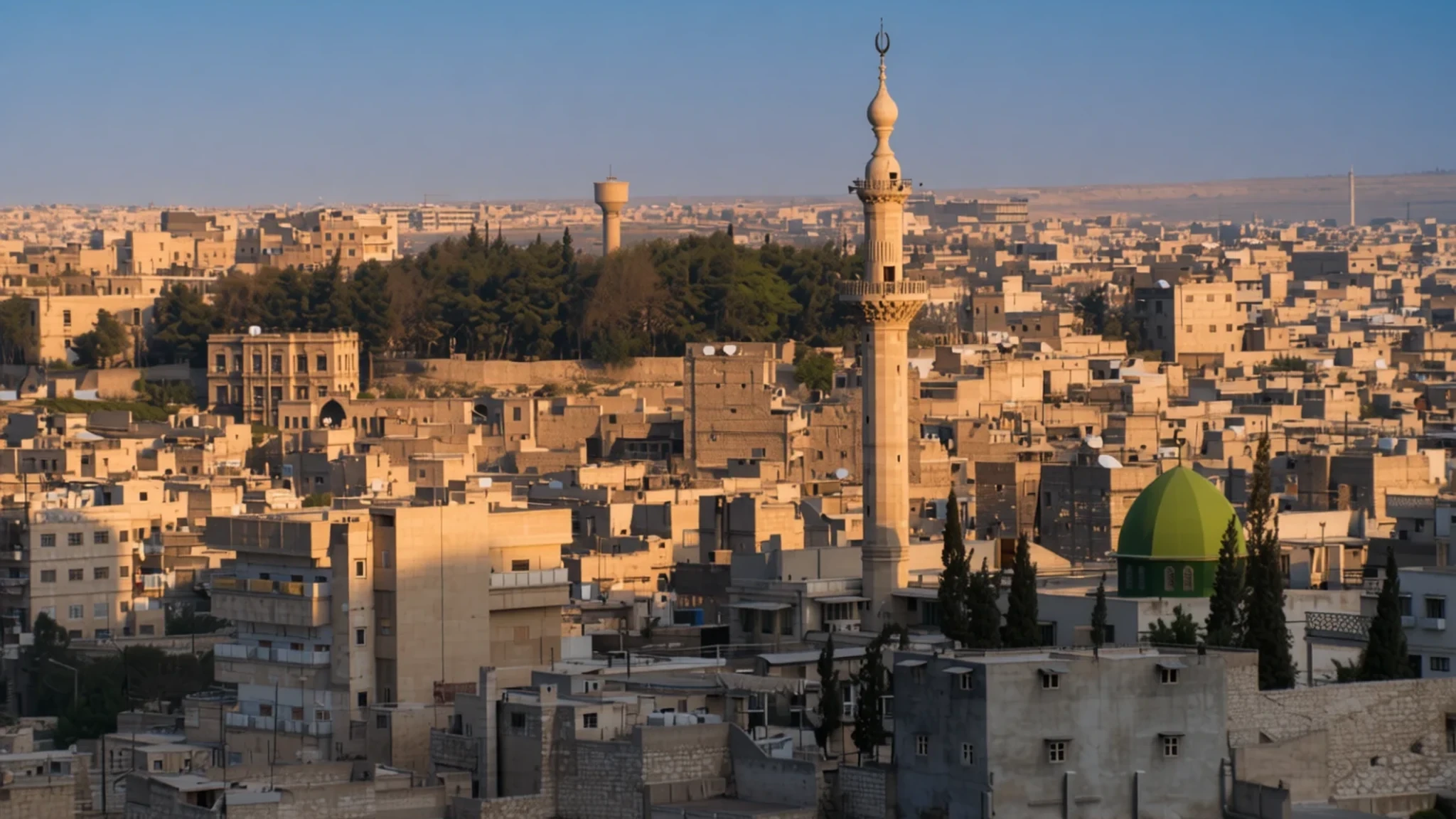
Aleppo (Halab) is an ancient trading city of stone lanes, a hilltop citadel and a musical tradition still sung as qudud.
The place
Aleppo, capital of its governorate, stands on a low northern Syrian plateau 379 metres above sea level. In Arabic it is Halab (حلب). The recorded population is about 2 million, which makes the city a major urban centre of the country. Its position, inland from the Mediterranean and on routes that once ran toward Mesopotamia, is the practical reason a settlement lasted here. Occupation here is dated to about 5000 BCE.
The modern city spreads around an older core. A citadel hill stands near the middle and can be picked out from many rooftops, with the covered souq and courtyard houses of stone packed beneath it. The Queik River runs through the urban area. Beyond the historic lanes lie avenues, a central public park and apartment districts. War damage is still obvious, especially around Salaheddin, where buildings were hit hard and some remain at risk of collapse.
Trade, more than any single dynasty, set the pattern of those lanes. Caravans moving between the Mediterranean coast and the river cities of Mesopotamia needed khans for storage, workshops for cloth and soap, and a market long enough to walk for an afternoon under stone vaults. Pistachio groves in the countryside still feed the sweet shops of the old city. The Grand Seray, mosques, churches and a historic synagogue stand within a short walk of each other, evidence that merchants of more than a single faith kept the place going.
Its story
Aleppo’s name enters the written record long after people were already living on the site. A settlement is dated here to about 5000 BCE. Because today’s houses stand on the old mound, excavators have rarely had an empty patch of it to dig. Ebla’s clay tablets, found well to the south, spell an early form of the name as Ha-lam. Scholars read that as Halab, pointing to a known swap of m and b in Sumerian spelling. Wayne Horowitz and others have equated the city with Armi, a polity near Ebla, but the match is disputed and should be held lightly.
Yamhad, an Amorite kingdom, ruled from Aleppo and drew its strength from trade and from arms. Hadad, the storm god, was worshipped in a chief temple on the citadel hill, which led people to call the city his. Naram-Sin, an Akkadian ruler, left an inscription about wrecking Ebla and a place he named Armanum. Linking that Armanum to Ebla’s Armi is contentious, and nothing in the record shows Akkad holding northern Syria for long.
In later cuneiform the name settles into Halab, the form behind today’s Aleppo. The kingdom lived off the corridor between the Mediterranean and Mesopotamia, a route that in later ages formed a strand of the Silk Road. The same hill was rebuilt under later rulers, including years within the Ottoman Empire, the Arab Kingdom of Syria and the French Mandate for Syria and the Lebanon. Through those changes the citadel and the market streets remained the working centre.
What to see
- Citadel of Aleppo — Centre of the old city
The Citadel of Aleppo stands on a hill in the centre and is visible from many surrounding streets. The hill was occupied long before the fortress now on it. The way in crosses a bridge between an outer gateway and an inner gateway, a bent approach meant to slow anyone forcing an entry. Those towers are the landmark the rest of the old city is read against.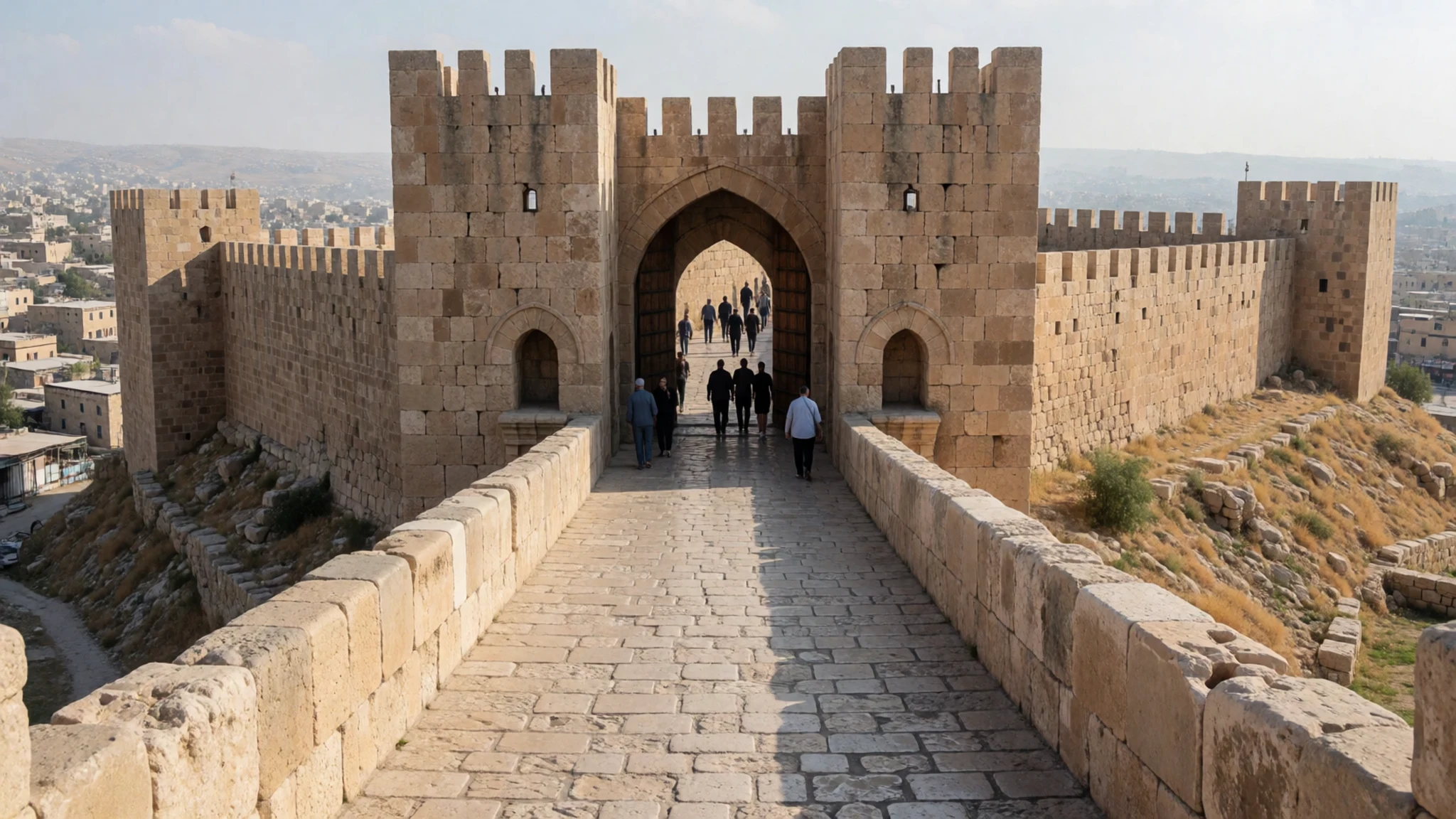
- Al-Madina Souq — Old city, below the citadel
Al-Madina Souq is a chain of vaulted lanes at the foot of the citadel rather than a single hall. Cloth, gold, soap and boxes were the historic stock, and some of that trade has returned as workshops reopen. Light falls through gaps in the stone roof onto a tunnel of shops.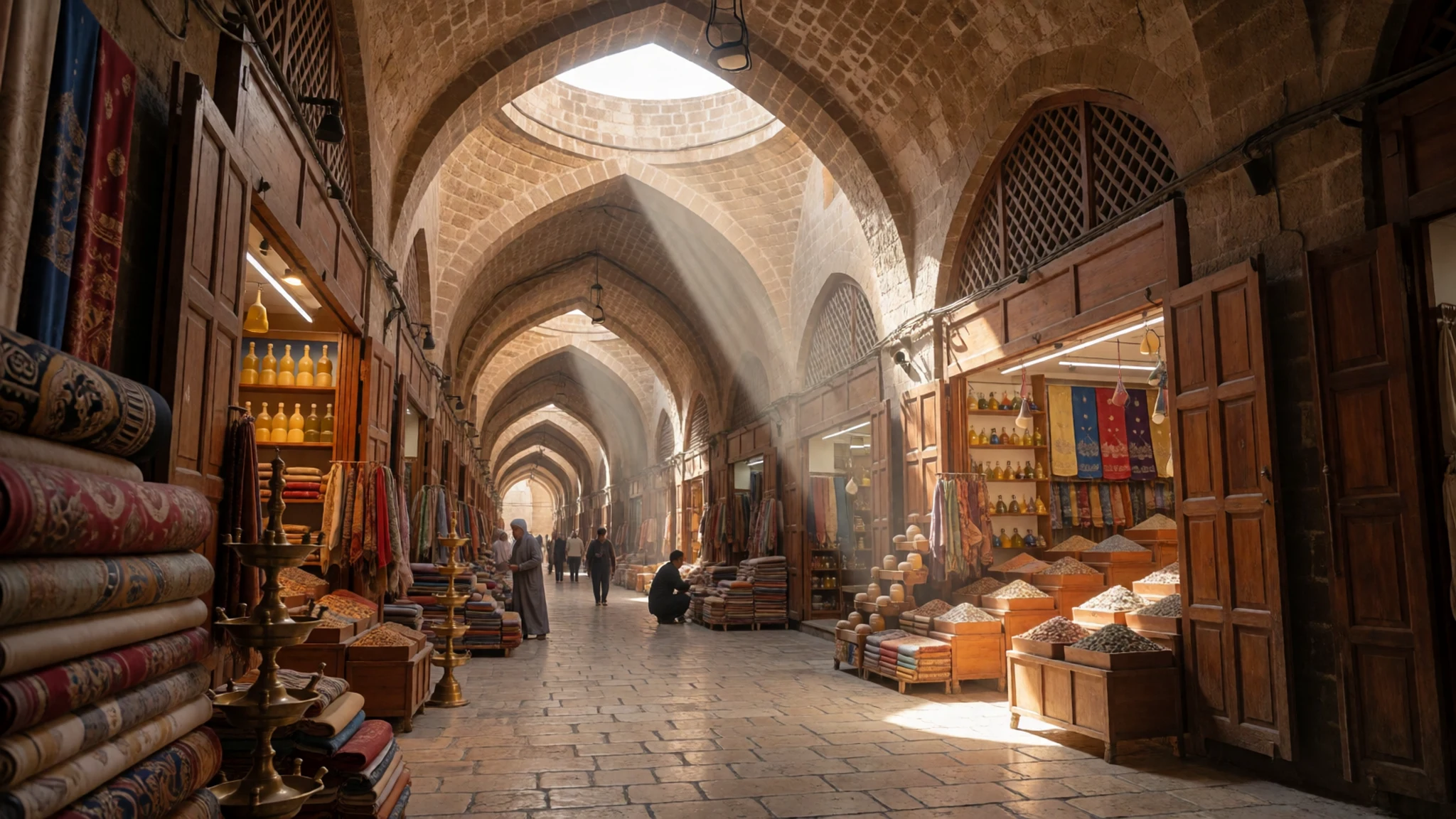
- Central Synagogue of Aleppo — Historic centre
The Central Synagogue of Aleppo stands in the historic centre, with a foundation placed in the Byzantine period. It belongs to a Jewish community that traded here for generations alongside Muslim and Christian neighbours. From the street the building is modest. What it carries is continuity in a merchant city, not a tall façade. Ask locally about access, and keep the manner of a guest in a house of worship.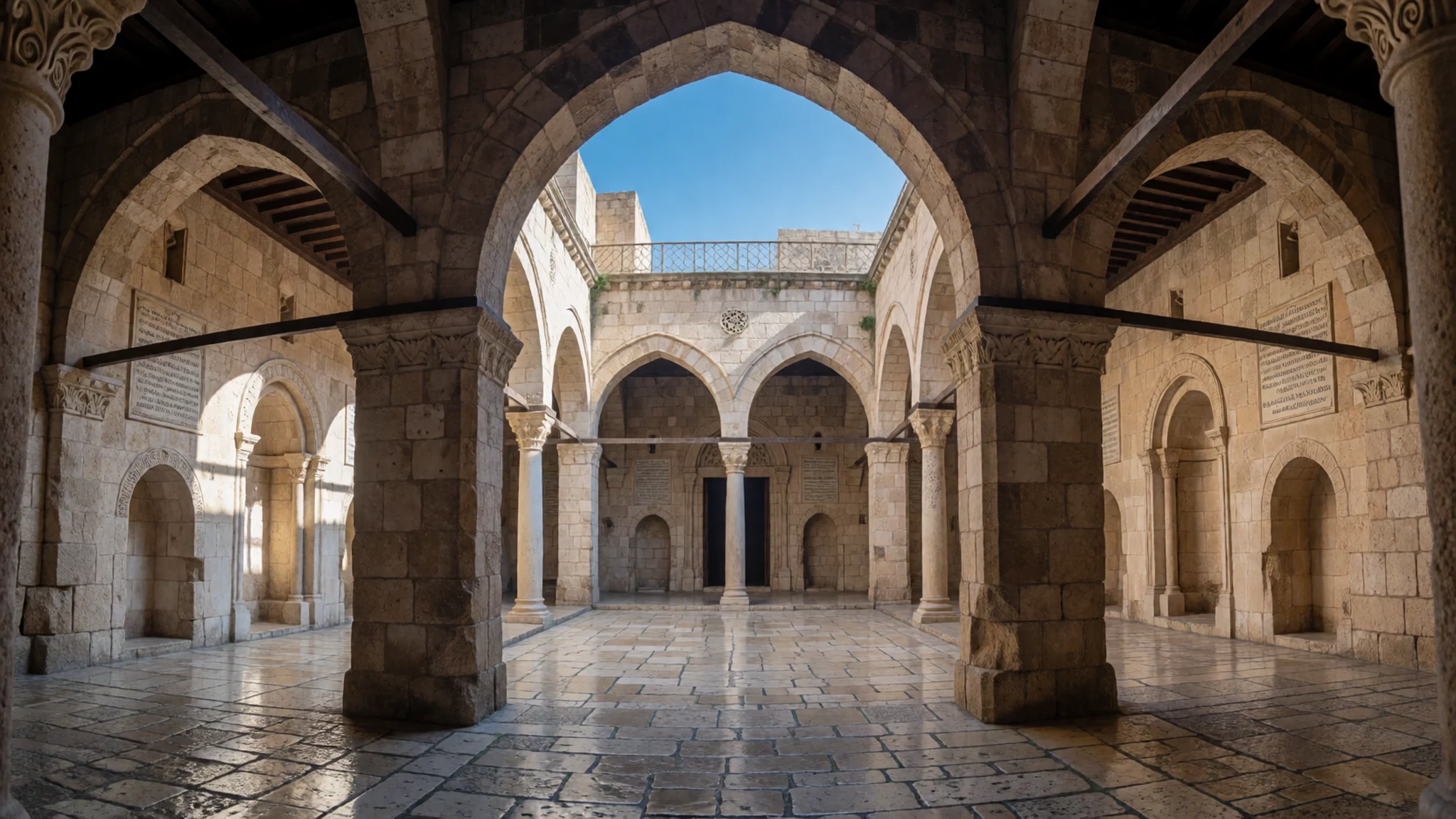
- National Museum of Aleppo — North of the old city
The National Museum of Aleppo, just north of the old core, holds the archaeological collection for the city. The building was hit in the war and most objects were moved away for safety. Repairs followed, and the museum has reopened. Galleries put the citadel and the region’s ancient kingdoms side by side. Check what is on show before a visit, because displays are still being rebuilt.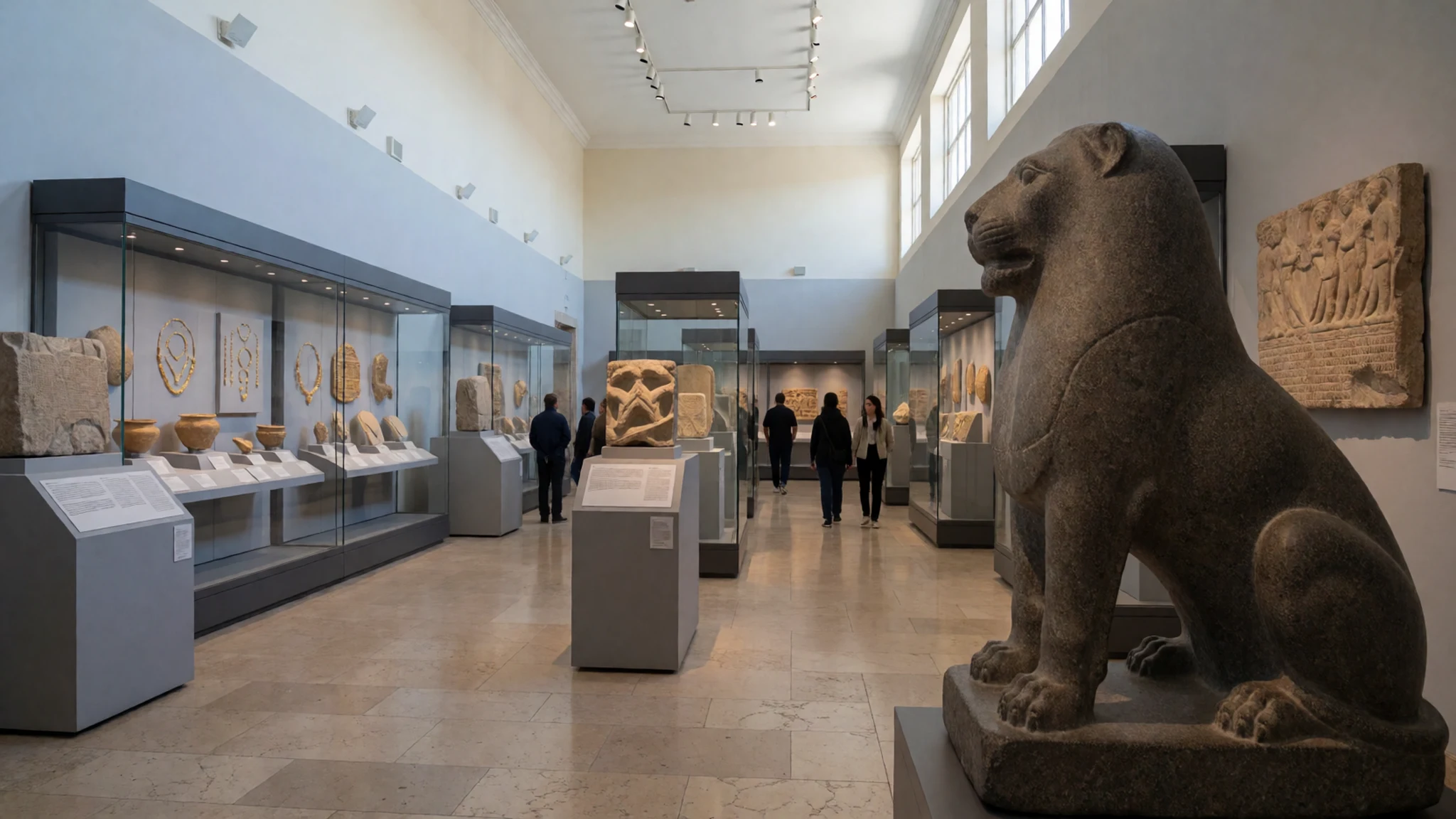
- Bimaristan Arghan — Old city
Bimaristan Arghan is a former hospital in Aleppo’s old city, built to care for people with mental illness and later opened as a museum. Rooms sit off a quiet courtyard, a domestic scale beside the grander mosques. It is a surviving hint that medicine was treated as a civic duty inside the walls, not only at a shrine. Ask on the day whether the doors are open.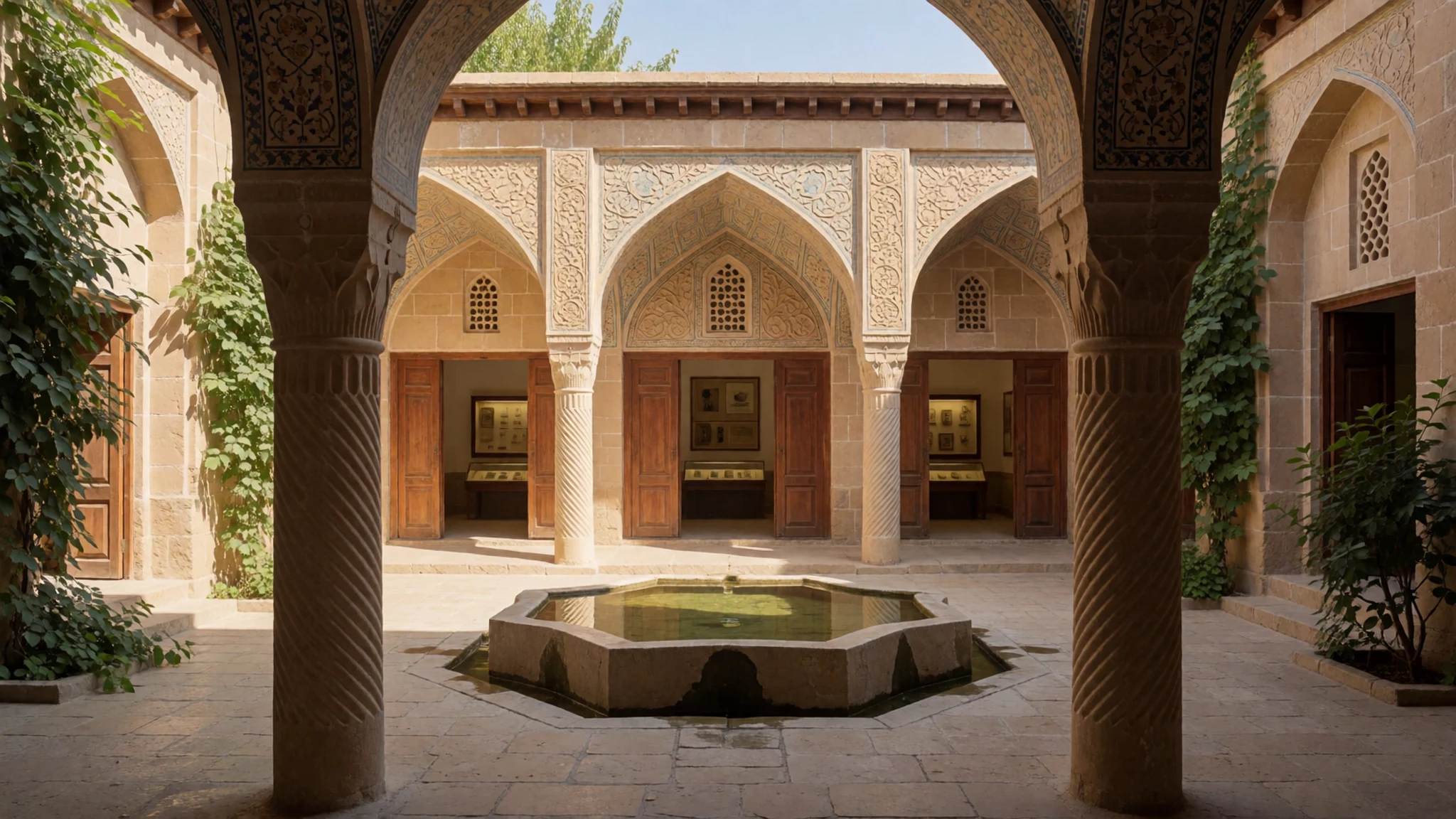
Culture
Aleppo treats music as a civic skill, not only as entertainment. The forms most closely tied to the city are the muwashshah, the qudud Halabiya and the wider maqam system, poetic settings that can be religious, worldly or folk. Listeners here have a reputation for knowing the difference: the sammi'a are listeners who know the art, and they are part of the performance, not a crowd that merely claps. Singers associated with this school include Sabah Fakhri, Sabri Mdallal, Shadi Jamil, Abed Azrie and Nour Mhanna, and performers from other Arab cities came to study the repertoire. The mood people still name is tarab, that held, attentive pleasure of classical song, and it belongs in courtyard houses as much as on a stage.
Public life in Aleppo has long included neighbours of different rites. The Great Mosque, the Maronite cathedral of Saint Elijah and the historic synagogue stand in the same old centre, and the musical repertoire itself moves between devotional and secular poems. A visitor who only looks at stone will miss the point of a gathering, where the honour sits with the listener who knows the verse. Market lanes are talkative; a mosque or a church courtyard is not.
Dress modestly and remove your shoes where a mosque entrance in Aleppo shows a step and a shelf for footwear, and ask before you photograph people at prayer.
What to wear
Aleppo’s traditional dress belongs to a cloth city. Silk and cotton were woven, dyed and sold in the souq, and a festive outfit was judged by the length and the weave as much as by the cut. For prayers and family occasions many men still wear a long jalabiya, sometimes with a plain jacket, and some older men add a keffiyeh. Women’s formal dress is modest and layered: a long coat or abaya, with a headscarf widely worn and embroidery kept for feasts. Tailors in the covered market still cut fabric by the piece, which is why the lanes of Aleppo still trade in cloth.
Daily clothes in Aleppo are ordinary city wear. Shirts, trousers and dark coats fill the avenues. The jalabiya comes out for the mosque, for home and for holidays more than for the office. A hijab with everyday clothes and a full abaya are both unremarkable.
A visitor should cover shoulders and knees in the old city and carry a scarf for mosques. Footwear matters more than fashion on the citadel bridge and the souq floors, which are worn stone, so closed shoes with a grip are the practical choice. Dress simply, in layers that can be added or removed, and leave beachwear for somewhere else.
What to eat
- Ful — Old-city bean stalls and neighbourhood markets
Ful is Aleppo’s usual breakfast, a stew of cooked fava beans served with bread. Bean stalls and plain eateries around the old city and in neighbourhood markets sell it in the morning, before the souq is busy. It is everyday food, the sort of bowl workers eat standing up.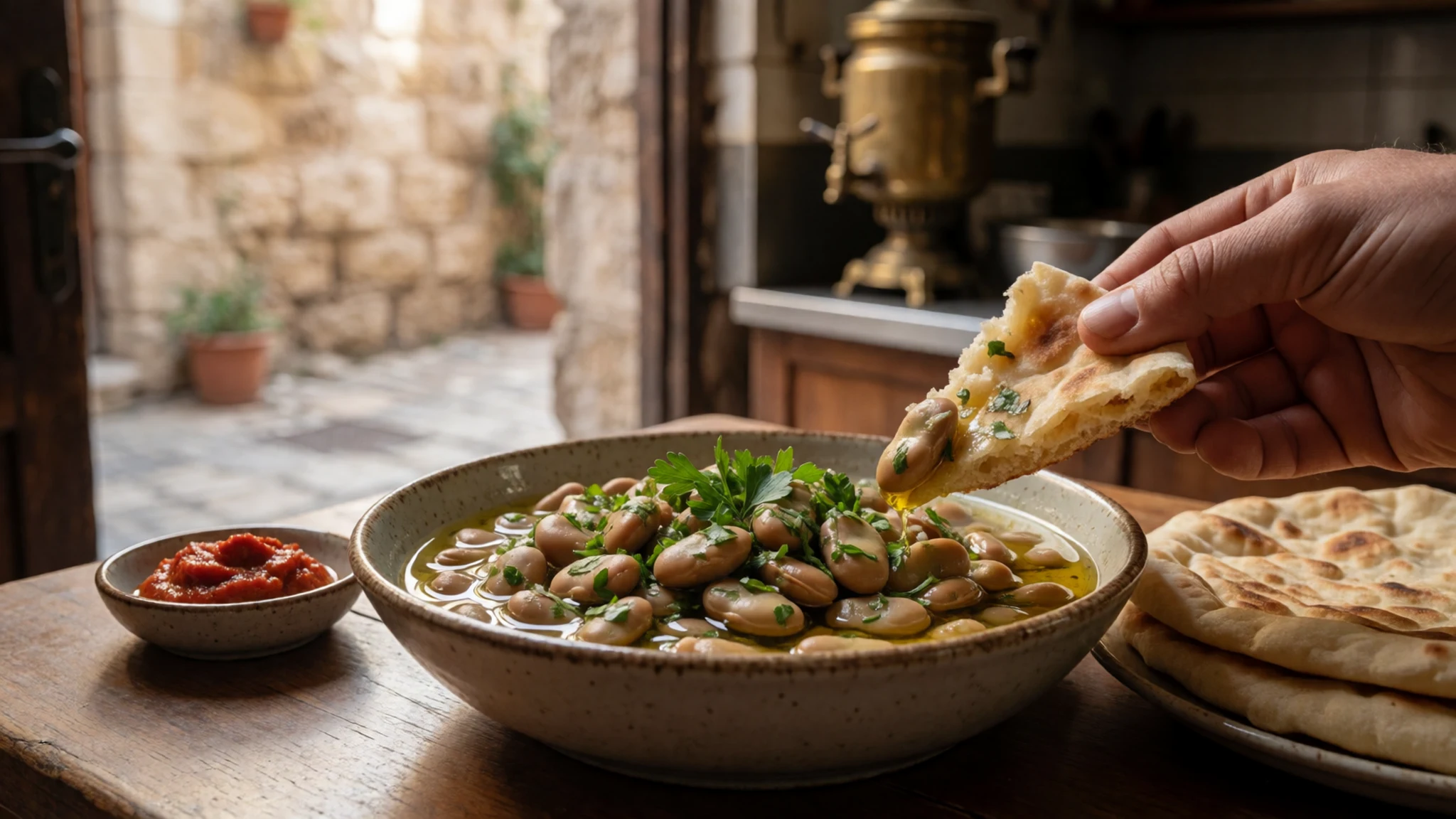
- Cherry kebab — Old-city courtyard eateries and grill houses
Cherry kebab is grilled meat in a cherry sauce, a sit-down dish of Aleppo rather than a street sandwich. Courtyard eateries and grill houses in the old city plate it with flatbread. Ask for it where kebabs are cooked to order, and expect a meal rather than a snack.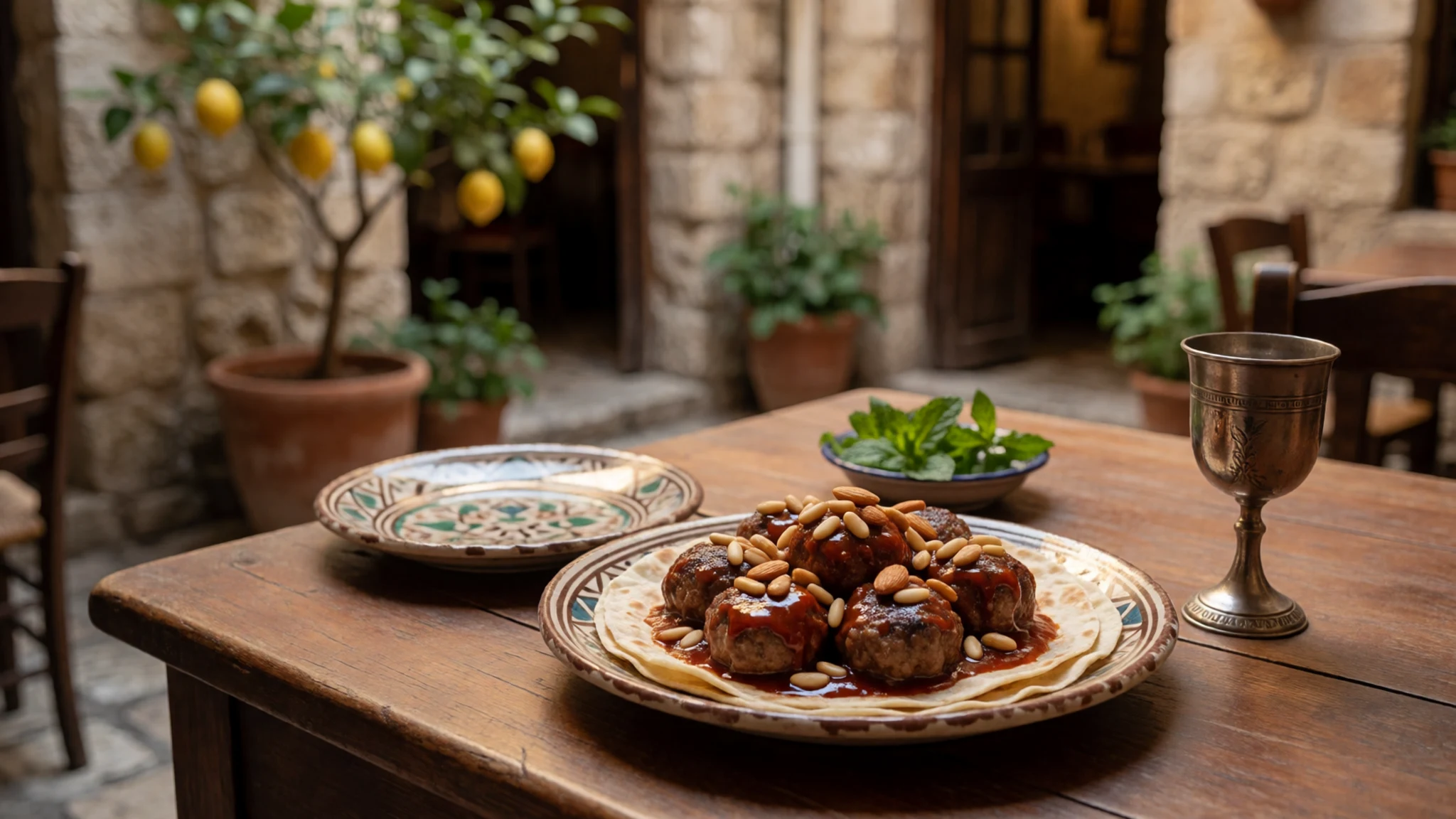
- Pistachio baklava — Sweet shops beside the souq and neighbourhood confectioners
Pistachio sweets come from the groves around Aleppo, and baklava is what visitors carry home. Sweet shops on the edges of the souq and neighbourhood confectioners sell it by the tray. Look for a filling that tastes of pistachio rather than a mixed nut paste. - Falafel — Street stalls from the old city to neighbourhood corners
Falafel in Aleppo is the usual street sandwich, chickpea fritters packed into bread with salad and tahini. Stalls sell it from the old-city lanes to ordinary neighbourhood corners. Eat it where the stand is busy with locals, which is the simplest way to choose. - Shawarma — Street grills on main roads and around the markets
Shawarma is Aleppo’s other street staple, meat turned on a spit and sliced into bread. Grills set up on main streets and around the markets. Chicken and lamb both appear. Choose a spit that is already turning, with a queue of locals.
Plan it
Best time. Go when you can be outdoors for several hours and, if you can choose, skip the worst of the summer heat in Aleppo. Check a current forecast before you book. Your government’s travel advice matters more than the season, because routes and security change.
How long. 3-4
Getting there. Aleppo’s airport has flights to regional cities including Istanbul, Doha, Dubai, Kuwait City, Amman and Jeddah, with carriers such as Turkish Airlines, Qatar Airways, Royal Jordanian, Jazeera Airways, SunExpress and SyrianAir. Some routes, including Turkish resort cities, run only in season. Long-haul journeys usually change planes at a hub such as Istanbul or Doha. Overland travel from Damascus is possible by bus or on your own, and buses from Gaziantep in Turkey also run, but check the latest visa rules and your own country’s travel advice before buying a ticket. Long-distance trains are cancelled. A local commuter run from Jibreen does not serve a sightseeing trip.
Budget. low
Tips
- Read your government’s travel advice and the visa rules before you book, because the security picture changes.
- Stay out of damaged buildings, especially in Salaheddin and the streets around it, because structures still collapse.
- Treat flight schedules as provisional, and confirm any seasonal route before you travel.
- Do not plan on long-distance trains; they are cancelled, so use air or a bus for the last leg.
- For municipal notices, start at https://alp-city.sy/ and confirm museum opening on the day itself.
Etiquette
- Remove shoes at mosque doors in Aleppo and dress so shoulders and knees are covered.
- Ask before you photograph people, especially at prayer or in the souq.
- Keep voices low inside mosques, churches and the synagogue.
Nearby
Sources
- Wikidata Q41183 (CC0)
- Wikipedia (rev 1382950311) (CC BY-SA 4.0)
- Wikivoyage (rev 5346289) (CC BY-SA 4.0)
- photos/01-aleppo-view-of-the-city-syria.jpg (CC BY 4.0)
- photos/02-aleppo-old-city-image.jpg (CC BY 2.5)
- photos/03-aleppo-citadel-entrance-seen-from-southeast-9933.jpg (CC BY-SA 4.0)
- photos/04-aleppo-suq-alp.jpg (CC BY 3.0)
- photos/05-aleppo-grand-seray.jpg (CC BY 2.5)
- photos/06-the-great-umayyad-mosque-in-aleppo-at-night.jpg (CC BY 3.0)
- photos/07-saint-elijah-maronite-cathedral-aleppo-4.jpg (CC BY 2.5)
- photos/08-aleppo-queik-river.jpg (CC BY 2.5)


