Yamoussoukro
Yamoussoukro, Ivory Coast
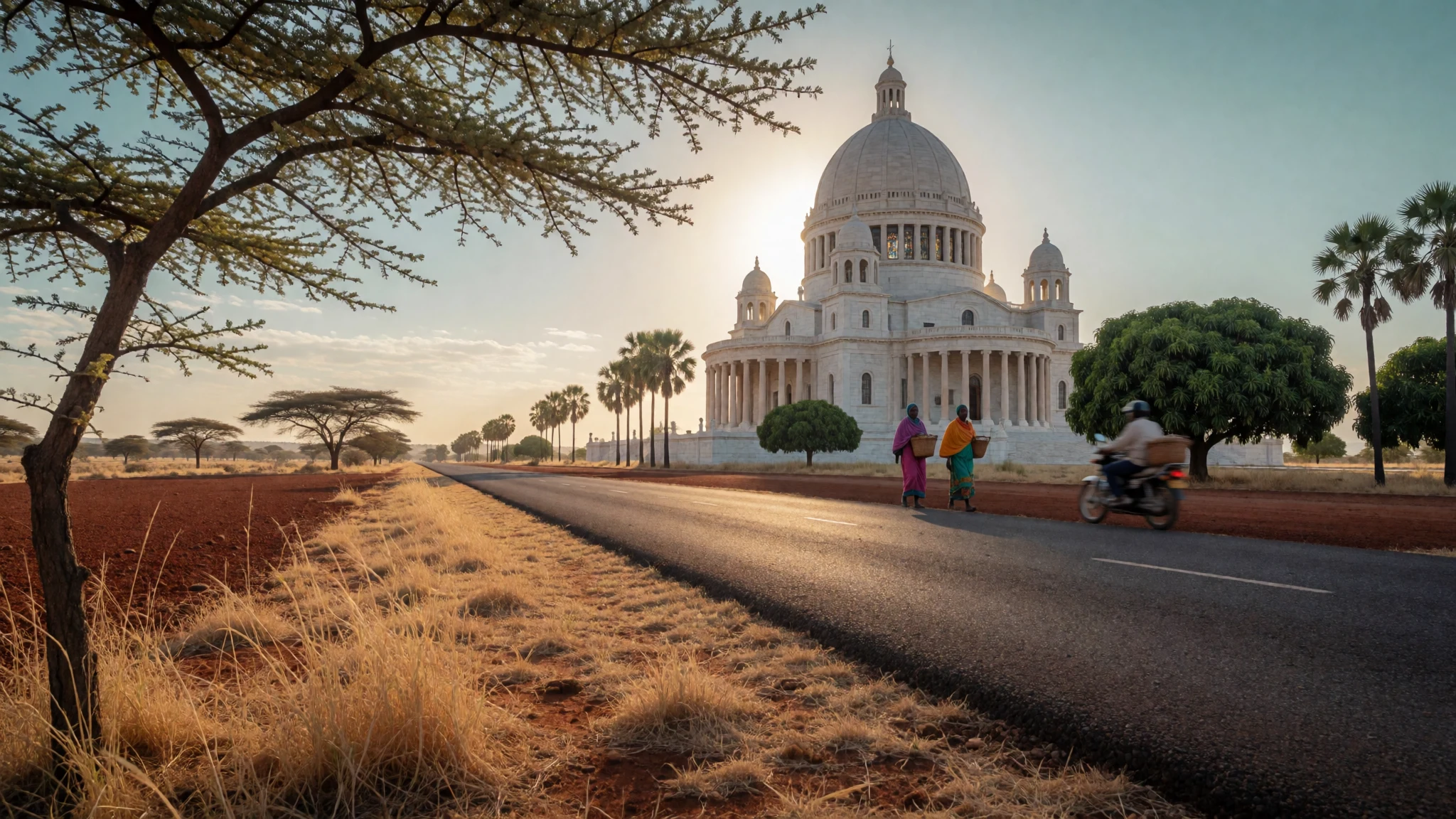
Yamoussoukro is a calm, spacious capital where one president's grand ambitions left a giant basilica, wide boulevards and an easy stop between Abidjan and the north.
The place
Yamoussoukro is the political capital of Ivory Coast, yet it feels more like a provincial town laid out on a grand scale. About a third of a million people live here, around 214 m above sea level, among rolling hills and plains in an autonomous district rather than an ordinary region. Abidjan, the big coastal city, still handles much of the country's business and many government functions, so ministries and embassies mostly sit there. The result in Yamoussoukro is wide, quiet boulevards, roundabouts built for far more traffic than they carry, and long gaps between landmarks. Distances suit cars and motorbike taxis better than walking. The city lies north-west of Abidjan, joined to it by a good toll motorway, and the land around it is farmed: plantations, market gardens and fishponds. Heat is constant. The year divides into a long wet season from March to October and a shorter dry one, shaped by the harmattan, a dry Saharan wind that brings haze and cooler nights. Rain is lighter than on the coast. Daily life gathers around the bus station, where hawkers work the stopped vehicles, around a handful of markets, and along riverbank eateries. Local industry is modest, with fishing, forestry and perfume named as the main activities. Visitors should expect space, calm and a few extraordinary buildings rather than a dense old quarter. It suits people who enjoy unusual urban planning and want a slow stop on the road between the coast and the north.
Its story
Yamoussoukro's name holds much of its early history. The village was once called N'Gokro; it took the name of Queen Yamoussou, a niece of the chief Kouassi N'Go, with kro meaning town in Baoulé. Stone tools found across the country show that people have lived in this region for hundreds of thousands of years, and many groups drifted south as the Sahara dried. Under French rule the area saw tension. The Akoué rose against the administration, a nearby station was burned, and the French moved their military post to Yamoussoukro. They built a pyramid there in memory of Kouassi N'Go, who was killed by rebels angry that he stood too close to the French. For decades afterwards the place stayed a small farming town. Félix Houphouët-Boigny became leader of the village before the Second World War, and a few hundred people lived here at mid-century. Independence changed everything. As president, Houphouët-Boigny began building on a large scale, and one day in 1965 he toured the plantations with local leaders, a visit later remembered as the Great Lesson of Yamoussoukro, urging them to copy its farming successes in their own villages. He later gave his plantations to the state. In March 1983 he made his birthplace the political and administrative capital, the fourth capital of the country in about a century after Grand-Bassam, Bingerville and Abidjan.
What to see
- Basilica of Our Lady of Peace — South-west of the centre
Houphouët-Boigny's most striking legacy is this basilica, whose dome and colonnade can be seen across the savannah from far outside town. It is built on a huge scale, though far fewer people can sit inside than its size suggests. Visit in the morning, cover shoulders and knees, and check access with the official site first.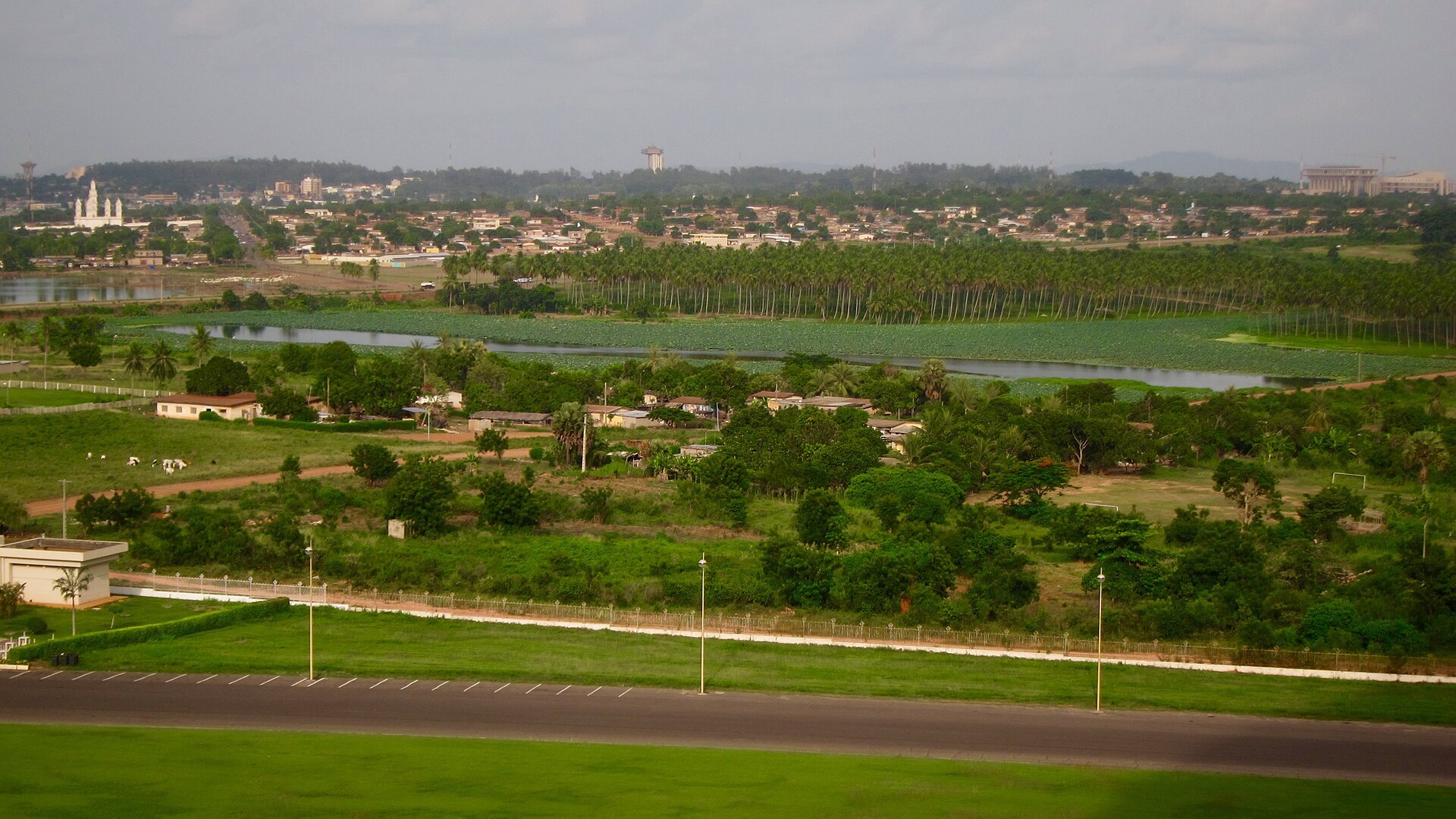
- Saint Augustin Cathedral — City centre
A much smaller cathedral in the city centre, and a useful counterweight to the basilica. It serves as an ordinary parish church for the local Catholic community, so the pace is gentler and the setting more human. Time a visit outside service hours and keep voices low if people are praying. - Fondation Félix Houphouët-Boigny — Central Yamoussoukro
This foundation is one of several institutions that grew out of public spending during the president's years in power. It is best treated as a way to understand the ambitions behind the capital rather than a quick photo stop. Opening arrangements change, so ask locally or check before making the trip. - Public gardens and the old Presidential Palace — Government quarter
Landscaped gardens and the former presidential residence show how the capital was imagined as a showpiece. Parts of the area around official buildings can be restricted, and guards may object to cameras, so ask before photographing. Late afternoon is cooler and softer for a stroll through the gardens. - Stadium — East of the centre
Home to the national football team, the stadium is the place to feel the country's most shared passion. Match days draw crowds, noise and street food. On quiet days it is mainly a landmark to see from outside, so check fixtures locally before planning an evening around a game.
Culture
Yamoussoukro sits in Baoulé country, and the town's name itself comes from the Baoulé language. The Baoulé are known across Ivory Coast for weaving, carving and gold-work, and their customs still shape funerals, naming ceremonies and village chieftaincy here. French is the common language of offices, schools and signs, while Baoulé is heard in markets and homes. Christianity, especially Catholicism, is strongly visible. The basilica and cathedral are the most obvious signs, but churches of many kinds fill the neighbourhoods, and Sunday morning is lively with services and finery. Football is the other shared passion, and conversation about the national team opens doors easily. Greetings matter. People expect a proper exchange, a handshake and questions about health and family, before any business such as bargaining or asking directions. The city's identity is also bound up with one man. Félix Houphouët-Boigny led the country at independence and made his birthplace the capital, so opinions about him run from deep affection to criticism of the money spent on grand projects. Listening is wiser than arguing. Daily rhythms are slow in the midday heat, and shops often pause or quieten between the hottest hours. Ask permission before photographing anyone, and do not photograph soldiers, police or government buildings, where guards may stop you.
What to wear
Traditional dress in Yamoussoukro follows Baoulé custom: wrapped cloths called pagnes, worn by women as skirts and shawls, and by men draped over the shoulder in the manner of a toga. Woven cotton cloth made in narrow strips and sewn together is prized for funerals, weddings, chieftaincy events and festivals, while factory wax-print cotton, bright with bold patterns, is the everyday fabric of choice. Gold jewellery and beads add finish for important occasions. Day to day, many people wear a mix. Women often have outfits tailored from pagne, with fitted tops and matching head wraps, and men wear shirts with trousers or a boubou, a loose gown, for church and celebrations. Jeans, football shirts and trainers are common among younger people, and smart dress matters for Sunday services. Tailors are everywhere and will make an outfit from a market length of cloth. Visitors should dress for heat and humidity: light cotton or linen, a hat and sunglasses, and sandals or closed shoes that cope with dust and wet roads. Shoulders and knees should be covered at the basilica and cathedral, and modest clothes help in markets and villages. In the wet season, carry a light rain jacket, and in the dry season, a scarf helps against harmattan dust.
What to eat
- Attiéké with grilled fish — Riverbank eateries and neighbourhood open-air restaurants
Fermented cassava grains, steamed to a light, slightly sour couscous, served with grilled fish, onions and tomato. This is a staple of Ivorian everyday eating, found in casual open-air eateries and on riverside tables. - Poulet braisé — Roadside grill stalls and evening street corners
Chicken marinated and grilled over charcoal, usually served with onions, chilli sauce and either attiéké or fried plantain. The smoke gives away the stalls from a distance, particularly in the evening. - Alloco — Street vendors around the bus station and markets
Ripe plantain cut into pieces and fried until caramelised, served hot with a spicy tomato and onion sauce, often alongside eggs or fish. It is a cheap, filling snack at any time of day. - Kedjenou — Sit-down local restaurants and family-run eateries
A slow-cooked stew of chicken or guinea fowl with vegetables and spices, traditionally sealed in a pot and shaken rather than stirred. It is rich, gently spiced and usually eaten with rice or attiéké. - Foutou with sauce — Local eateries and home-style restaurants, usually at lunchtime
Pounded plantain and cassava made into a smooth, stretchy dough, eaten by hand with peanut, palm-nut or other sauces. Baoulé homes treat it as a celebration dish, and some local eateries serve it at midday.
Plan it
Best time. November to February, in the shorter dry season, when roads are easier and the heat is more bearable, though the harmattan can bring dusty haze. March to October is the long wet season, with lighter rain than on the coast.
How long. 1–2
Getting there. Fly to Abidjan, then take a bus, shared car or private car north-west to Yamoussoukro on the good toll motorway, which takes a couple of hours by car and somewhat longer by bus. There is no rail service to the city; the nearest station is at Dimbokro, east of Yamoussoukro. The road from Bouaké is rougher.
Budget. mid
Tips
- Start sightseeing early, because the midday heat is strong and everything slows down
- Carry cash in small notes, since cards are rarely used outside larger hotels
- Agree a fare before getting into a taxi or onto a motorbike taxi
- Drink bottled or filtered water and carry a hat, sunscreen and insect repellent
- Check opening and access for the basilica and public buildings on the official district website
Etiquette
- Cover shoulders and knees at churches and religious sites
- Greet people properly before asking for help or starting a transaction
- Ask before photographing people, soldiers or government buildings
Nearby
Sources
- Wikidata Q3768 (CC0)
- Wikipedia: Yamoussoukro (rev 1382831748) (CC BY-SA 4.0)
- Wikivoyage: Yamoussoukro (rev 5299453) (CC BY-SA 4.0)
- Photo: Inphb de Yamoussoukro (Bosson), Honoré Bosson (CC BY-SA 4.0)
- Photo: Yamoussoukro panorama, Mickaël T. (CC BY 2.5)
- Photo: Yamoussoukro, arno B (CC BY 3.0)
- Photo: Yamoussoukro - Escale de bus, WILLAV-FR (CC BY-SA 4.0)
- Photo: Agama agama, Fabricio Cardenas (CC BY-SA 4.0)
- Photo: The golf in Yamoussoukro, Fabricio Cardenas (CC BY-SA 4.0)
- Photo: Abattoir de volaille, BeraDigle (CC BY-SA 4.0)
- Photo: Apôtre KPAN René, Yankopicture (CC BY-SA 4.0)


