Tsaritsyno
Tsaritsyno, Russia
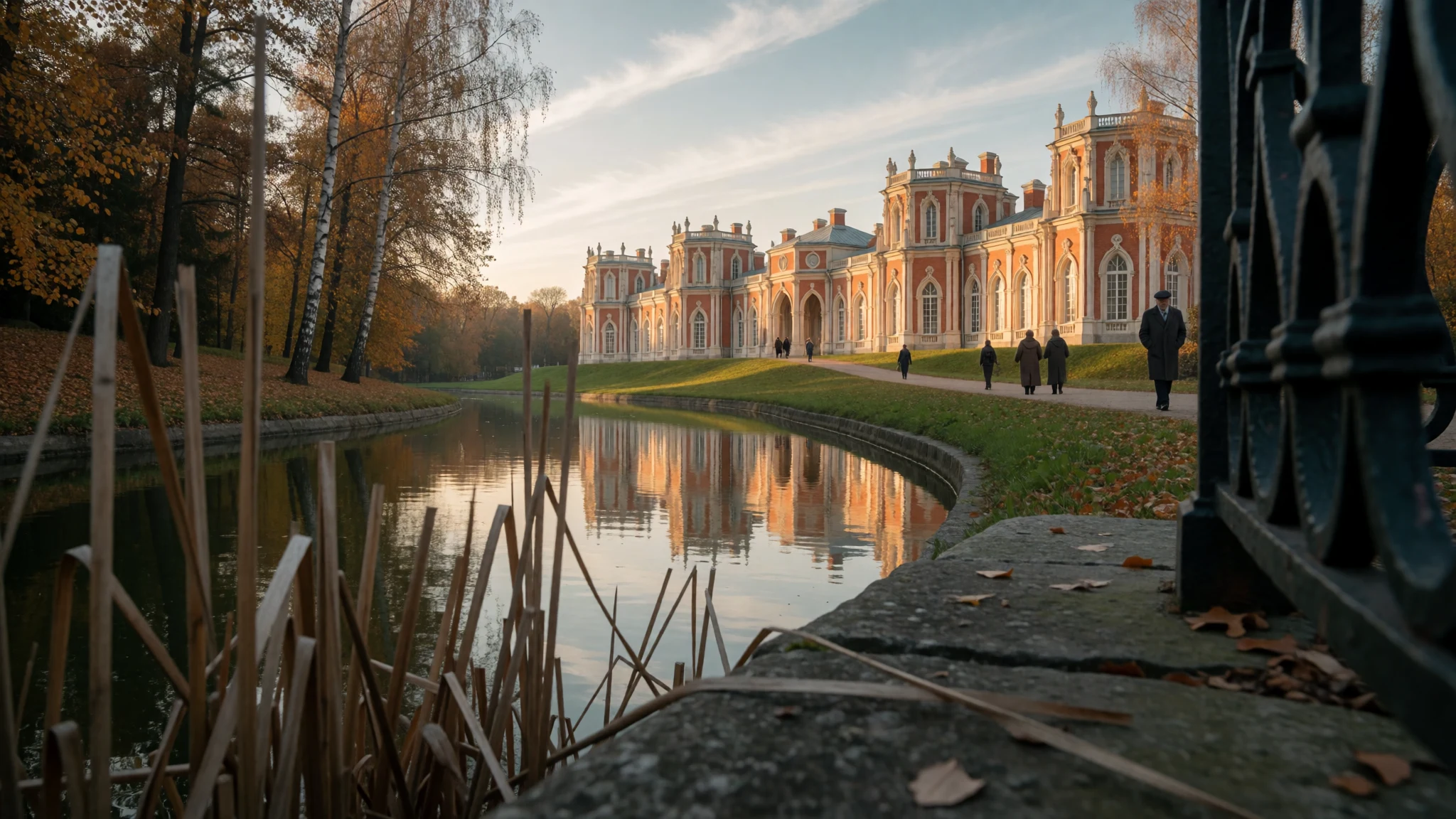
Tsaritsyno is a Moscow palace-park that Catherine II never finished, left as ruins for generations, then rebuilt to its architect's plans.
The place
Tsaritsyno lies on the southern edge of Moscow, an estate whose name points to a tsaritsa's own land. It began as a summer retreat for Catherine II and was founded in 1776. The empress never saw it finished, and for much of its later life it survived as an overgrown park scattered with romantic ruins. Restoration in recent decades brought the palace back according to the original drawings, and the site now works as a museum complex and a place where Muscovites come to walk, picnic and linger by the water. The estate was conceived as a small town rather than a single building, so a visit means moving between separate structures: a large palace, a smaller one, service blocks, gateways, bridges and pavilions, all threaded through landscaped grounds and ponds. The architecture mixes Gothic motifs, Moscow Baroque and Classical order, which is why the red brick with pale stone trim looks so different from the Kremlin or the Stalinist towers elsewhere in the city. Around it, Moscow is a vast metropolis on the Moskva River, and Tsaritsyno makes a calm half-day away from the dense centre. Weekends are the busiest, with families and wedding parties posing in front of the palace; weekday mornings are quieter. Winters are cold and paths can be icy, while summer suits long unhurried walks. Some interior signs and displays are in Russian only, so a translation app helps. The grounds are big enough that many people see only one corner, and the paths beyond the main palace repay the extra walking.
Its story
The land at Tsaritsyno had owners long before it had a palace. It was once tied to the village of Bogorodskoye and belonged to Tsaritsa Irina, sister of Tsar Boris Godunov. Over the following centuries it passed between noble families, among them the Streshnevs and the Galitzines, until it reached Prince Cantemir. Catherine the Great bought it from him and chose it as a country residence. Its position mattered: at that time it lay in open country outside Moscow, close enough for the court to reach easily. She gave her court architect, Vasily Bazhenov, the task of designing a summer residence there. Bazhenov did not draw a single house. He planned a miniature town in a blend of Neo-Gothic, Moscow Baroque and Classical styles, and he played with geometry: pavilions set out in the form of a cross, a palace curved like a semicircle, a kitchen block shaped as a square with softened corners. Inside, round, oval and half-oval halls were fitted among rectangular ones. The work was never completed. Through the years of the Russian Empire and then the Soviet Union, the buildings stood as a half-abandoned park of picturesque ruins, and nineteenth-century paintings and watercolours show the palace and its gallery as a ruin among trees. Only modern restoration, following Bazhenov's plans, brought the palace back as a finished building, so the ensemble seen today is partly old fabric and partly a careful reconstruction.
What to see
- The Grand Palace — Central grounds, Tsaritsyno Park
The restored Grand Palace is the centrepiece, rebuilt after Bazhenov's original plans and now used as a museum. Its red brick and white stone detail shows the Gothic-meets-Baroque mix he intended. Check the official site for current exhibitions and opening arrangements before planning the day around it.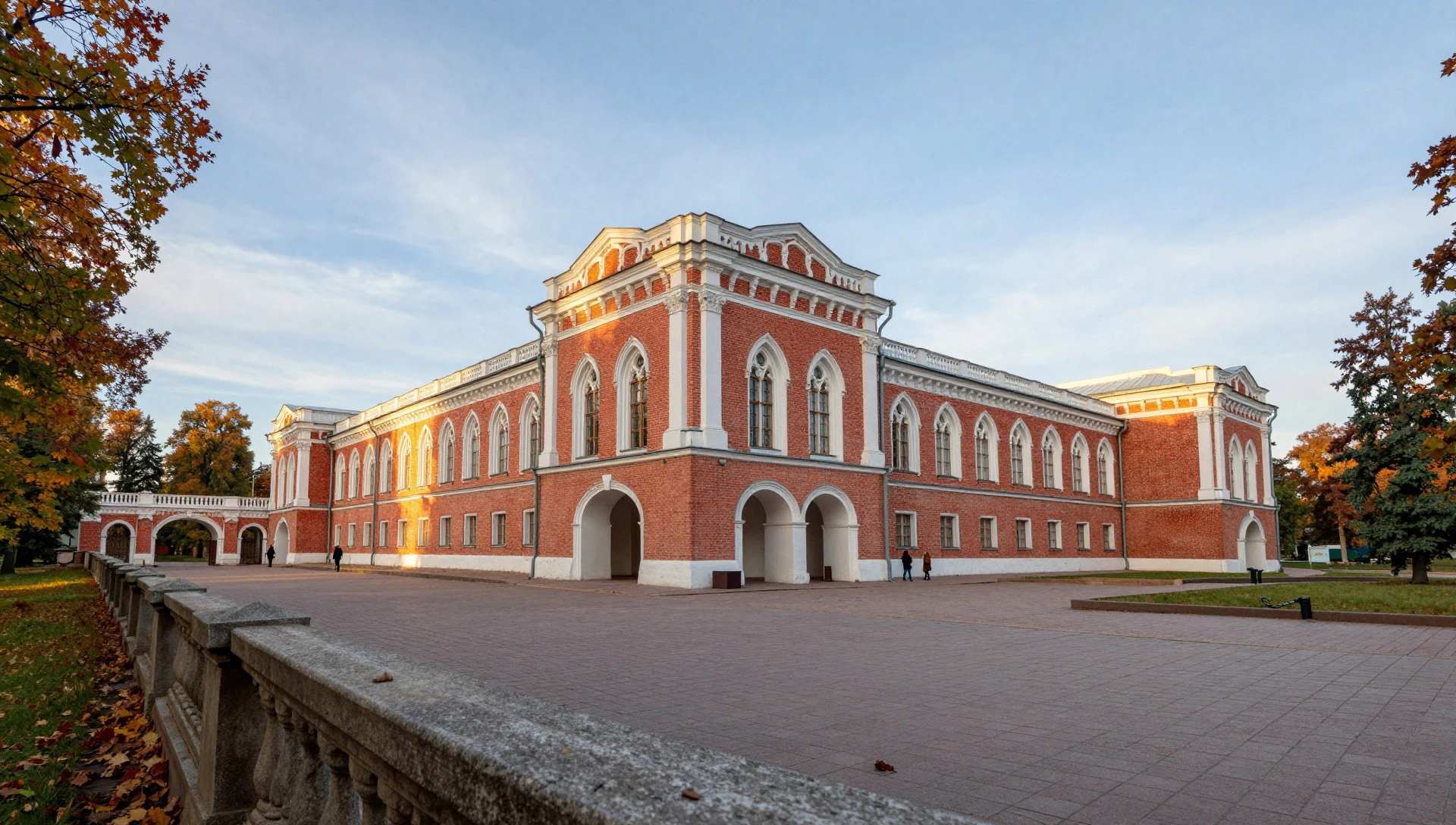
- The Bread House — Near the main palace
The Bread House is one of the service buildings, and its wall carries a relief of a loaf with a salt cellar on top, the traditional Russian sign of welcome. It is a small detail that shows how even practical blocks were decorated with care and symbolism.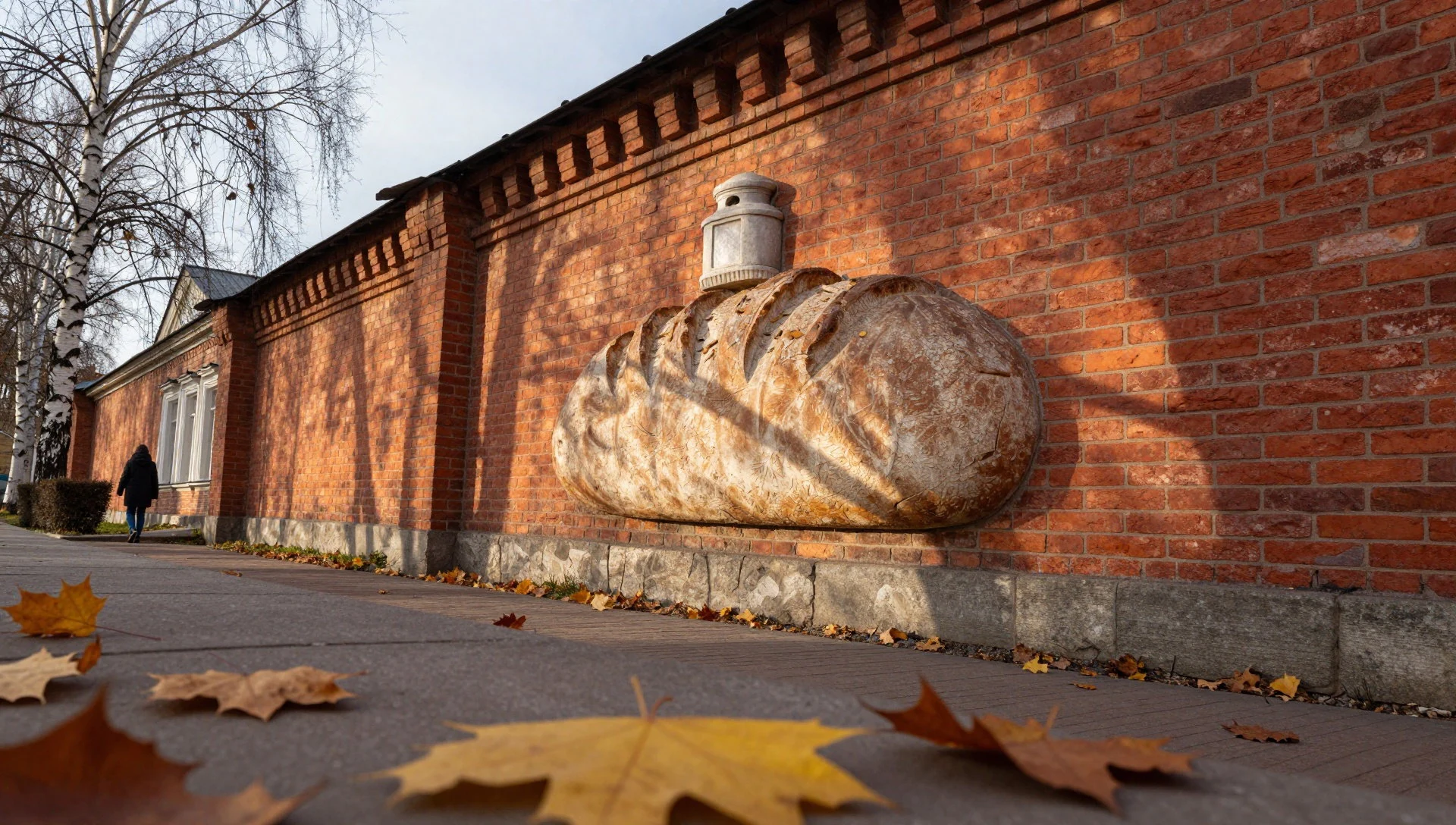
- The Small Palace — Beside the Grand Palace
The Small Palace is laid out as a semicircle, one of the geometric shapes Bazhenov used to give the estate its odd, playful rhythm. Look for the emblem above the entrance, then walk around the curve to see how the halls inside follow the same logic.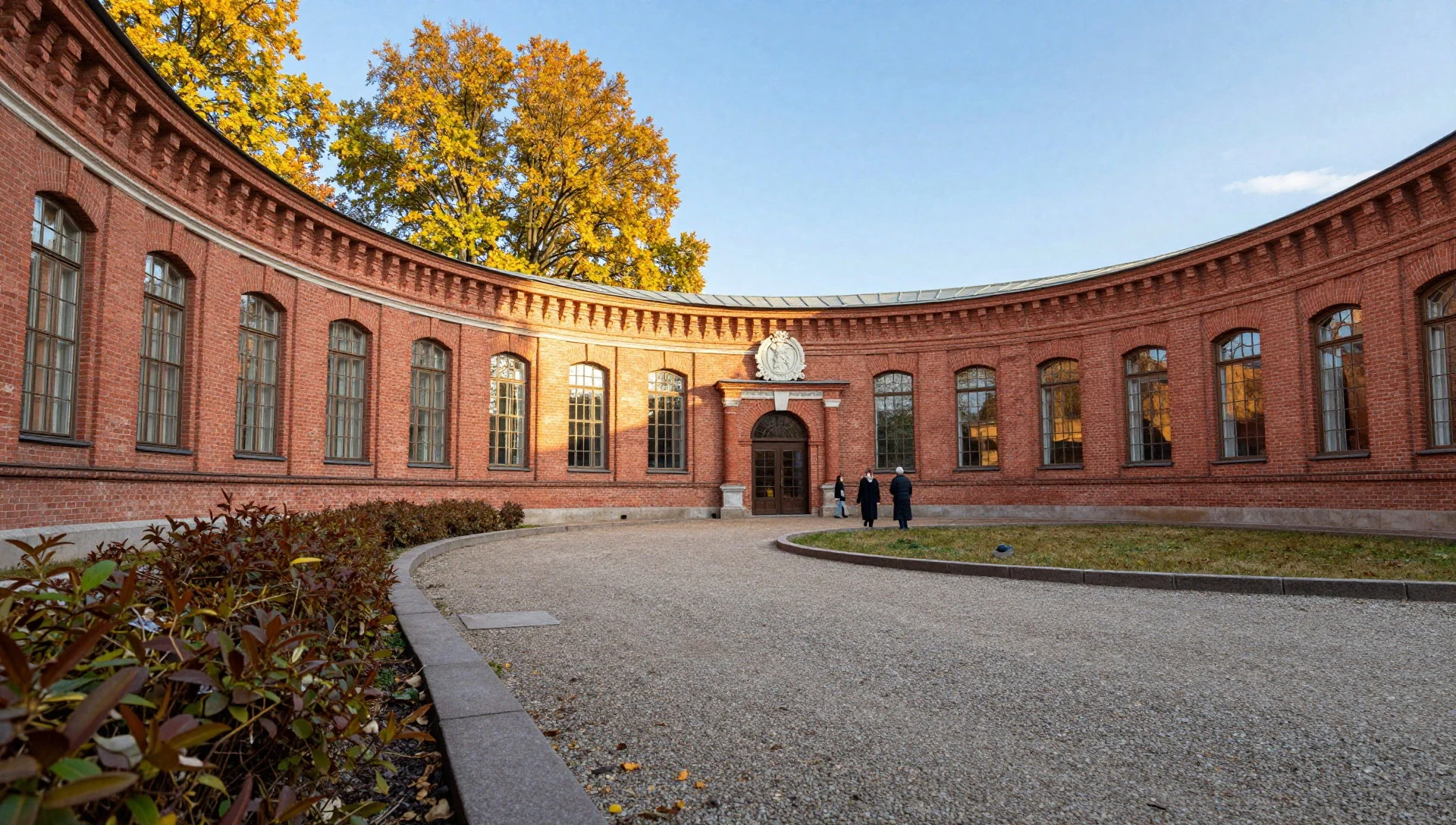
- The Kitchen Building — Central grounds
The Kitchen Building is a square with rounded corners, a plain-sounding function dressed in the same brick and stone as the palaces. It shows that Tsaritsyno was planned as a whole town, with working buildings given as much thought as ceremonial ones.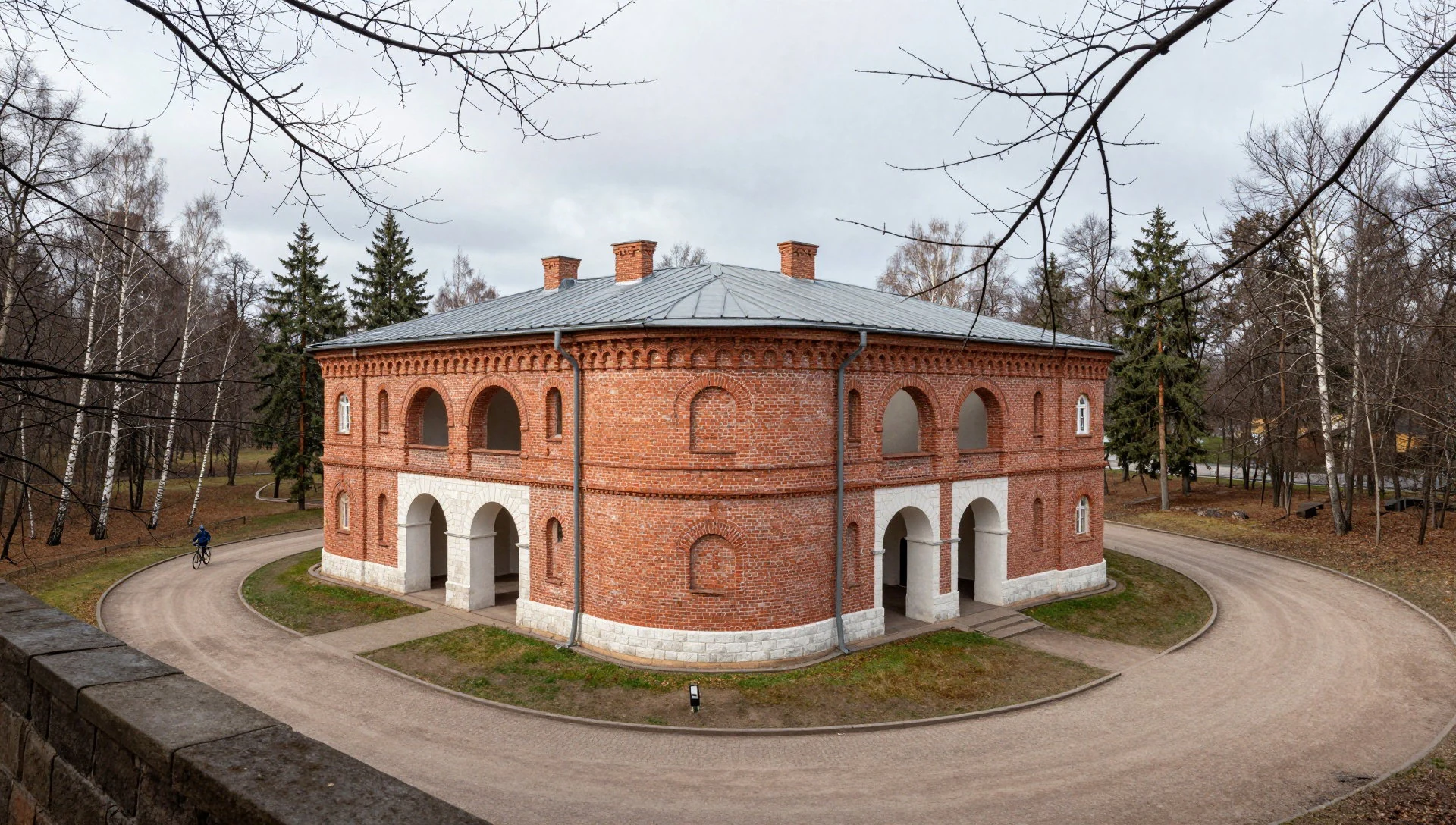
- The park and ponds — Whole estate, southern Moscow
The landscaped park and its ponds are the best way to see the ensemble from a distance, with paths looping past pavilions and gateways. Muscovites come here to stroll, cycle and rest on the grass, and the far corners are noticeably quieter than the palace forecourt.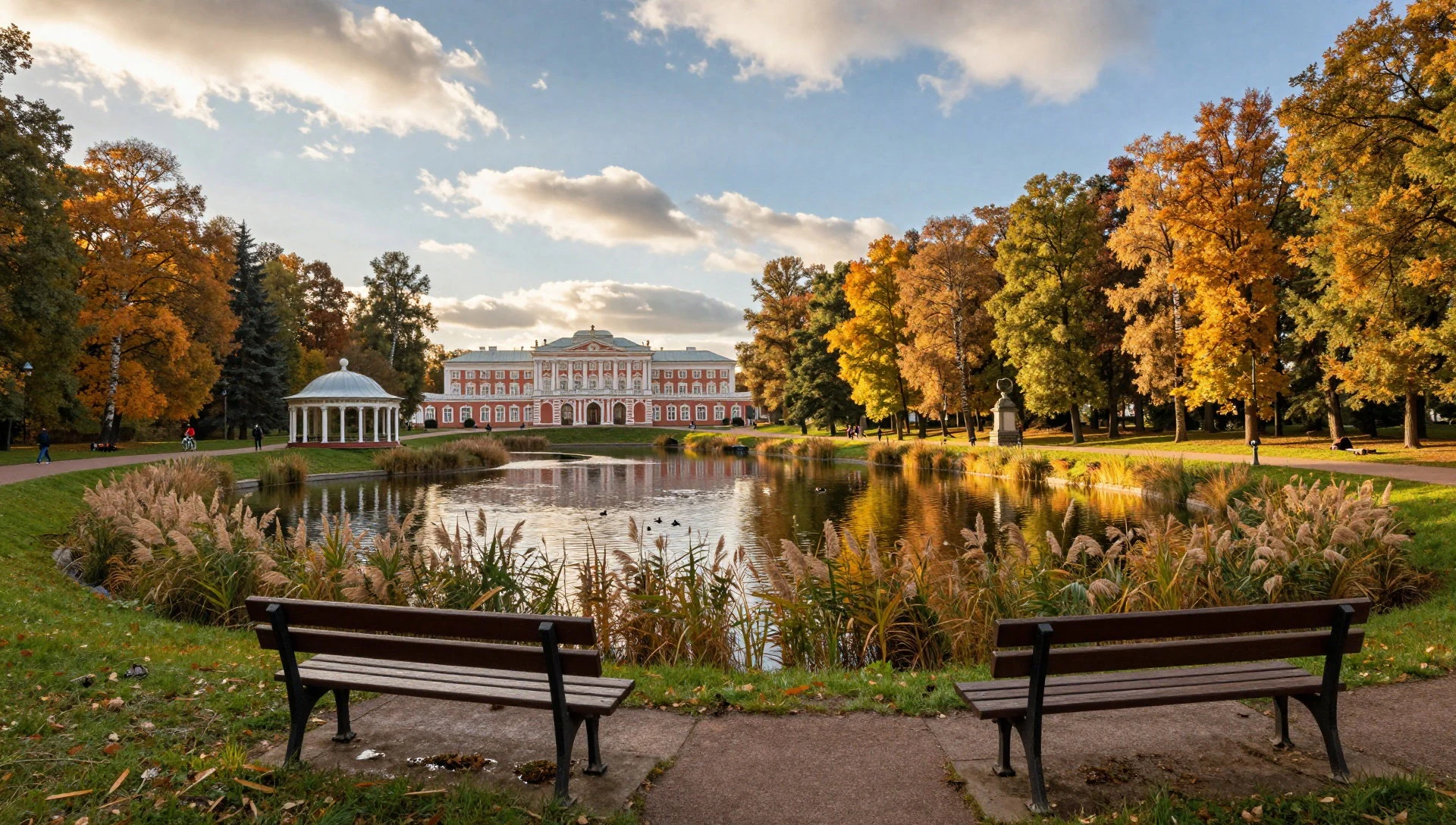
Culture
Tsaritsyno reflects the taste of Catherine II's court, which looked to Gothic and Baroque forms and tried to blend them with older Russian ones. Bazhenov's buildings are a statement of that imperial ambition, and the unfinished state of the estate for so long is part of its character: Russians have often treated it as a romantic ruin as much as a monument. Today the park carries a different kind of culture, that of ordinary Moscow leisure. Families walk the paths on weekends, couples pose for wedding photographs in front of the palace, and older visitors sit with flasks of tea by the water. Museums in the palaces present history, decorative arts and temporary exhibitions, mostly with Russian labelling, so patience and a phone translator are useful. The restoration itself is part of the story, and people hold differing views on whether a rebuilt palace can stand in for an original. Russian visitors often speak quietly indoors and expect cloakroom drop-offs for coats and large bags. Tipping in cafés is customary but modest. Keep to the marked paths, follow the signs about where photography is allowed inside the museum rooms, and ask before photographing wedding parties or strangers.
What to wear
Traditional Russian dress at its most familiar is the sarafan, a sleeveless dress worn over a linen or cotton shirt called a rubakha, often finished with a kokoshnik headdress embroidered in thread and beads. Men wore the kosovorotka, a shirt fastened at the side, with a woven belt. Wool shawls printed with flowers, such as those from Pavlovsky Posad, and fine knitted shawls were prized for winter. Felt boots called valenki kept feet warm in deep snow. These garments now appear mostly at folk festivals, on stage and in costume displays, including museum exhibits connected to the imperial period. Day to day, Muscovites dress smart-casual: dark coats and boots in winter, down jackets, fur or knitted hats and scarves, then lighter layers and trainers in summer. People tend to dress neatly even for a park walk. A visitor should wear comfortable, grippy shoes for the long paths, with winter boots and gloves in the cold months and a waterproof layer for rain. In summer, a sun hat and light clothes are enough, though evenings can be cool. Palace interiors are heated, so wear layers that are easy to remove. Modesty rules are relaxed in the park, but women visiting a working church nearby should carry a scarf to cover the head and keep shoulders covered.
What to eat
- Borscht — Stolovaya canteens and lunch cafés near the park
Borscht is a beetroot soup, often served with sour cream and dark bread. It is a staple of Russian home cooking and appears on most lunch menus. Look for it at canteen-style eateries and café lunch specials around the park and nearby metro stations.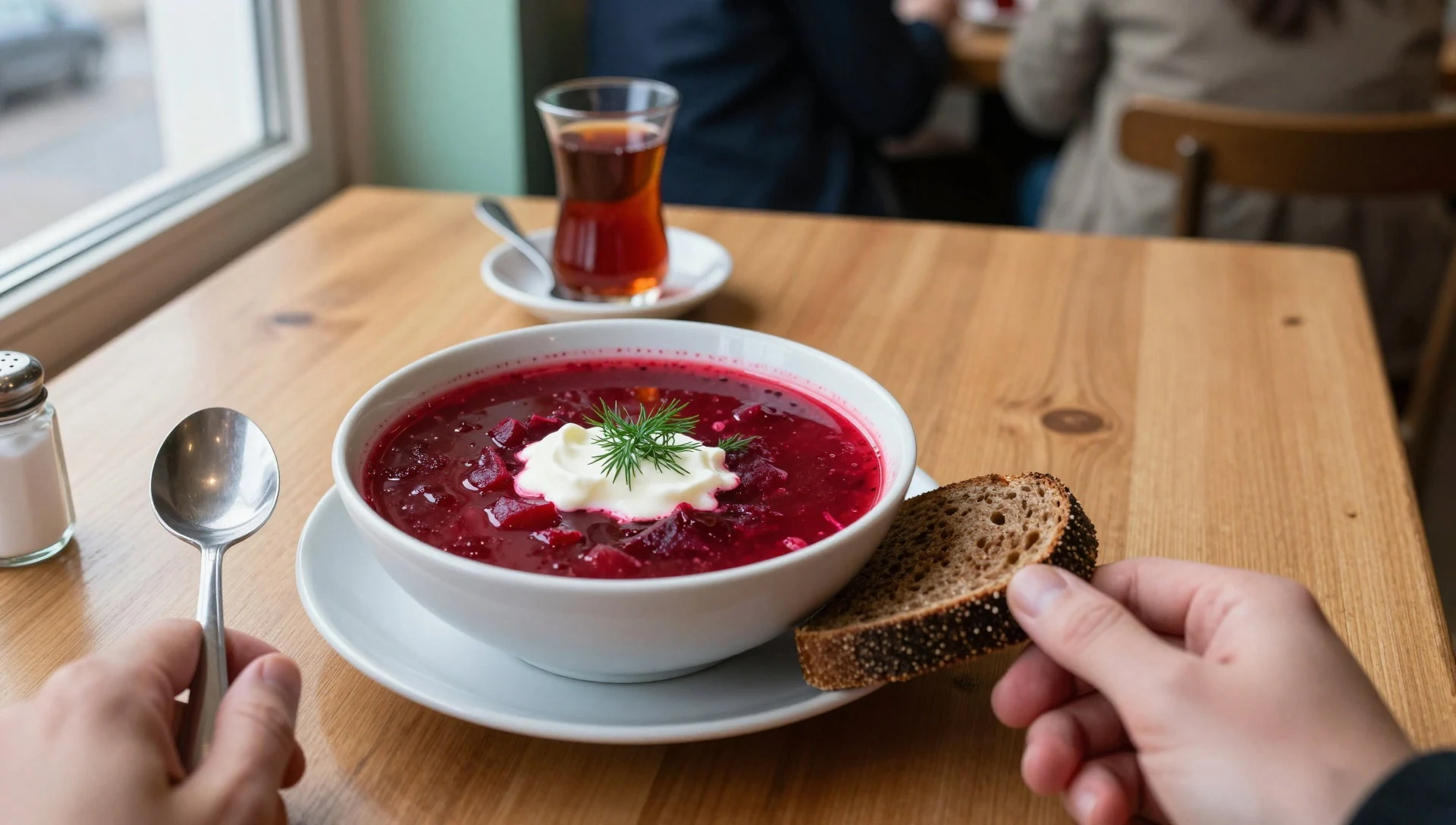
- Pelmeni — Casual Russian restaurants in southern Moscow
Pelmeni are small dumplings filled with meat, boiled and served with butter, vinegar or sour cream. They are comfort food on cold days, and a good choice after a long walk through the grounds. Many casual Russian restaurants make their own.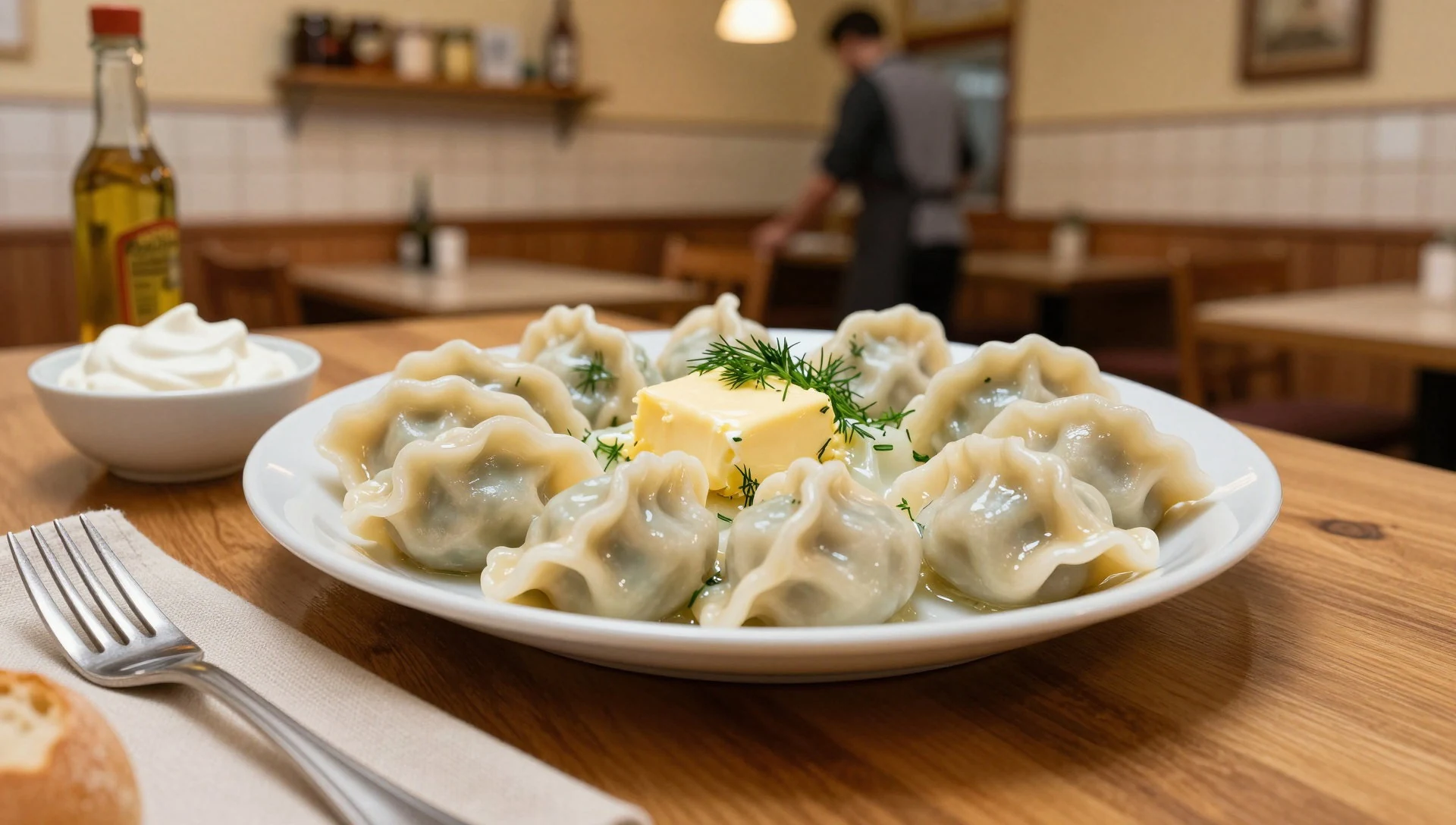
- Blini — Park kiosks and pancake cafés
Blini are thin pancakes, served with sour cream, jam, caviar substitutes or savoury fillings. They suit a light snack between sights. Kiosks and café windows around Moscow parks often sell them hot, and they are a pleasant way to warm up in the cooler months. - Khinkali — Georgian restaurants in the surrounding neighbourhoods
Khinkali are Georgian dumplings with a twisted top, filled with spiced meat and broth. Caucasus food is common across Moscow, and restaurants that focus on a single region tend to be better than those promising a bit of everything. Eat them by hand, holding the top. - Pirozhki — Bakeries and street stalls near metro stations
Pirozhki are small baked or fried buns stuffed with cabbage, potato, meat or sweet fruit. They are cheap, portable and good for a picnic by the ponds. Bakeries near metro stations usually sell them fresh in the morning.
Plan it
Best time. Late May to September, when the park is green and long walks are comfortable; early autumn is calmer and cooler. Winters in Moscow are cold and snowy, and paths can be icy, though the palace looks striking against snow.
How long. 1
Getting there. Fly into one of Moscow's airports, most often Sheremetyevo or Domodedovo, then take the Aeroexpress or a bus to the metro. From the centre, take the green Zamoskvoretskaya metro line south to Tsaritsyno station and walk to the park gates. Check Russia's visa requirements before booking.
Budget. mid
Tips
- Go on a weekday morning to avoid weekend family crowds
- Check the official site, https://www.tsaritsyno-museum.ru/, for exhibition times, tickets and fountain schedules
- Wear sturdy shoes: the park paths are long and can be icy in winter
- Carry a translation app, as many labels are in Russian only
- Bring a card and some cash for kiosks and café stops
Etiquette
- Follow photography signs in the museum rooms
- Leave coats and large bags at the cloakroom if asked
- Ask before photographing wedding parties or strangers
Nearby
Sources
- Wikidata Q147994 (CC0)
- Wikipedia: Tsaritsyno Palace (rev 1383137732) (CC BY-SA 4.0)
- Wikivoyage: Moscow (rev 5411542) (CC BY-SA 4.0)
- Photo: Tsaritsino from helicopter, Marina Lystseva (CC BY 3.0)
- Photo: Catherine II after Roslin / Rokotov (Public domain)
- Photo: Bazhenov's Tsaritsyno plan, Vasily Bazhenov (Public domain)
- Photo: Bread House detail, Andrey Korzun (CC BY 3.0)
- Photo: Small Palace emblem, Andrey Korzun (CC BY 3.0)
- Photo: Tsaritsyno, Fyodor Alekseyev (Public domain)
- Photo: View of Tsaritsyno in 1836, V. Ammon (Public domain)
- Photo: Palace and gallery watercolour, Alexander Golitsyn (Public domain)


