Toruń
Toruń, Poland
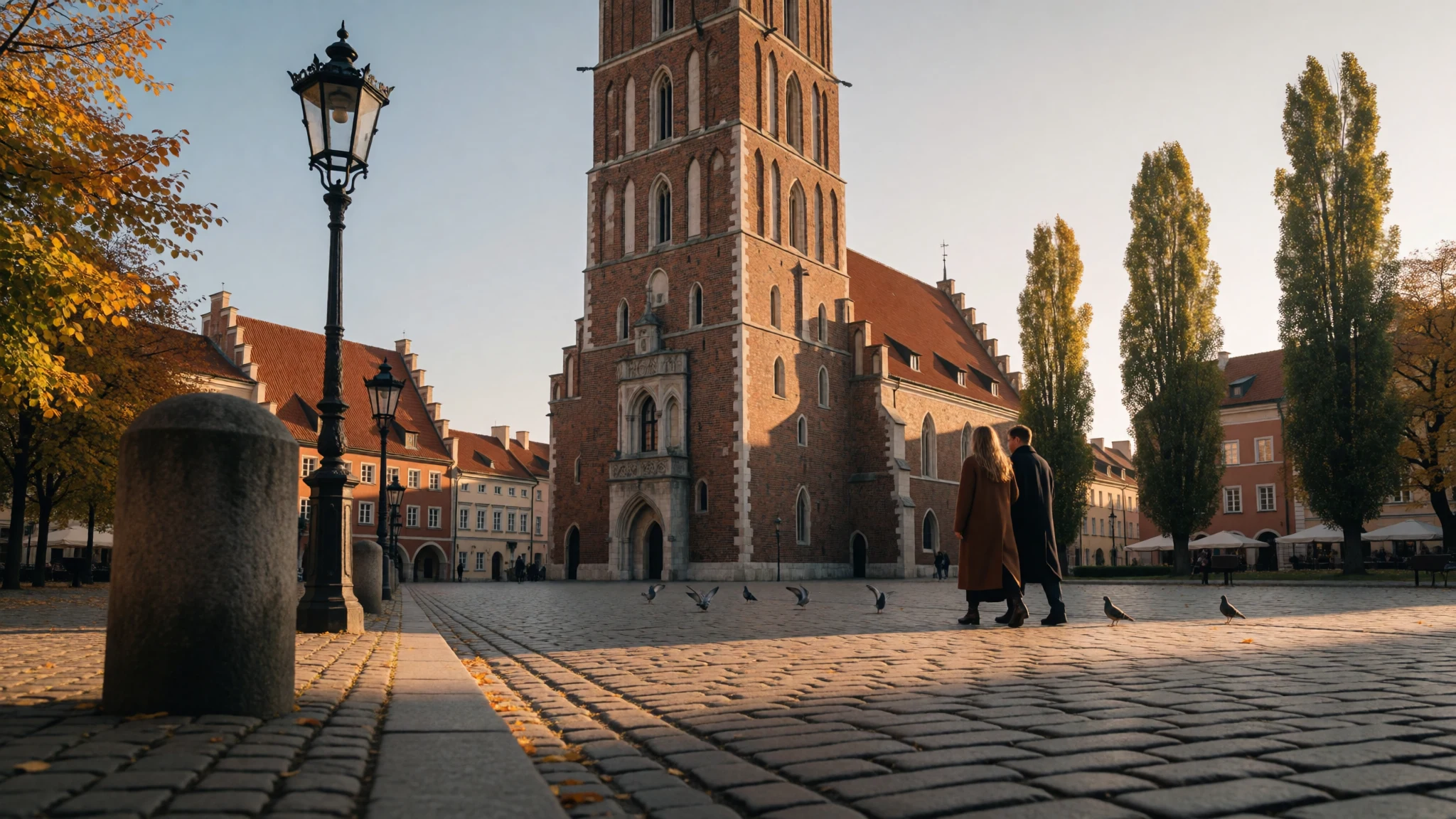
Toruń is a brick-Gothic Vistula river city with a largely preserved medieval street plan, gingerbread, Copernicus and a compact, walkable old quarter.
The place
Toruń lies on the Vistula in north-central Poland, a university and administrative city of about 198,000 people, standing 59 metres above sea level on flat river country. The historic centre is a UNESCO World Heritage Site, and its appeal is that the medieval street plan still works: narrow brick-fronted lanes run off broad market squares, and the whole quarter can be crossed on foot in well under an hour. The centre began as two separate towns, an Old Town in the west, founded in 1233, and a New Town beside it, each with its own square and its own parish church. The ruined castle of the Teutonic Knights fills the gap between them near the river. Much of the look is Brick Gothic, softened by Mannerist and Baroque gables that arrived with the wealth of the trading centuries, when Toruń belonged to the Hanseatic network and made money from river commerce. Today the city shares regional government with Bydgoszcz, its neighbour down the road, and the two form a twin-city metropolitan area. The feel is of a working university town rather than a museum: students fill the cafés, locals cut across the squares, and the riverside is where people stroll in the evening. Across the water, the island of Kępa Bazarowa gives the classic panorama of red roofs and church towers, best in late afternoon light. Toruń is small, so a weekend covers it, and the centre gets busy on summer weekends and during festivals.
Its story
The story of Toruń starts at a river crossing. Archaeologists find traces of people near this stretch of the Vistula from around 1100 BC, and a ford here let traffic cross the river for centuries. By the early Middle Ages a Slavic settlement stood on the spot where the castle would later rise, and in the 10th century the area came under the Piast rulers of the young Polish state, who turned it into a fortified stronghold. That stronghold was wrecked around the turn of the 13th century, most probably by Prussian raiders. The region then belonged to the Duchy of Masovia, whose ruler, Konrad I, failed to subdue the Prussians and instead settled the Teutonic Knights in the borderland. They built a castle and in 1233 founded the town, and a separate New Town grew up next to it. From 1264 to 1411 Toruń was a member of the Hanseatic League, and by the 17th century it was an important trading point, whose merchants paid for the grand gables still seen today. In the early modern period it was a royal city of Poland. Nicolaus Copernicus was born here in 1473. Over the following centuries the city passed through Prussian, Napoleonic Duchy of Warsaw and German Empire rule before returning to Poland, which is why it carries two names, Toruń and Thorn.
What to see
- Old Town Hall and its tower — Old Town square
The Old Town Hall is a Gothic brick block in the middle of the Old Town square. Steep wooden steps lead up its tower, and the view over red roofs and the river repays the effort. Museum labels inside are mostly in Polish, so non-readers should treat the tower and the architecture as the main reason to go.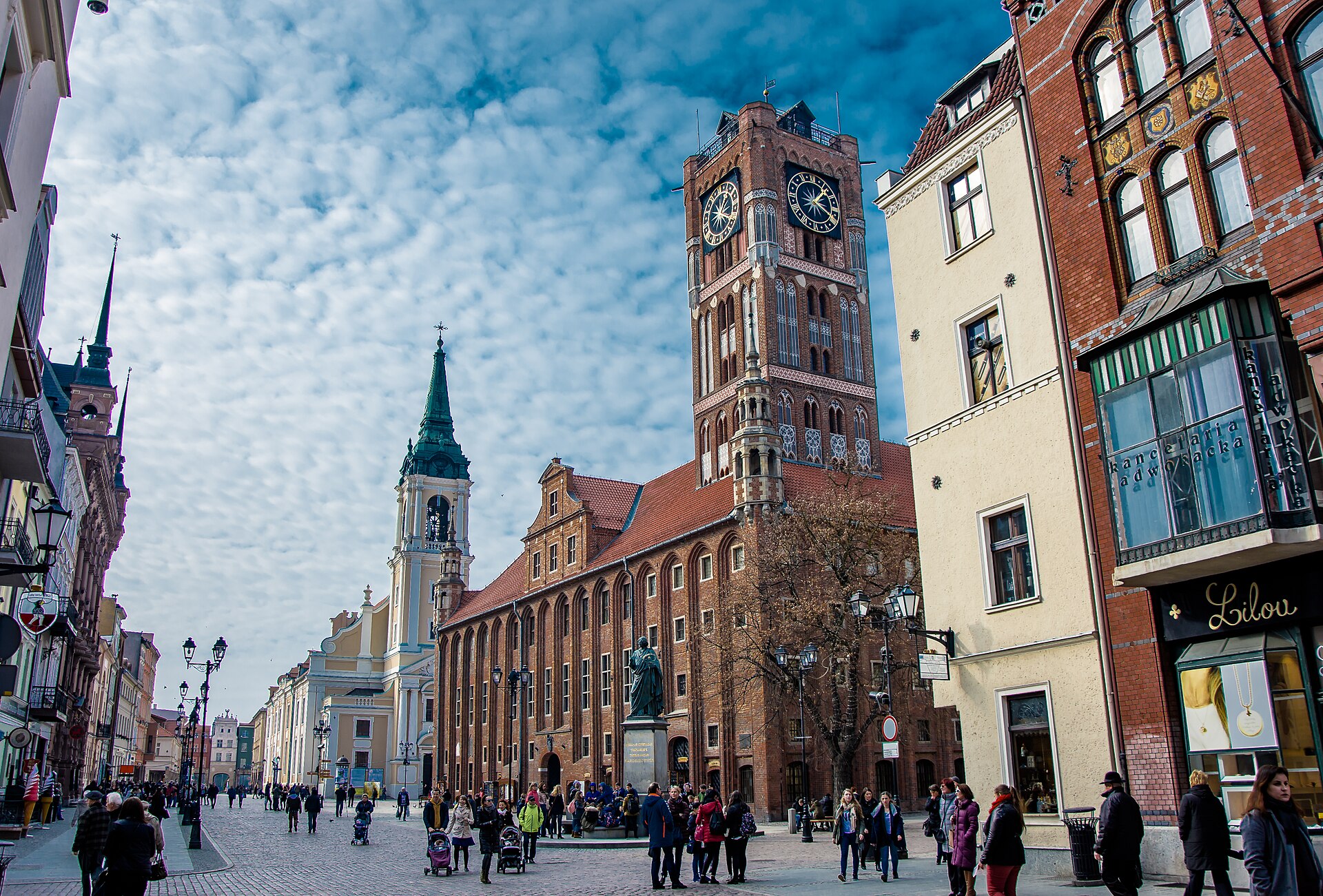
- Nicolaus Copernicus' House — Old Town, a few minutes from the main square
Nicolaus Copernicus was born in Toruń in 1473, and a museum now occupies a Gothic townhouse that his family owned in the fifteenth century, where he was probably born. The displays follow the astronomer's life and the city he grew up in. Opening times change, so check the city website, torun.pl, before going. - Szeroka Street and the Old Town lanes — Old Town, west of the square
Ulica Szeroka, the broad street leading towards the Old Town square, shows the Toruń townhouse at its best: tall, narrow façades with decorated gables, many dating from the trading centuries. Wandering the grid of lanes around it, past courtyards and carved doorways, is the real activity here, and it costs nothing.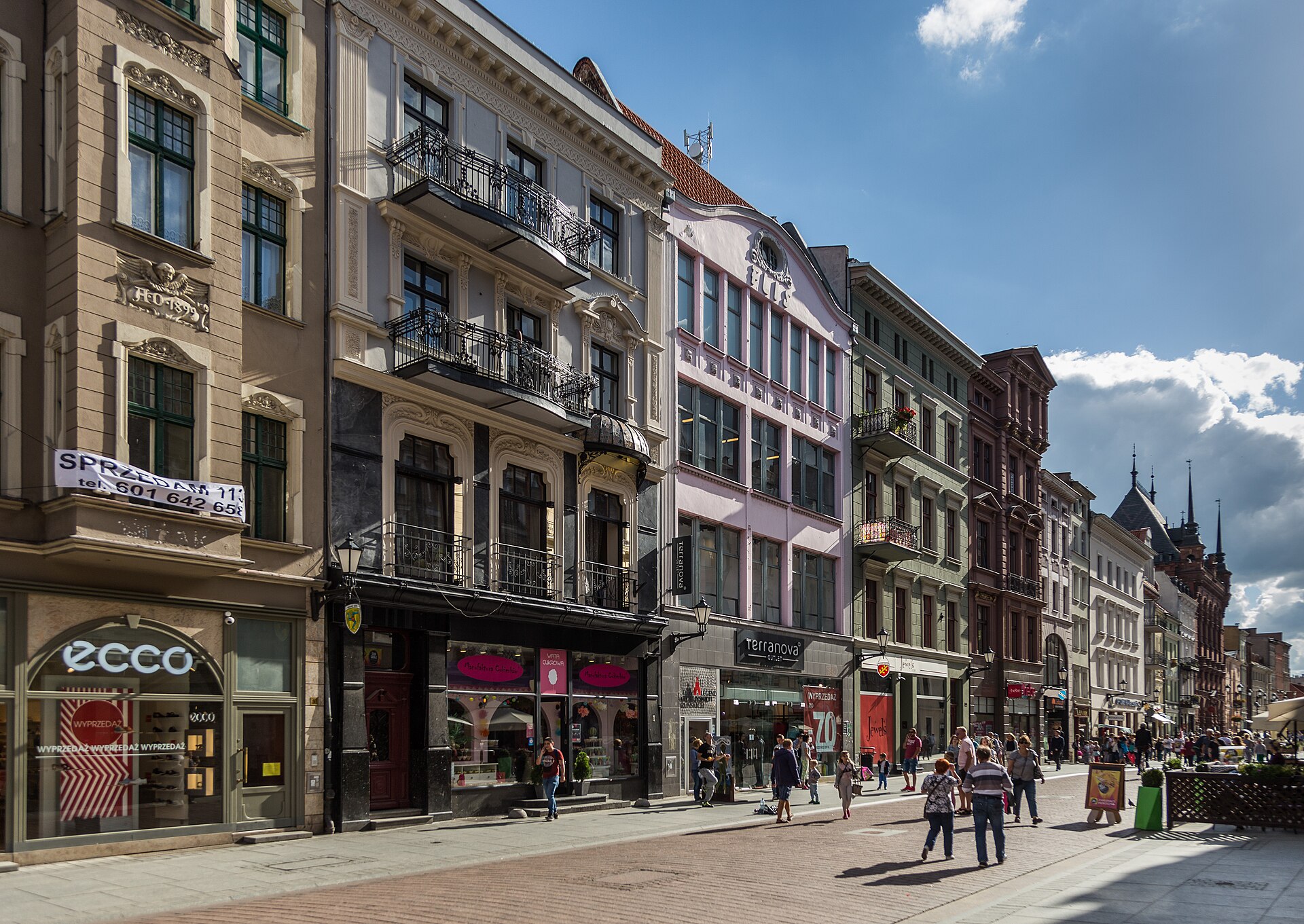
- The Leaning Tower (Krzywa Wieża) — Old Town, near the riverside walls
The Leaning Tower is a medieval brick tower in the Old Town whose tilt is plain to see from the street. It is a favourite for photographs, usually with someone pretending to push it over. Early morning gives the lane almost to itself; by late morning tour groups gather around the base.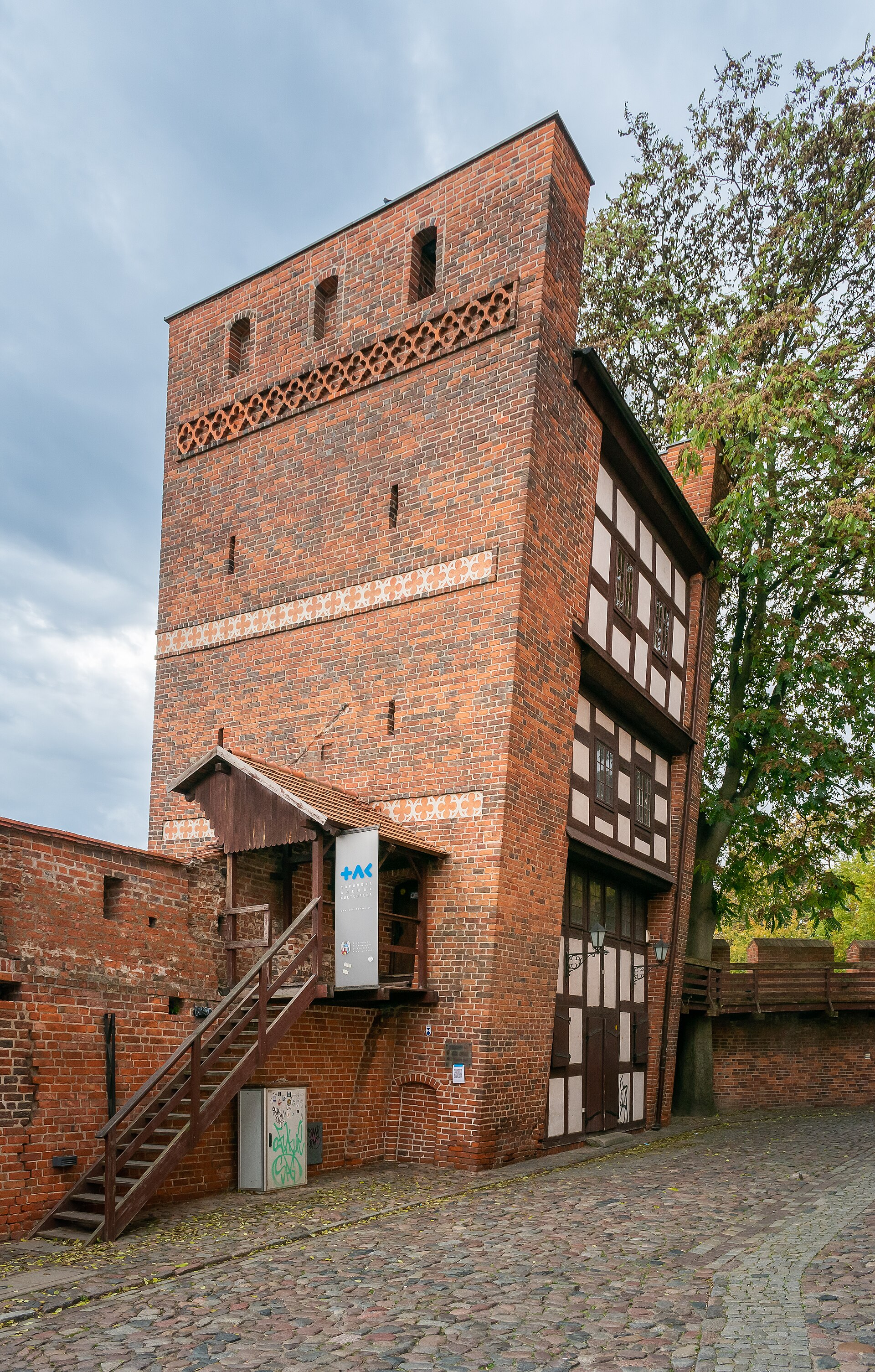
- Artus Court (Dwór Artusa) — Old Town square
Dwór Artusa is a grand merchants' meeting hall on the Old Town square, a building type that belongs to the Hanseatic trading cities of the Baltic. The façade is the draw, set among the surrounding gables. Check the official site for what is open inside, since access varies with events and exhibitions.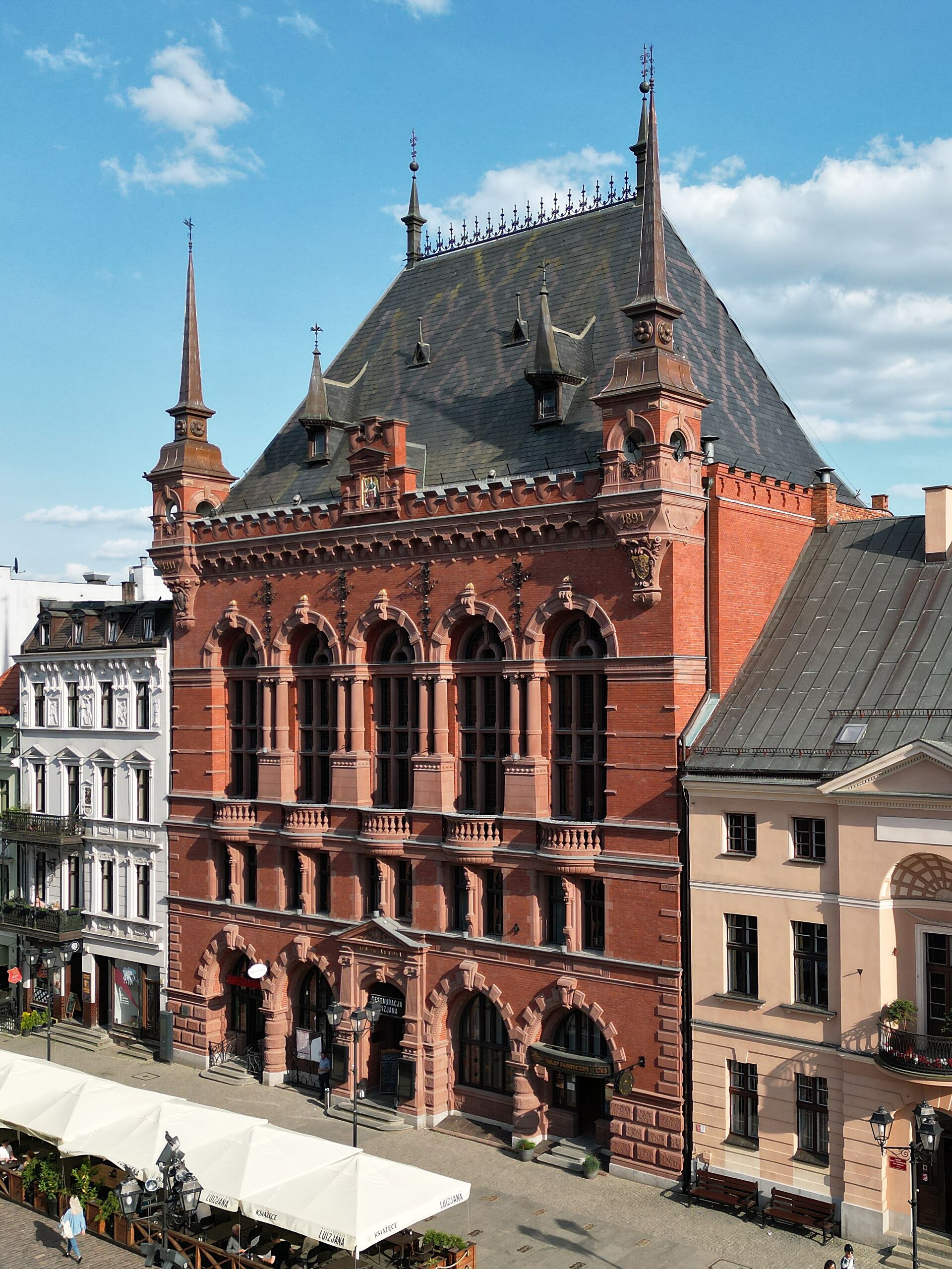
- Kępa Bazarowa viewing terrace — Island across the Vistula from the Old Town
Kępa Bazarowa is a river island on the far side of the Vistula, and its terrace gives the classic panorama of Toruń: church towers, gables and red roofs in a single frame. Late afternoon light is kindest. Reaching it means crossing the river from the Old Town on foot, a pleasant stroll in dry weather.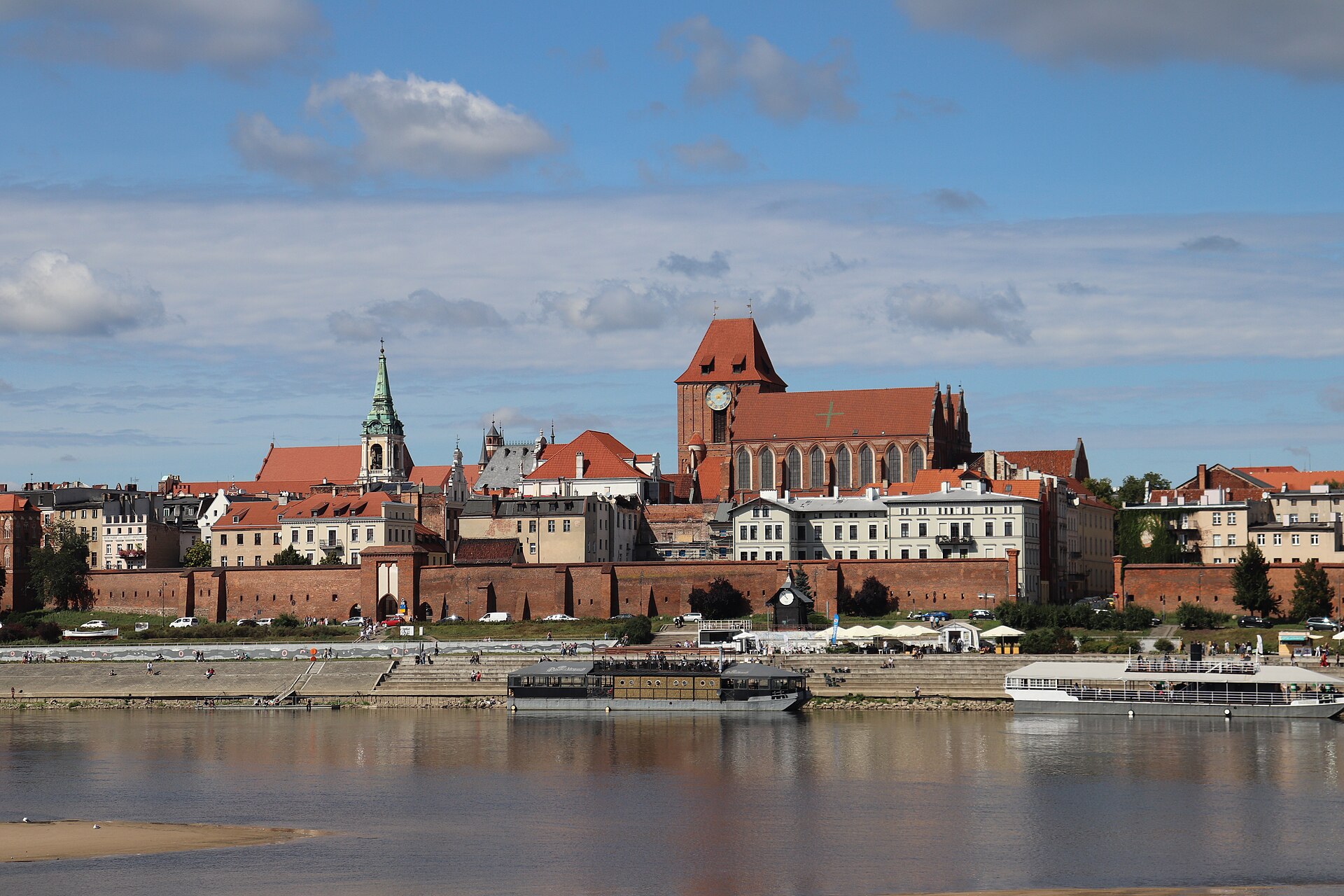
Culture
Toruń has a cultural life out of proportion to its size, helped by its university and a long habit of putting on shows. The Camerimage film festival, which celebrates cinematography, was founded here in 1993 and has been held in the city every year since 2019, drawing directors, camera operators and actors for a week of screenings that makes the centre feel crowded and festive. Theatre is just as strong: the city has two drama companies, among them Teatr im. Wilama Horzycy, two children's theatres, including the puppet house Baj Pomorski, which has recently been rebuilt, and several music and dance groups. The Kontakt international theatre festival takes place every May. Beyond the stage, local identity rests on the Hanseatic trading past and on Copernicus, whose name turns up on the university, in the museum and in shop windows. Religious life remains visible, with the Gothic churches of the Old and New Towns open for prayer through the week, and the city's mixed history, Polish and German, with people of several faiths living side by side for centuries, is part of how locals talk about it. Evenings are sociable and unhurried: people gather in the squares and in the cafés beneath the gables. A few words of Polish are warmly received, though English is common among younger people. In churches, speak quietly, cover bare shoulders if you can, and do not photograph people who are praying.
What to wear
Toruń's traditional dress belongs to the wider Kuyavian and Pomeranian countryside rather than to the city itself. Regional folk costume uses wool and linen, with striped or woven skirts, embroidered bodices and aprons for women, and long dark coats and hats for men. It is worn today mostly by folk ensembles and at festivals and parish celebrations, not in daily life. Everyday clothing in the city is smart-casual and practical: dark colours, jackets and boots in the colder months, jeans and trainers among the many students, and a neat dress or shirt for the theatre or a festival evening. The climate swings between oceanic and continental, so layers matter. Visitors should pack a waterproof layer for changeable weather, warm clothes and a hat for the cold season, and light cotton for the milder summer. Shoes are the main decision, because the old centre is paved with cobbles and uneven stone, and the tower stairs are steep, so sturdy flat soles beat sandals or heels. Shorts and vests are fine in the streets, but for churches carry a scarf or light shirt to cover shoulders and knees. Evenings by the river cool quickly, even in summer.
What to eat
- Pierogi — Dumpling restaurants and casual eateries in the Old Town
Pierogi are filled dumplings, boiled or fried, stuffed with potato and cheese, meat, cabbage and mushroom, or seasonal fruit. Toruń has plenty of places devoted to them, so there is no need to hunt. Sharing a mixed plate is the easy way to try several fillings. - Naleśniki — Casual crêpe cafés near the Old Town
Naleśniki are thin filled crêpes, served sweet with cheese, fruit or chocolate, or savoury with meat and vegetables. They arrive large, so one is often a full meal. Several budget-friendly places near the Old Town specialise in them and offer a wide choice of fillings. - Toruń gingerbread (pierniki) — Bakeries and gingerbread shops around the Old Town square
Gingerbread is the city's best-known sweet, a spiced honey biscuit baked in many shapes, plain, iced or filled with fruit. It keeps well, so it doubles as a souvenir. Buy from a bakery or shop rather than a stall, and check the ingredients if you have allergies. - Żurek — Traditional Polish restaurants in the Old Town
Żurek is a sour rye soup, often served with sausage and egg, and sometimes in a hollowed bread bowl. It is warming and tangy, a good match for cold days. Traditional Polish restaurants usually offer it, along with other hearty home-style dishes at reasonable cost. - Vegetarian and vegan plates — Small meat-free eateries in the Old Town
For meat-free eating, Toruń has a small group of budget vegetarian and vegan eateries serving soups, bowls, cutlets and salads. Portions are generous and prices modest by the standard of larger Polish cities. They are popular with students at lunchtime, so arrive a little early.
Plan it
Best time. May–June and September, when the weather is mild, terraces are open and May brings the Kontakt theatre festival. Winters are cold and summers moderate; the climate swings between oceanic and continental air, so expect changeable weather in any month.
How long. 1–2
Getting there. Fly to Bydgoszcz, the neighbouring twin city, or to Warsaw or Gdańsk, then take a train to Toruń; the Old Town is a short walk, tram or bus ride from the stations on the opposite bank of the Vistula. Check a journey planner for current times.
Budget. low
Tips
- Climb the Old Town Hall tower early in the day, before tour groups arrive
- Carry some cash for small shops and bakeries, though cards are widely accepted
- Wear sturdy flat shoes for cobbles and the steep tower steps
- Book ahead if visiting during the Camerimage film festival, when rooms fill quickly
- Check opening times on the official site, torun.pl, as museums change their hours
Etiquette
- Keep voices low in churches and avoid photographing worshippers
- Greet staff in shops and cafés with a quick Polish dzień dobry
- Do not touch or lean on exhibits in museums
Nearby
Sources
- Wikidata Q47554 (CC0)
- Wikipedia: Toruń (rev 1380936466) (CC BY-SA 4.0)
- Wikivoyage: Toruń (rev 5420433) (CC BY-SA 4.0)
- Photo: Toruń panorama from Kępa Bazarowa island, Andrzej Otrębski (CC BY-SA 4.0)
- Photo: Toruń panorama from Kępa Bazarowa island (cropped), Andrzej Otrębski (CC BY-SA 4.0)
- Photo: Stare Miasto, Ratusz Staromiejski w Toruniu, Domun (CC BY 3.0)
- Photo: Rynek Nowomiejski w Toruniu i kościół św. Jakuba, PiotrMig (CC BY-SA 4.0)
- Photo: Ul. Szeroka, Toruń, Pko (CC BY-SA 4.0)
- Photo: Park Miejski na Bydgoskim Przedmieściu w Toruniu, Mateuszgdynia (CC BY-SA 4.0)
- Photo: Krzywa Wieża in Toruń, Krzysztof Golik (CC BY-SA 4.0)
- Photo: Dwór Artusa w Toruniu, Kapitel (CC BY-SA 4.0)


