Terrassa
Terrassa, Spain
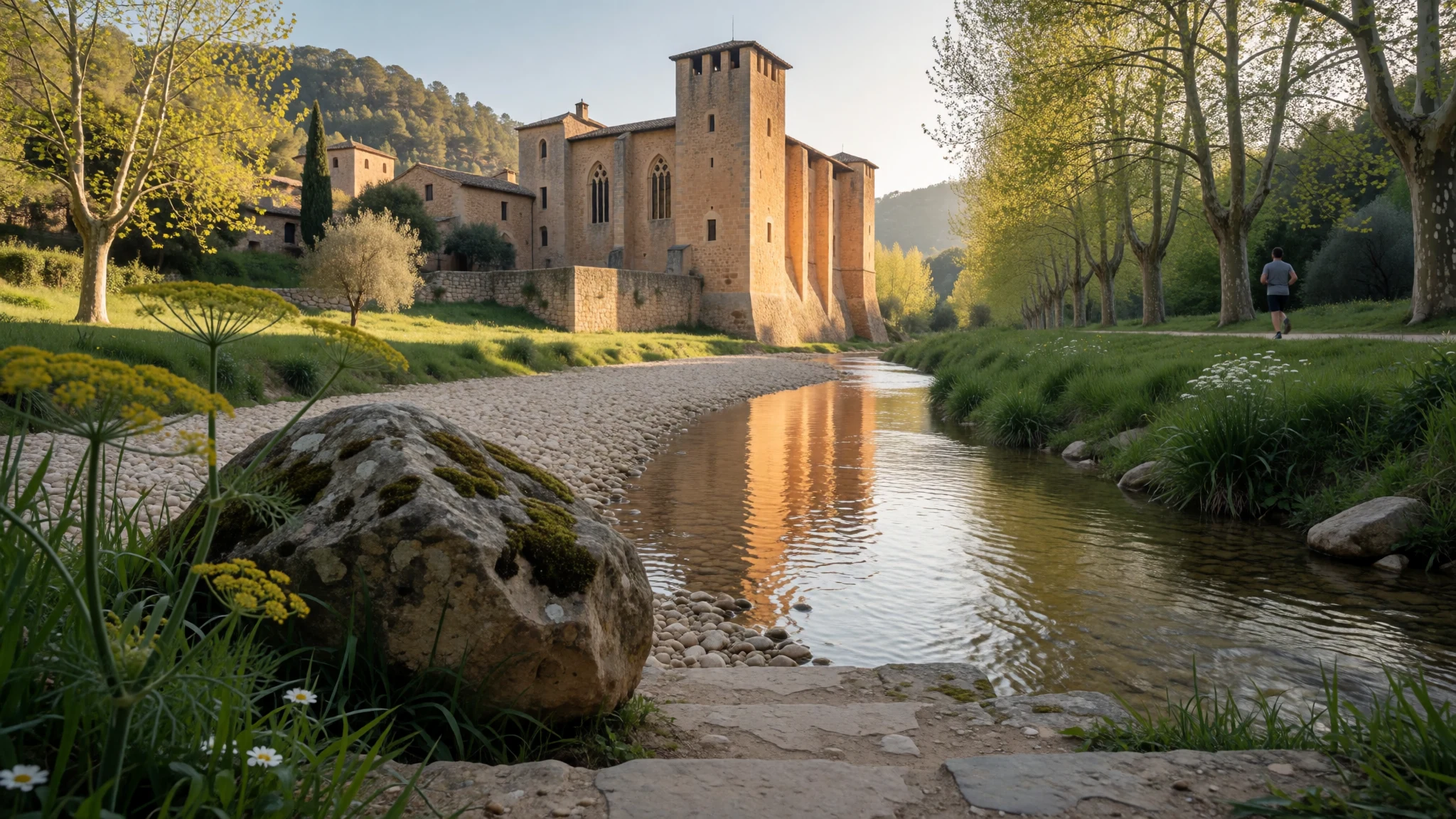
Terrassa is a working Catalan city of wool-mill chimneys, early Christian churches and human towers, close to Barcelona but far from its crowds.
The place
Terrassa sits in the Catalan Prelitoral depression, in the province of Barcelona, at the foot of the Sant Llorenç del Munt mountains. About 233,270 people live here, at an average height of 277 m above sea level. That makes it a city of real size, the third largest in Catalonia, yet it feels like a place for residents first and visitors second. It is the most inland city of the Barcelona metropolitan area, which is why it is sometimes called the doorway to central Catalonia. Barcelona and Montserrat are both a short ride away, so Terrassa works as a base for a quieter stay or as a long day out from the coast. The streets mix old stone, the brick chimneys and sawtooth-roofed mills of the textile years, and modernist façades from the same period. Universities and film and theatre schools bring students into the centre, and the city carries the title City of Film. In 2024 the Council of Europe gave it the Europe Prize for its commitment to European values. Expect a Catalan-speaking town where Spanish is understood everywhere, weekday bustle, calm Sundays, and mountain paths reachable on the edge of the built-up area. The city's official site is http://www.terrassa.cat/ for events and opening details.
Its story
Terrassa has been inhabited since prehistory. In 2005, while a tunnel was being dug for a railway line, workers uncovered a site in what is now Vallparadís Park, with stone tools and fossil bones of hunted animals, evidence of very early human presence in the valley. The Romans later founded a town here called Egara, close to an Iberian settlement named Egosa, where pottery and coins have been found. Egara became a bishopric in late antiquity, and its cluster of churches is the visible survivor of that era. The bishopric lapsed, and the title was revived as a titular see and then as a working diocese in 2004. In the Middle Ages the town grew around a castle-palace of the count-kings, of which a single tower remains, and around the Vallparadís castle, which housed a Carthusian monastery for some decades before becoming a municipal museum. The darkest episode came in the 17th century, when six women were arrested, tortured and convicted of witchcraft; five were hanged in 1619 near a spot now marked by a railway bridge. The 19th century then reshaped the city. Terrassa specialised in woollen cloth during the industrial revolution, and the mill owners left behind the modernist buildings and factories that define its look today.
What to see
- The churches of Egara — Egara episcopal complex, north of the centre
Three small churches stand together on the site of the old Roman town, built to serve the diocese of Egara. Their worn stone, rounded apses and plain interiors reward a slow visit. Expect quiet corners, traces of early wall painting, and a setting among modern streets that makes the age feel surprising.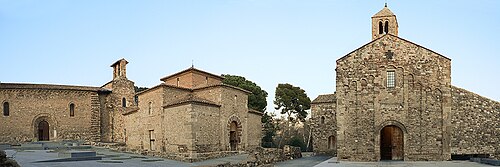
- Sant Miquel — Egara episcopal complex
The small church of Sant Miquel, the baptistery of the Egara group, is built on a compact plan beneath a low roof. Its columns look recycled from older buildings, which hints at how long people have been worshipping on this ground. Go when the light is low and the doors are open.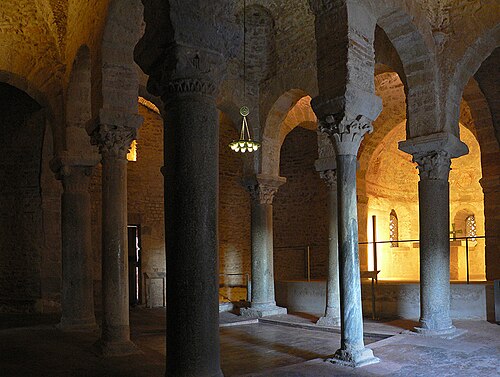
- Cartoixa de Vallparadís — Vallparadís Park, central Terrassa
This medieval castle was a Carthusian monastery for some decades and is now a municipal museum on the edge of Vallparadís Park. The valley around it holds footpaths, a stream and the prehistoric dig, so it combines a short culture stop with a green walk. Check the city website for current opening. - Tower of the Palau — Old town, near the Vallparadís castle
The Tower of the Palau is all that remains of the castle-palace of the count-kings of Catalonia in Terrassa. It is a modest stone block rather than a grand fortress, but it anchors the medieval core and sits close to other old buildings, so it fits easily into a morning wander. - National Museum of Science and Industry of Catalonia — Former textile mill, Rambla d'Egara area
The Terrassa branch of mNACTEC is set in a former mill and explains the technology behind Catalonia's textile boom. Looms, engines and workshop spaces make the industrial story tangible, and the building itself is part of the exhibit. A good rainy-day choice; check the official site for times.
Culture
Terrassa has a busy Catalan cultural life for a city of its size, with many colles, or local groups, keeping popular traditions going. The best known are the castellers, who build human towers. The Minyons de Terrassa are one of three tower-building groups in the city, alongside the Castellers de Terrassa and the university group, the Bergants del Campus Terrassa. The Minyons were the first to complete a ten-storey tower, in 1998. Alongside them are fire groups, the diables and bestiari de foc, including the Diables de Terrassa and the Drac de Terrassa, who parade with sparks and drums at festivals. These groups belong to neighbourhoods, and their rehearsals and street appearances are a social glue rather than a show put on for tourists. The city's film, theatre and university life adds a younger layer, and Catalan is the everyday language of signs, menus and conversation. A few words of Catalan, such as bon dia and gràcies, are noticed and appreciated, even though Spanish works everywhere. Religious heritage matters too: the Egara churches are historic sites as well as places of worship, so a calm manner suits them. When you watch a human tower or a fire run, stay behind the barriers, keep silent while the tower is climbing, and never step into the crowd at the base.
What to wear
Terrassa's traditional textile story is wool. The city grew rich on woollen cloth in the 19th century, and the mills turned out everyday fabrics rather than ceremonial costume. The classic Catalan folk outfit is worn at festivals and dances: the red barretina cap for men, a wide sash called a faixa, and espadrilles called espardenyes with ribbons tied at the ankle. The castellers have their own uniform of white trousers, a colla-coloured shirt and a tightly wound black sash that supports the back. Day to day, people in Terrassa dress like most of urban Catalonia: casual, tidy and unfussy, with linen and cotton in summer, jeans and light jackets in the cooler months, and trainers or leather sneakers rather than flip-flops in town. Students add a relaxed layer. Visitors should dress for the weather: sun hat and light cotton in the hot months, a warm layer and a rain jacket for winter evenings. Comfortable shoes with grip suit the worn stone around the Egara churches and the paths of Vallparadís. For church visits, cover bare shoulders and avoid beachwear, which would stand out well away from the coast. Sturdy shoes are needed if the Sant Llorenç del Munt trails are on the plan.
What to eat
- Pa amb tomàquet — Any bar or café in the centre, especially at breakfast
Toasted bread rubbed with ripe tomato, olive oil and salt, served beside cured meats or cheese. It is the Catalan table's basic building block, simple and filling, and a reliable first order when the menu is in Catalan. - Botifarra amb mongetes — Traditional restaurants and weekday set-lunch places
Grilled Catalan pork sausage served over white beans, often with garlic or a little oil. It is hearty, plain and good value, and well suited to colder months when the mountains nearby feel properly cool. - Escudella and canelons — Family restaurants around winter festivals
A rich meat-and-vegetable soup is often followed by canelons, cannelloni filled with the leftover meats. Families traditionally eat these at midwinter feasts, so restaurants serve them in season, and a local table usually knows the exact day. - Calçots — Countryside restaurants and festival tables in cooler months
Long spring onions grilled over fire, peeled by hand and dipped in romesco sauce, a nut and pepper blend. The ritual is messy and communal, with a bib provided. They appear in winter and early spring, so ask whether they are on. - Crema catalana — Bakeries and restaurant dessert menus
A chilled custard flavoured with citrus and cinnamon, with a burnt sugar crust cracked by the spoon. It makes a light end to a heavy meal and is a safe choice for anyone avoiding anything too rich.
Plan it
Best time. April–June and September–October, when days are mild and the mountains are green. July and August are hot, so go early or late in the day. Winter is cool and quieter, with some rain.
How long. 1–2
Getting there. Fly into Barcelona El Prat airport, about an hour away by road. The easiest route is train from Barcelona: FGC line S1 or Rodalies line R4 both reach Terrassa. Local buses link the surrounding towns; the stations are walkable to the centre.
Budget. mid
Tips
- Visit the Egara churches in the morning, when the light is soft and the grounds are calmer
- Check the official site, http://www.terrassa.cat/, for museum opening and festival dates before travelling
- Carry a refillable water bottle in summer; most days are hot by midday
- Combine the city with a half-day walk in Sant Llorenç del Munt if the weather is dry
- Cards are widely accepted, but keep a little cash for small bars and markets
Etiquette
- Greet shop and café staff with bon dia or a simple hello before ordering
- Keep behind barriers and stay quiet when castellers are building a tower
- Dress modestly and speak softly when entering a church
Nearby
Sources
- Wikidata Q13939 (CC0)
- Wikipedia: Terrassa (rev 1384567164) (CC BY-SA 4.0)
- Wikivoyage: Terrassa (rev 5426942) (CC BY-SA 4.0)
- Photo: Egara. Conjunt episcopal (Oliver-Bonjoch) (CC BY 3.0)
- Photo: Egara. Sant Miquel (Oliver-Bonjoch) (CC BY 3.0)
- Photo: Huguet-santsAbdoSenen-0021 collage (amadalvarez) (CC BY 3.0)
- Photo: Carretó elevador Terrassa 2 (Auledas) (CC BY-SA 4.0)
- Photo: Carretó elevador Terrassa (Auledas) (CC BY-SA 4.0)
- Photo: Contenidor de roba usada, plaça de Dolors Aleu (Hetemacaba) (CC0 1.0)
- Photo: El Corralito CCA (Friviere) (CC BY-SA 4.0)
- Photo: Font de Cantarelles (Romang) (CC BY 4.0)


