Tazumal
Tazumal, El Salvador
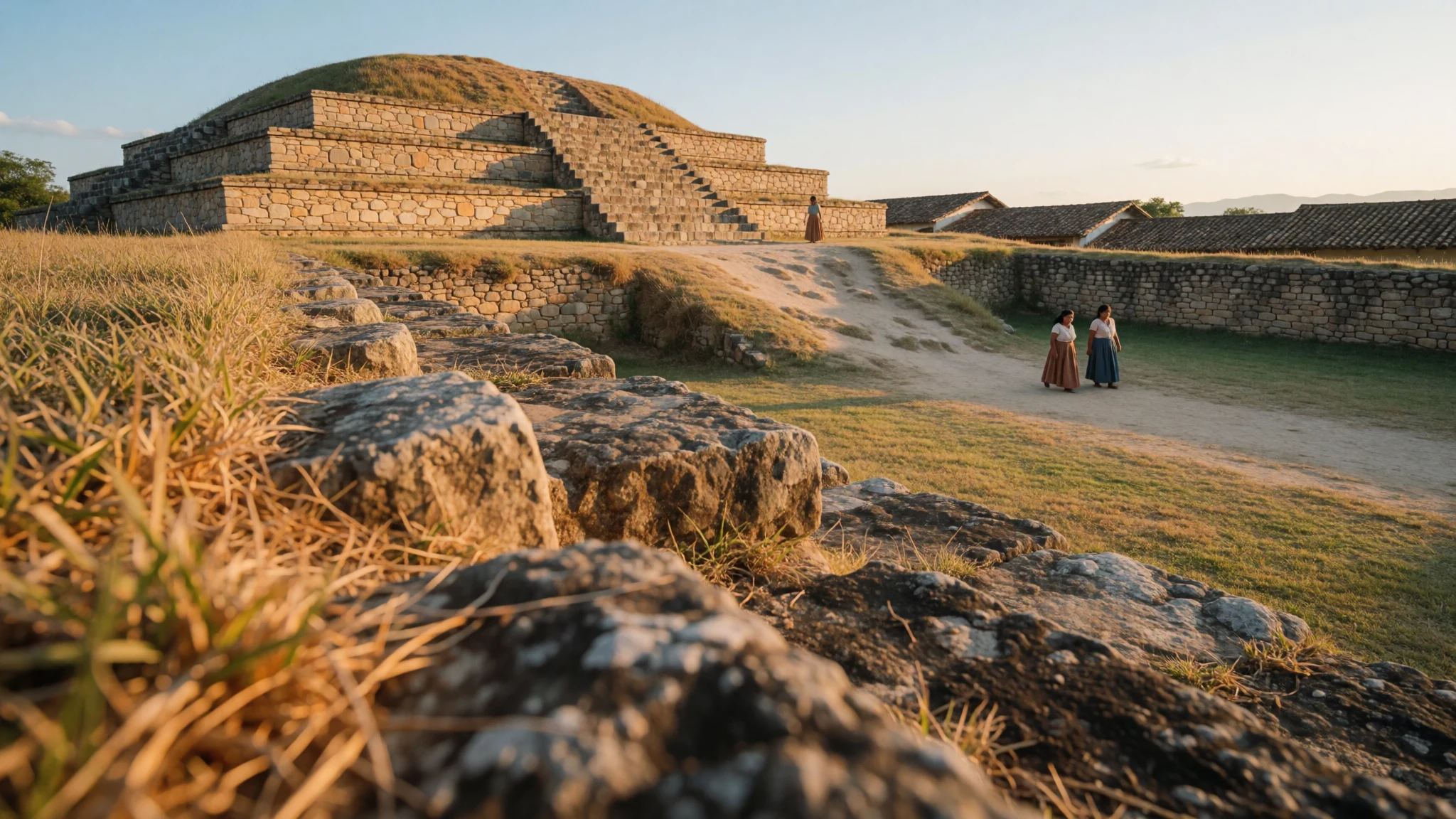
Tazumal is a restored Maya-era pyramid complex in a Salvadoran market town, with a museum, a ballcourt and some of Mesoamerica's earliest metal finds.
The place
Tazumal is a Maya-era archaeological site on the edge of Chalchuapa, a small town in the department of Santa Ana in western El Salvador. It forms the southern part of a wider archaeological zone that once held an ancient city, and its grassy platforms and stepped pyramid now sit among ordinary streets, houses and shops. The ground lies at about 720 metres above sea level, high enough that mornings feel gentler than on the coast, and the Río Paz basin spreads around it. Archaeologists read the site as a ceremonial centre that stayed in use for centuries and traded far afield. Pottery, architecture and carved stone point to contact with Copán in Honduras, with the highlands of Guatemala and with central Mexico. The main mound is the first thing to register. It was partly restored in the mid twentieth century by the archaeologist Stanley Boggs, whose name now belongs to the on-site museum. The result looks cleaner and more open than the jungle-wrapped Maya sites many travellers picture, with long views across the platforms and the town beyond. The visit is compact. A circuit of the main platform, the temple with its square columns and the ballcourt takes a couple of hours, longer if the museum cases are read slowly. Heat builds by midday and the open platforms offer little shade. It works well as a half-day from Santa Ana, and as a calm counterpoint to the volcano and coffee country that surrounds that city.
Its story
Tazumal belongs to a long story of settlement in the Chalchuapa area, where people were building on a large scale well before the Classic period. Occupation at Tazumal itself is thought to have begun around the first century BC. Then the Ilopango volcano, to the east, erupted around the fifth century, and construction here stopped for what may have been several generations. When building resumed in the Early to Middle Classic, the city never regained its former scale, though Tazumal's structures came closest to matching the huge Preclassic works. By the Late Classic it was an important ceremonial complex. Its connections shifted over time. In the middle of the Classic period it was tied to Kaminaljuyu in the Guatemalan highlands, a channel for the influence of distant Teotihuacan. Later, architecture, sculpture and pottery show links with Copán. A few early features even suggest contact with Chichen Itza or Tula. Metal objects recovered here date to the eighth century, evidence that metalworking reached this part of Mesoamerica early. The pottery sequence runs unbroken until around the early thirteenth century, after which the city appears to have been abandoned, as happened to many Maya centres of the time. For much of its life the population shared the area with Nahua-speaking Pipil neighbours. Modern excavation and restoration began in the mid twentieth century under Stanley Boggs.
What to see
- The main pyramid and Great Platform — Centre of the site
The Great Platform carries the stepped main pyramid and measures 73 by 87 metres, a broad raised stage with open areas around it. The entrance faces west. Climbing the pyramid steps gives the best view over the whole complex and the rooftops of Chalchuapa beyond.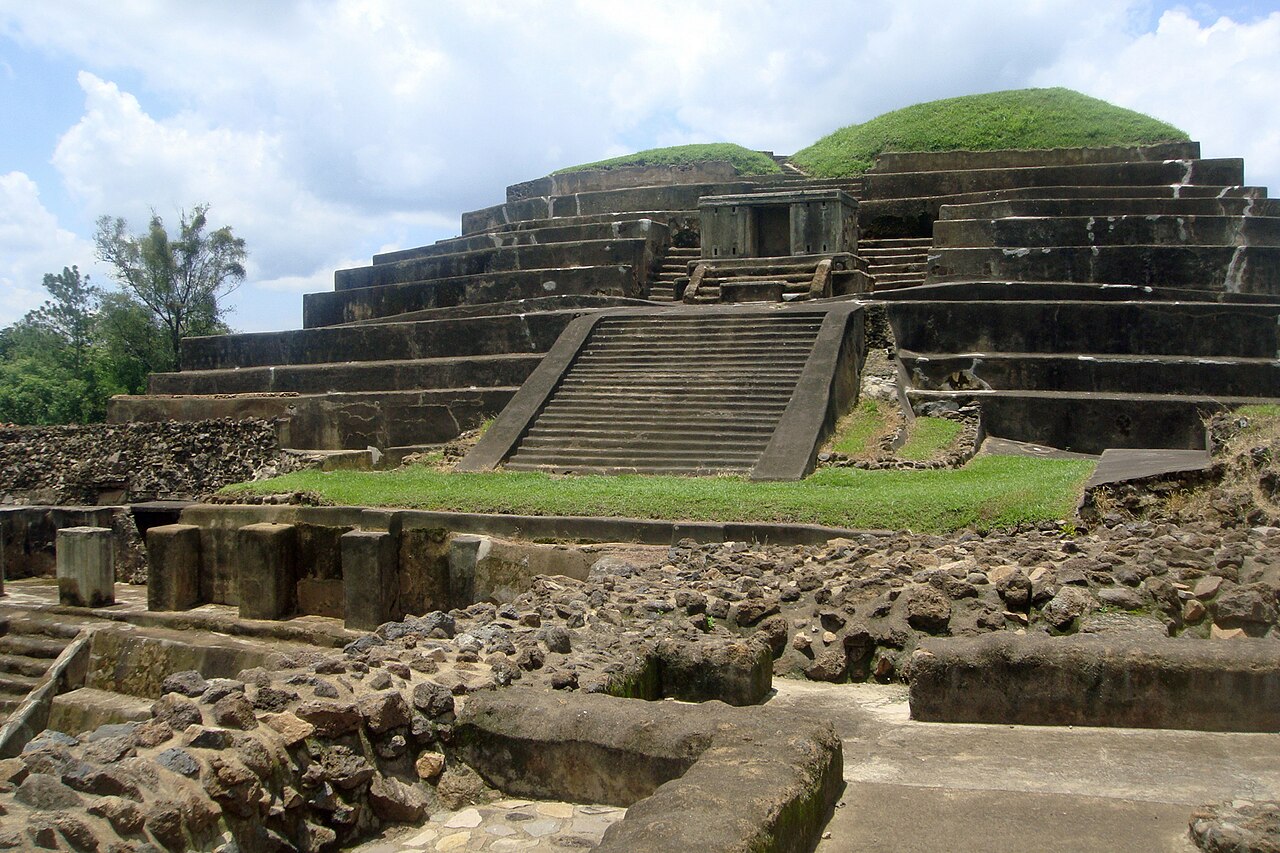
- Temple of Columns — Western side of the Great Platform
This structure served as the main western entrance, with further openings facing east and south. Square columns and two chambers of equal size define it. It is thought to have worked partly as a façade, and it rewards a slow walk-through for the proportions alone.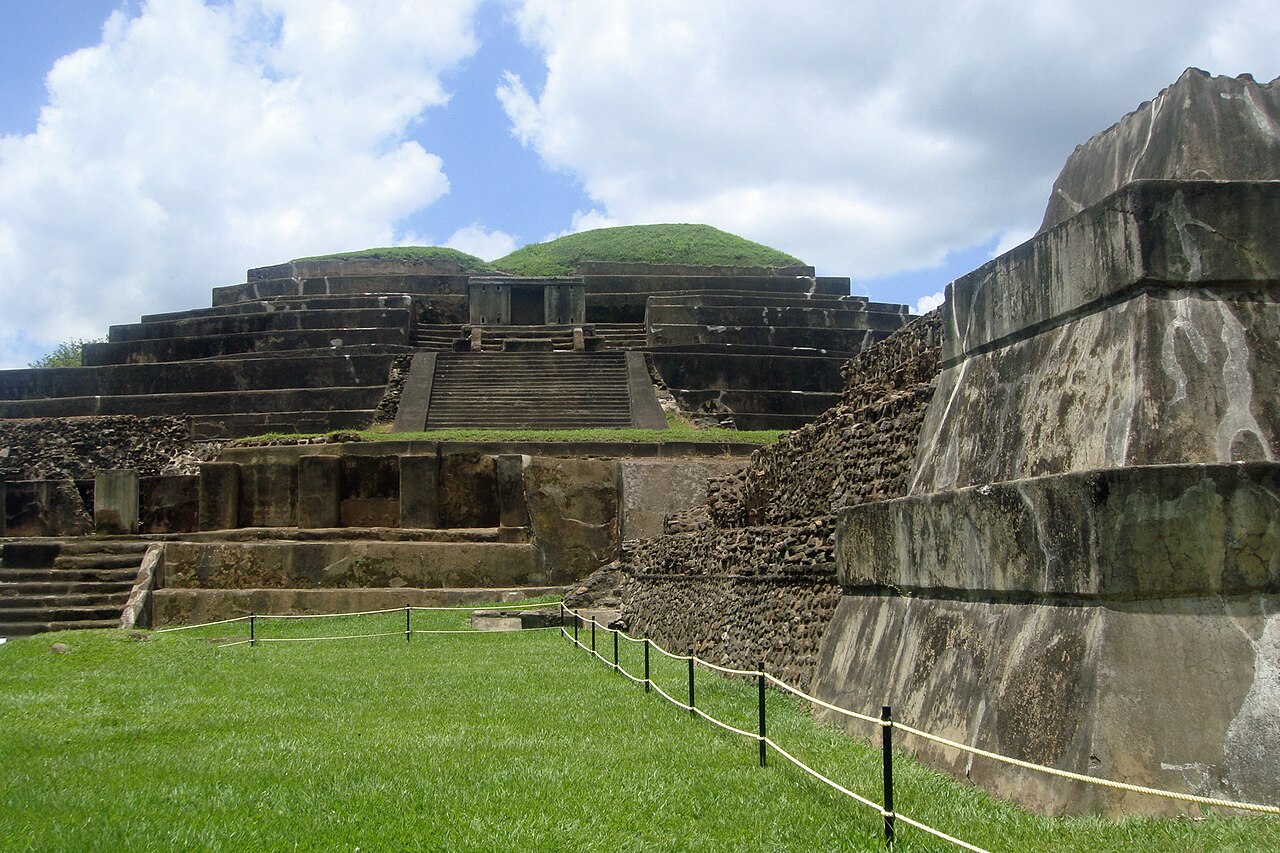
- The ballcourt — Eastern part of the complex
Two flanking structures form the sides of a court where the Mesoamerican ballgame was played. The setting is low and open, so the shape is easiest to read from a nearby mound. It is a reminder that the site was a place for ritual contests as well as worship.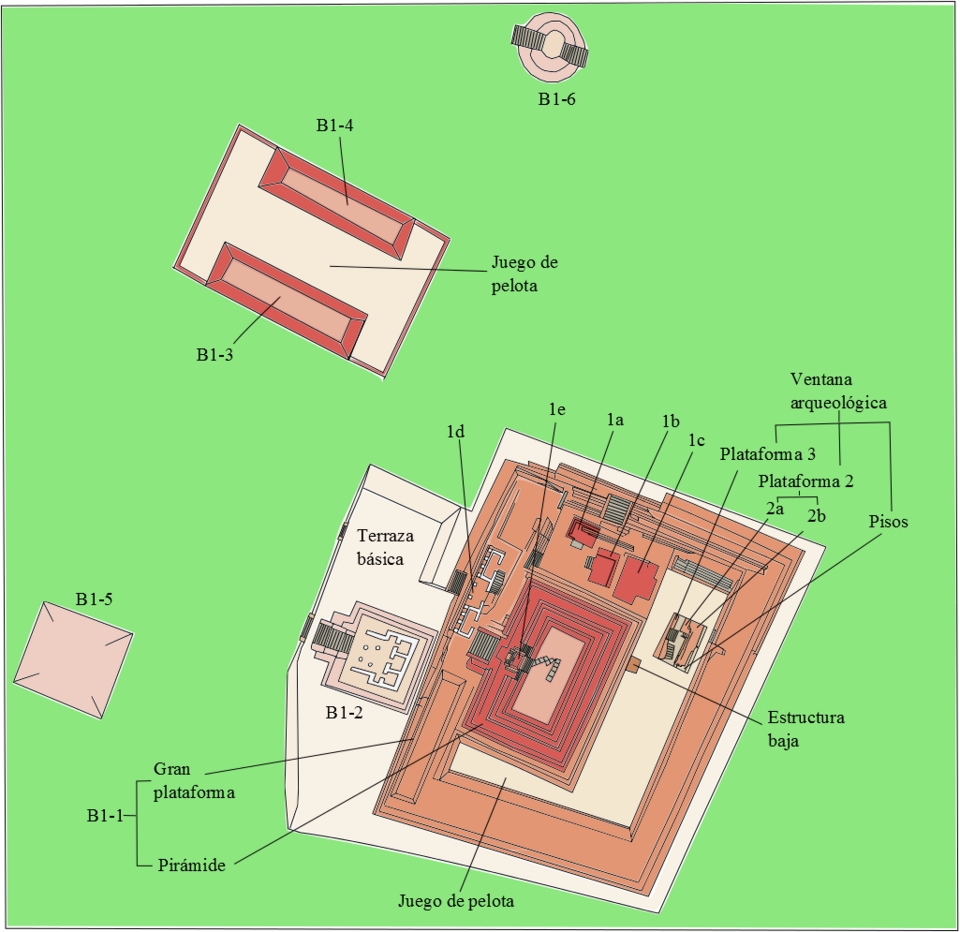
- Stanley Boggs Museum — Beside the entrance area
The site museum gives the background on the city, its architecture and its place among regional networks. Its cases hold a large range of objects recovered on site, including ceramics. It is a good first stop before walking the platforms, and shady on a hot day. - Reconstruction drawings of the pyramid — Main pyramid and museum
Reconstruction illustrations of the main structure at different building stages help explain how the mound grew in layers over generations. Looking at them next to the real pyramid makes the restored steps and rubble much easier to understand.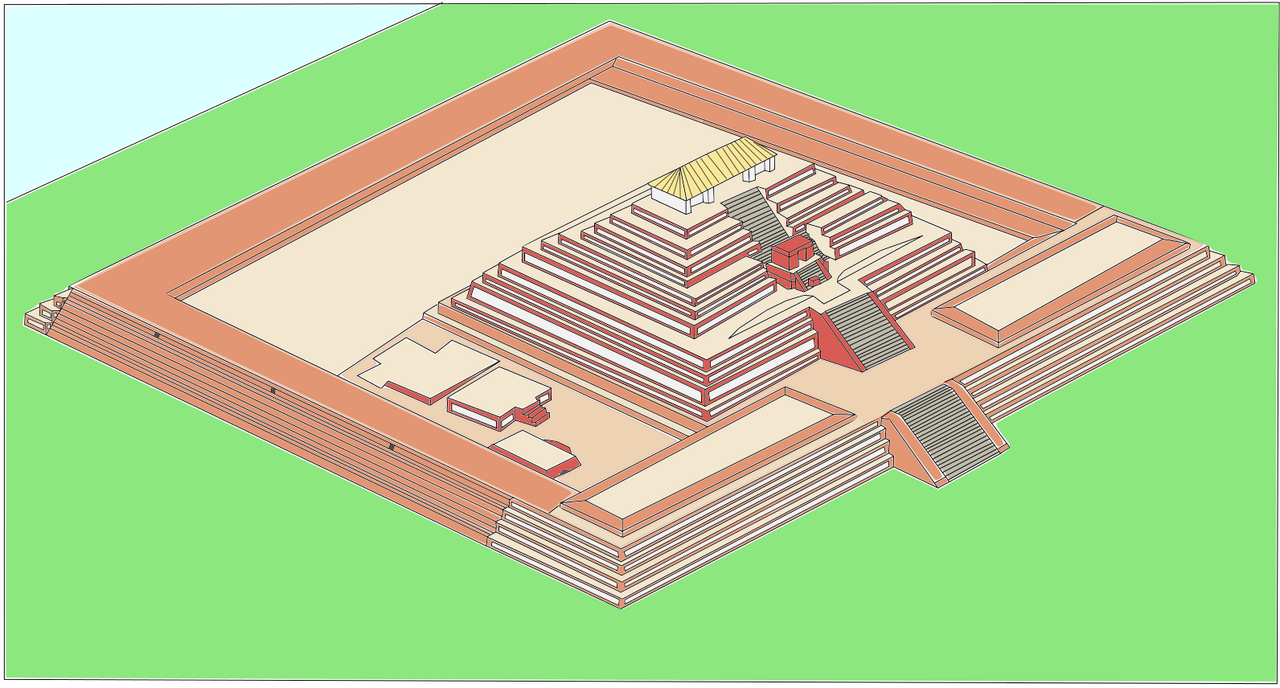
Culture
Tazumal sits inside a living town, and its culture is best understood as layers. The Maya-era builders were part of a wide trading world that linked this valley to Honduras, Guatemala and Mexico. Nahua-speaking Pipil communities lived alongside them, and their descendants and language are part of Salvadoran heritage today. Chalchuapa itself is a working market town, so a visit to the ruins naturally mixes with everyday life: schoolchildren on the street, vendors near the entrance, church bells on Sundays. El Salvador's modern identity draws on this deep past, and sites such as Tazumal are treated as shared heritage rather than distant relics. Local guides, when available, are often keen to explain the ballgame, the trade links and the story of the volcanic eruption, and conversation tends to be warm and unhurried. Spanish is the everyday language, and even a few polite phrases are appreciated. Mornings are quieter, and weekends can bring school groups and families. Evenings in town are relaxed, with food stalls and plazas where people gather. The metal finds and the architecture connect this place to wider Mesoamerica, which is why archaeologists value it. Stay on the marked paths and do not climb on ropes-off structures or take stones, sherds or any other piece of the site home with you.
What to wear
Tazumal and the Chalchuapa area do not have one single costume, but the region's traditional dress draws on indigenous and Spanish colonial roots. Women's clothing historically included woven cotton blouses, wrapped or gathered skirts and shawls, often with embroidery, while men wore simple cotton shirts and trousers with a straw hat in the fields. Cotton and natural dyes such as indigo are long associated with Central American weaving, though today traditional dress is mostly seen at festivals, school parades and folkloric performances rather than daily life. In Chalchuapa, people dress for the warm climate in light cotton, jeans or shorts, football shirts, sandals and trainers, with a smarter outfit for church on Sundays. Caps and sun hats are common. Visitors should dress for heat and open ground. Choose breathable, light-coloured clothing with sleeves or a scarf for shade, a wide-brimmed hat, sunscreen and sunglasses, as the platforms have little cover. Sturdy closed shoes or trainers with good grip suit the worn stone steps, which can be slippery after rain. A light rain jacket is useful in the wetter months. Modest dress is wise in town and in churches: knees and shoulders covered is a safe rule. Swimwear and very short shorts attract attention away from tourist areas. A small day bag with a water bottle completes the kit.
What to eat
- Pupusas — Pupusería stalls around the town plaza
Thick griddled maize tortillas stuffed with cheese, beans or pork, served with pickled cabbage and a thin tomato sauce. Almost every Salvadoran town has dedicated pupuserías, and the ones around Chalchuapa's central plaza fill up in the evening. - Yuca frita — Casual eateries and market stalls in Chalchuapa
Fried cassava served in chunky pieces, usually with chicharrón and curtido. It is a filling snack, popular at casual eateries and street stalls, and a good counterpoint to the lighter pupusa. - Sopa de gallina india — Family-run comedores and the town market
A hearty hen soup with vegetables and herbs, traditionally served for family meals and weekend lunches. It is a comforting dish, especially on a cooler morning, and is best sought in family-run comedores. - Tamales — Morning market and street vendors
Maize dough steamed in leaves, with fillings that vary from chicken to sweet versions. They are a standard breakfast and weekend food, often sold by vendors early in the day, and the leaf wrapping keeps them warm. - Atol de elote and Salvadoran coffee — Market drink stalls and cafés in Santa Ana
Atol de elote is a warm, lightly sweet drink made from fresh corn. Coffee grown in the hills of the Santa Ana department is widely served, and a cup at a café in the nearby city makes a good end to a day of ruins.
Plan it
Best time. November to April is the dry season, with clearer skies and easier walking on the open platforms; the wetter months bring afternoon downpours and slippery steps, and the hottest hours are around midday year-round, so mornings are best.
How long. 1
Getting there. Fly into San Salvador, then travel by road to Santa Ana, the usual base. From Santa Ana, a local chicken bus heads to Chalchuapa; a bus marked Directo skips most stops and saves time. Ask the driver or conductor for the Tazumal stop, then walk a few minutes to the entrance. Taxis and ride-hailing apps also work from Santa Ana, and a driver can sometimes be hired to include other nearby sites. From the Ruta de las Flores, change buses at Ahuachapan for Chalchuapa.
Budget. low
Tips
- Arrive early to beat the midday heat and the school groups
- Check the official opening hours and entry fee locally before travelling, as they can change
- Carry small cash for buses, snacks and the museum, as cards may not be accepted
- Bring water, a hat and sunscreen because shade is scarce on the platforms
- Combine with Santa Ana, Los Volcanes National Park or the Ruta de las Flores for a fuller trip
Etiquette
- Stay on marked paths and off roped-off structures
- Ask before photographing local people, especially children
- Do not remove stones or pottery fragments
Nearby
Sources
- Wikidata Q690372 (CC0)
- Wikipedia: Tazumal (rev 1375570736) (CC BY-SA 4.0)
- Wikivoyage: Tazumal (rev 5052612) (CC BY-SA 4.0)
- El Tazumal, Chalchuapa — ARamirez69 (CC BY 3.0)
- Tazumal main pyramid from structure B1-2 — Mariordo (Mario Roberto Durán Ortiz) (CC BY 3.0)
- Estructuras Tazumal — Juan Miguel (CC BY 3.0)
- Tazumal western side of main pyramid — Mariordo (Mario Roberto Durán Ortiz) (CC BY 3.0)
- Tazumal reconstruction, stage B1-1d-III — Juan Miguel (CC BY 3.0)
- Tazumal reconstruction, stage B1-1d-IV — Juan Miguel (CC BY 3.0)
- Tazumal reconstruction, stage B1-1d-VII — Juan Miguel (CC BY 3.0)
- Tazumal reconstruction, Late Classic — Juan Miguel (CC BY 3.0)


