Tashkent
Tashkent, Uzbekistan
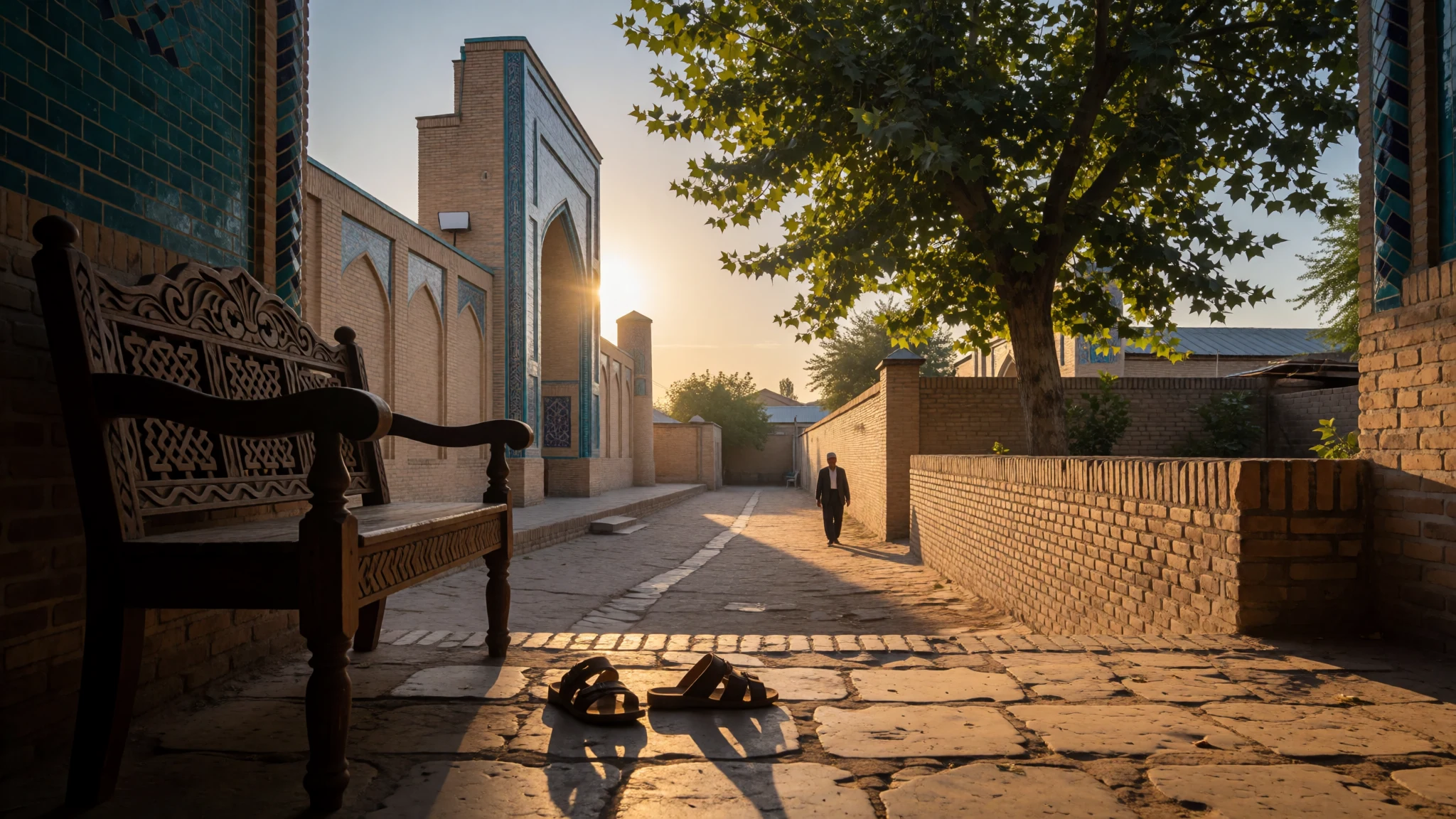
Tashkent is a leafy, rebuilt Silk Road capital where Soviet-era monuments, old madrasahs and plov lunches sit within a few metro stops of each other.
The place
Tashkent is the capital of Uzbekistan and the largest city in Central Asia, home to about three million people at an elevation of 455 m. It lies in the north-east of the country on a well-watered plain, and the water shapes the place: canals, fountains and long lines of plane and poplar trees keep the streets shadier than the surrounding steppe would suggest. The layout is really two cities. In the old quarter, lanes of low walled houses, madrasahs and bazaars follow the pattern of a Silk Road trading town. Beyond it, broad avenues, huge squares, concrete apartment blocks and a metro come from the decades after the 1966 earthquake, when the city was replanned as a showcase of Soviet design. Newer glass towers and landscaped parks now sit alongside both. Distances are larger than a map suggests, so most visitors combine the metro with short taxi rides booked through an app. Summers are hot and dry, winters can be cold and grey, and spring and autumn are the pleasant seasons. Tashkent is not a city of one great monument. Its appeal is in the mix: a Russian Orthodox cathedral a short ride from a Sufi shrine, a Lutheran church not far from a crafts madrasah, and tea houses and plov counters in between. Many travellers treat it as the gateway to Samarkand and Bukhara, but a couple of unhurried days here repay the effort, especially for anyone curious about how Central Asia lived through the twentieth century.
Its story
Tashkent's name is usually explained as "Stone City", from Turkic tash and Persian kent, a reading recorded by the scholar Abu Rayhan Biruni. Linguists still argue over older forms, notably Chach, the name the oasis once carried, and some think the stone meaning is a later reshaping or a translation of an even earlier word. Either way, settlement here long predates the present name. Sogdian and Turkic cultures shaped the oasis until Islam arrived in the middle of the eighth century. The Mongol sack of 1219 flattened the city, yet its place on the Silk Road made recovery worthwhile, and trade returned. For a spell in the eighteenth and early nineteenth centuries Tashkent ran itself as a city-state, until the Khanate of Kokand regained control. Russian forces took the city in 1865 and made it the administrative centre of Russian Turkestan, which is why a European-style quarter of churches and offices grew up beside the old town. The Soviet decades brought rapid growth and a changing population, partly through forced deportations from across the union, so that people of many origins settled here. The 1966 earthquake left large areas in ruins. The answer was a fresh plan of wide avenues, squares and housing districts, and much of the centre still follows that design. Recent decades have added museums and monuments that give more space to Uzbek history, but the Soviet layer remains very visible in the street plan, the metro and the big public buildings.
What to see
- Kukeldash Madrasah — Old town
Kukeldash Madrasah is a yellow-brick college built in 1570 by a vizier who was also a scientist and poet. The name is said to mean the khan's foster brother. Its large entrance portal and courtyard make it a good first look at older Tashkent architecture, away from the Soviet-era centre.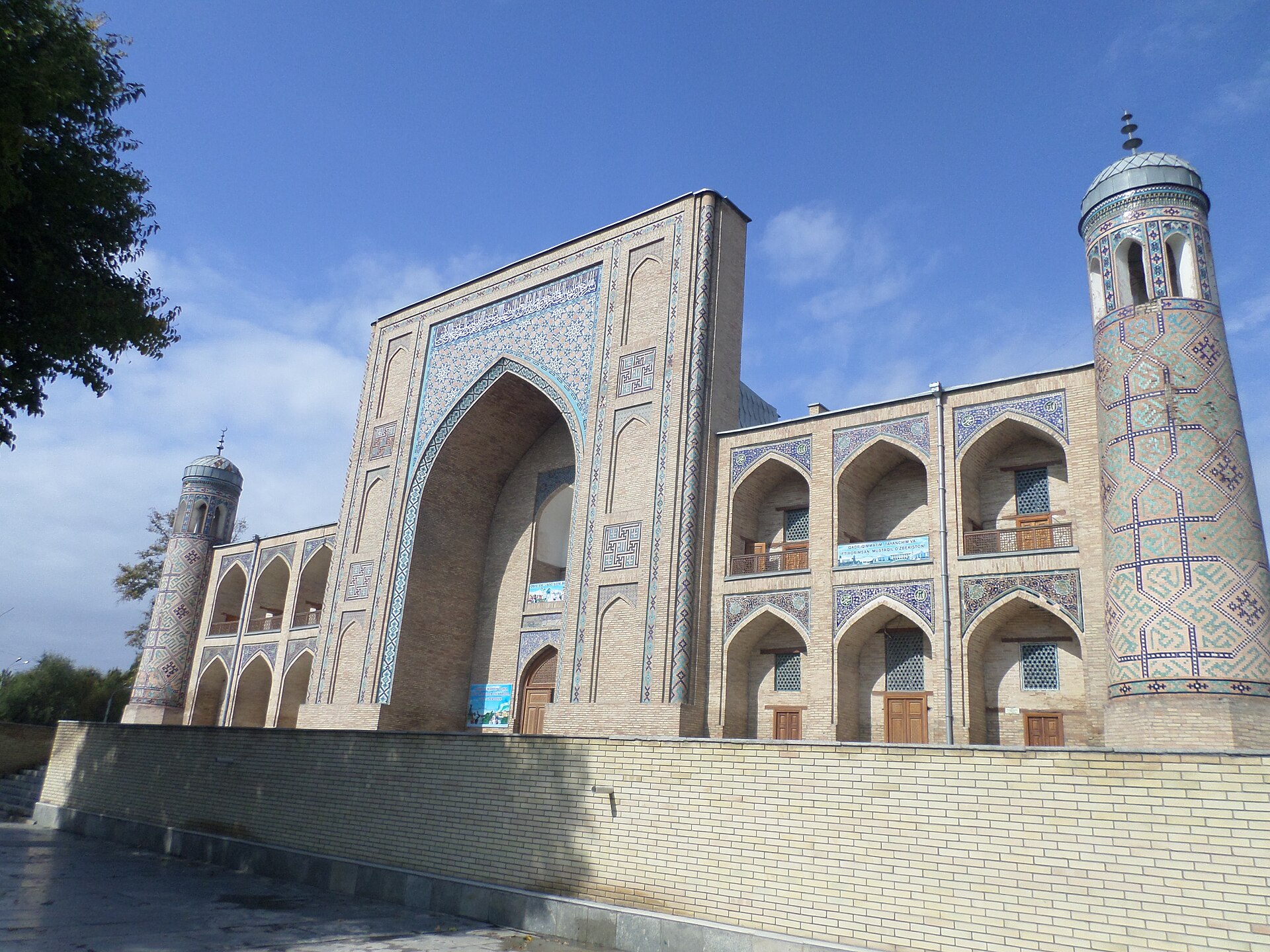
- Moyi Mubarek Madrasah — Old town religious quarter
Moyi Mubarek Madrasah dates from 1857 and is known for the Quran manuscript kept in the building, traditionally dated to the seventh century. It stands in the old religious quarter, so it combines easily with the neighbouring mosques. Check the official city site for opening arrangements before going. - Abdulkasim Madrasah — Central Tashkent
Abdulkasim Madrasah was put up in 1850 in honour of a scholar-ruler and now works as a crafts outlet. Its courtyard cells hold ceramics, textiles and woodwork. It is a pleasant place to browse and to see how a madrasah plan can be reused. Bargain gently and politely. - Kukcha Mosque and Zayniddin Mausoleum — North-west of the old town
Kukcha Mosque is a large mosque rebuilt in the 1990s. In the garden behind stands the mausoleum of Sheikh Zayniddin, a medieval Sufi holy man. The tomb building dates from the sixteenth century and was rebuilt in the nineteenth, and it is quieter and more local than the central sights. - Holy Assumption Cathedral — Central Tashkent
Holy Assumption Cathedral is a Russian Orthodox church built in 1871. The Soviets closed it, it was restored in 1945, and it was enlarged in the 1990s, with the bell tower rebuilt in 2010. Services draw a devout local congregation, so visit quietly and keep clear of worshippers.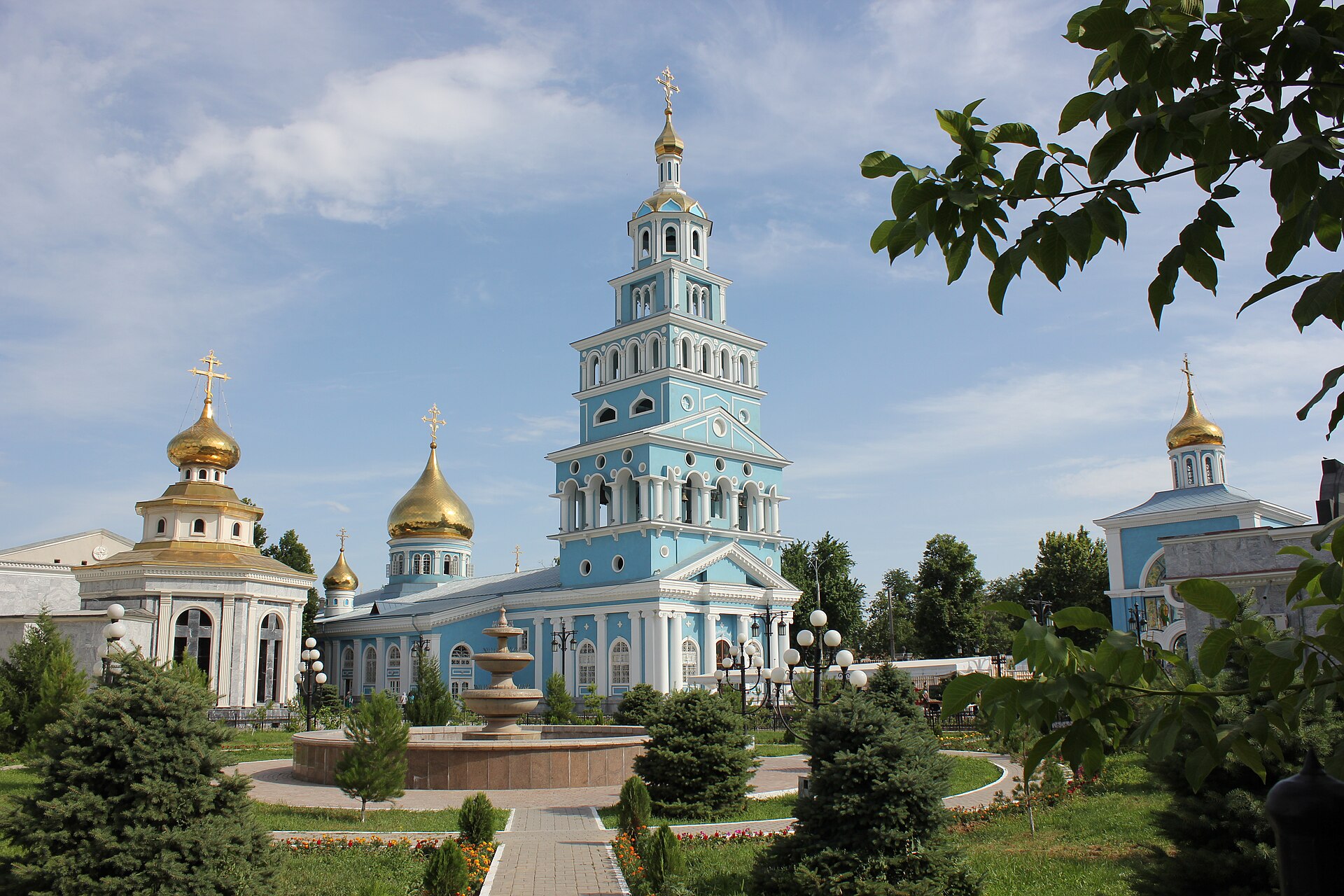
- Evangelical Lutheran Church — Central Tashkent
The Evangelical Lutheran Church was built in 1899 for the city's German community. Its plain, European-style building is a reminder of how mixed Tashkent became under the Russian Empire. It is a short and unusual stop between the larger sights, and exteriors are easy to photograph.
Culture
Tashkent's culture is layered. There is Islamic scholarship and Sufi devotion in the old town, Russian and German churches from the imperial period, and Soviet-era theatres, museums and monuments across the centre, including the opera and ballet theatre named for the poet Alisher Navoi. Uzbek is the national language, and Russian is still widely understood, which helps visitors who have neither. Hospitality is a point of pride. A guest is likely to be offered tea (choy) almost anywhere, and refusing outright can seem curt, so accepting a cup is the easy way to be polite. Bread is treated with respect and is not left upside down or dropped on the ground. Family and neighbourhood ties matter, and weddings and celebrations fill restaurants and halls on summer weekends. Religion is practised openly but quietly. Mosques and madrasahs are working places of worship as well as monuments, while the capital also has cafes, theatres and music venues with a relaxed, cosmopolitan feel. Visitors will notice how many different communities share the city, and how comfortable most residents are talking about it. A friendly question about food or family usually opens a conversation faster than a question about politics. Dress modestly at mosques and shrines, take your shoes off wherever others do, and ask before photographing people, especially women and worshippers.
What to wear
Traditional Uzbek dress in Tashkent centres on the doppi, a small embroidered skullcap, and the chapan, a padded long robe worn by men on formal and winter occasions. Women's festive dress uses ikat, a silk or silk-and-cotton cloth whose threads are resist-dyed before weaving, giving the blurred, feathery patterns known as abr. Atlas and adras are related fabrics. Suzani, large embroidered panels, hang on walls and appear in bridal households. Such dress mostly turns up at weddings, national holidays, folk performances and craft shops. Day to day, people in the capital wear what is common in any city: jeans, shirts, dresses and suits for work, with some women choosing headscarves and longer lines, and many younger people following international fashion. Visitors fit in easily in smart-casual clothes. Summer is hot and dry, so light cotton or linen with long sleeves and trousers or long skirts works better than shorts, and a hat helps. Winter is cold, so pack a proper coat. At mosques, madrasahs and shrines, cover shoulders and knees, and women may want a scarf for the head. Shoes should be comfortable on paving, marble steps and the occasional dusty lane, and easy to slip off at doorways.
What to eat
- Plov — Plov centres and neighbourhood canteens at lunchtime
Plov is the national dish: rice cooked with carrot, onion and meat in a large cauldron, often finished with chickpeas or a boiled egg. It is a midday meal, and it is served hot, in generous portions, until the pot is empty. - Samsa — Bakery counters and bazaar stalls
Samsa are baked pastries filled with spiced minced meat and onion, sometimes pumpkin. Their crust is flaky and the filling is juicy, so they are best eaten straight from the oven. They make a cheap, portable breakfast or snack. - Non — Bazaar bread sellers and neighbourhood bakeries
Non is the round flat bread baked against the walls of a clay tandoor, with a stamped pattern in the centre. Fresh loaves are crisp outside and soft within. It appears at every meal and is often bought warm and eaten on the walk. - Lagman — Family restaurants and canteens
Lagman is a noodle dish of hand-pulled wheat noodles in a broth or sauce of meat, peppers and other vegetables. It can be served as a soup or stir-fried, and shows the cross-border cooking of Central Asia. - Shashlik — Grill houses and evening street stalls
Shashlik is meat grilled on skewers over charcoal, usually lamb or beef, and served with raw onion, bread and tea. The smell of smoke is the easiest way to find a grill house on a summer evening.
Plan it
Best time. March–April and October–November, when days are mild and the trees are in leaf or colour; July and August are hot and dry, and winter is cold and often grey.
How long. 2–3
Getting there. Fly into Tashkent International Airport, a short taxi ride from the centre. Use the official taxi rank outside the terminal or the Yandex Go app, and agree the fare first. City buses leave from just across the car park, and the metro serves the centre. Trains and flights link Tashkent with Samarkand and Bukhara.
Budget. low
Tips
- Fix the taxi fare in advance or use a ride-hailing app, and ignore touts at the airport
- Yandex Go can freeze on a travel e-sim, so a VPN may be needed to load it
- Start sightseeing early in summer and rest in the afternoon heat
- Check museum and madrasah opening arrangements on the official city site, https://tashkent.uz
Etiquette
- Remove shoes where others do, and cover shoulders and knees at mosques and shrines
- Ask before photographing people, especially women and worshippers
- Accept a cup of tea when it is offered
Nearby
Sources
- Wikidata Q269 (CC0)
- Wikipedia: Tashkent (rev 1384474278) (CC BY-SA 4.0)
- Wikivoyage: Tashkent (rev 5427804) (CC BY-SA 4.0)
- Photo: Parliament (Supreme Assembly) building; Navoi Park — LBM1948 (CC BY-SA 4.0)
- Photo: Madrasah Kukaldash (Tashkent) — Bobyrr (CC BY-SA 4.0)
- Photo: Tashkent 2025 — Solijonov 1996 (CC0 1.0)
- Photo: Amir Timur Museum, Taskhent, Uzbekistan — Petar Milošević (CC BY-SA 4.0)
- Photo: Alisher Navoiy nomli DAKT teatri binosi — 26D (CC BY-SA 4.0)
- Photo: Успенский кафедральный собор в Ташкенте — ГОЛ ос (CC BY 3.0)
- Photo: State Museum of History of Uzbekistan — 26D (CC BY-SA 4.0)
- Photo: Shahids memorial complex, Toshkent, Uzbekistan — Humoyun Mehridinov (CC BY-SA 4.0)


