Szczecin
Szczecin, Poland
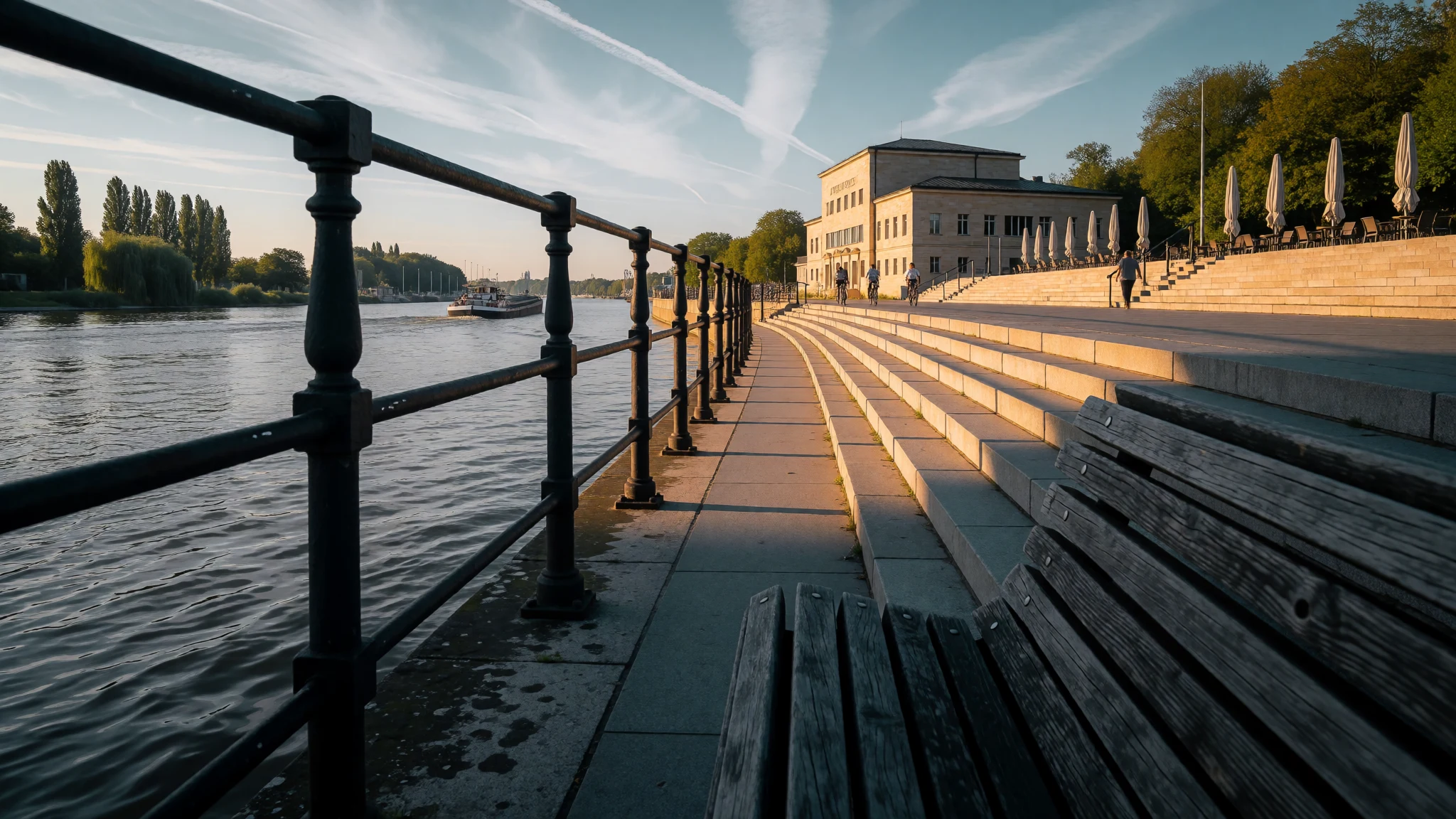
Szczecin is a Baltic port on the Oder, with Hanseatic brick, a rebuilt old town and river walks near the German border.
The place
Szczecin is Poland's seat of government for the West Pomeranian Voivodeship, a harbour city in the northwest, tucked toward the Baltic and the German frontier. Older English maps label it Stettin, the German form of the name. The recorded population is 387700, and the elevation is 131 metres, which leaves the city low, wet and organised around water rather than hills. The Oder runs through it, with the Szczecin Lagoon and the Bay of Pomerania to the north and Dąbie Lake along the southwestern edge of the built-up area. Water splits the streets: both banks are built up, and several large islands sit in the braid of channels, which makes a bridge an ordinary part of walking across town.
Forest, shrub and heath close in quickly. On the German side the same heathland is the Wkrzańska Heath, reaching toward Ueckermünde, while closer woods belong to the Szczecin Landscape Park. Police, the neighbouring town, presses against the built edge. The wider agglomeration does not stop at the border: communities in Brandenburg and Mecklenburg-Western Pomerania belong to the same metropolitan spread, which makes Szczecin feel both Polish and quietly international.
The port remains visible from the centre. Quays, cranes and passing hulls sit near brick civic buildings, a castle on the old stronghold site, and a promenade that looks straight onto the river and the harbour. A rebuilt old quarter clusters nearby, its houses set out on historic plots. Parks take the leftover ground: one runs through a large share of the city behind the council buildings, another fills the centre between the promenade and newer commercial blocks.
Its story
Szczecin begins in the written record as an eighth-century settlement, at a time when Viking crews and West Slavic communities were both using this stretch of the Pomeranian coast. Lechitic settlers raised their fort on the ground the ducal castle occupies now. Over the following century the defences grew and the houses crept down to the Oder bank, so safety and river trade became one project.
Poland's hold arrived in the tenth century, when Mieszko I pulled Pomerania into the young Polish realm. The grip did not stay firm. Under his successor, Mieszko II Lambert, the shore of the Oder lagoon slipped away and German overlordship took its place. Polish princes, the Holy Roman Empire and the Liutician federation afterwards all reached for the same coast. Wolin, the older hub nearby, then faded, and Szczecin took on the Baltic shipping that hub had carried, becoming a seaport of real weight in the twelfth century.
Bolesław the Wrymouth, a Polish duke, later compelled the city and the Pomeranian land around it to accept his overlordship. Wartislaw, the Pomeranian duke already in place, kept his own rule, recognised the higher claim and owed tribute. Bolesław paid for Otto of Bamberg to preach on that coast, and Wartislaw backed the mission locally. Otto returned for a further journey and carried Christianity deeper through Pomerania. The church of Saints Peter and Paul, the first in the city, belongs to that earlier visit.
Szczecin served as a capital of the Duchy of Pomerania under the House of Griffin, whose overlords at times included Poland, Saxony, the Holy Roman Empire and Denmark. The facts also attach the city to the Swedish Empire, the Kingdom of Prussia and the Free State of Prussia, and they class it as a Hanseatic city.
What to see
- Pomeranian Dukes' Castle — Old centre, above the Oder
Szczecin's Pomeranian Dukes' Castle stands on the old stronghold ground above the Oder. A museum shares the rooms with restaurants, cafes and a tourist information office that hands out free maps and pamphlets. The brick bulk marks the old centre. From the rebuilt streets the courtyard opens toward the river, and the building rewards a slow look rather than a dash through one gallery. - Old Town — Old Town
Szczecin's Old Town is a reconstruction residents treat with humour, because the houses are new even where the street plan is old. Rebuilding is still underway. Shops, restaurants and cafes occupy the lanes, and the castle sits a short stroll away, with the river just beyond the brick fronts.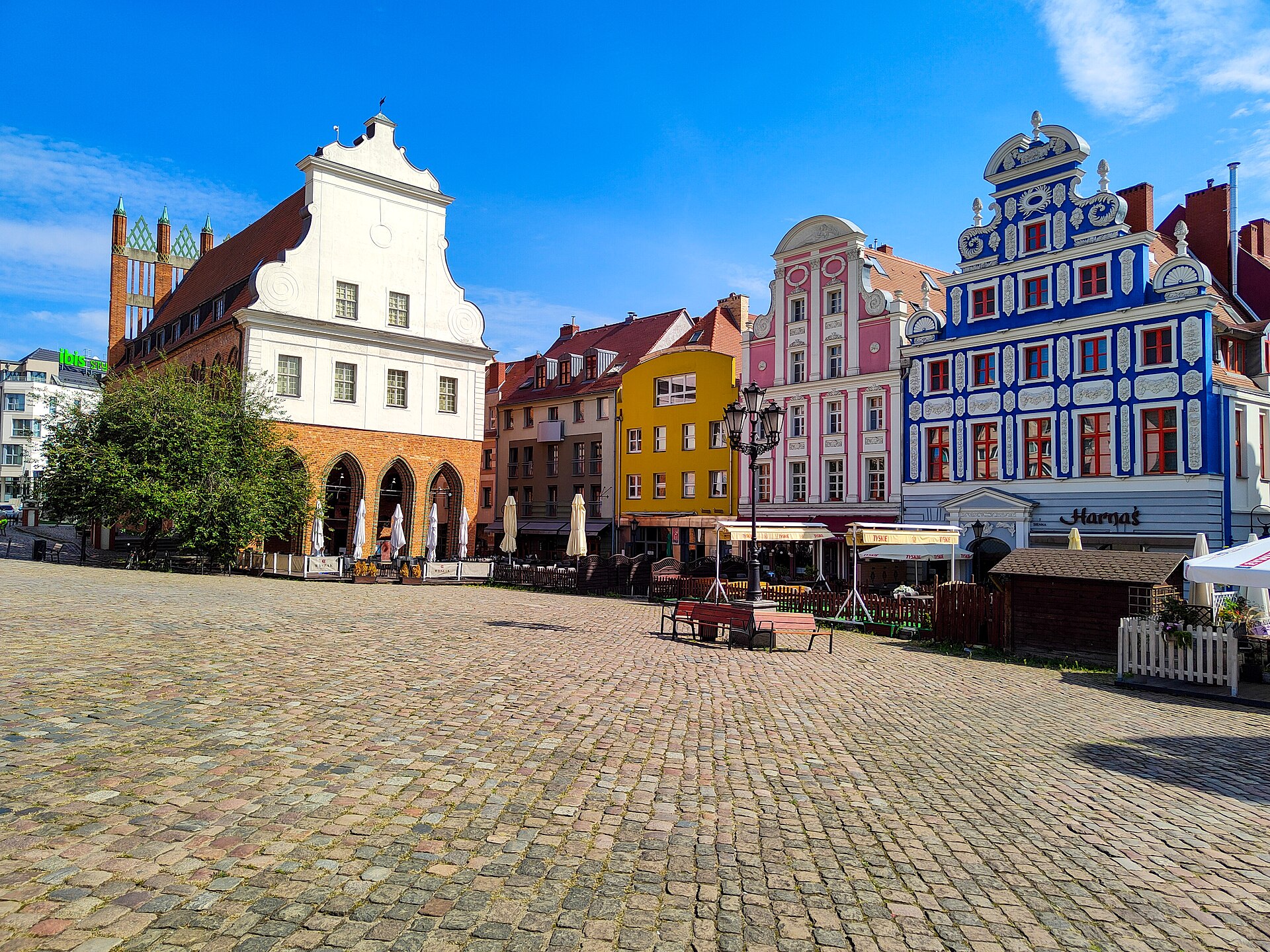
- Kamienica Loitzów — Between the Old Town and the castle
Szczecin's Kamienica Loitzów is a tenement a few steps from the Old Town, on the way toward the castle, and it is painted a loud orange that the street cannot hide. The house is a small stop rather than a long visit, useful as a marker between the rebuilt lanes and the ducal castle. Its colour makes it easy to pick out without a map. - Wały Chrobrego — River terrace above the Oder
Szczecin's Wały Chrobrego is a raised promenade with a long view over the Oder and the port. Cafes line the walk, and the maritime museum sits in the middle of the terrace, holding objects from the city's seafaring past. It shows how close the harbour still is to everyday life: ships, water and brick terraces in one glance. - Katedra św. Jakuba — Old centre
Szczecin's Katedra św. Jakuba is a large Gothic cathedral in the old centre, the Christian landmark that follows the city's medieval conversion. Brick and stone rise over the rebuilt streets and set the quarter's skyline. The interior is a working church as well as a monument, so a quiet manner belongs there, and the exterior alone is worth a slow circuit of the square around it.
Culture
Szczecin carries its culture in public brick and in ordinary routines rather than in costume on the street. The castle museum, the maritime museum on Wały Chrobrego and the Gothic cathedral form a short chain of memory: Slavic stronghold, Hanseatic port, Christian city, then the later Prussian and Swedish chapters that the record also names. The harbour has been a stage for the Tall Ships' Races, a moment when visiting sailing ships sit against the working port. Music has a modern home in the Philharmonic, a sharp contemporary building among older roofs, and cafes along the promenade do as much social work as any formal hall.
The rebuilt Old Town is part of the same public life. Residents treat it with humour because the houses are recent, yet they follow historic plans, and people use them as a real centre for shopping, meeting and eating. Parks such as Park Kasprowicza and Park Żeromskiego take the evening stroll when the quays are busy. Polish is the language of the street, with German never far away in memory or in visitors from across the border.
In the cathedral and inside the castle museum, keep your voice low, skip flash, and ask before photographing people at close range.
What to wear
Szczecin has no single costume that the streets still wear. On feast days and folk stages in Pomerania, traditional dress appears as regional Polish costume: full skirts, embroidered blouses, fitted vests and headscarves for women, and darker jackets or vests with trousers for men, in wool, linen and cotton rather than silk. Those clothes belong to festivals, dance groups and church holidays, not to the tram or the office. The textiles people point to with pride in this part of Poland are woven wool and linen, plus the bright embroidery of Pomeranian folk work, kept for performance and family ceremony.
What people wear now is ordinary northern-European city dress. Jeans, coats, trainers and practical layers fill the promenade and the shopping streets. A wind off the Oder makes a jacket normal even when the sun is out, and the rebuilt lanes are paved for everyday shoes, not costume.
A visitor to Szczecin needs a kit for a low, damp, windy port: a waterproof layer, a warmer mid-layer in the cooler months, and shoes that can handle cobbles and long park paths. The cathedral calls for covered shoulders and an avoidance of beachwear; the same modest layer is enough at the castle museum.
What to eat
- Pasztecik — Snack counters in the centre
Szczecin's own snack is the pasztecik, a small deep-fried cake (paszteciki in the plural). The filling is meat, or cheese with mushrooms. It is eaten standing up at snack counters, beside the kebabs, pizza and hot dogs that are easy to find across the city. - Żurek — Brewery bars in the centre
Szczecin serves żurek in brewery bars, the casual rooms young locals use for a drink as well as a meal. The soup is made on sour rye, tangy and filling, and it belongs beside a beer rather than on a formal cloth. - Pork neck — Brewery bars popular with young locals
Szczecin pairs pork neck with pickled vegetables in the brewery bars that pour beer for a young crowd. The meat is a hearty main, not a snack, and the pickles cut the richness. It is everyday Polish cooking in a relaxed room. - Zupa dnia — Vegetarian and vegan eateries
Szczecin's vegetarian and vegan eateries often list zupa dnia, the soup of the day, for people eating on a tight budget. The bowl changes with the kitchen, so the point is the habit rather than one fixed recipe. - Danie dnia — Vegetarian and vegan eateries
Szczecin's danie dnia, the dish of the day, is the main-course partner to the daily soup in vegetarian and vegan rooms. The plate changes with the kitchen and is aimed at a limited budget, so the menu stays short.
Plan it
Best time. Szczecin walks well in late spring and early autumn. High summer is warmer and busier on the harbour, and midwinter is cold, dark and quiet. The brief has no climate table, so check a current forecast.
How long. two to three
Getting there. Szczecin Główny, the main railway station, is the practical hub. Polish State Railways runs express or Intercity trains from Warsaw in less than six hours, often with small delays, and reaches Poznań in about two and a half hours on frequent daytime services. A rail line links the local airport with that station and with Kołobrzeg; the road transfer can take up to an hour in traffic. Berlin Brandenburg is a real alternative, two to three hours away by train or by minibus. See https://www.szczecin.eu/pl for city information.
Budget. mid
Tips
- Treat Szczecin Główny as the rail hub and allow slack on long-distance trains.
- Compare Berlin Brandenburg with the local airport; both are realistic, and the last leg differs.
- Visit the castle and the Old Town in the morning, before the cafe terraces fill.
- Carry a card and a little cash, because small snack counters vary.
- The old reputation for organised crime is described as long past; ordinary care with bags is enough.
Etiquette
- Keep voices low in the cathedral, especially during a service.
- Ask before close-up photographs of people.
- Leave room on narrow Old Town lanes for people who live there.
- Follow museum staff on bags and indoor photography at the castle.
Nearby
Sources
- Wikidata Q393 (CC0)
- Wikipedia (rev 1384726715) (CC BY-SA 4.0)
- Wikivoyage (rev 5419313) (CC BY-SA 4.0)
- Photo: Szczecin aerial — Andrzej Otrębski (CC BY 3.0)
- Photo: Most Kolejowy w Szczecinie — Kapitel (CC BY-SA 4.0)
- Photo: National Museum in Szczecin — Kengurjan (CC BY-SA 4.0)
- Photo: Ratusz Staromiejski w Szczecinie — Szczecinolog (CC BY-SA 4.0)
- Photo: Tall Ships' Races 2017 Szczecin — Szczecinolog (CC BY-SA 4.0)
- Photo: Red Town Hall in Szczecin — Szczecinolog (CC BY-SA 4.0)
- Photo: Palace of the Pomeranian Land Owners — Szczecinolog (CC BY-SA 4.0)
- Photo: Szczecin Philharmonic — Rudolf H. Boettcher (CC BY-SA 4.0)


