Sheffield
Sheffield, United Kingdom
Sheffield is a hilly, green northern English city, built on steel, where industrial brick meets moorland and good sandwiches within a short bus ride.
The place
Sheffield is a city in South Yorkshire, in the north of England, about 47 km south of Leeds and 51 km east of Manchester. Roughly 578,000 people live here, and the centre sits about 75 m above sea level, though that figure hides the real shape of the place: the city rises and falls across ridges and river valleys on the eastern edge of the Pennines. The River Don runs through it, joined by the Loxley, Porter Brook, Rivelin and Sheaf, and those valleys explain why so many streets seem to tilt. The same hills are the reason Sheffield has no airport of its own, so most visitors arrive by train. The city is leafier than its industrial reputation suggests. It counts more than 250 parks, woodlands and gardens, with an estimated 4.5 million trees, so a short walk from the centre can end among woodland. Steel and cutlery built Sheffield, and recent decades of redevelopment have turned old works and canal-side plots into galleries, flats, university buildings and bars, while plenty of brick workshops remain. Compared with Manchester or Leeds, the mood is less polished and more neighbourly: conversation starts easily at a bus stop, and the moors of the Peak District begin at the western edge of the suburbs. Summers are mild, winters can be grey and wet, and the slopes mean sturdy shoes matter more than smart ones.
Its story
Sheffield's story starts long before the steelworks. People are believed to have lived in this area about 12,800 years ago, and the earliest evidence comes from Creswell Crags, east of the city. In the Iron Age the land lay at the southern edge of the territory of the Brigantes, a Pennine tribe to whom the hillforts around Sheffield are usually attributed. After Roman rule ended, the valley may have sat on a frontier: the Sheaf and the Don formed part of the line between the Brittonic kingdom of Elmet and the kingdom of Mercia. Anglo-Saxon and Danish settlers then shaped the villages that later merged into one town, and Wikidata gives a founding date of around 701. Nearby place names such as Wales and Waleswood hint at the earlier Britons. Sheffield's fame, though, came from metal. Fast rivers turned grinding wheels, and in the nineteenth century new ways of making high-quality stainless and crucible steel turned cutlery into a worldwide trade. The population multiplied nearly ten times over. The town received its municipal charter in 1843 and city status in 1893. Then foreign competition cut deep into iron and steel, and coal mining collapsed across the region in the late twentieth century, leaving unemployment and empty sites. The twenty-first century has brought rebuilding, and the story Sheffield tells today is of reinvention without erasing its workshops.
What to see
- Sheffield Cathedral — City centre, Church Street
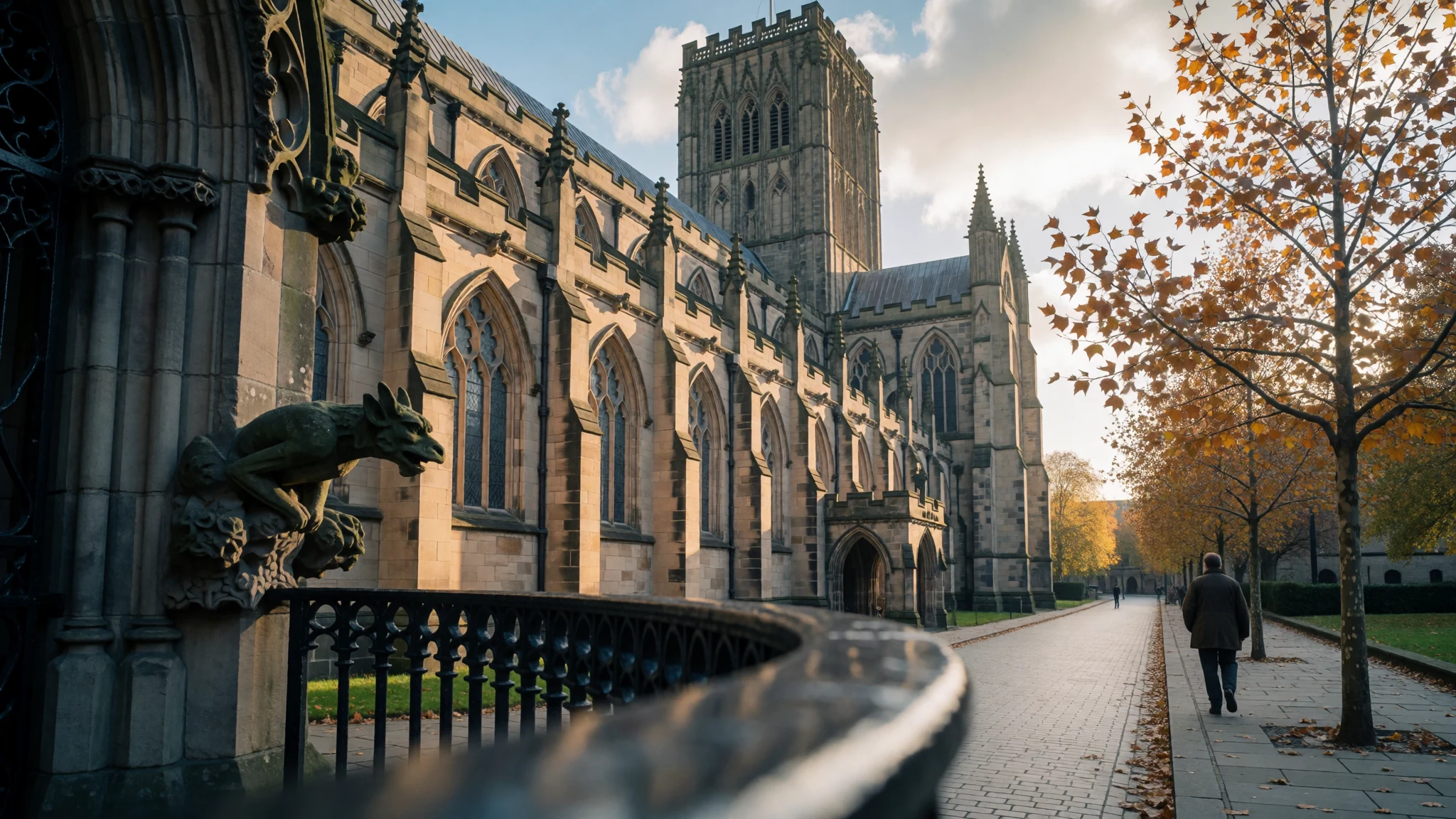
Sheffield's Anglican cathedral stands on Church Street, and the interior rewards a slow walk. Look for the crypt chapel dedicated to a local regiment, the modern nave added in the twentieth century, and the carved gargoyles around the gatepost. It is a working church, so check for services before visiting.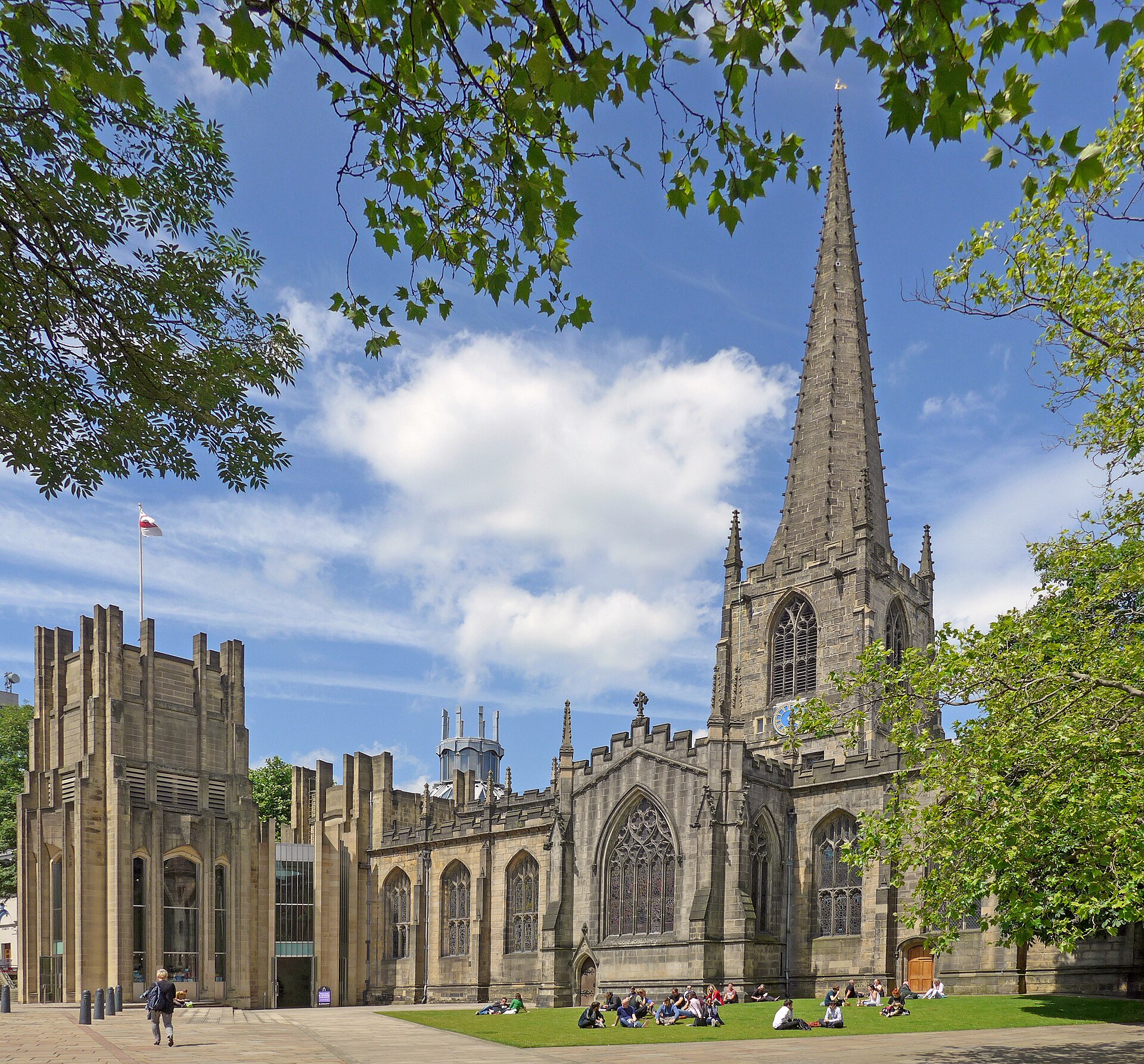
- Arts Tower — University of Sheffield campus, west of the centre
The University of Sheffield's Arts Tower is a clean-lined piece of mid-century modernism and a landmark of the Sheffield skyline. Its draw for architecture fans is a paternoster lift, a rare continuous loop of open cabins that survives in use. Check the university's website for public access rules. - Central Library — City centre, near the Town Hall
Sheffield's Central Library is a substantial Art Deco building from the 1930s, handsome in stone and generous in scale. It is a good stop for architecture and for a quiet sit-down between museums and shops. Opening arrangements change, so check the official council site first. - Cholera Monument — Park Hill side, east of the centre
This memorial in Sheffield marks a burial ground for victims of the 1832 cholera outbreak, set in a small park with woodland edges. It is sobering, and the slope also gives a wide view across the rooftops of the centre. Wear shoes with grip after rain. - Catholic Cathedral — City centre, Norfolk Row area
Sheffield's Catholic cathedral dates from the middle of the nineteenth century and serves as the mother church for local Catholics. Inside are stained-glass windows and an organ built by Lewis in the same era. It sits a few minutes' walk from the Anglican cathedral, so the two pair easily. - Barker's Pool — City centre, near City Hall
Barker's Pool is the open square in central Sheffield where crowds gather for public events and protests. At its heart stands the Cenotaph, a memorial to the city's war dead. It is a handy meeting point, with shops and cafés close by and the Town Hall within sight.
Culture
Sheffield's culture is shaped by work, weather and a strong local pride. For generations the city's identity rested on cutlers, steel melters and coal miners, and a straight-talking, no-airs manner still marks everyday conversation. Strangers are often addressed as "love" or "duck" without any offence meant, and a joke at your own expense goes down well. The faith picture has changed. At the last census, having no religion was the most common answer among residents, Christianity remained the largest religion, and Islam came next, with smaller Hindu, Jewish, Buddhist and Sikh communities also present. The city has two cathedrals, one Anglican and one Catholic, alongside mosques, gurdwaras and temples that serve neighbourhoods rather than tourists. Universities bring a large student population, which feeds a lively mix of live music, theatre, independent cafés and late-night food. Pubs remain the main social room: rounds are bought in turn, and people queue at the bar rather than waiting to be served. Football is followed closely, and the city has two professional clubs whose supporters take the rivalry seriously. Local people are generally proud of the parks and moorland on the doorstep and will happily recommend a walk. In Sheffield's cathedrals and other places of worship, keep voices low, check whether a service is on, and ask before photographing anyone at prayer.
What to wear
Sheffield has no single regional costume, but its working past left a recognisable wardrobe. Cutlers and steelworkers wore leather aprons, heavy boots and flat caps, and the wool tweeds and worsted cloth of Yorkshire were everyday fabrics. Those pieces now turn up in heritage displays, brass-band uniforms and as a nod in modern workwear. Today people dress for hills and rain. Waterproof jackets, fleeces, jeans, trainers or walking shoes are normal, even in the evening, and the large student population keeps things casual and a little retro. Smart clothes appear for weddings, concerts at the City Hall and dinners out, but formality is rarely required. Visitors should dress in layers: mornings can be cool even in summer, and rain arrives quickly. A proper waterproof coat and shoes with good grip matter more than an umbrella, which is awkward on windy ridges. Those coming from warmer climates should pack a warm jumper, a hat and gloves for winter. For cathedrals and mosques, covered shoulders and knees are the polite choice, and a scarf is useful for covering the head in a mosque or gurdwara. Walkers heading into the Peak District need ankle-supporting boots, since paths turn muddy and slippery.
What to eat
- Pork sandwich — Traditional sandwich counters in the city centre
Sheffield has its own tradition of pork sandwich shops, started by a Hungarian-born baker and his local wife. Expect roast pork piled into a soft bread roll with stuffing, crackling or apple sauce. Look for the small counter shops in the centre. - Bakery pies and buns — Neighbourhood bakeries across the city
Sheffield's local bakery chains sell hot pies, pasties, sausage rolls and iced buns at low prices. They feel more regional than the national high-street names and make a cheap, filling breakfast or lunch on the go. - Yorkshire pudding with gravy — Sunday roast menus in local pubs
A Yorkshire pudding is a puffed, crisp batter, served in Sheffield with roast meat and rich gravy, often as a Sunday meal. Some pubs serve oversized versions as a meal on their own, filled with sausages or beef. - Henderson's Relish — Pubs, cafés and corner shops
This peppery, vinegary brown sauce is a Sheffield staple, splashed over pies, chips, sausages and cheese on toast. It is not a dish but a flavour that defines local cooking, and it is sold in shops and cafés throughout the city. - Sandwich-shack breakfasts — Sandwich bars and independent cafés in suburban high streets
Small sandwich bars in Sheffield produce bacon, egg and sausage baps, soup and fresh coffee, with queues at weekends. They suit walkers and students alike, and the better ones are known by word of mouth. - Market stall lunches — The Moor Market and other indoor markets
Sheffield's covered market hall mixes butchers, fishmongers, greengrocers and cheap hot food from many cuisines. It is a good place to try local pies and South Asian snacks side by side, and to watch regulars shop.
Plan it
Best time. May to July and September for the best chance of mild, dry days, long evenings and green parks; October brings autumn colour in the woods. Winters are cold, grey and wet, and snow can close hill roads.
How long. 2–3
Getting there. Sheffield has no airport. The usual route is Manchester Airport (MAN), then a train to Sheffield that takes about 80 minutes with a quick change at Manchester Piccadilly. East Midlands Airport (EMA) is about an hour south by road, with National Express coaches to the city. From either, the last leg ends at Sheffield station, a short tram or walk from the centre.
Budget. mid
Tips
- Pack a waterproof and shoes with good grip, since the city is hilly and rain is frequent
- Check the official site, https://www.sheffield.gov.uk/, for events, transport and opening arrangements before travelling
- Use trams and buses for the steeper hills rather than walking everywhere
- Allow a half-day for the Peak District edge if the weather is clear
- Carry a bank card for most purchases, with a little cash for small market stalls
Etiquette
- Queue at bars and bus stops and wait your turn
- Say thank you to bus drivers when getting off
- Keep voices down and ask first before taking photographs inside cathedrals and other places of worship
Nearby
Sources
- Wikidata Q42448 (CC0)
- Wikipedia: Sheffield (rev 1384854179) (CC BY-SA 4.0)
- Wikivoyage: Sheffield (rev 5417908) (CC BY-SA 4.0)
- Pictures of Sheffield, Neil Theasby (CC BY 2.5)
- Sheffield night skyline, Nbfreeh (CC BY-SA 4.0)
- Sheffield Town Hall, Tim Green (CC BY 2.5)
- The Moor Market, Sheffield, Chris Morgan (CC BY-SA 2.0)
- Sheffield Cathedral, Tim Green (CC BY 2.5)
- Early September in Sheffield's Botanical Gardens, Neil Theasby (CC BY-SA 2.0)
- Sheffield City Hall, Tim Green (CC BY 2.5)
- Winter Garden, Sheffield, Mr Ignavy (CC BY-SA 2.0)


