Sevastopol
Sevastopol, Ukraine
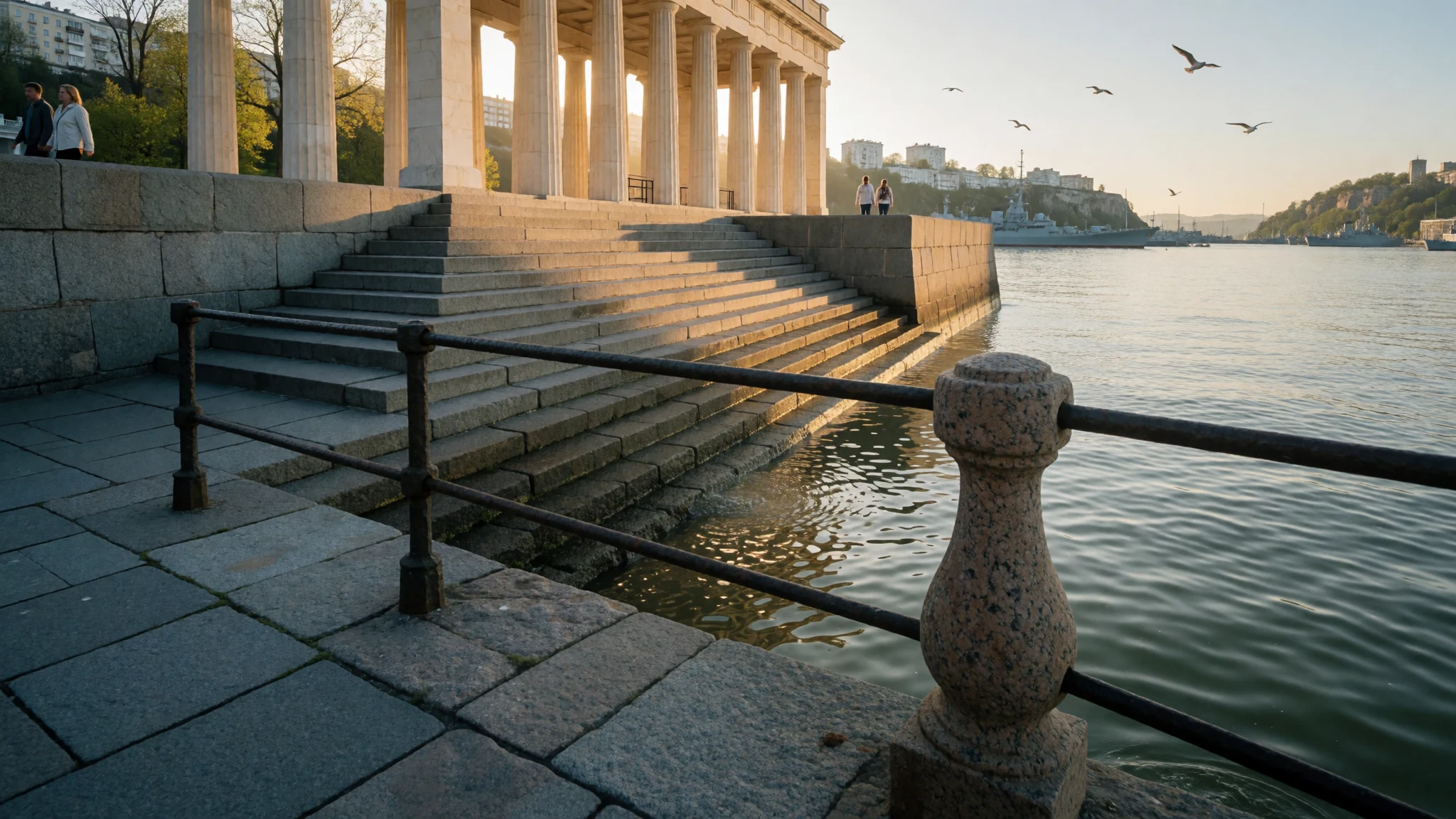
Sevastopol is a Black Sea naval harbour with Greek ruins, siege-era memorials and sea-facing stairways, in a region that is currently occupied and war-affected.
The place
Sevastopol sits at the south-western tip of the Crimean peninsula, built around a long, sheltered inlet of the Black Sea. The bay is the reason the city exists: its deep water stays ice-free and shields ships from storms, which is why navies have wanted it for more than two centuries. The city proper has about 485,000 people and lies low, at around 15 metres above sea level, though the streets climb quickly from the waterfront onto limestone ridges, so most walks involve steps.
The centre is compact and formal. Wide squares, pale stone civic buildings and monuments to admirals and sunken ships face the water, and the older eastern districts and the fishing harbour of Balaklava hold most of the historic buildings. The western districts are newer and more modern, with tower blocks going up in recent years.
Sevastopol is not an ordinary holiday city, and an honest reading has to say so. Internationally, the city and the rest of Crimea are recognised as part of Ukraine, and under Ukrainian law Sevastopol has special city status, shared only with Kyiv. Russia has controlled it since 2014 and treats it as one of its own federal cities. Its identity is tied up with the Black Sea Fleet, and for much of the Cold War it was closed to outsiders. Anyone thinking of a visit should read their own government's current travel advice first, because the surrounding region is affected by war and the rules of access change.
Its story
Sevastopol's story begins well before the modern city. Greek settlers founded Chersonesus on this coast in the sixth century BC, and the town later passed through the hands of the Bosporan Kingdom, Pontus, Rome and Byzantium. By the time the Crimean Khanate held the peninsula, the old Greek city was ruined and mostly abandoned.
The present city dates from 1783, when a Scottish-born rear admiral in Russian service, Thomas MacKenzie, set up a naval base here. It was first called Akhtiar, meaning White Cliff, and the Russian Empire annexed the Khanate soon after. The settlement was renamed Sevastopol, a Greek-style name that nods to the ancient past, and it grew as the home port of the Black Sea Fleet.
The city's reputation was made by sieges. It was defended at great cost during the Crimean War in the nineteenth century, and again in the Second World War, when German forces held it for a time and left much of it in ruins. Rebuilding gave the centre its uniform, Soviet-era look. Under the Soviet Union it was a closed naval city, so ordinary visitors were kept out.
In the Soviet years the city moved from Russian to Ukrainian administration, and after Ukraine's independence the fleet stayed on under lease. In 2014 Russia occupied the city and then announced its annexation, which most countries do not recognise. That history, layered over Greek ruins, is why locals, historians and officials describe the same streets in very different ways.
What to see
- Nakhimov Square — City centre
The main square of Sevastopol is a broad open space ringed by official buildings, with a statue of Admiral Pavel Nakhimov at its centre. He commanded during the first defence of the city. It is the natural starting point for a walk, and parades and ceremonies are held here. - Count's Landing Stage — Waterfront, central bay
A classical colonnade and a flight of granite steps lead straight down into the bay, forming a ceremonial sea gate to the city. It is a good place to watch the harbour, the grey naval ships and the small ferries crossing, especially in the soft light of early evening. - Monument to the Sunken Ships — Sevastopol Bay, Leninsky district
A lone column topped by an eagle stands on a rock a short way offshore, marking vessels deliberately sunk to block the harbour mouth against an enemy fleet. It is best seen from the embankment, where the white stone shows against the water and the light is good for photographs.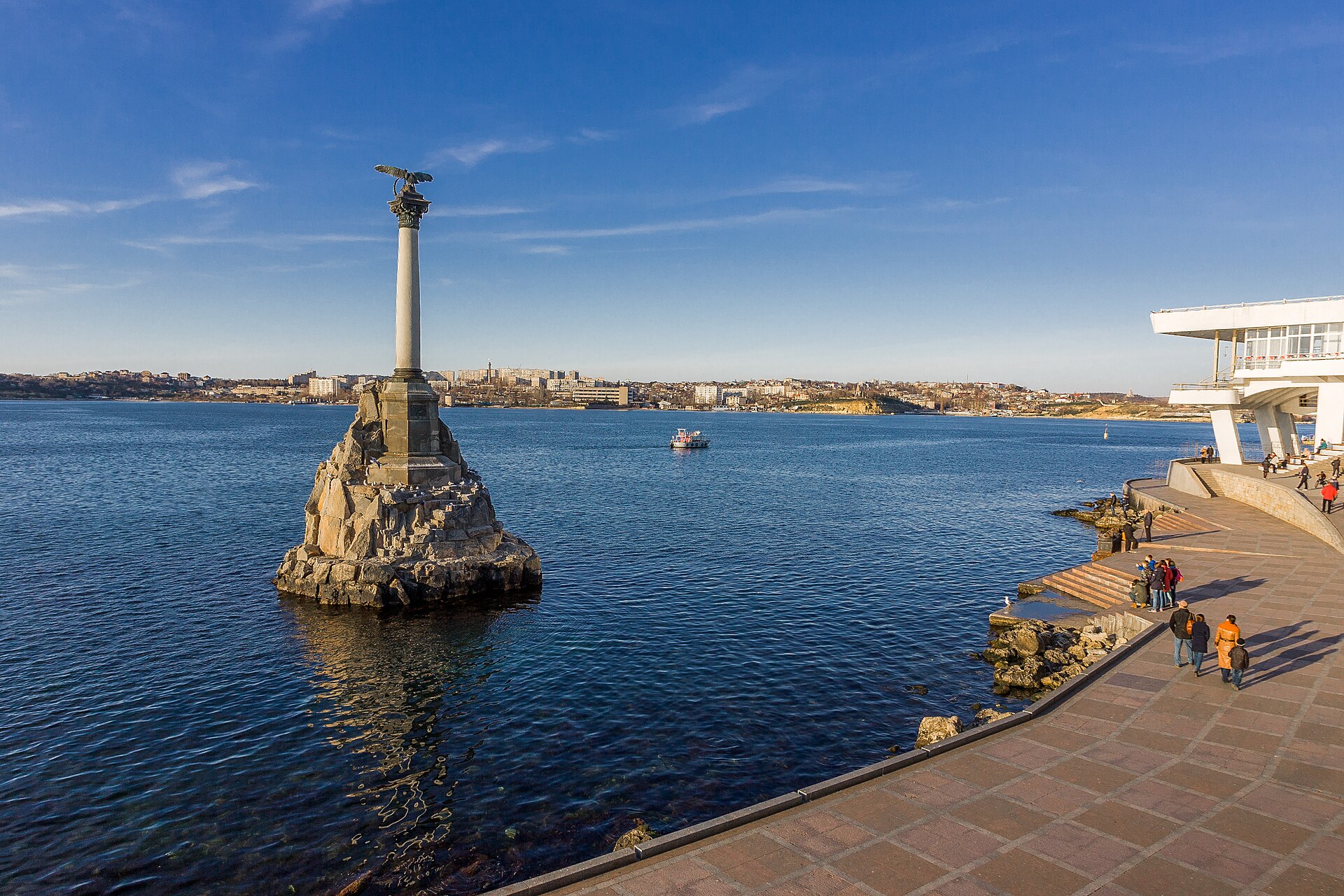
- Black Sea Fleet Museum — City centre
This museum follows the story of Russia's Black Sea Fleet from the city's founding through the Crimean War and the twentieth-century conflicts to the present. It presents one national account of events, so it is worth reading the displays with that in mind and checking opening arrangements on the official city site. - St Vladimir Cathedral — Central hill
This church stands on a rise in the centre and is closely tied to the city's naval history. Naval officers are buried in its crypt. It is a working place of worship, so expect services, candles and quiet, and treat it as a church first and a sight second. - Chersonesus — Western coast, edge of the city
The ruins of the ancient Greek colony lie beside the sea on the city's western edge, with column bases, street lines, a basilica and views over the water. It is open ground with little shade, so go in the morning, wear sturdy shoes and bring water.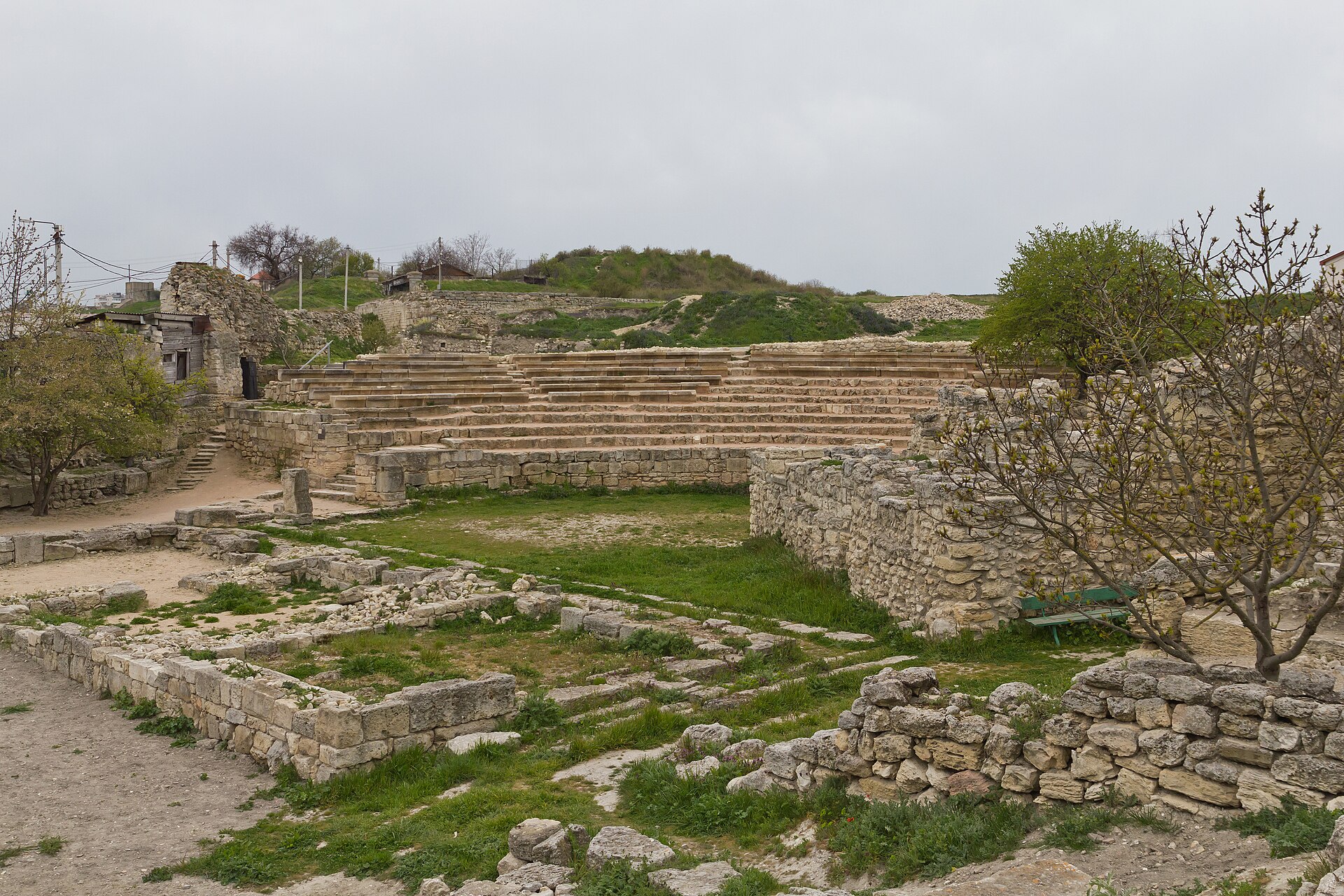
Culture
Sevastopol's culture is shaped by the navy more than by any single ethnic tradition. For generations the city has been a place of officers, sailors, dockyard workers and their families, and the habits show: public ceremonies, memorials on almost every other corner, and a strong feeling for anniversaries of battles and sieges. Naval pride is open and sincere here, and it sits alongside very different views of the city's present.
The population is largely Russian-speaking, with Ukrainian and Crimean Tatar communities whose experience of the last decade has been very different from the majority's. That makes the city's politics sensitive. Many residents have little patience for visitors who show no interest in the language or local history, and conversation about the status of Crimea can quickly become personal.
In daily life, the pace is that of a port: early starts at the harbour, long evenings on the waterfront, families walking on the embankments, and summer crowds heading for beaches along the coast. Architecture ranges from imperial-era stone buildings in the centre to Soviet apartment blocks and newer glass towers in the west. Football, fishing and cafe sitting are the usual leisure pursuits, and Balaklava keeps a more relaxed, fishing-village feel.
Visitors should keep political opinions to themselves, ask before photographing people, and avoid photographing ships, bases or military sites, since this is an active naval area where cameras draw attention.
What to wear
Sevastopol has no single traditional costume of its own, so older dress here comes from the communities who live around it. Russian and Ukrainian festival clothing includes the embroidered linen shirt, known in Ukrainian as the vyshyvanka, worn with red and black thread patterns, along with wool waistcoats and woven belts. Crimean Tatar dress, with richly embroidered velvet and silk, is seen mostly at cultural events. The best-known local uniform is the sailor's: the blue-and-white striped telnyashka undershirt and navy cap are part of the city's image, and are worn proudly on naval holidays.
Day to day, people dress simply and neatly. Jeans, light shirts and dresses are normal in the warm months, and layers, wool coats and boots in winter, when the sea wind makes the city feel colder than the temperature suggests. On the promenade in the evening, people tend to dress a little smarter than the beach clothes seen on the coast.
Visitors should pack for sun and wind: a hat, sunglasses and a light jacket, with comfortable, grippy walking shoes for the steps and the uneven stone at Chersonesus. Beachwear belongs on the beach. For churches, cover shoulders and knees, and women may be expected to cover their heads, so carry a light scarf. Keep dress modest and unremarkable, and avoid military-style clothing, which could draw unwanted attention in a naval city.
What to eat
- Crimean-style baklava — Bakeries and pastry stalls in the centre and Balaklava
Local cooks insist their baklava differs from the Greek and Turkish versions, so it is worth trying a piece. Expect layered pastry with nuts and syrup in a Crimean version, best eaten fresh with strong tea or coffee. - Chebureki — Street kiosks and small cafes near markets
These large, crisp, half-moon pastries of fried dough filled with spiced minced meat are a Crimean Tatar speciality now eaten across the peninsula. They are greasy, hot and filling, and sold at kiosks as a quick lunch, usually with a cup of tea. - Grilled or fried Black Sea fish — Fish restaurants along the waterfront and Balaklava harbour
Fish is the obvious order in a port city. Sea-side restaurants serve local catches grilled whole or fried with lemon and herbs. Ask what came in that day, as the catch varies with season, and expect restaurants on the water to cost more. - Borscht — Ukrainian restaurants and canteen-style eateries
The beetroot soup of Ukrainian and Russian kitchens appears on most menus, usually served hot with sour cream and dark bread. Versions differ by cook, with some richer in meat and others lighter. It makes a sound, warming meal after a windy walk on the front. - Varenyky — Ukrainian restaurants and home-style cafes
Boiled dumplings stuffed with potato, cabbage, cheese or cherries, usually topped with sour cream or fried onion. They suit vegetarians when filled with potato or cheese, though it is worth checking whether the fat used for frying contains meat.
Plan it
Best time. May–June and September–October are the most comfortable months: warm, with sea air and fewer crowds. July and August bring heat and busy beaches along the coast, while winter is cool and windy with a quieter, greyer harbour.
How long. 2–3
Getting there. The international airport serving the area is at Simferopol, about two hours from Sevastopol by train, with up to 20 connections a day, but flight and rail services change with the political situation, so check current status. Long-distance trains are poor, and the last leg is usually by rail, bus or taxi from Simferopol.
Budget. mid
Tips
- Check your own government's travel advice before planning anything, as the region is occupied and affected by war
- Look at the official city site, https://sevastopolis.com/, for current opening arrangements instead of relying on printed hours
- Visit Chersonesus in the morning, since it has little shade, and carry water
- Carry some cash as well as cards, as card acceptance and international payments may be limited
- Use the ferry across the bay to reach beaches on the north shore, then a short marshrutka (minibus) ride
Etiquette
- Do not photograph ships, naval bases or military personnel
- Avoid political arguments about the status of Crimea, which many locals find painful
- Cover shoulders and knees in churches and keep quiet during services
Nearby
Sources
- Wikidata Q7525 (CC0)
- Wikipedia: Sevastopol (rev 1383766517) (CC BY-SA 4.0)
- Wikivoyage: Sevastopol (rev 5417779) (CC BY-SA 4.0)
- Photo: Sevastopol collage 2015 (Dmottl) (CC BY-SA 4.0)
- Photo: Monument to the Sunken Ships (GIC198) (CC BY-SA 4.0)
- Photo: St Vladimir Cathedral, Chersonesos (George Chernilevsky) (Public domain)
- Photo: Chersonesus, Basilica (Alexxx1979) (CC BY 3.0)
- Photo: Institute of Biology of the Southern Seas (Alexxx1979) (CC BY 3.0)
- Photo: The Bell of Chersonesos (Dmitry A. Mottl) (CC BY 3.0)
- Photo: Balaklava, Sevastopol (Juri Kowski) (CC BY 3.0)
- Photo: Chersonesus archaeological site (A.Savin) (CC BY-SA 2.0)


