Sarazm
Sarazm, Tajikistan
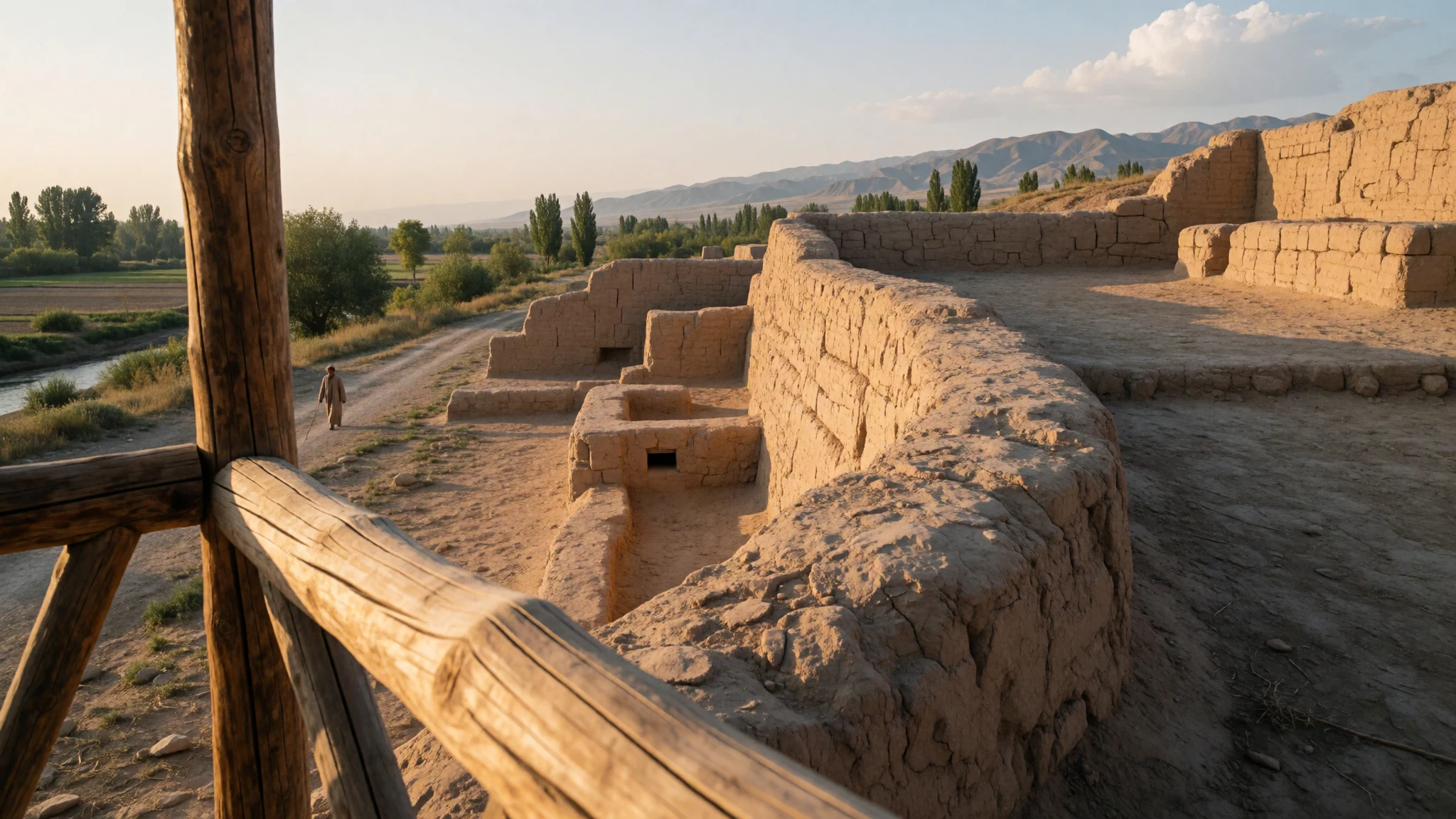
Sarazm is a quiet, UNESCO-listed excavation in the Zeravshan valley where one of Central Asia's earliest town-like settlements can be read in the ground.
The place
Sarazm lies in the north-west of Tajikistan, a short distance from the town of Panjakent in Sughd Region. The archaeological site stands near the village of Sohibnazar on the left bank of the Zeravshan river, and the Uzbek border is close by. The name also belongs to a modern jamoat, a local administrative unit made up of villages, with Chimqal'a as its seat. So a map search for Sarazm turns up both a living rural district and an ancient settlement.
What survives on the ground is modest to look at: low walls of earth and mudbrick, laid out in excavated areas on a flat terrace above the valley, with fenced and sheltered patches where the digging has been protected. There are no standing towers or carved gateways here. The reward is context. Foothills rise to the south, the river carries water from the high Fann ranges, and the surrounding land is farmed, which explains why people settled here at all.
The site is described as proto-urban, meaning it had the beginnings of town life rather than a full city. UNESCO inscribed it, and the listing number is 1141. The summers are hot and sunny, as across most of Tajikistan, so the landscape is dry, pale and dusty for much of the year, and greener in spring.
Visitors should expect a small, uncrowded place. Many of the finest finds are in Dushanbe rather than on the site itself.
Its story
Sarazm's story begins in the fourth millennium BC, when farmers and herders settled on the Zeravshan terrace. Radiocarbon dates from the site stretch over well more than a thousand years, which tells archaeologists that the place was lived in, rebuilt and reused across a very long span rather than founded and abandoned in a single moment.
The settlement matters because of what it connects. Its people farmed the river land, kept animals and worked metal, but the objects found here also point outwards. Beads, seals and ornaments suggest contact with communities far to the south and west, while the mountains to the east offered stones and ores that were worth carrying. Sarazm looks like a hinge between farming oases and the wider uplands, an early example of the trade logic that later made this valley a Silk Road corridor.
Its culture also comes before the steppe pastoralists known as the Andronovo culture, who spread into this part of Central Asia in the second millennium BC. That gives Sarazm a place in the story of what the region looked like before those later arrivals.
The site was excavated over several seasons in the modern era, and the finds, including jewellery, seals and carved ornaments, were studied and partly moved to the National Museum of Antiquities in Dushanbe. The wider valley kept its importance for centuries. Ancient Panjakent, a later city nearby, is itself part of a separate UNESCO listing for the Zeravshan Valley.
What to see
- The excavated settlement — Sohibnazar, near Panjakent
The main draw is the excavated terrace itself, where low mudbrick walls and room outlines are laid out in numbered areas. It rewards slow walking more than quick photography. Try to picture the river, the fields and the hills as they would have looked to a farming community.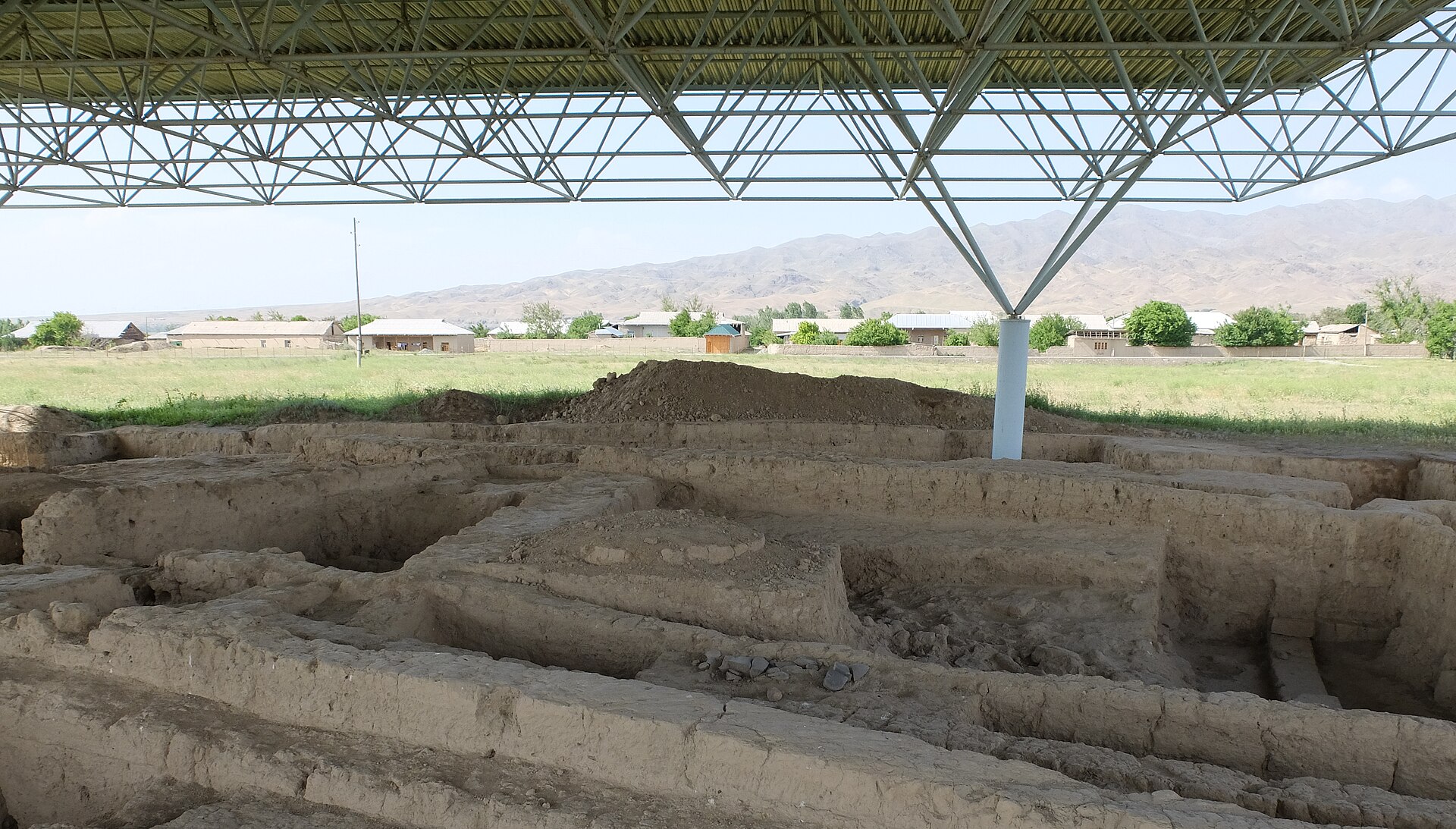
- Excavation area XII — Sarazm archaeological site
One of the dig areas has been photographed and documented in detail, and it shows the layered earth and wall footings particularly clearly. Seeing the stratified soil makes the long occupation easier to grasp: building on building, rebuilt over many generations on the same ground.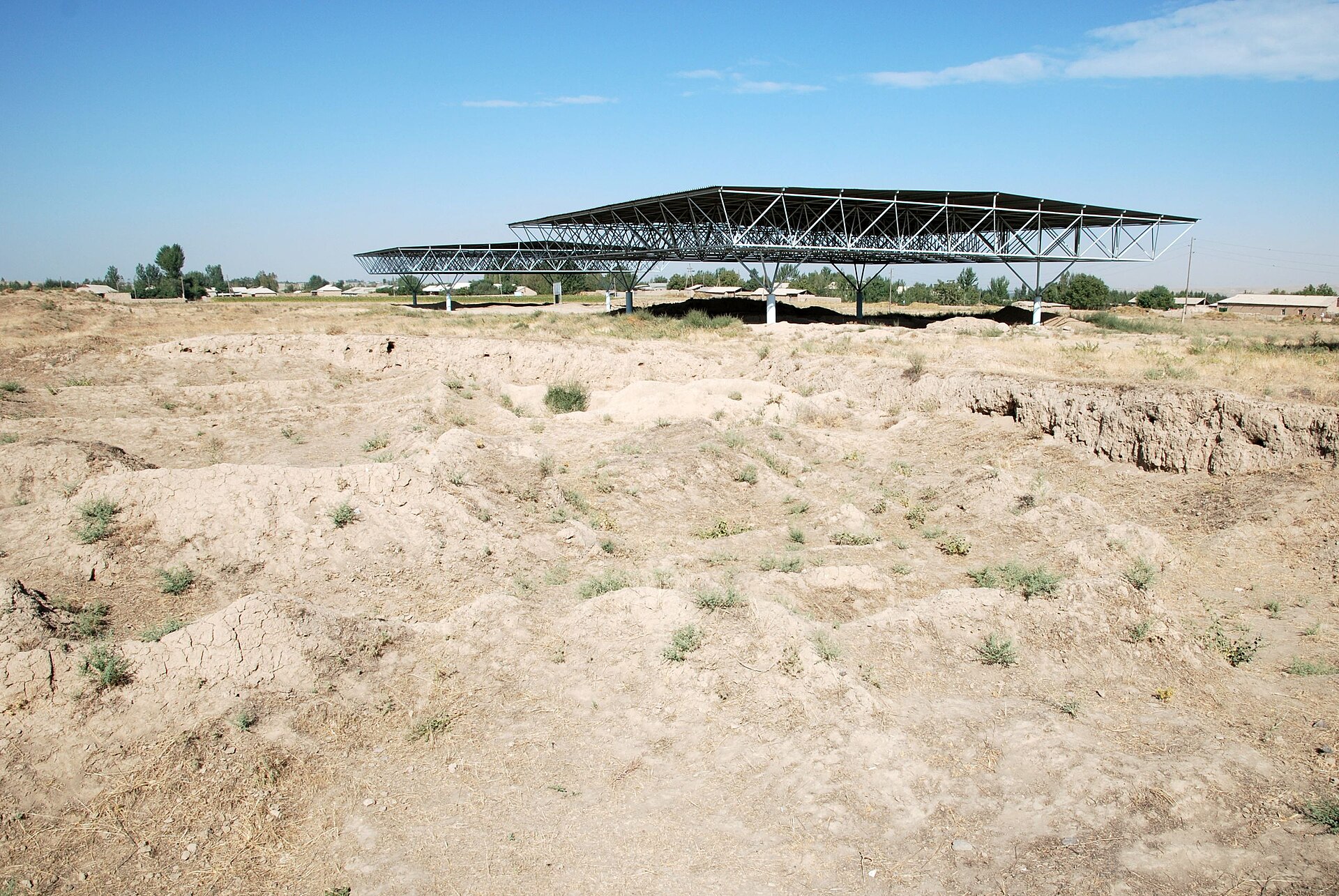
- Sarazm gallery, National Museum of Antiquities — Dushanbe
Much of the portable treasure sits in Dushanbe, in the national antiquities museum, where Sarazm has its own display. A day trip from Panjakent cannot cover it, so it suits travellers passing through the capital. Check the museum's official channels for opening arrangements before going.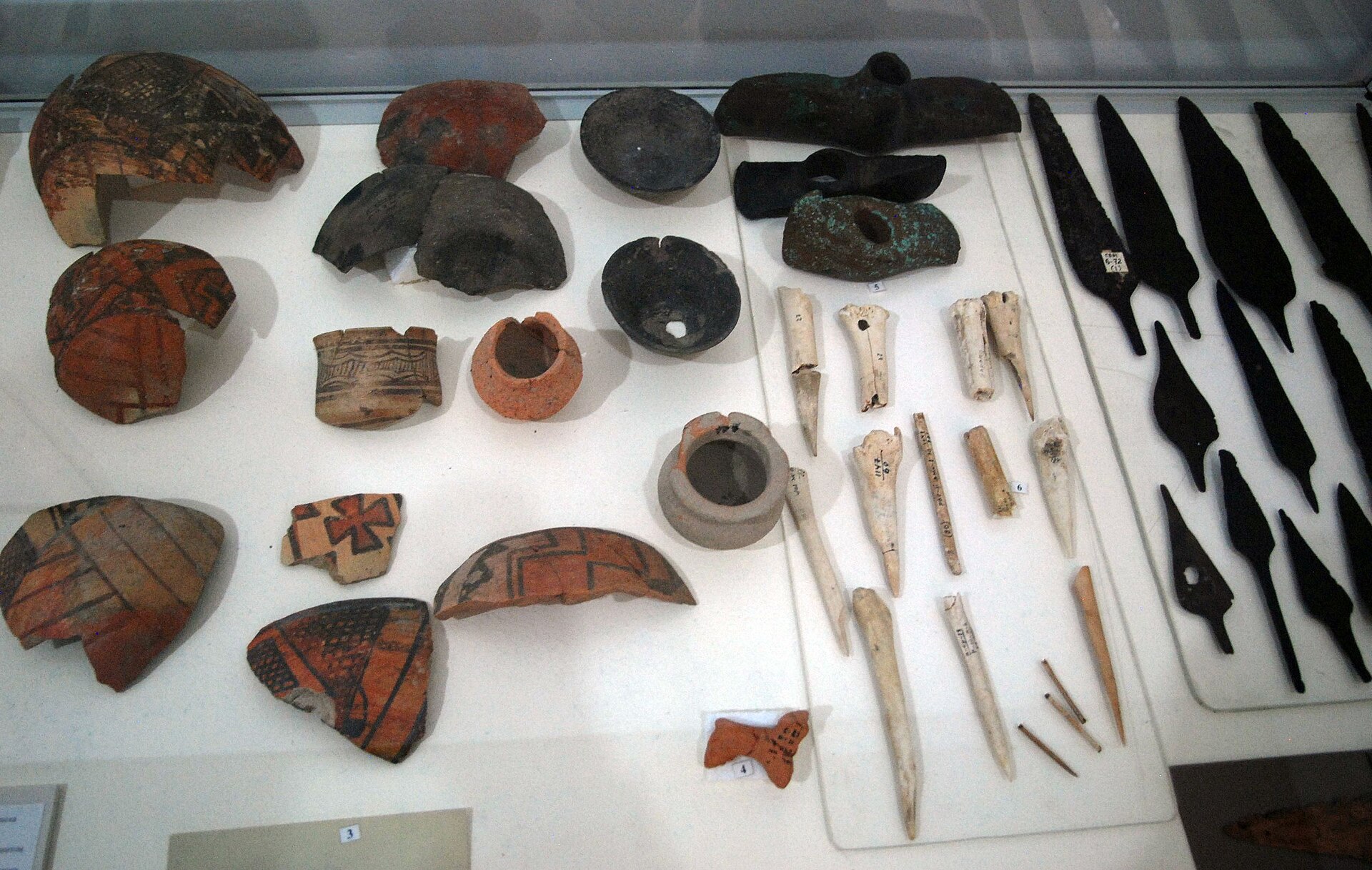
- The Sarazm necklace — National Museum of Antiquities, Dushanbe
Among the finds is a necklace of carefully shaped beads, which shows both skill and access to far-sourced materials. Looking at it in the museum is a good way to understand why archaeologists describe the settlement as a trading place, not just a farming village.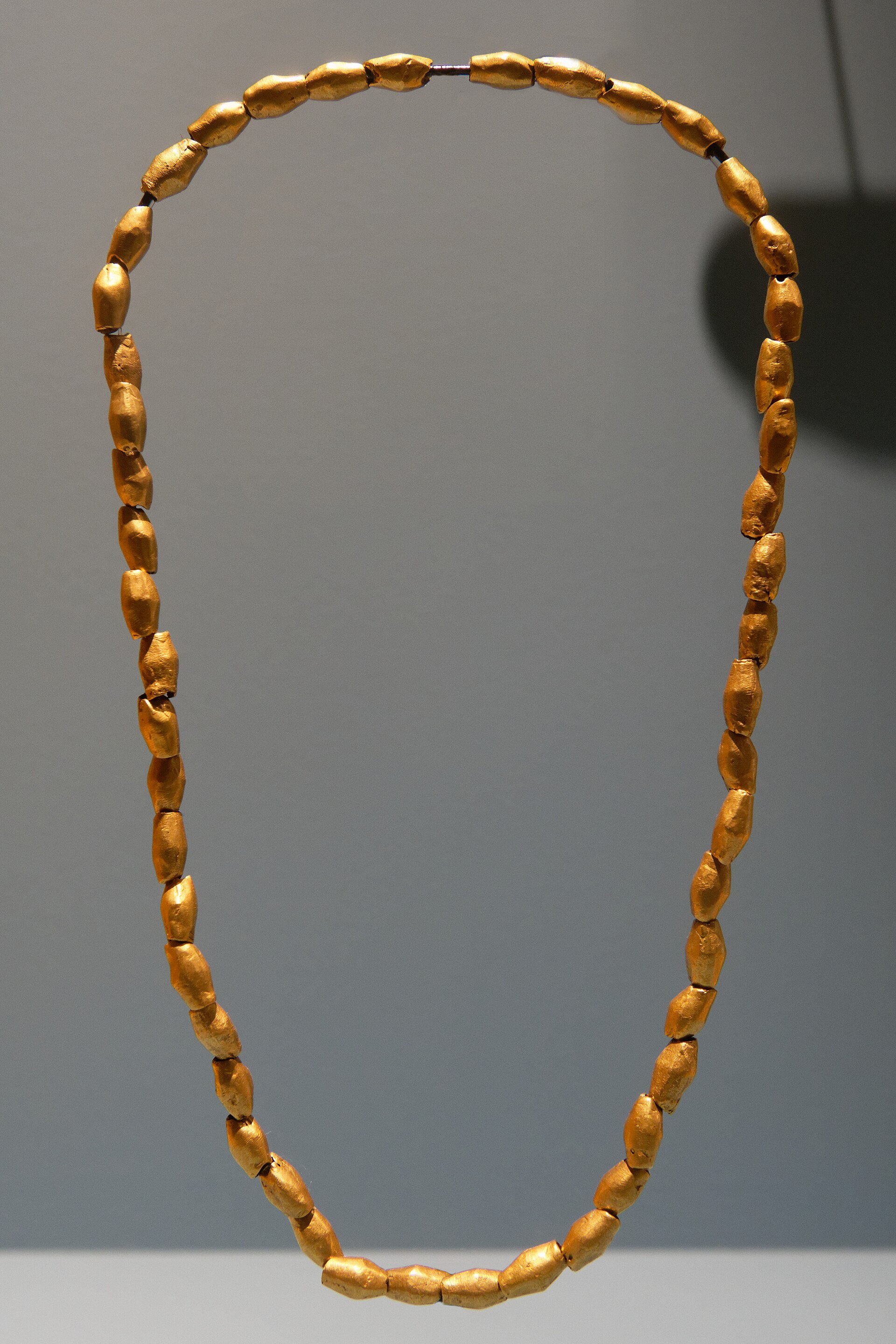
- Seals and the twelve-petalled flower — National Museum of Antiquities, Dushanbe
Small carved seals, including one with a cow design, and a flower ornament with twelve petals show how people marked goods and ownership, and how much care went into decoration. They are tiny, so allow time to look closely rather than glance past the cases.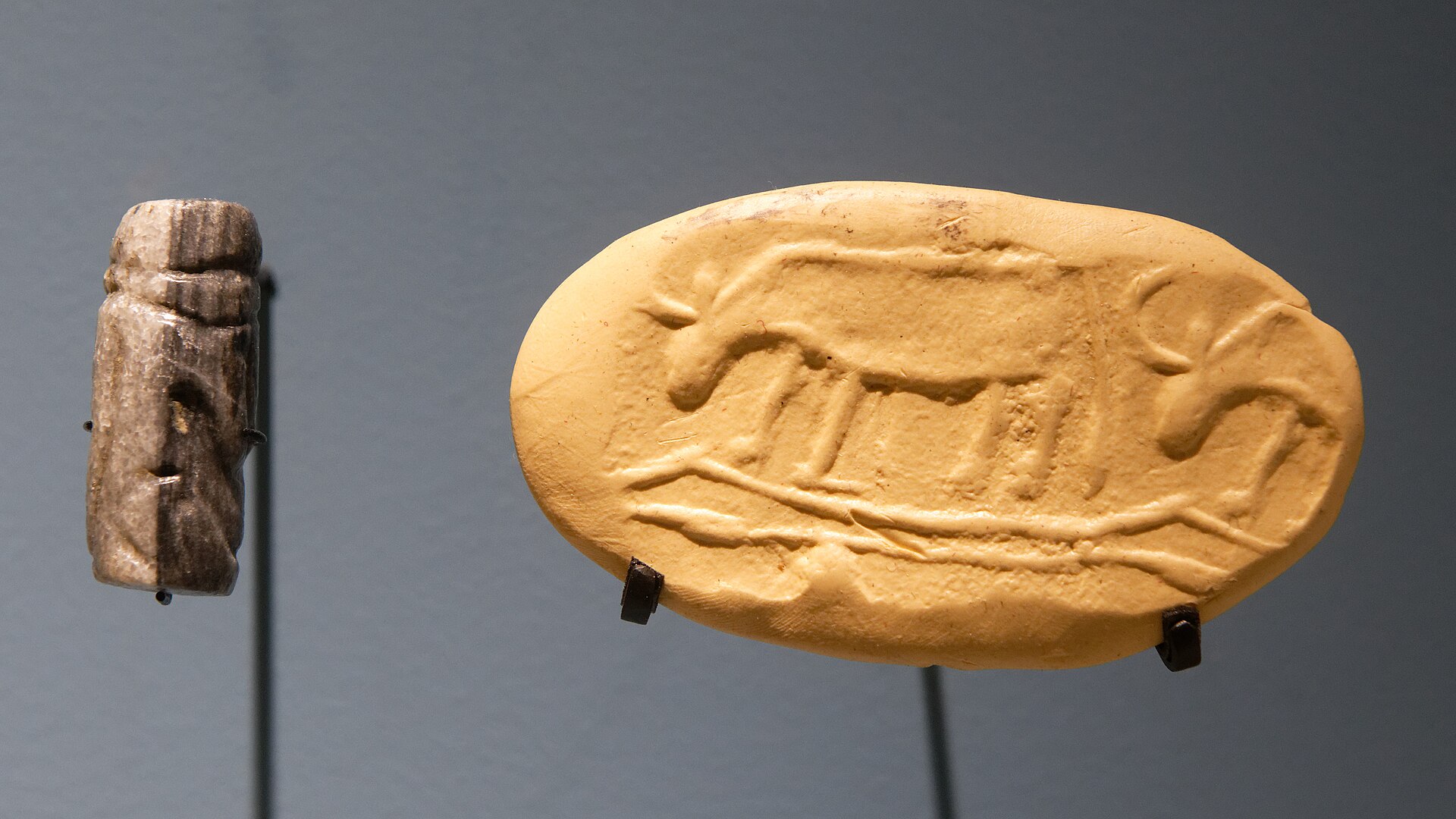
Culture
Sarazm is in the Zeravshan valley, where daily life in Tajikistan is still shaped by family, hospitality and religion. Tajikistan is a fairly conservative society, and that is felt most in villages like those around the site. People are often warm to visitors, and curious young people may come up to say hello and practise English. Others can be reserved or blunt, which is not a sign of hostility.
The valley's identity is layered. The ancient settlement belongs to a time before the Silk Road, the later city of Panjakent grew in the same valley, and today's villages carry on farming the river land. Tajik is the language of the district, written in Cyrillic, and spellings of place names vary in English, so Sarazm may appear in slightly different forms on maps and signs.
Tea is the centre of hospitality. Being offered green tea, bread and fruit is normal, and refusing everything outright can feel cold. Meals are often shared from a common plate, and guests are fed generously.
Religion is part of ordinary life, and mosques are mainly used by men. Women visitors should not expect to join prayer, though some larger mosques admit tourist groups. The archaeological site is not a place of worship, but local people may pass through or work close by, so it deserves quiet, respectful behaviour.
When greeting older people, place your right hand over your heart as a sign of respect, and ask before photographing anyone, especially women.
What to wear
Around Sarazm, traditional dress draws on the wider Central Asian wardrobe. Women's festive clothing is made from bright silk and cotton fabrics, often ikat-style cloth with blurred, feathered patterns such as atlas and adras, cut into long dresses worn over loose trousers. Men's formal wear includes the chapan, a quilted or lined robe, and the embroidered skullcap, called a tubeteika or doppi. These are most visible at weddings, holidays and festivals rather than on an ordinary weekday.
Everyday clothing is simpler and often practical. In villages, many women wear long dresses with a headscarf tied loosely, while men wear trousers and shirts, with a jacket when it is cool. In towns and among younger people, jeans, trainers and sportswear are common. Fabrics tend to be cotton for heat, with wool and padding in winter.
Visitors should dress for both sun and local norms. Summers are hot, so loose, light cotton or linen with long sleeves and trousers or a long skirt works better than shorts. Shorts on men tend to draw disapproving stares even in cities, and women are expected to be fairly modest in public. A headscarf is not required but can be useful if visiting a home or religious building.
The site itself is dry and uneven, with loose earth and little shade. Wear sturdy closed shoes or light boots, bring a brimmed hat, sunglasses and a scarf for dust, and pack a warm layer for cooler mornings in spring and autumn.
What to eat
- Osh (plov) — Local eateries and tea houses in Panjakent
Osh is the everyday celebration dish: rice, mutton or beef and strips of carrot cooked together in oil in a large cauldron over fire. It is usually served on a shared plate. Look for it at local eateries and family gatherings around Panjakent. - Qurutob — Traditional eateries and family tables
Often called the national dish, qurutob is flaky bread soaked in a tangy yogurt-like sauce made from dried cheese, topped with fried onions and vegetables. It contains no meat and is eaten by hand from a shared plate. It appears less often than osh. - Laghman — Bazaar eateries in Panjakent
Laghman is a hearty noodle soup with vegetables and lamb or beef. It is a reliable lunch after a morning of walking in the sun, and easy to find in simple roadside and bazaar-side eateries across northern Tajikistan. - Green tea — Any tea house, home or roadside stop
Green tea is drunk all day, sweetened or plain, and is poured as soon as a guest sits down. Expect it with bread, dried fruit and sweets. Accepting a cup is the easiest way to be sociable and take a rest from the heat. - Compote — Home-style eateries and family tables
Compote is a sweet fruit drink made by cooking fruit in water, served in homes and eateries, especially in the warm months. Check that it is made from clean ingredients and avoid anything with ice, since tap water in Tajikistan is not safe to drink.
Plan it
Best time. May–June and September–October, when it is warm but not at its hottest. Summers are very hot and sunny across most of Tajikistan, and the site has little shade.
How long. 2–3
Getting there. Fly to Dushanbe, then travel west by road to Panjakent through the mountains; shared taxis and private cars are the usual options. Sarazm is a short taxi ride from Panjakent. Panjakent is also reachable from Uzbekistan, which is close by. Check the Ministry of Foreign Affairs visa checker before travel.
Budget. low
Tips
- Check the current visa rules and print any e-visa, since a digital copy may not be accepted
- Visit in the morning, as the site has little shade and midday sun is strong
- Drink bottled water and avoid ice, and expect water to be shut off in some buildings
- Combine Sarazm with the later Panjakent ruins and the Fann Mountains if time allows
- Carry cash for taxis and small eateries, as card use is limited outside cities
Etiquette
- Greet older people with your right hand on your heart
- Dress modestly, with covered shoulders and knees
- Ask before photographing people, especially women
Nearby
Sources
- Wikidata Q422929 (CC0)
- Wikipedia: Sarazm (CC BY-SA 4.0)
- Wikivoyage: Tajikistan (CC BY-SA 4.0)
- Sarazm, area XII — Bertramz (CC BY 3.0)
- Sarazm, National Museum of Antiquities Dushanbe — Bertramz (CC BY 3.0)
- 12-petalled flower MNAT SZM001 — Marie-Lan Nguyen (CC BY 4.0)
- Necklace Sarazm NMAT SZM5-190 1147-365 (cleanup) — Marie-Lan Nguyen (CC BY 4.0)
- Cylinder seal cow MNAT SZM211 — Marie-Lan Nguyen (CC BY 4.0)
- Excavated and protected area of Sarazm — Phelynx (CC BY-SA 4.0)
- PC Sarazm EN — Fan Zhang, Chao Ning, Ashley Scott (CC BY-SA 4.0)
- Stone seal from Sarazm — Zunkir (CC BY-SA 4.0)


