San Salvador
San Salvador, El Salvador
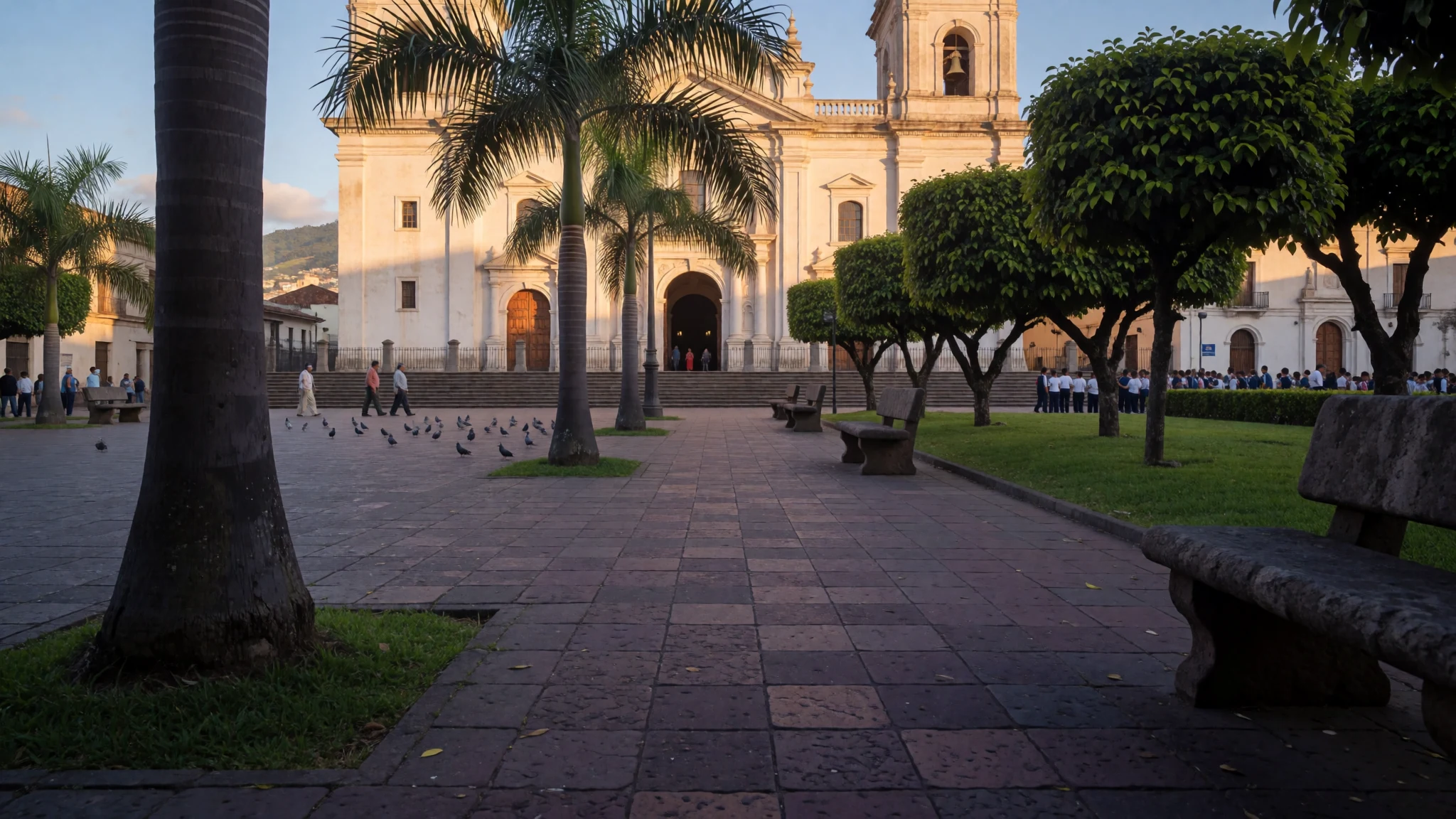
San Salvador is a working highland capital of volcano views, civil-war memorials, a pilgrim's tomb and corn-griddle cooking, best used as a base.
The place
San Salvador sits about 670 m above sea level in a highland valley ringed by volcanoes, which gives it cooler nights than the coast and a skyline backed by green slopes. The municipality holds roughly 330,000 people, but the metropolitan area, which spills across the capital and neighbouring towns, is closer to 2.4 million, and the traffic shows it. Government, courts, universities, banks and the president's residence are all here, so the city works as the country's administrative engine rather than a resort. Most travellers treat it as a base: a few days for the old centre, the memorials and the museums, then day trips to volcanoes, lakes and coffee hills. The centre is a tangle of plazas, churches and market streets, while the wealthier districts to the west, such as Zona Rosa and Escalón, hold malls, restaurants and glass towers. Most Salvadorans are Christian, with Catholic, Evangelical and Pentecostal congregations all present, so Sunday mornings bring bells, hymns and amplified sermons. The ground underneath is restless. Earthquakes have shaped the city's history and its buildings, and low, sturdy construction is common. The honest picture is a hot, busy capital at midday and not an easy place for casual wandering after dark. Most visitors plan routes in advance, use trusted transport and read current official travel advice before going. In return it offers a frank view of everyday Central American life, without the polish of a tourist town.
Its story
San Salvador's Spanish founding date is 1 April 1525, but the story starts earlier with the Pipil people, whose capital, Cuzcatlan, lay close to where the modern city stands. Its residents left rather than live under Spanish rule, and Gonzalo de Alvarado and Diego de Holguín, acting for Pedro de Alvarado, took over the empty site. Holguín became the first mayor. The settlement did not stay put: it moved in 1528 and again in 1545, ending in the Valle de las Hamacas, the Valley of the Hammocks, a name that nods to the ground swaying beneath it. Open land and the fertile soils beside the Acelhuate River made the new spot attractive. For a long time the town remained modest. It became the seat of an intendancy in 1785, and its population grew markedly only in the early twentieth century. Allegiances shifted repeatedly: Spanish rule until 1821, a short spell in the Mexican Empire, membership of Central American federations, independence as El Salvador from 1841 and a brief union again in the 1890s. The twentieth century left heavier marks, above all the civil war remembered at the city's black granite memorial, and the quakes that repeatedly forced rebuilding. Much of the centre today, from the National Palace of 1905 to the cathedral of the 1950s, is therefore far younger than the founding date suggests, a city remade many times on the same valley floor.
What to see
- Metropolitan Cathedral — Historic centre
The Metropolitan Cathedral faces the main plaza in the old centre and was rebuilt in the 1950s in a blend of Baroque and eclectic styles. It holds the tomb of Saint Óscar Romero, the archbishop whose name the airport carries; entry to it is through the side door on the right. Expect quiet pilgrims, school groups and services.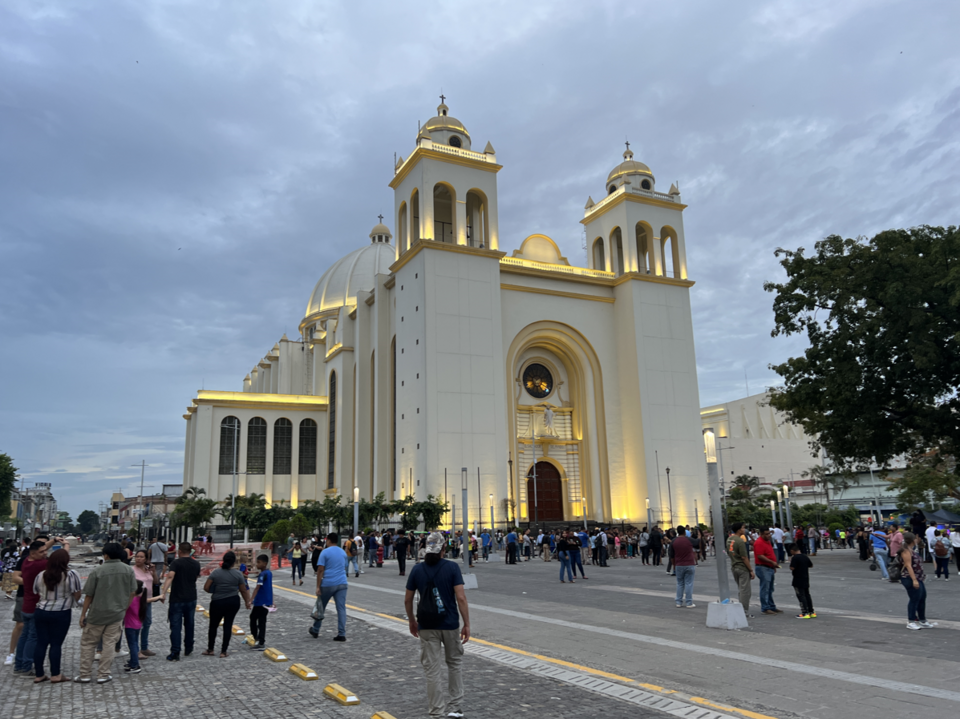
- National Palace — Historic centre
The National Palace, completed in 1905, stands close to the cathedral and mixes Gothic, Neoclassical and Renaissance Revival styles. It is a handy anchor for exploring the historic centre on foot. Opening arrangements change, so check the city's official site, https://www.sansalvador.gob.sv/, or ask locally before making a special trip. - Monument to the Divine Savior of the World — Plaza las Américas
This monument shows Christ standing on a globe, raised on a tall pedestal in Plaza las Américas. It works as the city's emblem, turning up on postcards and as a landmark in local directions. Traffic circles around it, so view it from the plaza rather than the roadside, and go in daylight.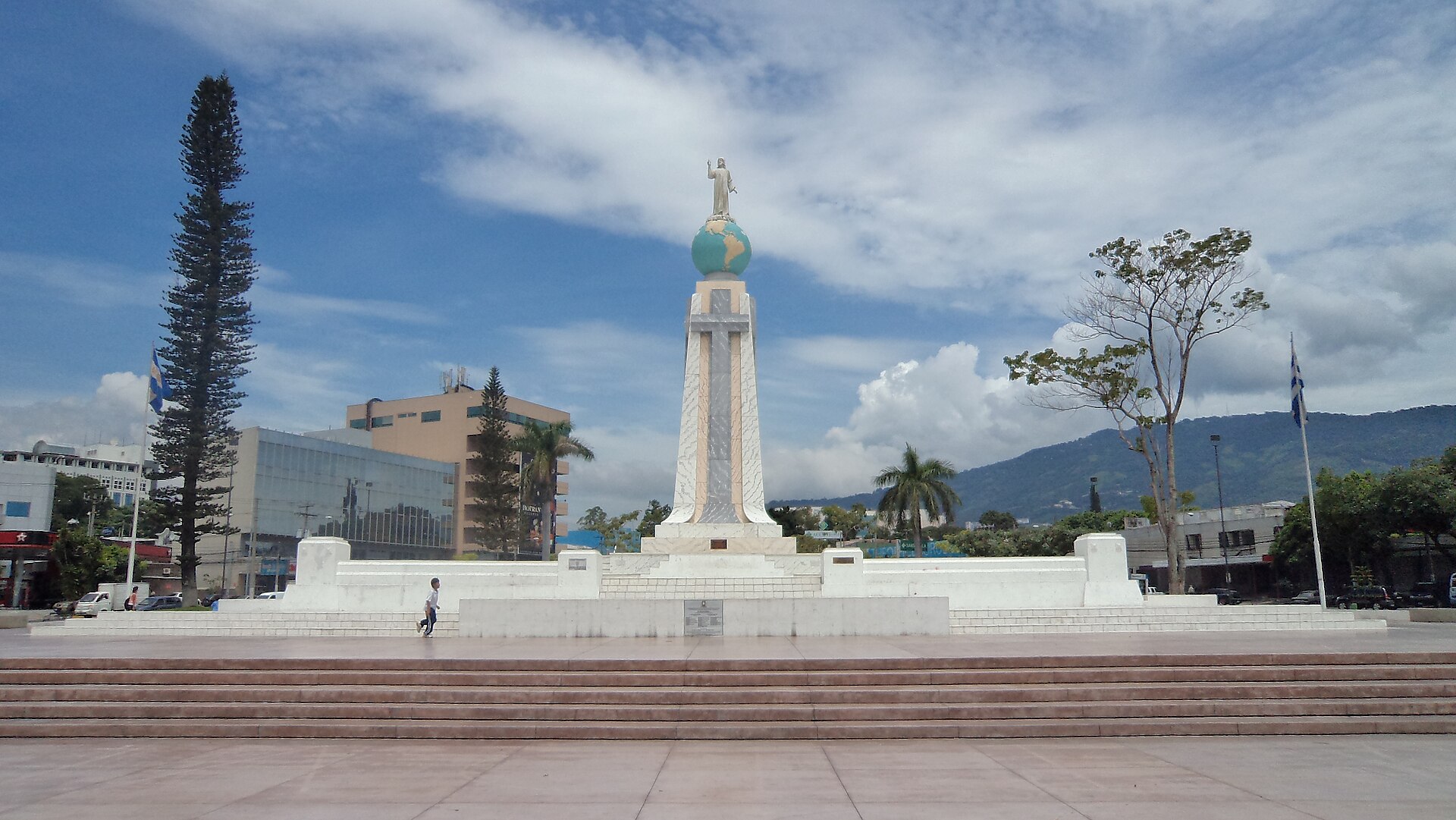
- Monument of Memory and Truth — Central San Salvador
This black granite wall, 85 m long, opened in 2003 and carries about 25,000 engraved names of victims of the Salvadoran Civil War. Visitors walk along it reading, and relatives sometimes leave flowers. Go quietly, allow time, and treat it as a memorial rather than a photo stop. - Rosario Church — Central San Salvador
Rosario Church is a modernist building whose plain exterior hides an interior of arched concrete lit by coloured glass, so patches of colour move across the walls through the day. Sit for a few minutes and watch the light shift. It is an active church, so avoid visiting during services unless attending.
Culture
San Salvador's culture is shaped by its Spanish colonial inheritance, by Pipil roots that survive in names such as Cuscatlán, and by a faith that runs from Catholic processions to Evangelical street preaching. The built heritage shows layers of ambition. The cathedral, the National Palace and the National Theatre, finished in 1917 in a French Renaissance Revival style with Rococo and Art Nouveau touches and seating for 650, all sit within walking distance of one another in the centre. The civil war and Archbishop Romero loom over public memory, and many families carry personal stories about both, so conversations can turn serious quickly. Football is a common bond, with weekend matches and stadium nights drawing crowds, while Sundays belong to family meals and church. Spanish is the everyday language, and a few polite phrases go a long way: Salvadorans tend to respond warmly to a greeting such as buenos días when someone enters a shop or joins a queue. Locals often say vos instead of tú, a small marker of the national voice. Humour is dry and neighbourly, and people are generally proud of their country's resilience. When visiting a church or the war memorial, dress modestly, keep your voice low, and ask before photographing worshippers or mourners.
What to wear
In San Salvador, traditional dress is mostly seen at festivals, school folklore days and dance performances rather than on ordinary streets. Women's costume usually means a full, bright cotton skirt, often trimmed with ribbon, worn with an embroidered or lace-edged blouse, while men wear white cotton shirts and trousers with a straw hat and neckerchief. Indigo dyeing, known locally as añil, has a long history in the region and still appears in craft textiles sold at markets. Day to day, people dress practically for the warm climate: jeans or light trousers, cotton shirts, trainers or sandals, and football shirts at weekends. Office workers in the financial districts wear smart-casual or formal clothes, and the mall areas lean fashionable, with branded sportswear and neat grooming. Visitors should pack light, breathable fabrics, a sun hat and sunscreen, and a thin rain jacket for the wet season. Closed shoes with good grip suit uneven pavements and old cobbles. Shoulders and knees should be covered inside churches and at memorials, so a light scarf or overshirt is useful. Flashy jewellery, expensive watches and visible cameras draw attention in crowded areas, so keep them out of sight.
What to eat
- Pupusas — Any pupusería or evening street stall
Thick griddled cakes of corn or rice flour, stuffed with cheese, beans or pork and served with pickled cabbage (curtido) and a thin tomato sauce. They are eaten by hand, at any time of day, and are the usual first Salvadoran meal. - Yuca frita con chicharrón — Market food counters and casual eateries
Fried cassava with crisp pieces of pork, topped with curtido and salsa. The cassava is soft inside and crunchy outside, and the plate is hearty enough to share. It suits a late lunch or a casual evening snack. - Tamales — Morning stalls and the central markets
Steamed parcels of corn dough wrapped in banana leaf or corn husk, filled with chicken, pork or something sweet. They are a common breakfast and appear in quantity at festivals and family gatherings. Unwrap carefully, as the filling is hot. - Pan con pollo — Street vendors and neighbourhood bakeries
A warm bread roll stuffed with shredded roast chicken, watercress, cucumber and sauce. The Salvadoran version is saucy and savoury, and it is a popular lunch and festival snack, easy to eat on the move. - Horchata de morro — Markets and street stalls near the plazas
A cold drink made from ground morro seeds, spiced with cinnamon and sweetened. It is nutty and refreshing, and often served alongside pupusas or on hot afternoons. Choose busy stalls, where the drink is made fresh.
Plan it
Best time. November to April is the dry season, with sunnier days and less mud; March and April are the hottest months. The wet season, roughly May to October, brings afternoon downpours that can slow traffic.
How long. 2–3
Getting there. Fly to Saint Óscar Arnulfo Romero y Galdámez International Airport, which has routes to cities in Mexico, Guatemala and the USA, then take a pre-booked transfer or registered taxi to the city, allowing extra time for traffic. Ask your airline whether departure charges apply.
Budget. mid
Tips
- Start sightseeing in the morning, when it is cooler and the centre is calmer
- Plan your routes in advance and use registered taxis or trusted ride apps, especially after dark
- Carry some cash for markets and small eateries, but keep it discreet
- Drink bottled or filtered water and carry a sun hat
- Check current official travel advice and the city's website, https://www.sansalvador.gob.sv/, before you travel
Etiquette
- Dress modestly and keep your voice low in churches and at the war memorial
- Greet people with buenos días or buenas tardes before asking for anything
- Ask before photographing people, especially worshippers
Nearby
Sources
- Wikidata Q3110 (CC0)
- Wikipedia — San Salvador (rev 1377476653) (CC BY-SA 4.0)
- Wikivoyage — San Salvador (rev 5423892) (CC BY-SA 4.0)
- Photo: Monumento al Salvador del Mundo (Frankjh) (CC BY 3.0)
- Photo: Cathedral of San Salvador 2023 (Echa24161) (CC BY-SA 4.0)
- Photo: Inauguracion BINAES, Biblioteca Nacional (PresidenciaSV) (CC0 1.0)
- Photo: Monumental Estadio Cuscatlán (JMRAFFi) (CC BY-SA 4.0)
- Photo: World Trade Center San Salvador (JMRAFFi) (CC BY-SA 4.0)
- Photo: Gatuvy från El Salvadors huvudstad San Salvador, 1927 (Eduard Paulig) (CC BY 4.0)
- Photo: Monumento a la Paz en San Marcos (Jose Quintanilla) (CC BY 3.0)
- Photo: Atardecer de San Salvador desde Los Planes de Renderos (JOSAL) (CC BY 3.0)


