Ravenna
Ravenna, Italy
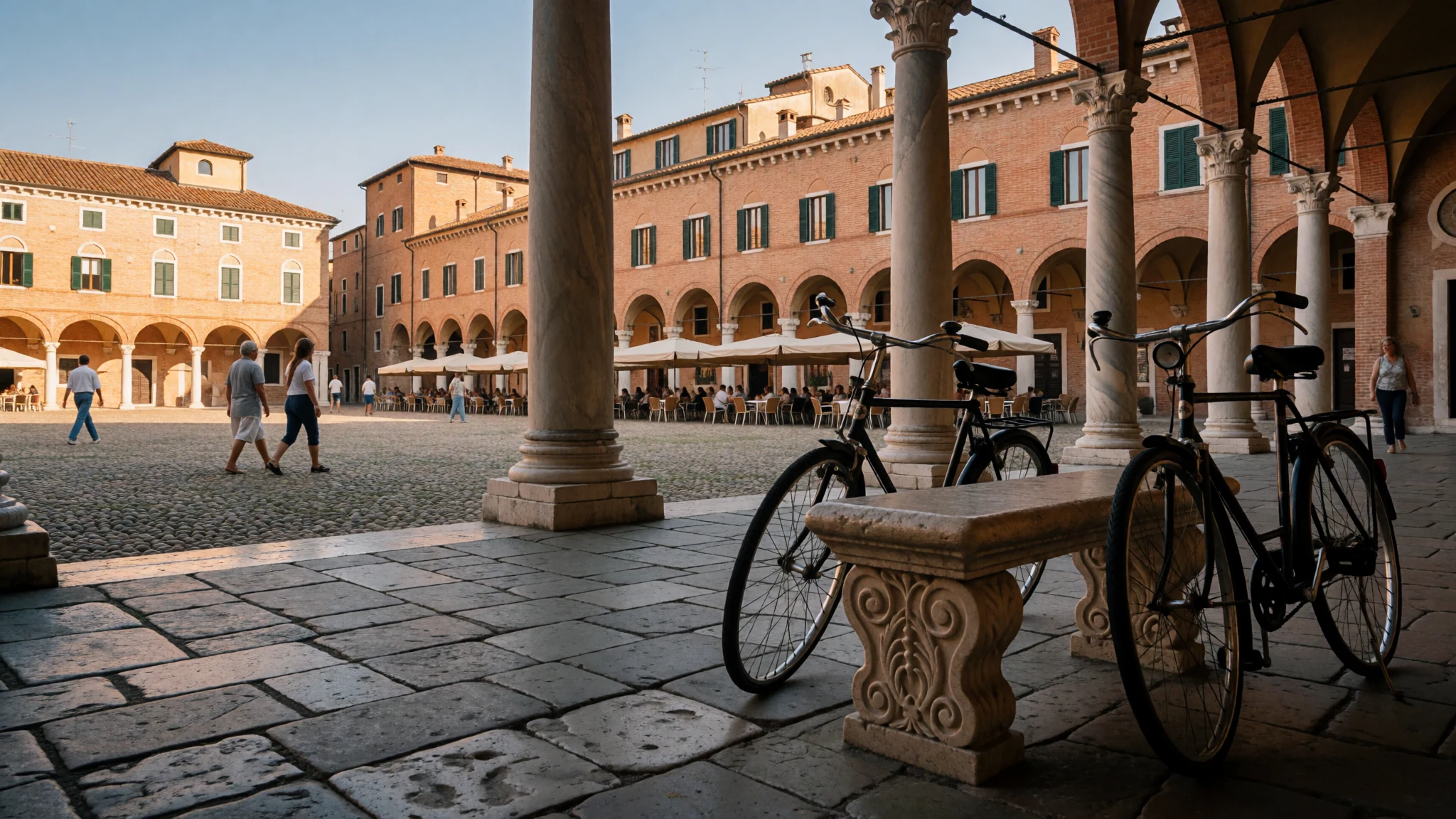
Ravenna holds a set of early Christian and Byzantine buildings whose interiors glitter with mosaic, in a calm, flat, bike-friendly Italian town.
The place
Ravenna is a provincial capital in Emilia-Romagna, northern Italy, on flat ground about 4 m above sea level and a short distance inland from the Adriatic. About 156,000 people live in the municipality, which reaches well beyond the old centre to take in farmland, port installations and beach resorts such as Marina di Ravenna. The historic core is compact and unhurried, a place of brick façades, pedestrian lanes and a great many bicycles, and the main monuments sit within a few minutes' walk of each other. What sets the city apart is its group of early Christian churches, baptisteries and tombs, plain brick outside and lined inside with mosaics of gold, green and deep blue glass. Most date from the fifth and sixth centuries, when Ravenna was a seat of imperial power. Away from the monuments the town feels like a working Italian provincial city rather than a museum: students, cafés on the main square, a covered central market and a port that still handles ships. Many visitors come for the day from Bologna or the Adriatic coast, so the churches are busiest late in the morning and the evenings are quiet. The landscape explains much of the history. The city began as houses on piles among marshes, later gained a harbour, and became a defensible refuge for rulers who needed one. Today the water has retreated, and the sea is a short bus or car ride away.
Its story
Ravenna's story begins in a lagoon. Early settlers, among them the Umbri, built houses on piles on small islands in the marsh, a arrangement that Venice would repeat centuries later. Rome accepted the town as a federated ally in 89 BC, and in 49 BC Julius Caesar gathered his forces here before crossing the Rubicon. Octavian later built the military harbour of Classis nearby, and the port kept the city useful long afterwards. The decisive change came in 401, when the emperor Honorius moved his court here from Milan. Marshes and walls made Ravenna easy to defend, and it stayed the capital of the Western Empire for most of that century. When the empire fell in 476, the city did not fade. It became the seat of Odoacer, then of the Ostrogoth king Theodoric, who left behind a mausoleum and an Arian baptistery. In 540 the Byzantine general Belisarius took Ravenna, and it became the centre of Byzantine rule in Italy. Much of what visitors admire now, including San Vitale, dated to 547, comes from that Ostrogothic and Byzantine moment, when rulers wanted churches that expressed both faith and authority. Later centuries brought the Venetians and the Papal States, and Ravenna settled into quieter provincial life, which is part of the reason its early buildings were never swept away by rebuilding. Even the name is unsettled: some link it to the Etruscan word for themselves, but scholars have not agreed.
What to see
- Basilica di San Vitale — Old centre, north-west side
The Basilica di San Vitale is an octagonal church dated to 547, plain brick outside and dazzling within. Mosaics cover the choir and apse, including the panel of the emperor Justinian with his court. Give the eyes a few minutes to adjust, then look slowly at the faces and jewelled borders. Check the official site for tickets, which often cover several monuments.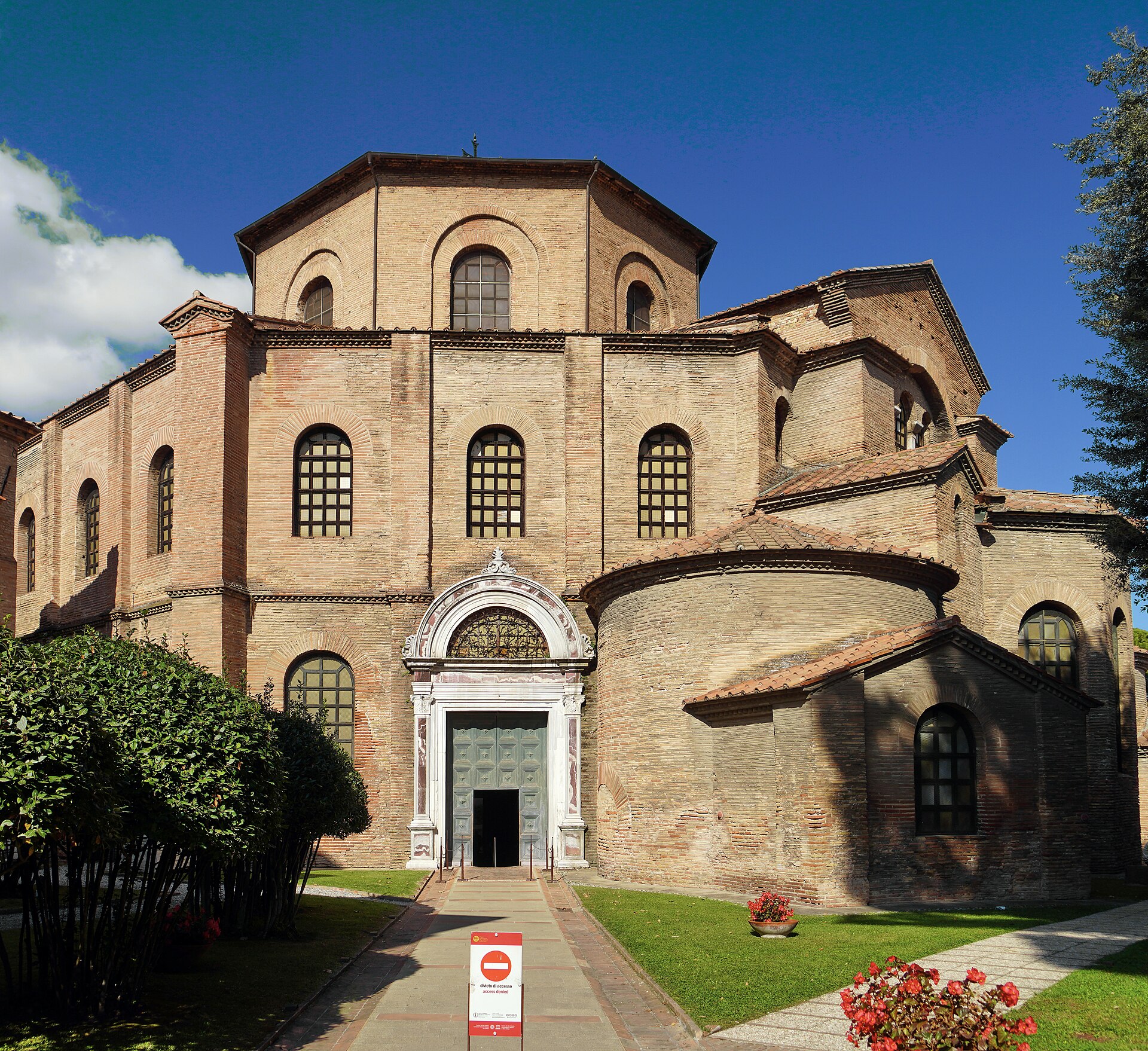
- Mausoleo di Galla Placidia — Next to San Vitale
The Mausoleo di Galla Placidia is a small cross-shaped building beside San Vitale, holding three sarcophagi; the largest is traditionally linked to Galla Placidia, sister of the emperor Honorius. The real draw is the interior, where a ceiling of deep blue glass and gold stars glows even in dim light. Visits are short, and a brief queue is likely in busy months.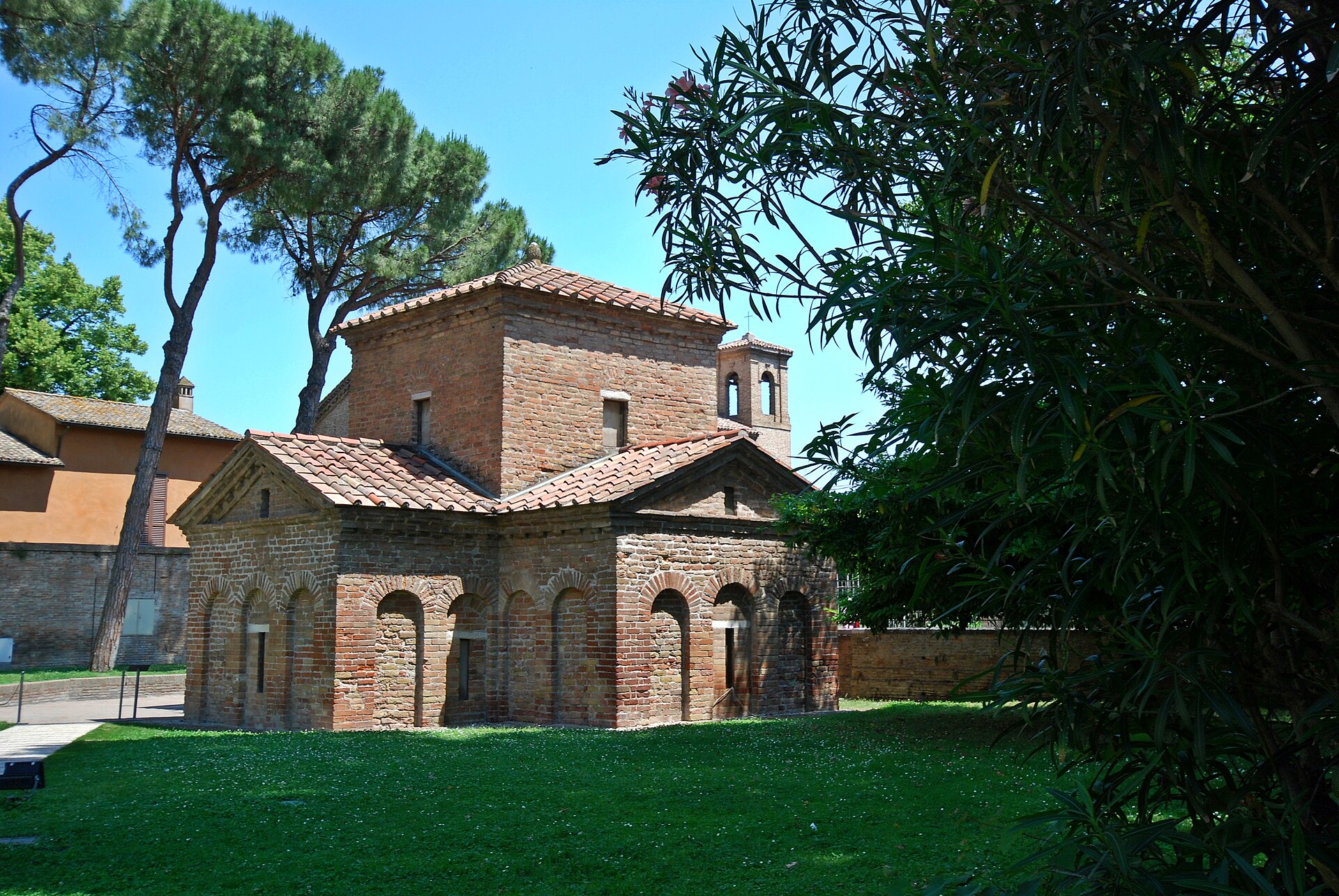
- Basilica di Sant'Apollinare Nuovo — Old centre, east side
The Basilica di Sant'Apollinare Nuovo is a sixth-century church close to the centre, where the nave walls carry long bands of mosaic figures in procession above the columns. The scale is human and the layout simple, which makes it a good place to understand how these pictures were meant to be read, from the door towards the altar.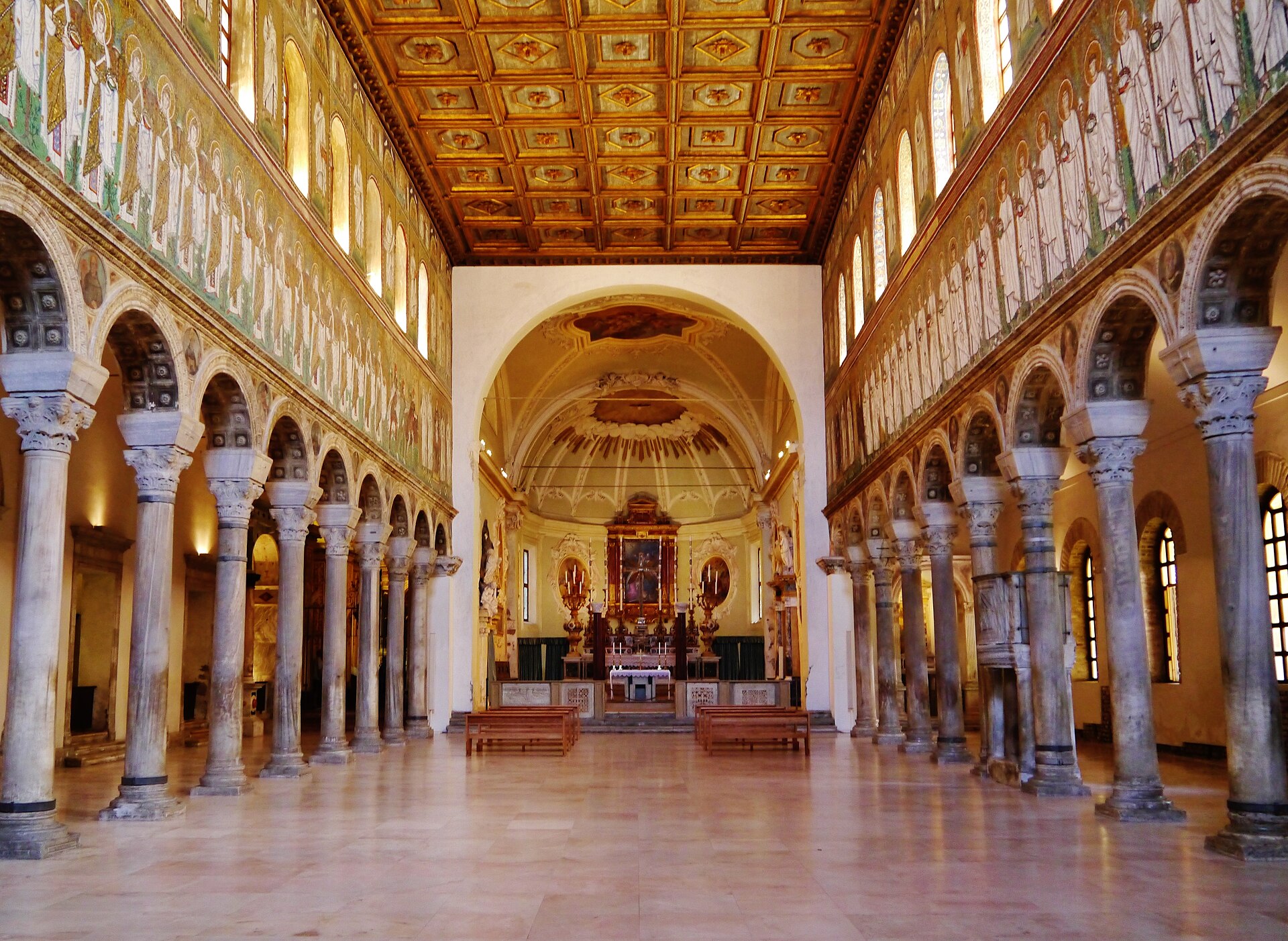
- Baptisteries and Sant'Andrea — Around the cathedral and archbishop's palace
The Battistero Neoniano dates from around 430 and is among the city's earliest surviving buildings; its dome is covered in a mosaic of baptism. Close by, the Cappella di Sant'Andrea, from the early sixth century, keeps its original look as an archbishop's chapel. The Battistero degli Ariani was built under Theodoric and is a short walk away. - Mausoleo di Teodorico — North-east edge of the centre
The Mausoleo di Teodorico stands a little north-east of the old centre, built in the sixth century for the Ostrogothic king. Its stone exterior is stark compared with the brick-and-mosaic churches, and the setting is open and calm. It is an easy walk or cycle from the main sights and a useful breather between crowded interiors.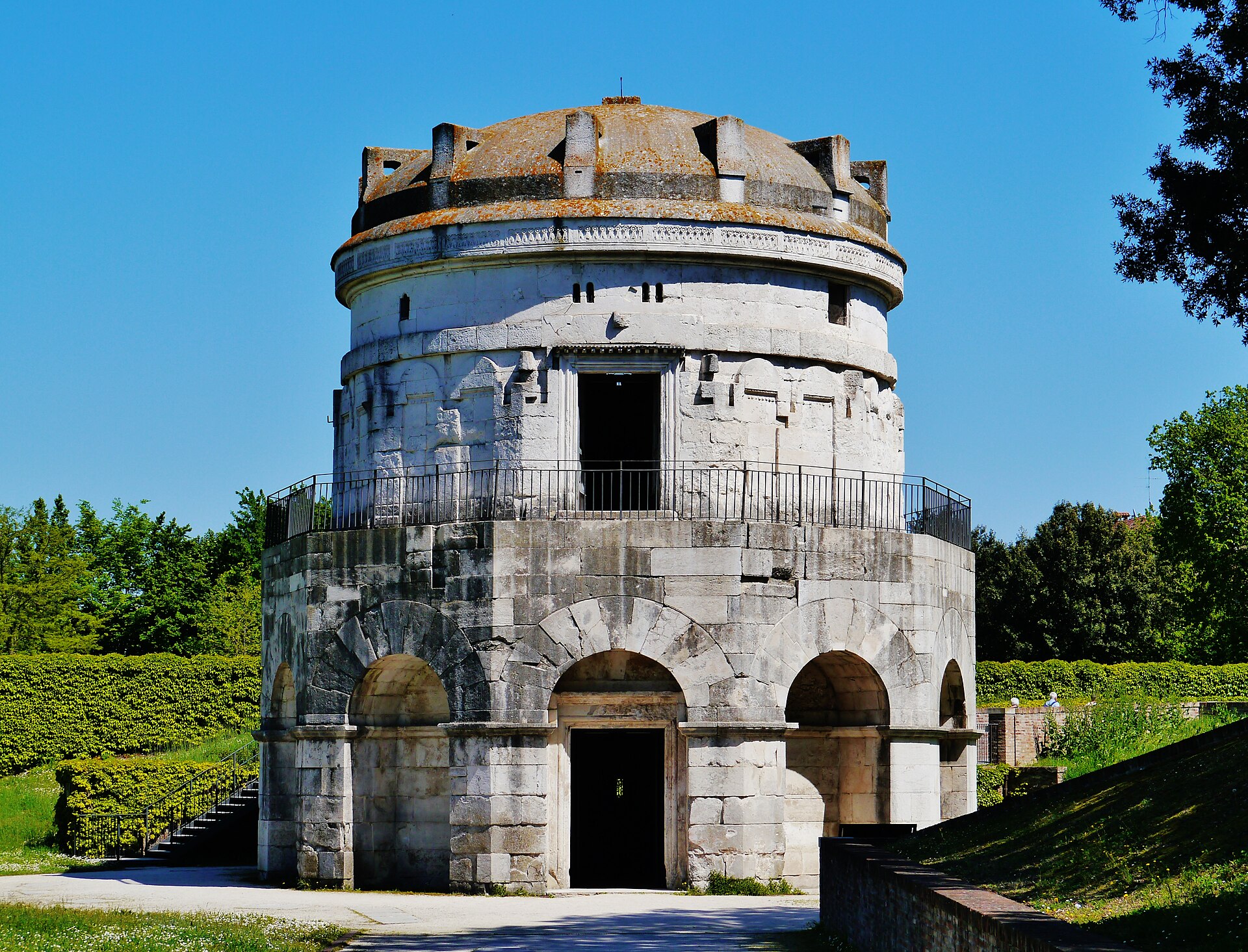
- Basilica di Sant'Apollinare in Classe — Classe, south of the city
The Basilica di Sant'Apollinare in Classe lies south of the city, near the site of the old harbour of Classis, and like many Ravenna churches it is known for its mosaics. The setting feels more open than the old streets. It takes a short bus, train or bike ride, so it suits a half-day addition to a visit.
Culture
Ravenna's culture rests on two things: the memory of an imperial and Byzantine past, and the easygoing habits of Romagna, the eastern half of Emilia-Romagna. Locals are proud of the mosaics, and mosaic-making is still a living craft, with studios and training where artists cut and set pieces of glass and stone. The poet Dante spent his last years here and is buried in the city, and his tomb near the centre is a quiet place of civic pilgrimage. Daily life runs on bicycles, long lunches and an evening stroll around the main square. The city hosts music and theatre events, including a summer festival, so check the official site for dates. Religion remains visible. The early churches are monuments but also places of worship, so services take priority over sightseeing. Romagnol dialect is still heard among older residents, and a few words of Italian, such as buongiorno, grazie and per favore, are well received. Pace matters. Smaller shops close for part of the afternoon, restaurants fill later than in the UK, and Sundays are slow. Visitors who accept that rhythm get far more from the place. Cover your shoulders and knees inside the basilicas and mausoleums, keep your voice low, and never use flash near the mosaics.
What to wear
In Ravenna and the wider Romagna, no single costume is still worn on the street. The best-known traditional textile is rust-printed cloth, tela stampata a ruggine, in which wooden blocks stamp patterns such as vines, birds and wheat onto linen or hemp using iron-oxide dye. It appears on tablecloths, aprons and cushions and is sold in craft shops. Older rural dress, with aprons, headscarves and waistcoats, now turns up mainly at folk festivals and in museums. Everyday wear today is smart-casual and fairly muted: jeans or tailored trousers, linen shirts and light dresses in summer, wool coats and scarves in the damp winter months, and sensible shoes because so many people walk or cycle. Locals dress a little neatly even for the market. A visitor should pack for the season and for churches. Shoulders and knees need to be covered in the basilicas and mausoleums, so carry a light scarf or overshirt in summer. Comfortable flat shoes matter, as the old centre has cobbles and uneven paving. In July and August the plain is hot and humid, so choose breathable fabrics, a hat and sun protection. In winter bring a waterproof layer and warm socks. A small umbrella is useful in any season.
What to eat
- Piadina romagnola — Piadina kiosks and stands around the old centre
A thin, soft flatbread cooked on a griddle and folded around cured ham, rocket and fresh soft cheese such as squacquerone. It is the standard quick lunch in Romagna, eaten warm and by hand, and easy to find for a light, cheap meal. - Cappelletti in brodo — Family-run trattorias in the old town
Small hat-shaped parcels of fresh pasta, traditionally filled with cheese, served in a clear broth. It is a comfort dish for cold days and festive meals, and a good test of a trattoria's kitchen. - Passatelli — Traditional Romagnol restaurants and osterie
Short strands made from breadcrumbs, grated cheese and egg, pressed through a mould and cooked in broth. The texture is soft and savoury, and the dish is a Romagna favourite that rarely appears outside the region. - Strozzapreti with sausage ragù — Trattorias and osterie off the main square
Hand-rolled twisted pasta, rough enough to hold a rich sauce of local sausage and tomato. The name means priest-stranglers, and portions tend to be generous, so it works as a main course. - Fritto misto di pesce — Seafood restaurants near the port and Marina di Ravenna
A mixed fry of small Adriatic fish, squid and prawns, lightly floured and served hot with lemon. It is best near the coast, where the catch is fresh, and suits a relaxed lunch after the churches. - Sangiovese di Romagna — Wine bars and enoteche in the old centre
The region's main red wine, dry and fruity with a savoury edge that suits ragù and cured meats. A glass or a tasting flight is an easy way to sample local producers without a trip to the vineyards.
Plan it
Best time. April–May and September–October, when the days are mild and the churches are less crowded. July and August are hot and humid on the plain and the coast is busy, while winter can be damp and foggy, though the mosaics look as good as ever indoors.
How long. 1–2
Getting there. Bologna airport is about 80 km away, with a seasonal CRAB shuttle bus to Ravenna; Rimini airport is the other nearby option, and Forlì airport should be checked for current flights. Trains link Ravenna with Bologna and the Adriatic coast, so check the national rail site for times. By car, the A14 and A14D lead to Ravenna, and the last stretch is clearly signposted to the centre. Ravenna's old centre is small enough to cover on foot.
Budget. mid
Tips
- Book tickets for the main mosaic monuments through the official site, especially in spring and autumn.
- Visit San Vitale and Galla Placidia early or late in the day to avoid the day-trip groups.
- Hire a bicycle for the flat ground out to Theodoric's mausoleum and Classe.
- Carry some cash and cards for small cafés and market stalls.
- Parking near the old centre is easier at the edge of town than on the main street.
Etiquette
- Cover shoulders and knees in churches and mausoleums.
- Keep voices low and avoid flash photography near the mosaics.
- Do not walk into a church during a service as a sightseer; wait or come back later.
Nearby
Sources
- Wikidata Q13364 (CC0)
- Wikipedia: Ravenna (rev 1383308861) (CC BY-SA 4.0)
- Wikivoyage: Ravenna (rev 5415600) (CC BY-SA 4.0)
- Basilica of San Vitale — Commonists (CC BY-SA 4.0)
- Mausoleum of Theodoric — Zairon (CC BY 4.0)
- Metropolitan Cathedral of the Resurrection, north side — Zairon (CC BY-SA 4.0)
- Basilica of St. Vitalis, exterior — Zairon (CC BY-SA 4.0)
- Mausoleo di Galla Placidia — Ernesto Sguotti (CC BY-SA 4.0)
- Nave of Sant'Apollinare Nuovo — Zairon (CC BY 4.0)
- Piazza del Popolo, Ravenna — Marie Thérèse Hébert & Jean Robert Thibault (CC BY-SA 2.0)
- Mosaic of Justinian I, San Vitale — Petar Milošević (CC BY-SA 4.0)


