Rani ki Vav
Rani ki Vav, India
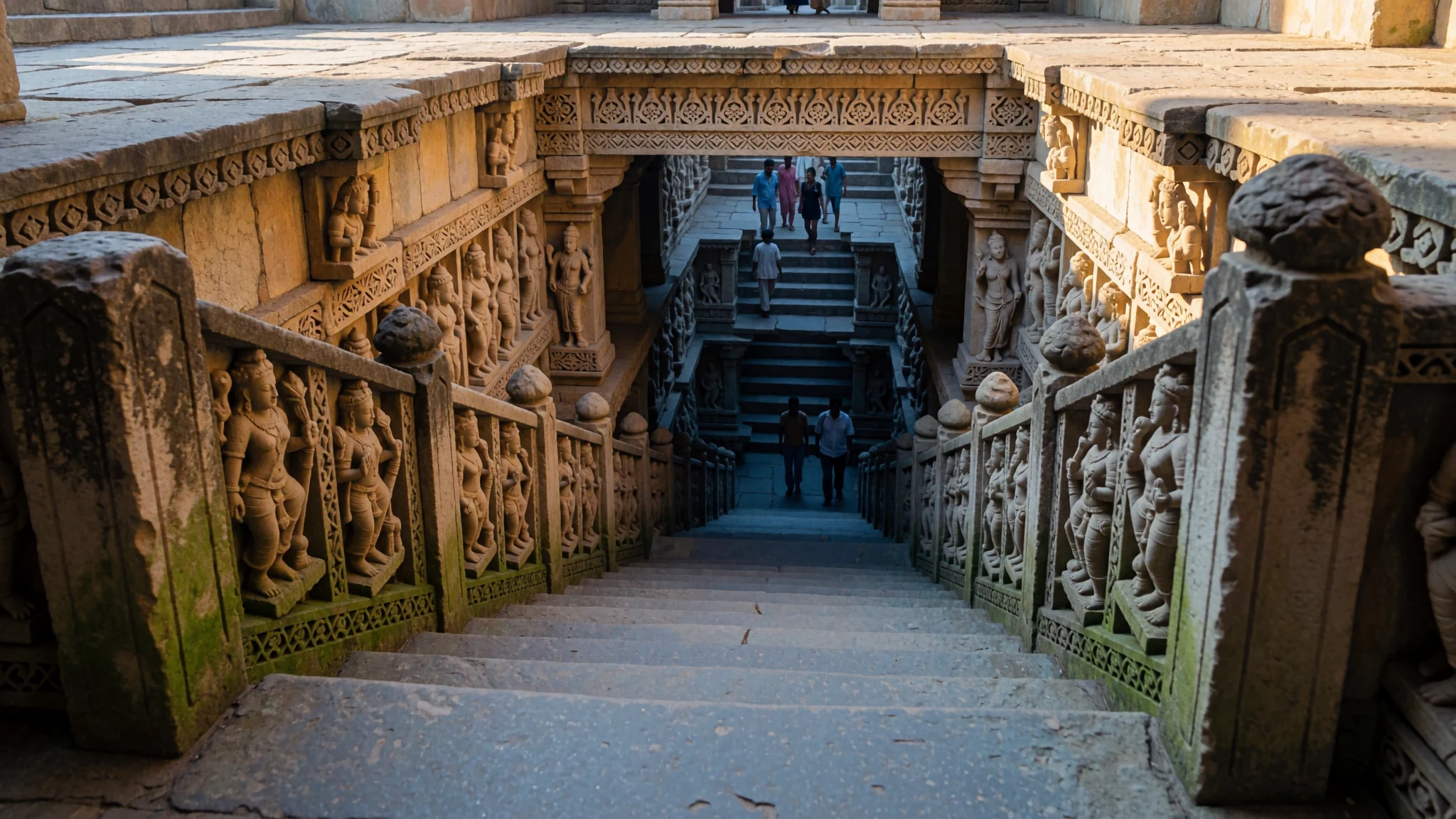
Rani ki Vav is a carved stepwell in Patan, Gujarat, and one of India's most striking surviving examples of its kind.
The place
Rani ki Vav, which means the Queen's Stepwell, sits in the town of Patan in Gujarat, on the banks of the Saraswati River. It is a stepwell, a deep well with stairs that descend in stages to the water, and it was built to be entered rather than simply drawn from. The stairs run down through seven levels, and the walls of each level carry sculptural panels. Visitors often describe it as an underground shrine, and that is a fair description: the whole structure is arranged around the idea that water is sacred, so the descent feels like moving toward something holy. The panels contain more than 500 principal figures and over a thousand smaller ones, mixing religious scenes, everyday life and symbolic motifs. Many of the figures are Hindu deities, and the carving is dense enough that it rewards slow looking. The site is now a UNESCO World Heritage Site, listed in 2014. Most of the monument is cut into the ground, so the first impression is of depth and shade rather than height. The top of the structure is open to the sky, and the lower levels stay noticeably cooler. Go in the cooler months, bring water, and expect the steps to be steep and uneven in places.
Its story
Rani ki Vav was built during the rule of the Chaulukya dynasty, which controlled much of this part of western India in the eleventh century. A Jain monk's chronicle, written a few centuries later, credits the stepwell to Udayamati, a queen connected to the king Bhima I, and says it was completed after a long construction period. Historians have debated whether she commissioned it as a widow or as a serving queen, and some believe the project was finished after the king's death under a later ruler. The stepwell was not built in isolation. Patan was an important town on trade routes, and the Chaulukya rulers filled it with temples and water works. The complex fell into ruin after the town was attacked by sultanate armies from Delhi in the years that followed. The Saraswati River shifted and flooded the structure, which silted over until only the top of the well shaft and a few pillars remained visible. British officials who visited in the late nineteenth century found it almost entirely buried. It was uncovered in the twentieth century and restored by the Archaeological Survey of India, which continues to care for it. Today the stepwell is protected, and its survival is a reminder of how much of India's built heritage lies under later layers of history.
What to see
- The seven-level stairwell — Patan town, Gujarat
The main attraction is the stairwell itself, which descends through seven levels toward a deep pool. Each landing offers a different view of the carved walls, and the light changes as you move from the open top into the cooler, shadowed lower floors. Take time on each level rather than rushing to the bottom. The architecture is designed to frame the water at the end, so the view upward from the lowest level is often the most memorable.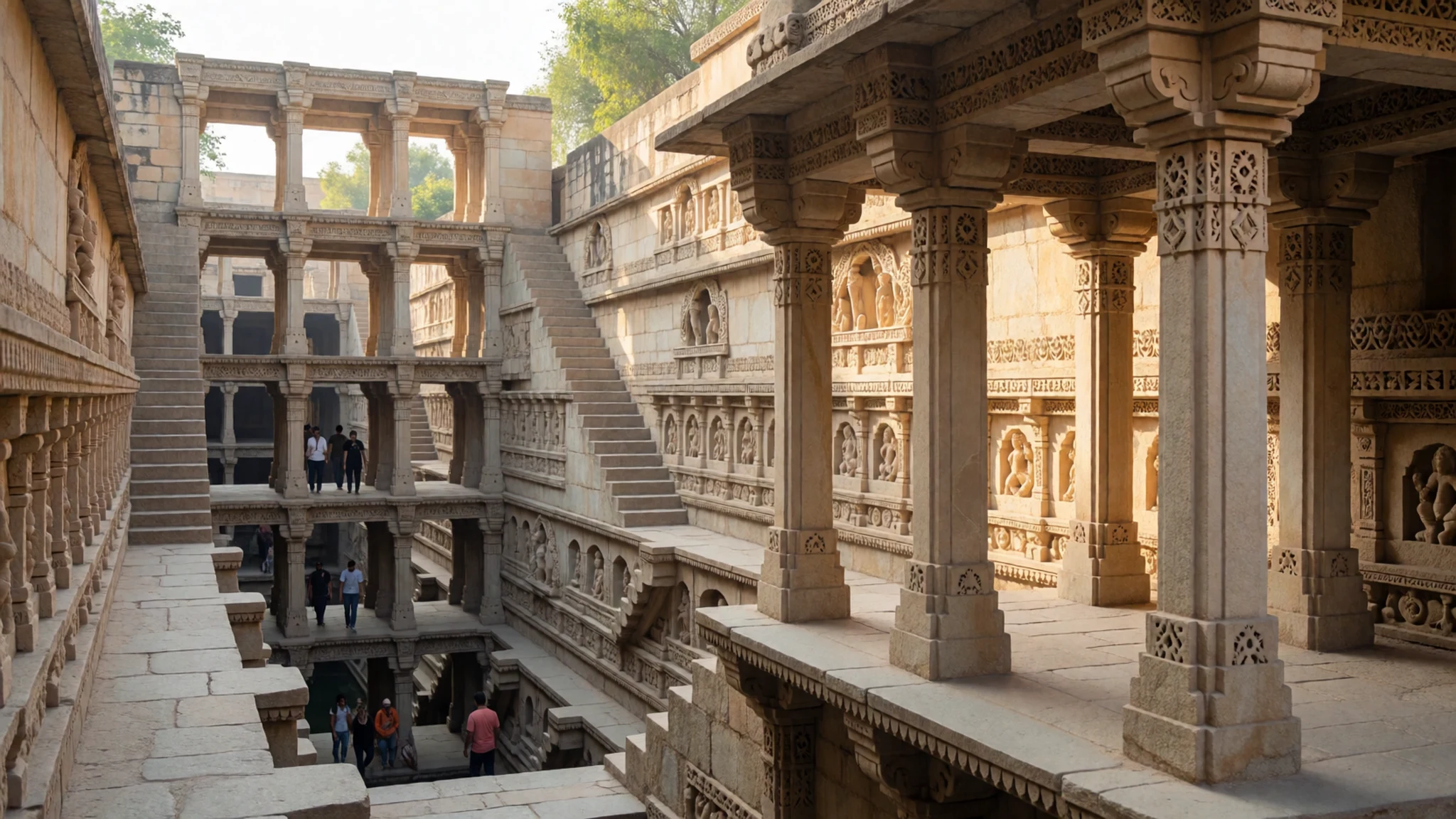
- The Vishnu panel — Lower stair levels, Rani ki Vav
Among the sculptures, the figure of Vishnu is one of the most often photographed. He appears in a carved niche within the wall, surrounded by attendants and decorative foliage. The carving is shallow in places and deep in others, which shows how the stone was worked to catch light from above. Look closely at the details of the crown and jewellery, which are finely finished even where the surface has weathered.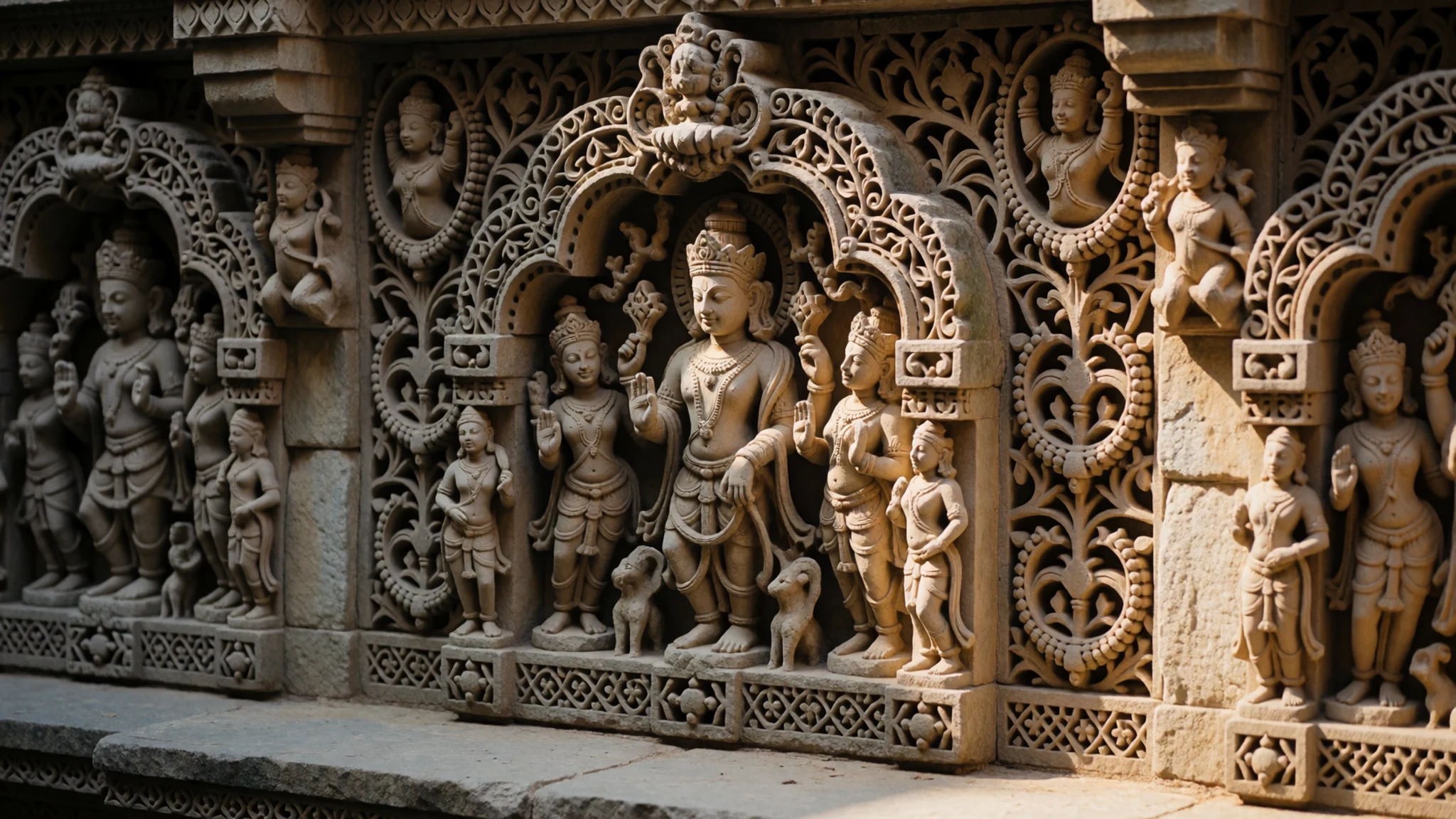
- The Kalki panel — Stair walls, Rani ki Vav
A stone panel shows Kalki, the future incarnation of Vishnu who is traditionally expected to end an age of decline on horseback. The scene is worth seeking out because it shows how the sculptors combined mythology with everyday imagery. Figures around the central image are arranged in tiers, and the panel rewards a patient look, especially in the early morning when the light falls across the carving.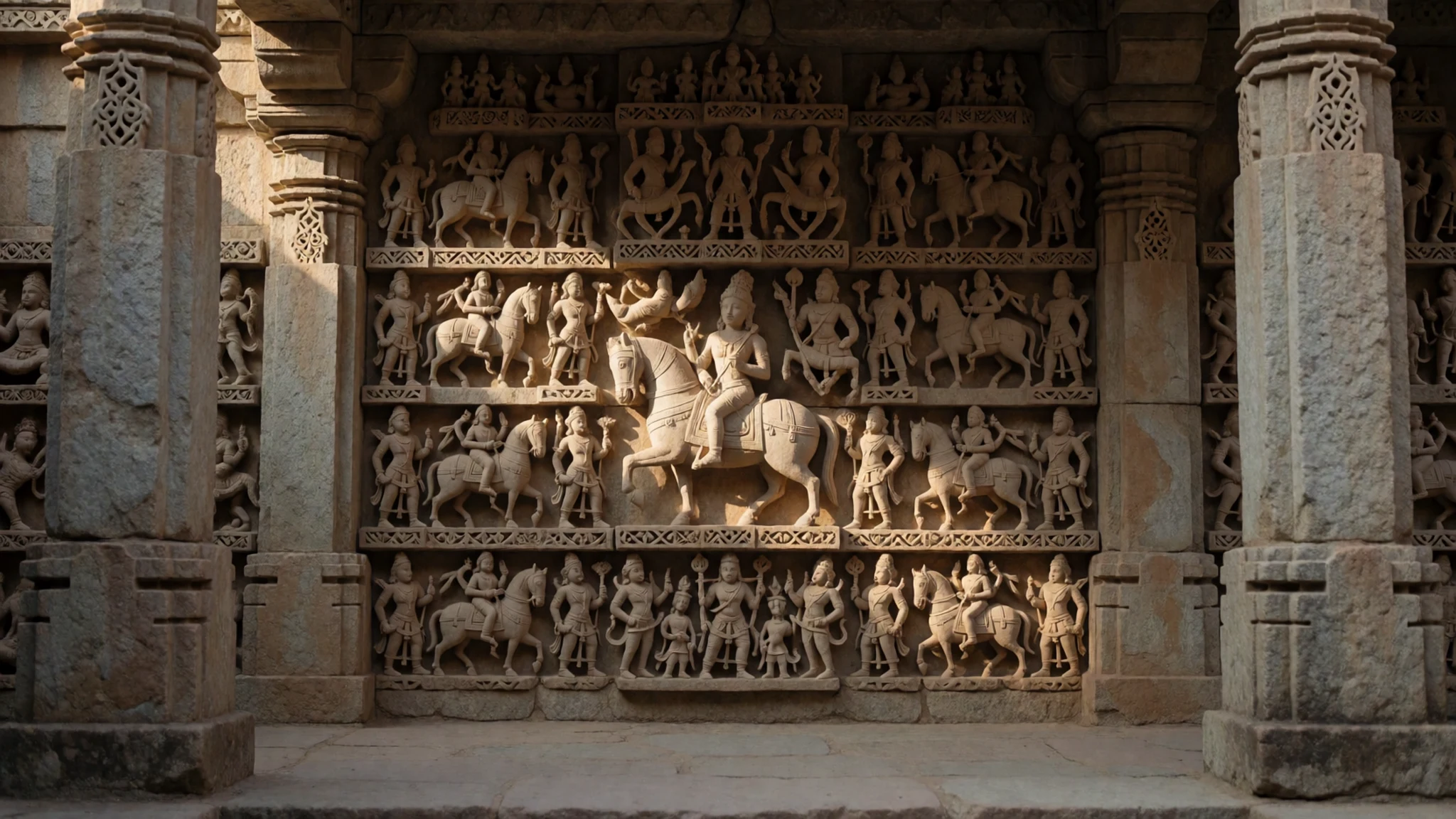
- The Ganesha sculptures — Stair walls, Rani ki Vav
Ganesha, the elephant-headed deity of new beginnings, appears in several places across the walls. His figures are among the more recognisable in the complex and make a good way to orient yourself as you descend. Compare how the sculptors handled his posture and ornaments on different levels, since the panels were not carved all at once and show subtle differences in style.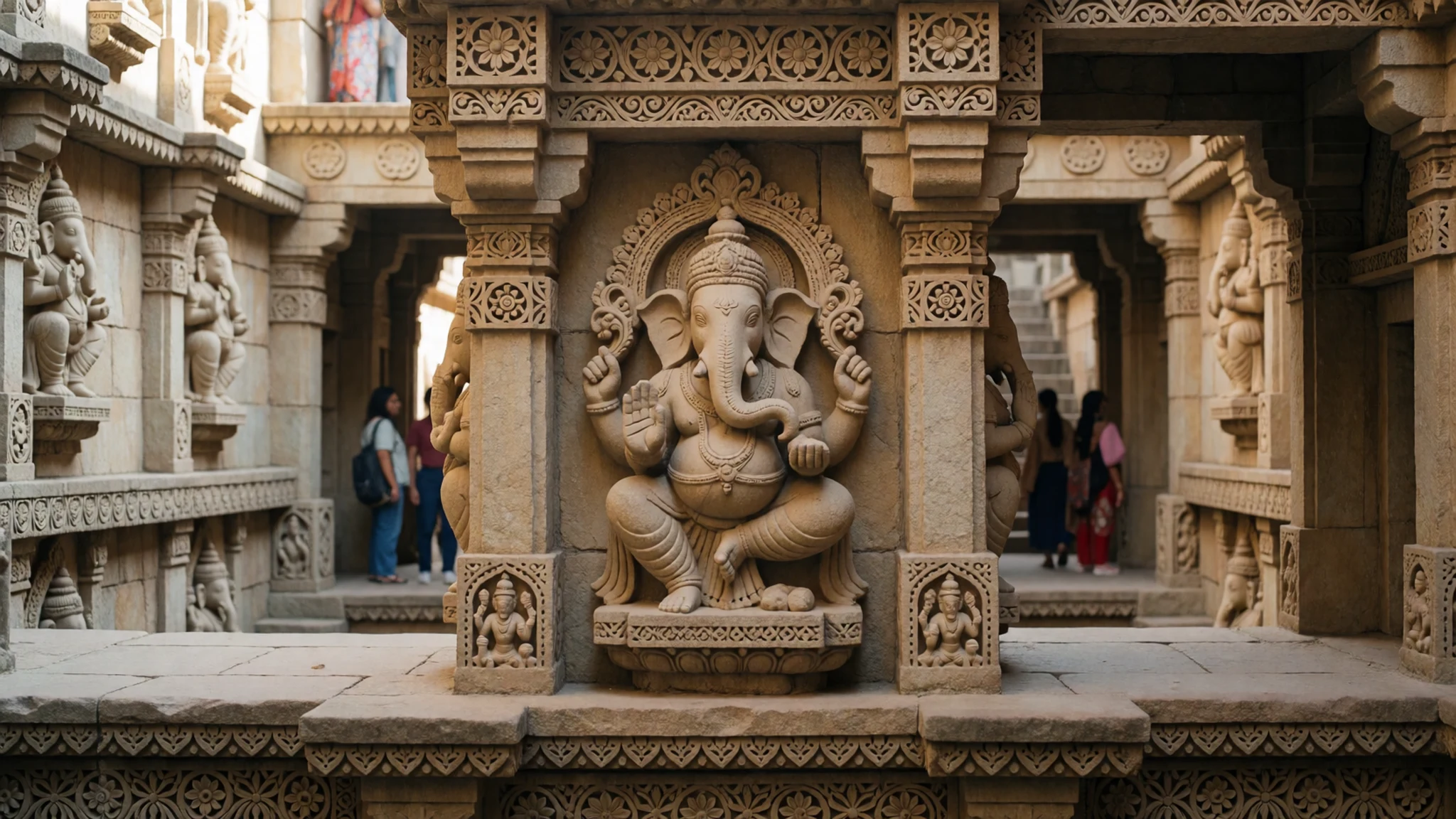
Culture
Rani ki Vav is a protected heritage monument, and visitors are expected to treat it with the care due to a place of worship as well as a historic site. Modest clothing is the norm, and shoulders and knees are best covered. Many of the carved figures are still honoured by local people, so behave calmly near the sculptures and avoid climbing on the carved edges. Photography is generally allowed, but ask before photographing people at prayer or making close pictures of anyone who is worshipping. Gujarat has a strong business culture, and people value courtesy and punctuality in conversation, so a friendly greeting and a few words of Gujarati go a long way. Basic phrases such as aabhar, meaning thank you, are warmly received. Community ties in Patan are close, and showing interest in local crafts or food often leads to friendly exchanges. In rural areas people can be more conservative, so keep your voice low and your behaviour unobtrusive. When visiting, remove your shoes wherever you see a shrine area or a step up to a sacred space, and do not walk on the carved steps with footwear where signs ask you not to.
What to wear
Traditional dress in Gujarat is colourful and closely tied to community and occasion. Women often wear the chaniya choli, a fitted blouse and a long, flared skirt with a draped scarf, while many older women wear the sari in cotton or silk. Men traditionally wear a kediyu, a knee-length tunic, with a dhoti or churidar. Textiles are central to the state's identity. Bandhani, tie-dyed cotton in small dots, is made in several centres, and patola, a double-ikat silk, has long been prized for weddings. Kutchi embroidery, worked in silk and mirror, shows up on bags, waistcoats and wall hangings. In Patan itself, the patola tradition is especially associated with the town, so visitors may see it in shops. What people wear today is a mix. In towns and cities you will see jeans, kurtas and saris side by side, and many people wear Western clothes at work. Traditional dress tends to appear at festivals, weddings and temple visits. For a visit to Rani ki Vav, wear light cotton that covers the shoulders and knees, since the sun is strong above ground and the stone is hot to touch. Choose shoes you can remove easily, and bring a scarf for the sun or for covering your head in some sacred areas. Comfortable, closed sandals with grip are better than heels for the steps.
What to eat
- Gujarati thali — Local eateries and simple restaurants in Patan's main market streets
A thali is a platter of many small dishes served together, usually including vegetable preparations, dal, kadhi, rice, rotis and a few sweets. The meal is often refilled generously, so you can keep eating until you are satisfied. Find thalis in small local restaurants and family-run eateries in Patan and in the larger towns nearby.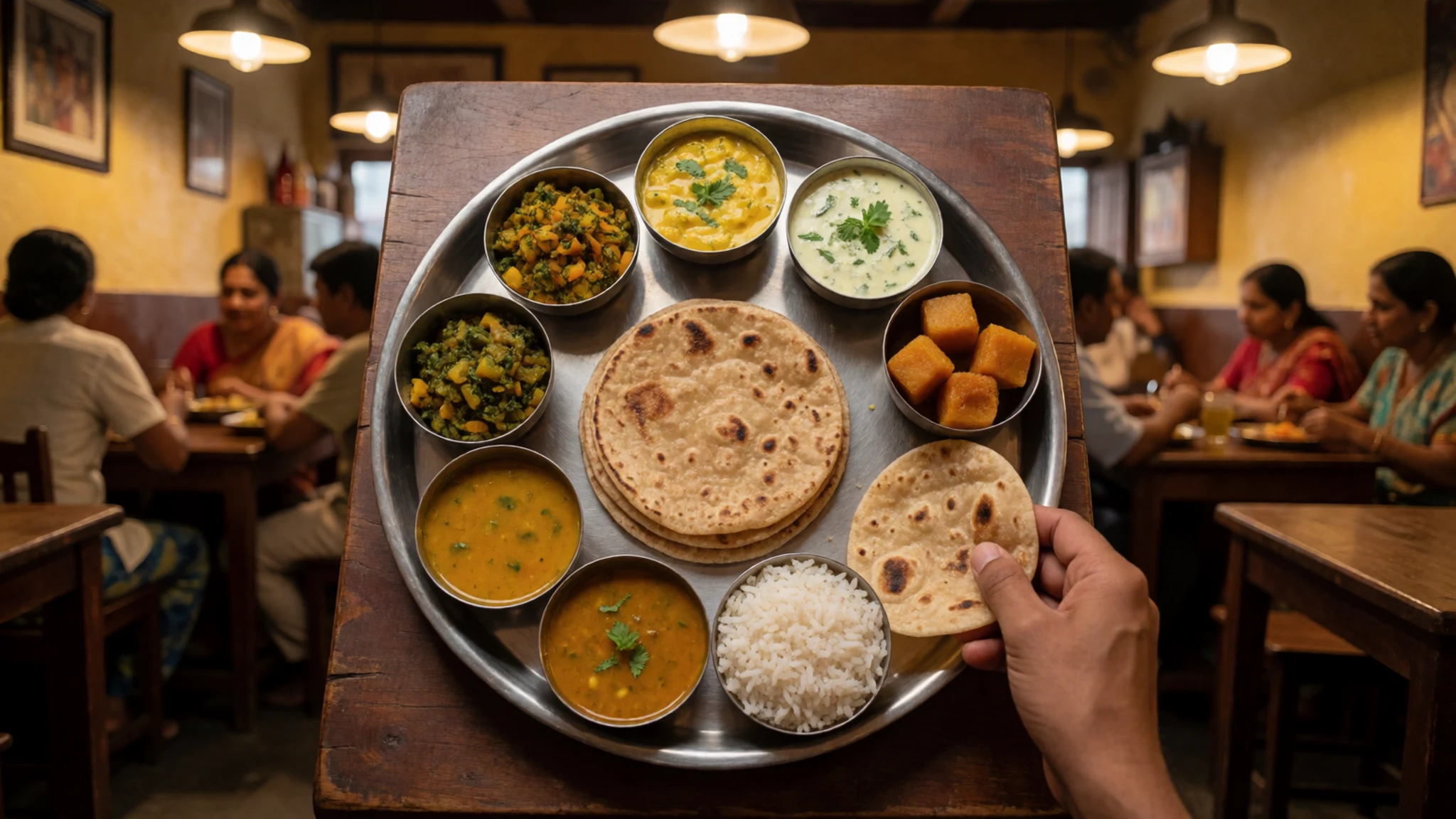
- Dhokla and khandvi — Snack stalls and sweet shops along market lanes
Dhokla is a steamed savoury cake made from fermented gram flour, often served with green chutney. Khandvi is a delicate roll of spiced gram flour, folded and tempered with mustard seeds. Both are typical snacks found at morning and afternoon stalls.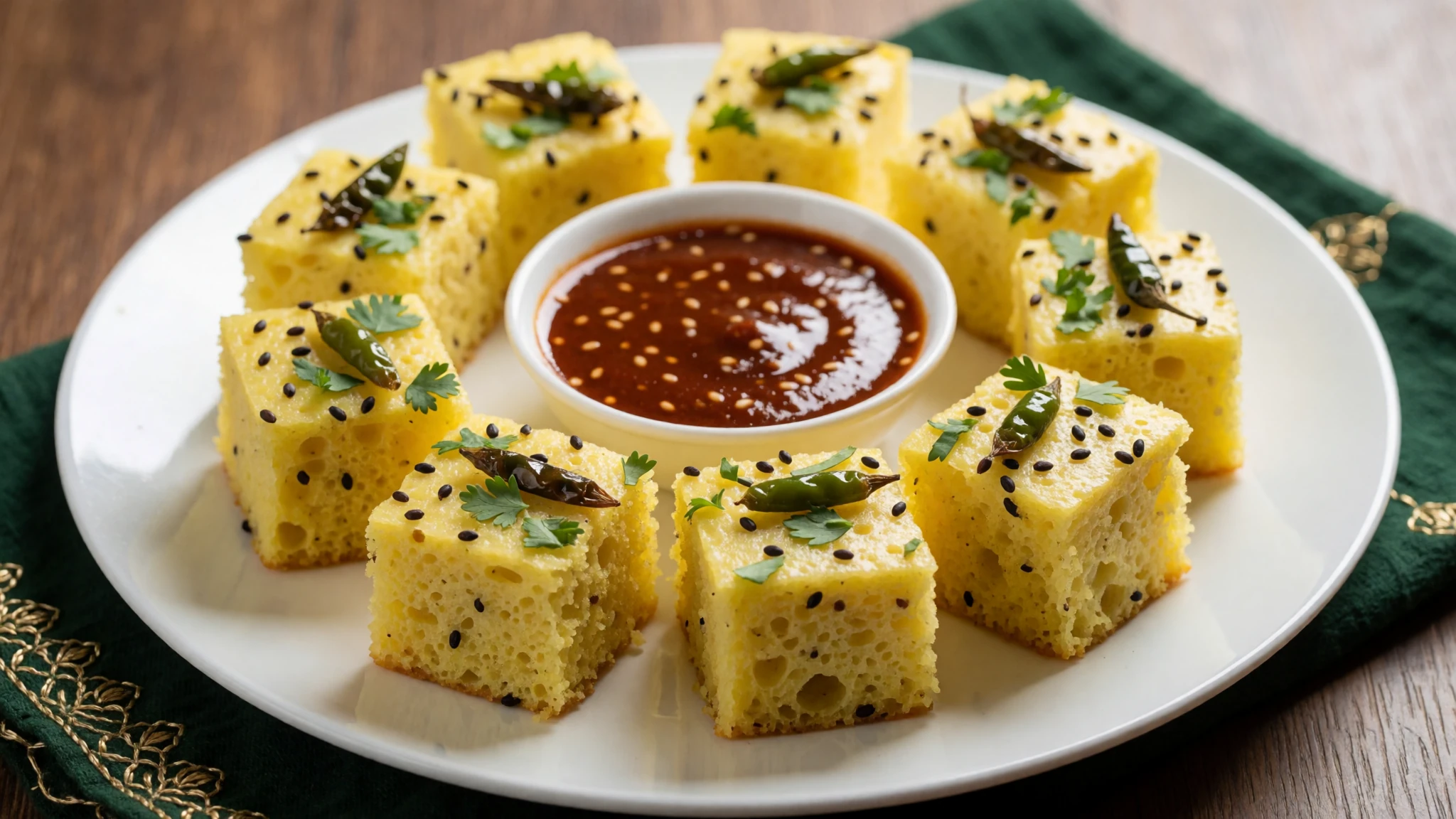
- Masala chai and chaas — Tea stalls near the monument entrance and in the town centre
Milky masala chai is sold everywhere, brewed with spices and served in small glasses or cups. Chaas, spiced buttermilk, is a refreshing alternative in the heat of the day. Both are cheap and easy to find near the entrance to most heritage sites. - Bajra rotla — Family-run eateries and rural market towns
Bajra rotla is a flatbread made from pearl millet, traditionally eaten with curd or a spicy vegetable dish. It is more common in the drier regions to the west, so you may find it on menus in local eateries rather than in every town. Ask for it with fresh buttermilk.
Plan it
Best time. November to February, when the days are cooler and dry and the stone is comfortable to walk on. By March the heat is already building, with highs near 43 °C, so it is better to visit before then. From April to June the heat is intense, and the monsoon from June to September brings rain and humidity, though the monument can look striking after rain.
How long. 1–2
Getting there. The nearest large airport is Sardar Vallabhbhai Patel International Airport in Ahmedabad, from which Patan is reached by road; check current journey times on a map before you set out. Trains serve the wider region, so confirm the nearest station and the last leg with a local timetable.
Budget. low
Tips
- Arrive early in the day for cooler light and fewer visitors
- Carry drinking water and a hat, as the open upper level is exposed to the sun
- Carry cash for small purchases, tea stalls and local transport
- Wear shoes with good grip, since the stairs are steep and uneven
- Plan a second half-day in Patan to see the local textile and market streets
Etiquette
- Dress modestly and remove your shoes where you see a sacred area or step up to a shrine
- Ask before photographing people, especially those at prayer
- Keep your voice low near the sculptures
Nearby
Sources
- Wikidata Q7293002 (CC0)
- Wikipedia, Rani ki Vav (rev 1381397454) (CC BY-SA 4.0)
- Wikivoyage, Gujarat (rev 5410752) (CC BY-SA 4.0)
- Photo: Rani ki vav, Patan, India, Bernard Gagnon (CC BY-SA 1.0)
- Photo: ASI monument, Kshitij Charania (CC BY-SA 4.0)
- Photo: Vishnu sculpture, Shakti (CC BY 3.0)
- Photo: ASI monument, Gaurav Marfatiya (CC BY-SA 4.0)
- Photo: Wall decorations, Vijay Barot (CC BY-SA 4.0)
- Photo: Kalki on stone panel, Ops1975 (CC BY 3.0)
- Photo: Maa Durga idol, Anurag choubisa (CC BY-SA 4.0)
- Photo: Ganesha sculptures, Nagarjun Kandukuru (CC BY 2.5)


