Portofino
Portofino, Italy
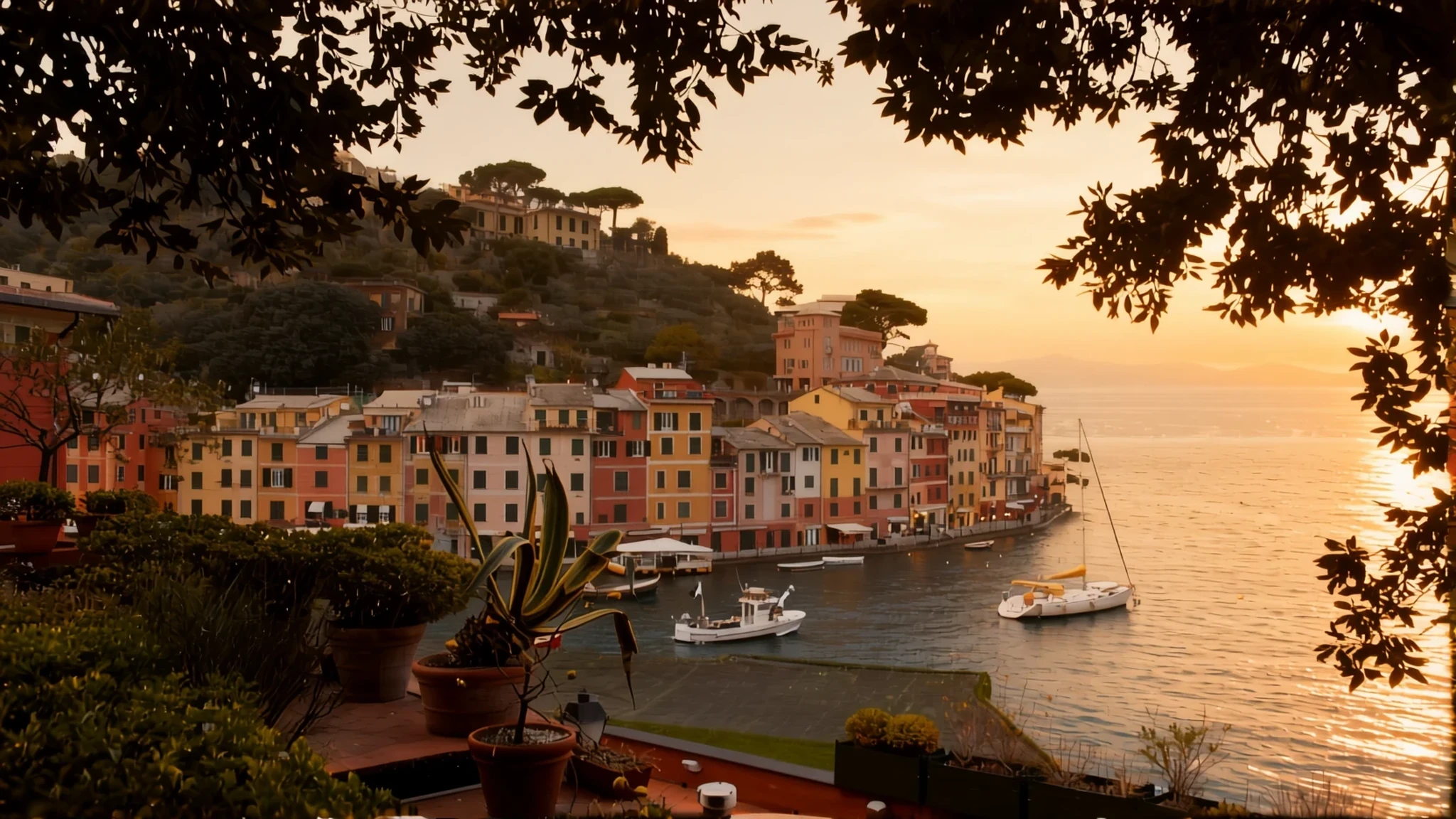
Portofino is a tiny Ligurian harbour of painted houses, yachts and a wooded headland.
The place
Portofino is an Italian comune in the Metropolitan City of Genoa, set on the Riviera where a wooded headland shelters a very small harbour. The houses that ring the water are painted in strong, plain colours, and the village barely climbs the slope behind them. The facts give an elevation of 18 metres and a population of 355, which explains the scale: this is a village whose reputation outruns its size. The Ligurian form of the name is Portofin. The inlet has always been the point of the place. It is deep enough and calm enough for fishing boats and for yachts, and too tight to have served as a real port for a large merchant fleet. That geography still decides a visit. Almost everything a visitor comes for sits within a few minutes' walk of the quay: the coloured façades, the church just off the water, the castle on the point, and the path that leaves town toward Paraggi. Genoa lies along the coast to the west and the Gulf of Tigullio to the east. Santa Margherita Ligure is the neighbouring harbour town and the railhead people actually use. From the late nineteenth century onwards, British and other northern European visitors began to stay, coming across from Santa Margherita by horse-drawn cart, and the waterfront slowly turned from a working quay into a resort. The comune publishes visitor information at https://www.comune.portofino.genova.it. In high summer the inlet fills with day boats and the lanes slow to a shuffle.
Its story
Portofino enters written history as Portus Delphini, the Port of the Dolphin. Pliny the Elder placed that name on the Ligurian coast between Genoa and the Gulf of Tigullio. A diploma issued by Adelaide of Italy granted the village to the Abbey of San Fruttuoso di Capodimonte, whose bay is still reached by boat from the harbour. The settlement was later joined with Santa Margherita Ligure under Rapallo, and then it passed to the Republic of Genoa. Fishing boats could use the inlet comfortably. Genoa's traders needed more room than the cove could offer, so larger ships treated it as a pause rather than a home port, and the village remained small. Charles the Sixth of France, during his time as Doge of Genoa, sold Portofino to Florence; after he lost control of Genoa, Florence handed it back. Through the fifteenth century the Fieschi, Spinola, Adorno and Doria families held it as a fief. A fort on the headland watched the approaches. In the nineteenth century the village moved from the Kingdom of Sardinia into the unified Kingdom of Italy. What changed the shore's reputation was the arrival of British and other northern European guests, who came over from Santa Margherita Ligure by horse-drawn cart. Aubrey Herbert and the novelist Elizabeth von Arnim were among the English visitors who made long stays fashionable. Wealthy expatriates put up holiday houses on the slopes. Work shifted from nets to guests, and places to eat and drink filled the quay edge to edge.
What to see
- The harbour — The quay
Portofino's harbour is the reason the village exists and the picture everyone stops for. Houses painted in clear colours stand almost on the water, and boats lie close under them. The quay is short; a slow walk from one end to the other takes in the whole front. Late in the day the headland cuts the sun and the air cools. - Castello Brown — Headland above the harbour
Castello Brown stands above Portofino's harbour, a coastal fort now used as a museum. The terrace looks over the inlet and out to the Mediterranean, which is why people climb the short, steep path from the quay. The rooms recall the years when the headland was a lookout. There is no need to rush the view. Opening days change, so confirm them on the comune website before setting out. - Church of St Martin — Lane just inland from the quay
The Church of St Martin stands a short turn inland from Portofino's quay, a small parish church rather than a monument built to impress. The stroll from the water takes almost no time, and the lane is calmer than the harbour front. Pale walls and a compact interior suit the scale of the village. Anyone stepping inside should keep quiet, especially if a service is under way. - San Fruttuoso and Christ of the Abyss — San Fruttuoso Bay, by sea
San Fruttuoso is the bay linked to Portofino by the old abbey grant, and the only way there is by sea. Boats leave the harbour, some of them on a public run and some hired for the crossing. The Abbey of San Fruttuoso di Capodimonte stands on that shore. Offshore, the submerged sculpture Christ of the Abyss is the sight people hope to glimpse when the water is clear. - Paraggi — Footpath toward Santa Margherita Ligure
Paraggi is the small beach settlement on the footpath that leaves Portofino toward Santa Margherita Ligure. The walk follows the coast and needs no car, which matters where the road is too narrow for easy passing. The shore draws a younger crowd, and more families, than the yacht quay in the village. People swim, sit, and walk back in daylight.
Culture
Portofino's culture is a fishing village's habits wearing a resort's clothes. The Ligurian name Portofin is a reminder that the speech around the harbour was not only standard Italian, and older families still carry that coastal identity even when the quay speaks several languages by lunchtime. Days follow an Italian summer rhythm: the morning is for the water and the lanes, the middle of the day slows, and dinner is a late affair. Weekends and the days when cruise passengers or yacht tenders come ashore are the busy ones; the village is too small to absorb a crowd without everyone feeling it. Boutiques trade through the warmer months and then many of them close, so the winter village is quieter and more local. The harbour restaurants charge at a level that startles visitors used to other expensive cities, and a small purchase is simpler with cash. Faith is still visible at the Church of St Martin and in the abbey across the water, not only in the shop windows. Treat the church and the narrow residential lanes as someone's home: cover your shoulders, keep your voice down, and do not block a doorway to photograph a boat.
What to wear
Portofino has no single ceremonial costume still worn in the lanes, but the old working dress of the Ligurian coast was practical cloth: wool jerseys and heavy cotton trousers for men on boats, headscarves and dark cotton or wool skirts for women, and rope-soled or leather shoes that could cope with wet stone. Those clothes belonged to fishing and to church, not to display. The resort years replaced them in public view with a lighter Riviera wardrobe. Today the harbour crowd wears linen and cotton in summer, pale trousers, simple dresses, sunglasses and soft jackets once the sun drops behind the promontory. Boutiques along the water sell that look more than they sell folk costume. A visitor will be comfortable in breathable clothes and a pair of shoes that can handle smooth quay stones and the stepped path to the castle and to Paraggi. Shoulders and knees should be covered at the Church of St Martin. Even in high summer, a light layer is worth carrying, because the headland puts the harbour in shade by late afternoon and the air cools quickly. Leave fragile heels for the boat; the lanes are narrow, uneven and often wet.
What to eat
- Seafood pasta — Restaurants around the harbour
Portofino's harbour restaurants build a meal around pasta with seafood, the plate most tables seem to share. The kitchens ring the water and the menus look alike from one awning to the next. Ask whether the fish was landed that morning or frozen earlier; the menu often says. - Ligurian white wine — Harbour tables and small wine bars on the quay
Portofino sits in a stretch of Liguria known for white wines that travel poorly and are worth drinking on the spot, among them local Pinot Grigio. A glass at a harbour table or at a small wine bar on the quay is the easy way to taste them. - Coastal red wine — Waterfront restaurants
The reds poured in Portofino are full of flavour and easy to miss if a table assumes the coast means pale wine alone. Order a glass with dinner at the waterfront restaurants. Some of these bottles barely leave Liguria, so the harbour is the sensible place to try them. - Limoncino — Shops near the harbour
Limoncino, the lemon cordial also called limoncello elsewhere in Italy, is sold in shops around Portofino's harbour. It is drunk cold at the end of a meal, or taken home in a small bottle. Choose a shop that presents it as a local product rather than a trinket. - Espresso and cappuccino — Cafés on the waterfront
Afternoon coffee in Portofino is a reliable pleasure: espresso and cappuccino from the cafés that face the harbour. Take it standing or at a table close to the water, and expect the bill to match the address.
Plan it
Best time. Late spring and early autumn are the kindest months in Portofino: warm enough for the water, before and after the thickest yacht and weekend crowds. High summer is bright, busy and social, and the boutiques are open; the headland shades the harbour by late afternoon, so evenings are cooler than the noon glare suggests.
How long. 2–3
Getting there. Portofino is reached from Genoa's airport, with Nice and Milan as further airports if Genoa is impractical. From Genoa the last leg is a narrow, winding coast road through Santa Margherita Ligure, or a train to Santa Margherita Ligure-Portofino and then the bus that runs to the village. Parking in Portofino is scarce. The road between Santa Margherita and the harbour is often a single lane, so drivers need patience with pedestrians and oncoming cars. A ferry links the area with Genoa; San Fruttuoso is by boat only.
Budget. high
Tips
- Reserve a weekend table if a particular harbour restaurant matters, because Saturdays and cruise calls fill the quay.
- Carry cash; harbour meals and small shops are easier to settle that way.
- Come by bus or on foot from Santa Margherita Ligure when you can; parking in Portofino is scarce and pricey.
- Pack a light layer for late afternoon, when the promontory puts the harbour in shade.
- Visit Castello Brown and the Church of St Martin before day boats empty onto the front.
- Check boat departures for San Fruttuoso on the day itself, and do not plan on a road.
Etiquette
- In the Church of St Martin, cover your shoulders and keep your voice low.
- Ask before you photograph people on private yachts or in the windows of houses.
- On the single-lane road into Portofino, give way and do not stop on a bend for a photograph.
- Leave doorways and the narrow quay clear when you pause to look.
Nearby
Sources
- Wikidata Q232782 (CC0)
- Wikipedia (rev 1375295829) (CC BY-SA 4.0)
- Wikivoyage (rev 5239452) (CC BY-SA 4.0)
- Photo photos/01-portofino-italy-2025.jpg (CC BY 4.0)
- Photo photos/02-portofino-panorama.jpg (CC BY 3.0)
- Photo photos/03-2016-portofino-cimitero.jpg (CC BY-SA 4.0)
- Photo photos/04-2016-portofino-st-martin.jpg (CC BY-SA 4.0)
- Photo photos/05-daphne-i-portofino-1948-slsa-1150-foto-999.jpg (CC BY 4.0)
- Photo photos/06-portofino-harbor.jpg (CC BY 4.0)
- Photo photos/07-.jpg (CC BY-SA 4.0)


