Port Vila
Port Vila, Vanuatu
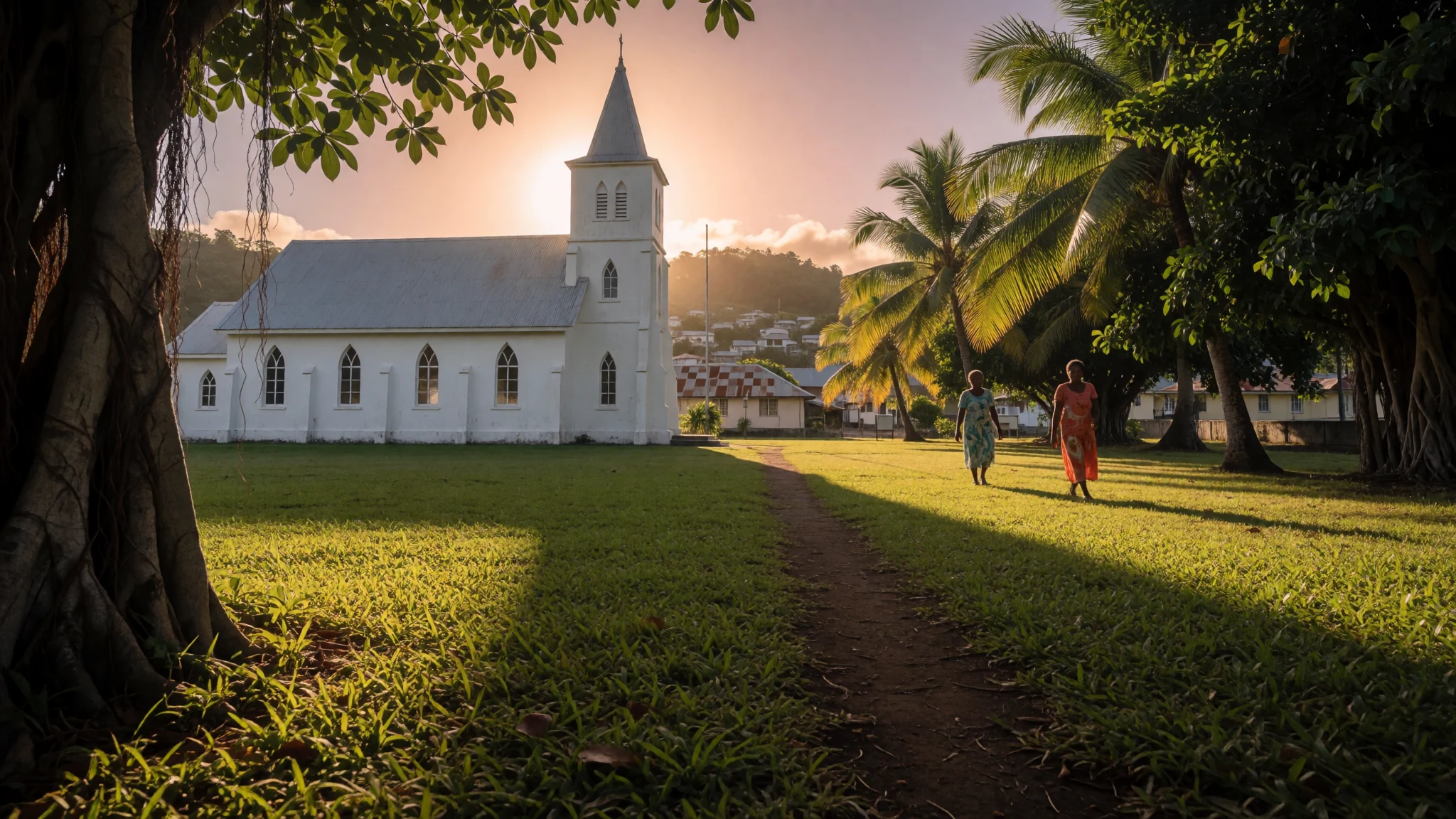
Port Vila is a green, harbour-side capital where Pacific island custom, French cooking and snorkelling reefs sit within a short ride of each other.
The place
Port Vila is the seat of government and the biggest town in Vanuatu, spread around a sheltered harbour on the west coast of Efate island, in Shefa Province. About 49,000 people live here, so it feels closer to a busy market town than a capital: one main waterfront road, a covered market hall, and green hillsides of tin roofs and banyan trees climbing back from the water. The centre sits at 59 m above sea level, and most of it can be crossed on foot, though the heat encourages taxis and minibuses.
Commerce is what the town does. Banks, shipping agents, dive operators and import shops cluster near the harbour, while resorts and guesthouses thin out along the coast towards the Pango peninsula, where beaches and reefs are easier to reach. The city council keeps local notices at https://pvmc.gov.vu/.
Bislama, English and French all turn up on signs and in conversation, a legacy of joint British and French rule, and the food and architecture carry the same double accent.
The weather is tropical and maritime. South-east trade winds blow almost constantly and take the edge off the heat, and temperatures hardly swing between seasons. February is the warmest month and July the coolest, with fresh evenings in July. Rain is frequent, March is the wettest month and September the driest, and cyclones are a real part of life rather than a rarity. Beach days work best when planned loosely, with a wet-weather fallback such as the museum or a long lunch.
Its story
Port Vila stands on land that Melanesian communities have used for thousands of years. The evidence lies just outside town at Teouma, where archaeologists working in 2004 uncovered a burial ground containing the remains of people from the Lapita culture, the seafaring potters whose decorated ceramics turn up across the western Pacific.
European contact began lightly. Captain James Cook sailed past Efate in 1774, charted it as Sandwich Island and noted that the harbours looked useful and the land suitable for farming, though he never went ashore. Later, as the archipelago became known to outsiders as the New Hebrides, British traders and missionaries arrived first, but French planters steadily gained ground and bought large blocks around the harbour. One of them, Ferdinand Chevillard, set out to clear land for a plantation; the settlement that grew instead became Franceville, a breakaway town that proclaimed itself a separate state and folded within about a year.
The rival claims were eventually settled by sharing control. Britain and France ran the islands together, and in 1906 that arrangement was formalised as the Anglo-French Condominium, a doubled administration that left parallel languages and institutions behind. During the Second World War, Port Vila served as an airbase for American and Australian forces. In 1987 Cyclone Uma struck the city and caused severe damage, a reminder that storms have shaped the town's story as much as treaties have.
What to see
- Vanuatu Cultural Centre and National Museum — Saralana Park, town centre
Port Vila's Vanuatu Cultural Centre is the natural first stop for making sense of the country. The museum holds artefacts from several islands, and the displays feel a little dated rather than glossy. Live sand-drawing demonstrations are often held, and the National Library, the council of chiefs and Parliament are all close by. - Parliament memorial — Saralana Park, opposite Parliament
Opposite Vanuatu's Parliament stands a small memorial that says a lot in a short space: two carved totem poles flank a sculpture shaped like a pig's tusk, a symbol of wealth and standing in many island communities. It takes a few minutes, but works as a quick lesson in how custom and the modern state sit together.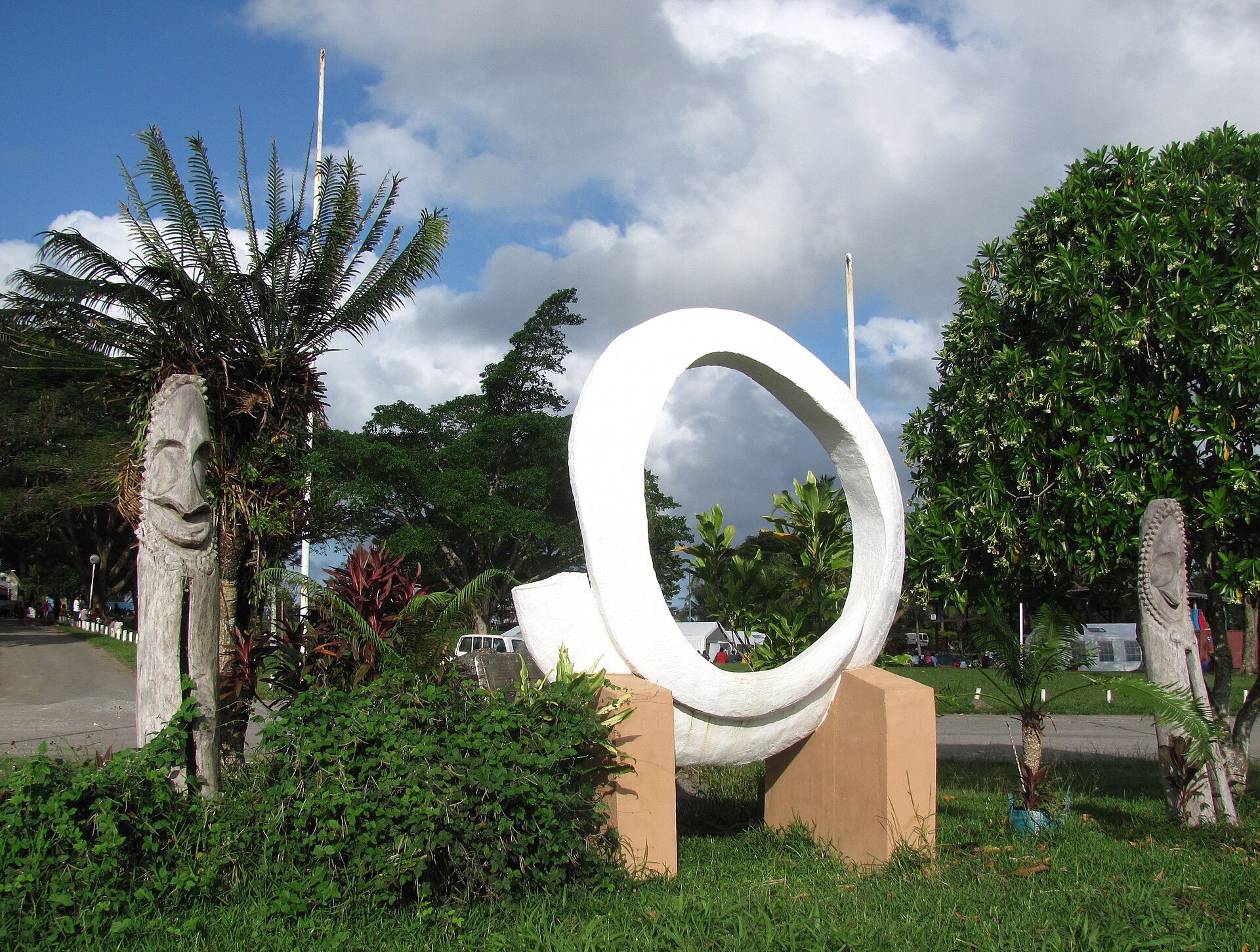
- Presbyterian Church and Independence Park — Town centre
The Presbyterian church faces Independence Park in the middle of Port Vila and makes an easy anchor for a walking loop. The hilltop City Hall is also in the centre, and the two together give a compact look at the mission and civic buildings of the town, best done before the midday heat.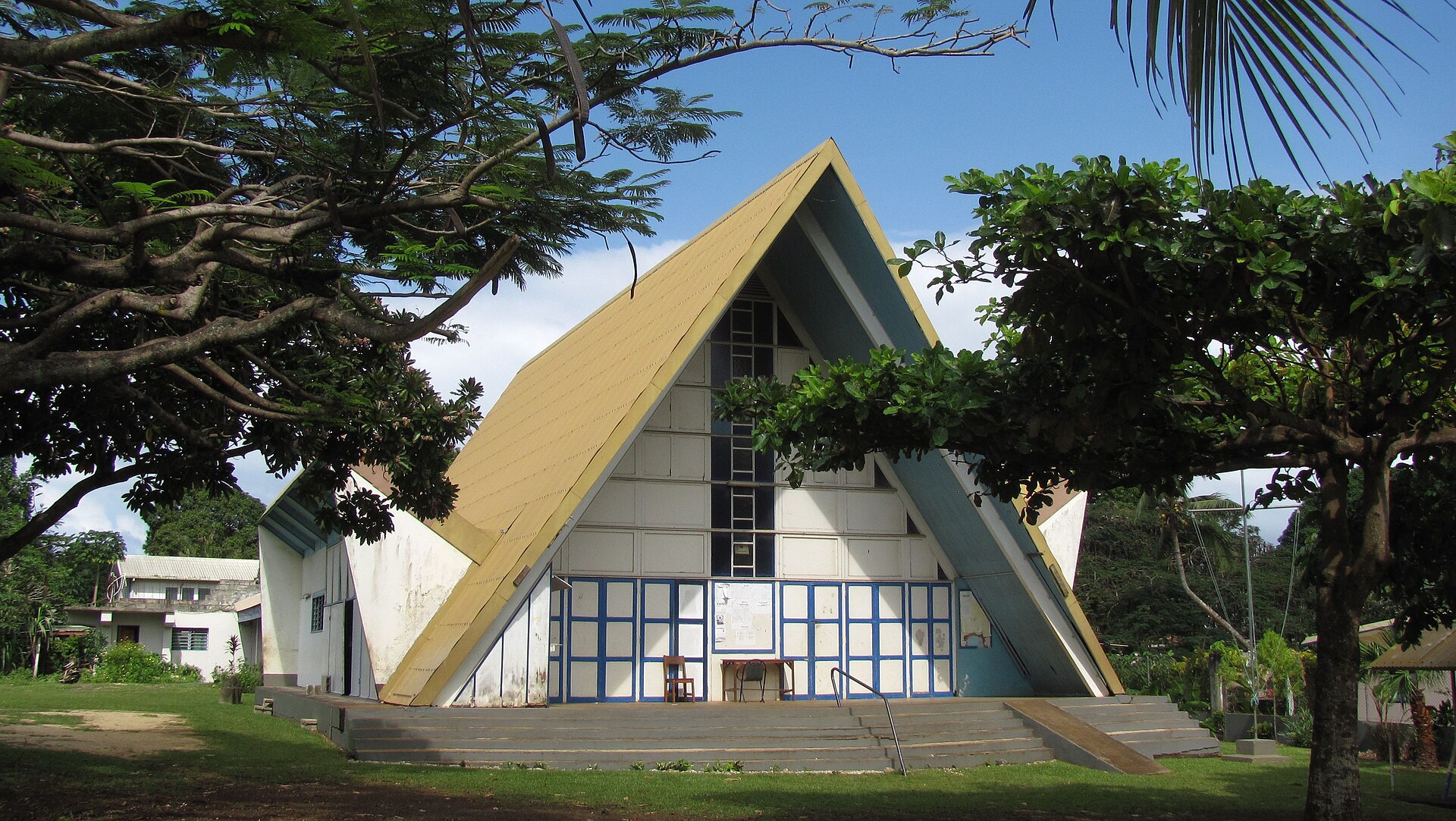
- Wall paintings and the market hall — Main Street
Colourful murals brighten several public buildings along Main Street, including the administration building opposite the market hall and the façade of the post office. A slow walk past them, ending with a drink or snack near the market hall, shows everyday Port Vila better than any single monument.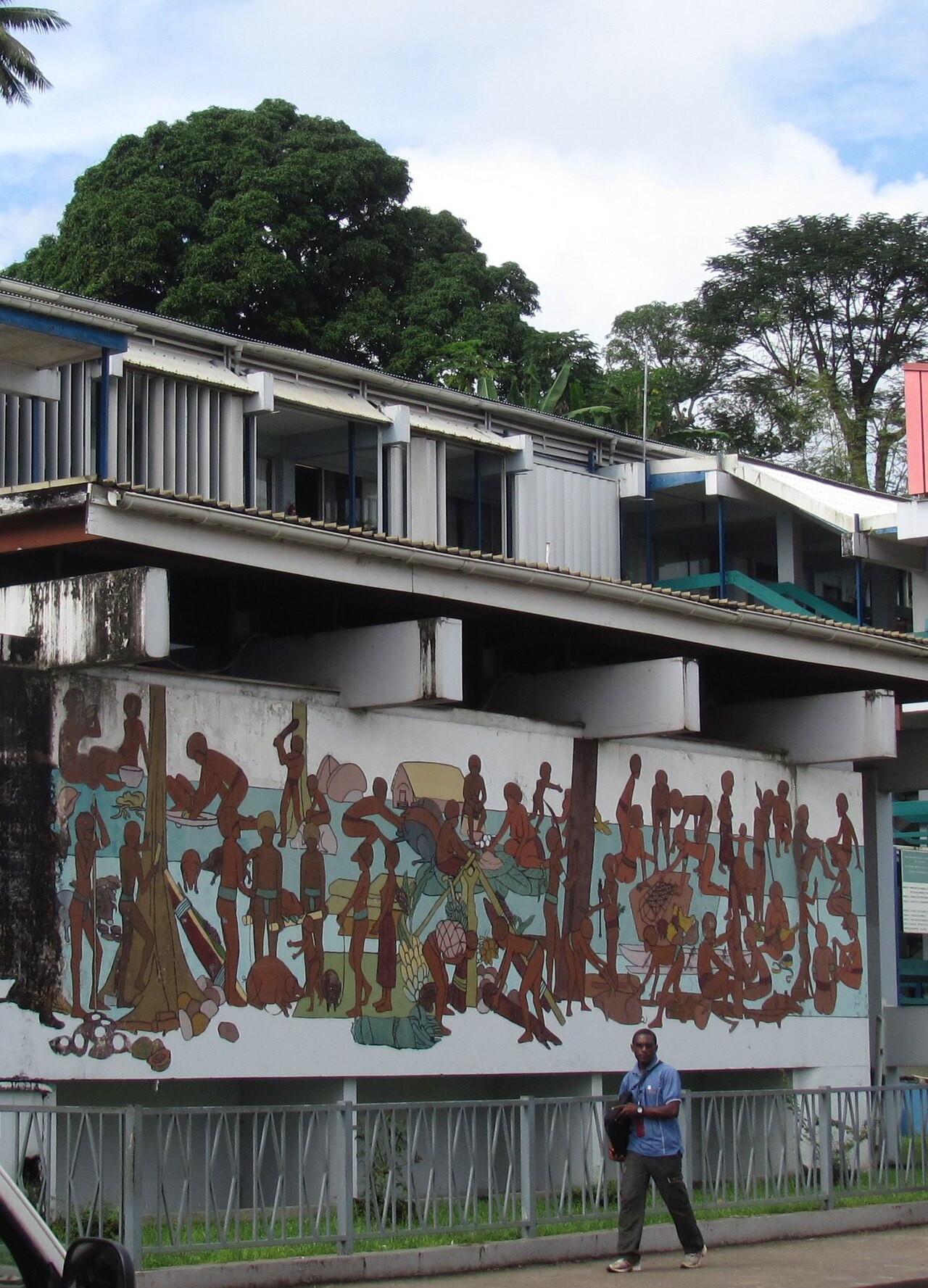
- Evergreen Cascades — North-west of the centre
Evergreen Cascades is a tall waterfall north-west of the centre, with natural pools where swimming is possible. Independent guides lead walks to the falls. Go in the drier months when paths are less muddy, wear sturdy sandals, carry water, and check conditions after heavy rain before getting in. - Hideaway Island and Honeymoon Beach — Offshore and the Pango peninsula
Hideaway Island, a small resort islet, offers reef snorkelling and glass-bottom boat trips, with ferries from Mele Pier. Honeymoon Beach, at the far end of the Pango peninsula, has coral just offshore but takes ocean swell at high tide. Reef shoes, drinking water and picnic food are worth packing.
Culture
Port Vila is where Vanuatu's many island cultures meet in one small capital. People here come from across an archipelago with a great many separate languages, and Bislama, the shared creole, ties them together in the market, in offices and on the bus. Custom, known locally as kastom, remains a living framework rather than a museum subject: chiefs hold real standing, and the national council of chiefs, the Malvatumauri, has its base close to Parliament.
The Vanuatu Cultural Centre at Saralana Park is the natural place to see how that diversity is kept and passed on. Its museum shows artefacts from several islands, and sand drawing, a pattern traced in one continuous line on the ground, is often demonstrated there. Opposite Parliament, a memorial pairs two carved totem poles with a monument shaped like a pig's tusk, an object linked with wealth and rank in many island communities.
Christianity is just as visible, from the Presbyterian church near Independence Park to the Catholic cathedral of the Sacré-Coeur, and the mission and colonial layers sit side by side. Sundays are quiet, with many families at church and many shops shut. Evenings often revolve around kava, a mildly numbing root drink served at informal drinking spots called nakamals, where local rules about who may drink, and where, differ from place to place.
Ask permission before photographing people or any ceremony, and do not enter a nakamal or custom site unless someone invites you in.
What to wear
Port Vila draws on the dress of the whole country, which varies island by island. Traditional wear includes mats and skirts woven from pandanus leaf, garments of bark and plant fibre, and ornaments of shell and feather. These appear at ceremonies, festivals and custom events, and visitors should treat them as part of living tradition rather than as costume.
Everyday clothing in town is simpler. The island dress, a loose, modest cotton gown with short sleeves and bright floral prints, introduced through missionary influence, is still worn by many women, often in matching fabric for family occasions and church. Men favour short-sleeved shirts, often in tropical prints, with shorts or light trousers. Flip-flops and sandals are standard, and a clean shirt counts as smart.
Visitors should dress for heat, humidity and sudden rain: light cotton or linen, a hat, sunscreen and a quick-dry layer. Swimwear belongs on beaches and boats; in town, in villages and at church, cover shoulders and knees. Reef shoes protect feet from coral and sea urchins, sturdy sandals suit waterfall paths, and a light rain jacket earns its space in a bag between November and April.
What to eat
- Laplap — Market hall food stalls and restaurants serving Ni-Vanuatu dishes
Laplap is the national comfort dish: grated root vegetable, often yam or manioc, mixed with coconut cream, wrapped in leaves and baked in an earth oven until dense and soft. It is often served with meat or fish and suits a long, slow lunch. - Fish in coconut cream — Harbourside stalls and casual eateries
Fresh reef or open-water fish, grilled or simmered with coconut cream, appears on many local menus. It is simple, mildly spiced and usually served with rice or root vegetables. Ask what came in that morning, as the catch changes with the weather. - Stone-grilled beef — Grill restaurants in the town centre
Local beef is a point of pride here, and several grill restaurants serve it on a hot stone brought to the table so that each diner cooks the steak to taste. It is a lively, social meal, popular with visitors and residents after a day at the beach. - Hunanese home cooking — Family-run Chinese restaurants on the town's side streets
Port Vila's Chinese community runs small family restaurants where the cooking leans hard on chilli, garlic and fermented flavours. Portions are generous and shared, and the dishes are a welcome change after several days of coconut and grilled fish. - French Pacific cooking — Older waterfront restaurants and bakeries
French influence shows in long-running restaurants that mix European technique with local seafood, tropical fruit and island vegetables. Bakeries sell baguettes and pastries early in the morning, which make a sensible breakfast before a day of snorkelling. - Tropical fruit and island produce — The covered market hall in the centre
The market hall fills with papaya, bananas, pineapple, coconuts and root crops, many sold by growers from nearby villages. It is the easiest place to buy a picnic, taste fruit at its best and see what ordinary households actually cook.
Plan it
Best time. May to October is the cooler, drier half of the year, with September the driest month and July the coolest. February is the hottest month and March the wettest, and cyclones are not rare, so check forecasts for any trip between November and April.
How long. 3–4
Getting there. Fly into Port Vila's small airport, where fixed-fare taxis are posted at the exit, shared shuttle buses serve most accommodation, and cheap public buses run from the main road. Cruise ships currently use tender boats because landslides after an earthquake cut off the main cruise terminal, so check with the cruise line.
Budget. mid
Tips
- Carry some cash for market stalls, buses and small beaches, and check that cards work before relying on them
- Agree the taxi fare with the posted list before getting in, or use a shared shuttle or public bus to save money
- Pack reef shoes, drinking water and sun protection for beach and waterfall outings, as facilities at some spots are basic
- Plan a wet-weather alternative, such as the museum or a long lunch, because showers can come in any month
Etiquette
- Ask before photographing people, ceremonies or custom sites
- Cover shoulders and knees in town, villages and church, and keep swimwear for the beach
- Do not enter a nakamal or village without an invitation
Nearby
Sources
- Wikidata Q37806 (CC0)
- Wikipedia: Port Vila (rev 1377098234) (CC BY-SA 4.0)
- Wikivoyage: Port Vila (rev 5423280) (CC BY-SA 4.0)
- Port Vila aerial (Phillip Capper) (CC BY 2.5)
- Vanuatu Parliament, Port Vila (Phillip Capper) (CC BY 2.5)
- Natural Harbour, Port Vila (Steffen Wurzel) (CC BY 3.0)
- City Hall, Port Vila (Torbenbrinker) (CC BY 3.0)
- Cathédrale du Sacré-Coeur, Port-Vila (Gérard Janot) (CC BY 3.0)
- Presbyterian Church, Port Vila (Torbenbrinker) (CC BY 3.0)
- Wall painting in Main Street, Port Vila (Torbenbrinker) (CC BY 3.0)
- Memorial in front of the Parliament, Port Vila (Torbenbrinker) (CC BY 3.0)


