Port Moresby
Port Moresby, Papua New Guinea
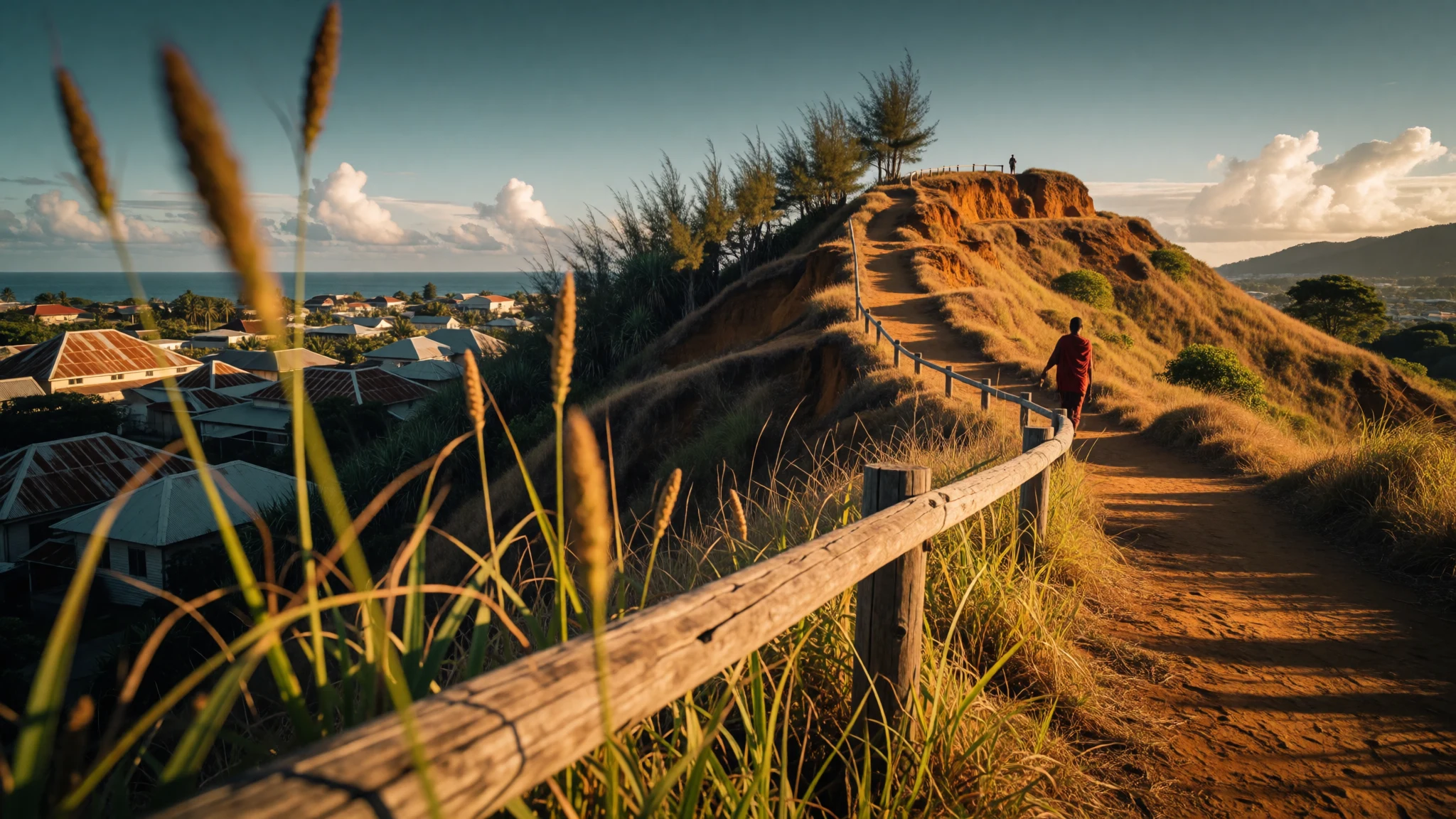
Port Moresby is the working capital of Papua New Guinea, worth a few days for its harbour views, museum, war graves and the gateway it offers.
The place
Port Moresby (Tok Pisin: Pot Mosbi, and Pom City to plenty of locals) is the capital of Papua New Guinea, spread over dry brown hills beside the Coral Sea on the south-western side of the Papuan Peninsula. Its elevation is 74 metres, and the harbour views from the ridges are the city's best argument for a few days' stay. It is a working capital rather than a resort: government offices, port yards, shopping centres, walled compounds and urban villages sit side by side, and distances feel longer than the map suggests because traffic is slow. Counts of residents vary widely. Wikidata carries 317,374, while the 2024 census recorded 756,754, so any single figure deserves caution. Politically the city stands apart from the province around it. Central Province surrounds it, yet Port Moresby forms its own National Capital District, and the Motu and Koitabu landowners are represented through the Motu Koita Assembly. The rainfall surprises many first-time visitors. With an average of 898.8 millimetres a year, this is the driest place in New Guinea, a savanna of grass and scrubby trees rather than the rainforest people imagine. Most travellers arrive by air, since the city is the main entry point for the country, and many move straight on to the Kokoda Trail, the highlands or the islands. Those who stay find real museums, a nature park, war graves and an eating scene shaped by Chinese, Japanese, Korean and Australian communities. The city hosted the APEC summit in November 2018, a sign of its role as the country's front door.
Its story
Port Moresby's recorded history as a town begins in 1873, though the Motu and Koita people had lived on this shore for centuries before. In February of that year the crew of HMS Basilisk, surveying the southern coast of New Guinea, anchored off Paga Hill, and Captain John Moresby named the harbour after his father, Admiral Sir Fairfax Moresby. European visitors guessed the local population at around 2000 people. The biggest settlement, Hanuabada, was a cluster of five villages. The Motu were coastal people and the Koita came from the inland hills, and the two groups intermarried widely, living in family units called iduhu, loosely comparable to clans. Missionaries followed fast. Polynesian teachers dispatched by the London Missionary Society arrived within months, and in 1874, Reverend William George Lawes constructed a mission residence at Metoreia, across from Elevala Island. The harbour was already a trading hub that drew people from far along the coast, which the missionaries hoped to use. Rumours of gold came next. Prospecting around the Laloki and Goldie Rivers in the late 1870s turned up traces within walking distance of the harbour, and a trader, William Bairstow Ingham, set out from Cooktown early in 1878 to open a store. In the twentieth century the port gained strategic weight. Japanese planners wanted it as an air base for isolating Australia from Southeast Asia and the Americas, and it was a main target through 1942 and 1943.
What to see
- Port Moresby Nature Park — Northern suburbs
Port Moresby Nature Park is a small zoo and garden on the northern side of the city, and a gentle first stop. Its enclosures hold birds of paradise, cassowaries and other native birds that visitors rarely glimpse in the wild. Go early, before the heat builds, and check locally for opening arrangements. - Papua New Guinea National Museum & Art Gallery — Waigani
The national museum in Port Moresby is modest in size but rewarding, with carved sculptures, beadwork, traditional boats and everyday cultural objects from across the country. It gives useful background before travelling to the provinces. Allow a couple of hours, and check the current opening arrangements before setting out. - Bomana War Cemetery — Outskirts, east of the centre
Bomana War Cemetery holds 3,824 Commonwealth burials from World War II, including many Australian soldiers from the Kokoda Trail and, in the last rows, men of the Papuan Battalion. It is quietly and carefully kept. Visit in the cooler morning, and expect a sombre, reflective hour rather than a sightseeing stop. - National Parliament of Papua New Guinea — Waigani
Parliament House in Port Moresby is modelled on a Maprik haus tambaran, the spirit house of East Sepik Province, with a steep gabled roof and carved detail. It is the most striking public building in the city. Admire it from outside, and ask locally whether tours are running before planning one.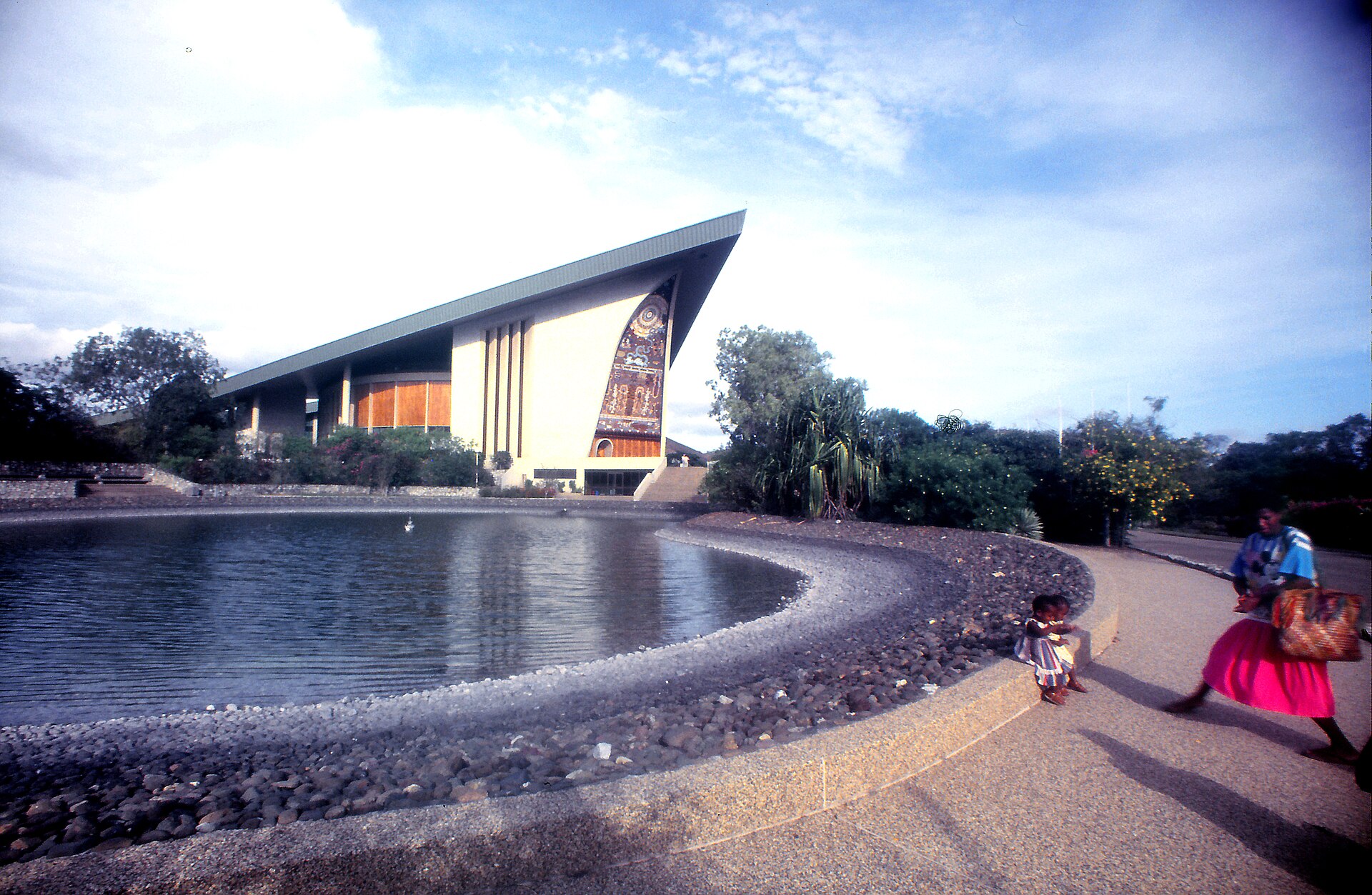
- Touaguba Hill lookout — Town centre
Touaguba Hill gives a broad view over the old town centre, the harbour and the water beyond. It is a good place to grasp how the city sits between sea and dry hills, and it is best in the clearer, softer light of early morning. Take local advice on safe access and transport.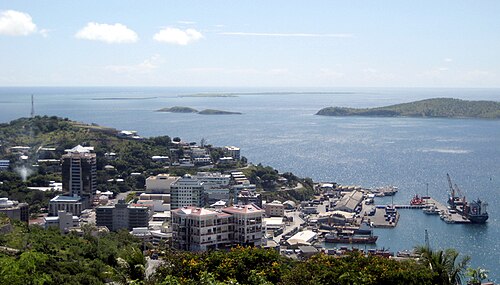
- Hanuabada village — Harbour shore, near the centre
Hanuabada is the Motu-Koita settlement on the harbour, historically five villages, built partly over the water on stilts. It remains a living community rather than an attraction. Visit only with a local guide or an invitation, ask permission before taking photographs, and treat it as someone's neighbourhood.
Culture
Port Moresby is a meeting point for the whole of Papua New Guinea, so its culture is a mix rather than a single tradition. The Motu and Koitabu are the traditional landowners, and their villages, such as Hanuabada, still sit within the modern city. Alongside them live people from the highlands, the islands and the Sepik, each with their own languages and customs, and Tok Pisin and English carry most everyday conversation. Family and clan obligations, often called wantok ties, shape daily life, from finding work to sharing food, and visitors will notice how readily strangers are connected through relatives. Churches matter greatly, and Sunday morning is a time for services, singing and rest, so the city can feel quieter. Chewing betel nut is common and leaves red stains on pavements, which locals know well and visitors soon spot. Cultural shows and festivals bring out string bags, drums, face paint and feathered headdresses, and the national museum is the best place to see how varied the traditions are. Parliament House borrows from the spirit houses of the Sepik, a reminder that the capital draws on the whole country for its symbols. People are generally warm once greeted properly, and a handshake and a smile go a long way. Ask permission before photographing anyone, especially in villages and markets, and respect a refusal without argument.
What to wear
Traditional dress in the Port Moresby area varies by community, and across Papua New Guinea it is closely tied to ceremony. Coastal Motu and Koita people have long worn wrap garments and decoration made from shell, beads, feathers and plant fibre, and the full display of body decoration is called bilas in Tok Pisin. Woven bilum bags, looped by hand from plant or wool fibre, are carried everywhere and are the most visible textile craft. These outfits are worn mainly for festivals, dances and important family occasions. Day to day, people dress simply and practically for the heat. Women often wear the meri blouse, a loose, bright cotton top of missionary origin, or a wrap skirt called a lap-lap, and men wear short-sleeved shirts with trousers or a lap-lap. Offices favour neat shirts, and school uniforms are common sights on the roads. Visitors should pack light, breathable cotton or linen, with a hat and sunscreen for the strong sun. Shoulders and knees are best covered in town, in villages and at churches, as modest dress is the norm and avoids unwanted attention. Closed, comfortable shoes are better than flip-flops for uneven pavements and for walks to lookouts. From December to May, add a light rain jacket. Keep jewellery and expensive watches out of sight while walking.
What to eat
- Crocodile teppanyaki (puk puk) — Japanese restaurants in the town centre
Crocodile, called puk puk in Tok Pisin, turns up on teppanyaki menus at Japanese restaurants in the city, cooked on a hot plate at the table. It is a mild, firm white meat, and a memorable local curiosity for adventurous eaters. - Chinese-style dishes — Chinese restaurants around the town centre and Waigani
Chinese restaurants are an established part of Port Moresby's eating scene, serving stir-fries, noodles, rice dishes and seafood to a mixed crowd of residents and visitors. Portions are generous and good for sharing, making this an easy, dependable choice after a long day. - Australian-style grills with local touches — Waterfront clubs and larger restaurants
Yacht-club style dining combines Australian staples such as grilled meat and fish with Papua New Guinean touches, often as an à la carte menu or a changing buffet. Tables overlook the water, which makes it a pleasant way to end a hot day. - Korean cooking — Korean restaurants in the suburbs
Korean restaurants serve barbecue, rice dishes and soups, reflecting the Asian communities who have settled in the city. The food is hearty and tasty, and a useful change if the heat has dulled the appetite for heavy dishes. - Mumu, the earth-oven feast — Cultural events and village gatherings, by invitation
Mumu is the traditional way of cooking pork, chicken, sweet potato and greens, steamed over hot stones in a pit. It is usually prepared for festivals and gatherings rather than daily meals, so ask a local guide or lodge about arranging a taste.
Plan it
Best time. June to November is the dry season and slightly cooler, so it suits walking and sightseeing. December to May is the wet season, with heavier rain. Highs run from 28 to 32 °C through the year and lows hover around 23 °C, so the heat never really lets up.
How long. 2–3
Getting there. Jacksons International Airport serves Port Moresby, with flights from Cairns, Brisbane and Sydney in Australia, and from Singapore, Manila, Tokyo, Hong Kong and Pacific neighbours such as Fiji and Honiara. The last leg is a taxi or a pre-arranged transfer arranged with your accommodation.
Budget. high
Tips
- Arrange airport pick-up through your accommodation before you land
- Take local advice on safety and which areas to avoid, especially after dark
- Use pre-booked or recommended drivers rather than walking between sights
- Carry some cash for small purchases, and keep it discreet
- Drink bottled or filtered water and carry sun protection
Etiquette
- Ask permission before photographing people or entering villages
- Dress modestly, covering shoulders and knees, in town and at churches
- Greet people with a handshake and a smile before asking for help
Nearby
Sources
- Wikidata Q36526 (CC0)
- Wikipedia: Port Moresby (rev 1384648377) (CC BY-SA 4.0)
- Wikivoyage: Port Moresby (rev 5427628) (CC BY-SA 4.0)
- MSchlauch, Overlooking Port Moresby 'Town' from Touaguba Hill (Public domain)
- Jialiang Gao, Jacksons International Airport, Port Moresby, 2008 (CC BY 3.0)
- Brian ireland, Port Moresby (Parliament House) (CC BY-SA 2.0)
- Frank Hurley, Aerial photo of Port Moresby, 1921 (Public domain)
- Masalai, Walter Bay from hills (CC BY 3.0)
- Masalai, Port Moresby Airport looking west (CC BY 3.0)
- Carlquist, Sherwin John, Aerial view of Port Moresby Beach (CC BY 4.0)
- Carlquist, Sherwin John, Aerial view of Port Moresby coastline (CC BY 4.0)


