Por-Bazhyn
Por-Bazhyn, Russia
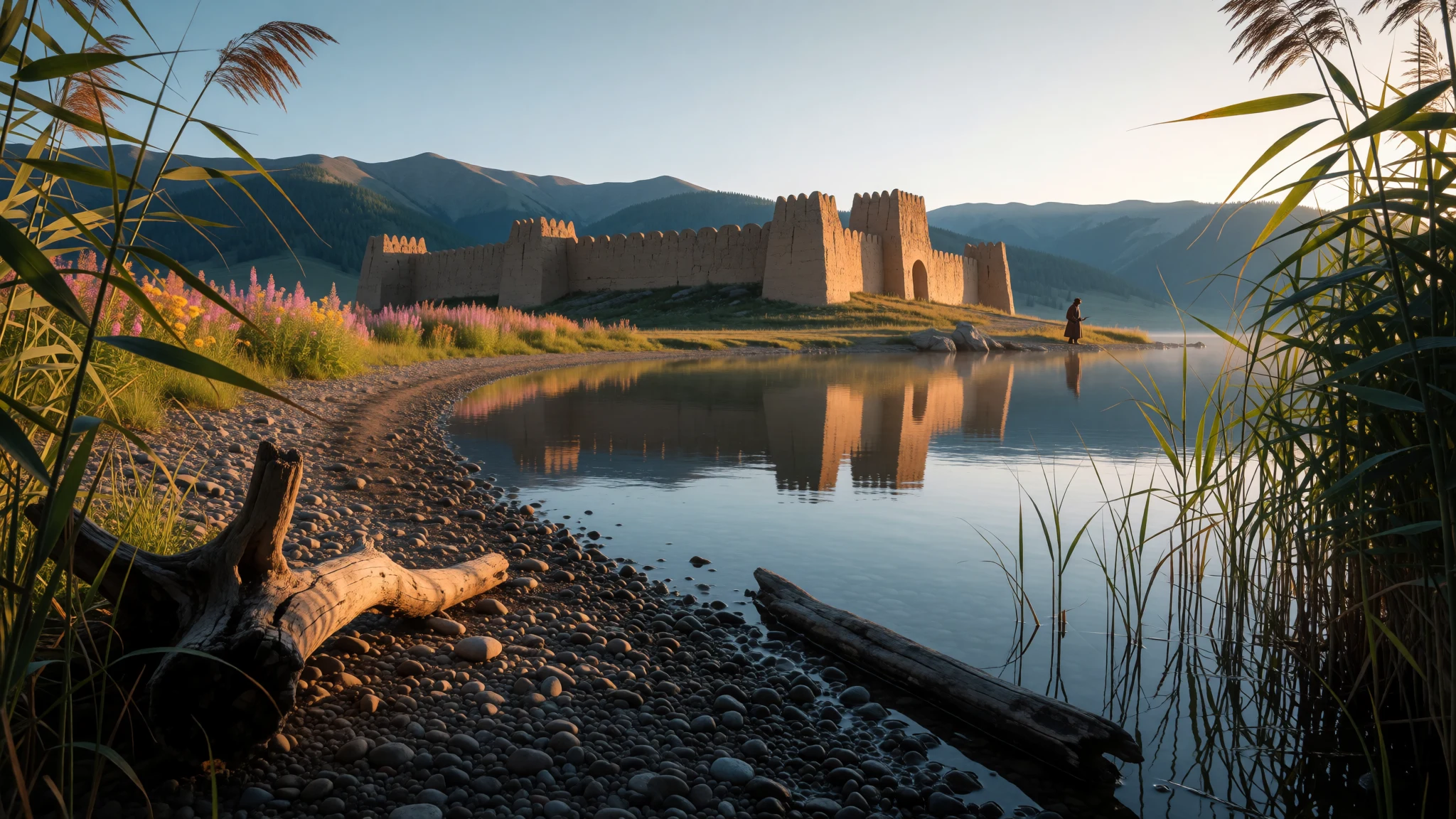
Por-Bazhyn is a ruined clay palace on a lake island in remote Tuva, where Tang-style building met Siberian mountains.
The place
Por-Bazhyn stands on a small island in Lake Tere-Khol, in the Sengelen mountains of southern Tuva, a Russian republic that borders Mongolia. The lake lies about 1,300 m above sea level, and the nearest village, Kungurtuk, is roughly 8 km to the east. The Tuvan name means "clay house", which suits a complex built largely of earth rather than stone. The walls enclose a rectangle about 215 m long, running east to west and covering nearly the whole island. Inside, two large courtyards surround a central group of buildings, with a chain of smaller yards along the northern, western and southern sides. The main gate faces east, with towers and ramps on either side. The outer walls still rise to about 10 m in places, while the inner walls are no more than a low bank. Builders used methods from the Tang Chinese tradition, which is striking this far into Siberia. The likeliest sequence is a Uyghur palace, a brief second life as a Manichaean monastery, then abandonment and ruin after an earthquake and fire. Tuva is distinct from much of Russia: most people are Buddhist, Tuvans keep their own names rather than Russian-style surnames, and cultural ties with neighbouring Mongolia are close. Reaching the island is an expedition rather than a day out from a city, so the experience is as much about space, silence and weather as about masonry.
Its story
Por-Bazhyn has been known to outsiders since the 18th century, and it was first explored in 1891. The Soviet archaeologist S.I. Vajnstejn dug in several areas of the site during the late 1950s and early 1960s, and his plan is still the base map for later work. Far larger fieldwork came in 2007–2008, run by the Fortress Por-Bajin Foundation with specialists from the Russian Academy of Sciences, the State Oriental Museum and Moscow State University. Wikidata gives 777 as the founding date. The Uyghur link goes back to the end of the 19th century. It rests on the location, the date of the finds, and a ground plan that resembles the palace complex at Karabalgasun, capital of the Uyghur Khaganate. Vajnstejn went further and identified Por-Bazhyn as the palace "at the well" mentioned in the runic inscription on the Selenga stone, built by Khagan Moyanchur after a victory over local tribes. Moyanchur meddled in China's internal struggles and married a Chinese princess, which helps explain the Tang-style architecture. Older books offered other readings: a border fortress, a ritual site, a monastery, even an astronomical observatory. The completed fieldwork of 2008 has largely settled the debate in favour of a palace that was later converted to religious use and then lost to earthquake and fire.
What to see
- The island fortress of Por-Bazhyn — Lake Tere-Khol, southeast Tuva
The main sight is the ruin itself: earthen outer walls, the eastern gate with its ramps, and the grassy outlines of courtyards inside. Walk the perimeter first to grasp the rectangle, then cross the interior. Without a printed plan, such as Vajnstejn's survey, the low inner walls are hard to read.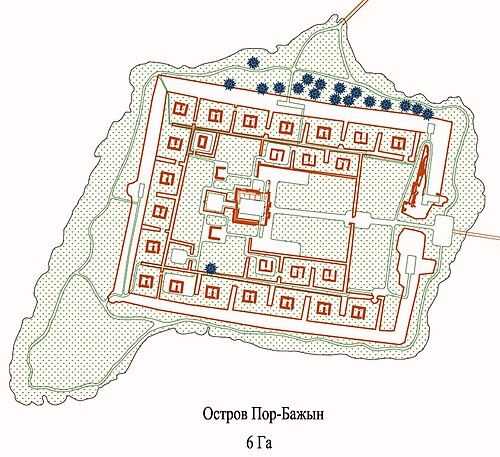
- Lake Tere-Khol shoreline — Southeast Tuva
The lake is the reason the site feels so isolated, ringed by the Sengelen mountains with little human trace beyond the ruin. Shore walks give the best views back at the island, especially in early light. Expect wind, quickly changing weather and very few other visitors in any month. - Kyzyl and the Centre of Asia monument — Kyzyl
Kyzyl, the republic's capital, is the practical base and the place to see Tuvan museums, markets and the Centre of Asia monument. Stock up here on supplies and maps before heading southeast, and ask in town about current road conditions and any border-zone paperwork. - Valley of the Kings near Arzhan — Arzhan, northern Tuva
Far to the north of Por-Bazhyn, the Valley of the Kings holds enormous Scythian burial mounds. Their treasure is kept in the national museum in Kyzyl, so the two make a sensible pair. The valley shows how much older and wider Tuva's archaeology is than one island palace. - Samagaltai temple — Samagaltai, southern Tuva
Samagaltai was once the old trading centre for Mongolia, in the years when Tuva belonged to China. It has a lovely Buddhist temple, a useful reminder that living Tuvan faith sits alongside the ancient ruins. Visit with a local guide if possible, and ask before photographing inside.
Culture
Por-Bazhyn sits in a part of Tuva where Buddhism, shamanic custom and nomadic herding life all shape daily manners. Tuvans are proud of a culture that is distinct from the rest of Russia, and many speak Tuvan at home. Throat-singing is the best-known art: one singer produces a steady drone and, above it, separate whistling notes, so that a single voice sounds like several. Listen for it at festivals and concerts in Kyzyl rather than expecting it at the ruin. Khuresh, Tuvan wrestling, is the other great tradition. A wrestler loses by touching the ground with anything other than his feet, and matches draw big, good-humoured crowds in summer. Hospitality matters enormously in the countryside. A guest in a village home may be offered a whole sheep, prepared with great care and served in shared heaps on a flat dish. Refusing everything outright can cause offence, so accept at least a taste. The wider region also carries painful history: Tuva was once part of the Qing empire, then an independent state, then annexed by the Soviet Union, and people hold different views about that past, so listen before offering opinions. The ruin is an archaeological site, not a playground. Stay on existing paths along the earthen walls, take every scrap of rubbish away with you, and never climb or dig into the clay.
What to wear
Around Por-Bazhyn, traditional Tuvan dress is a long, wrap-over robe called a deel, closely related to the Mongolian garment. Winter versions are lined or trimmed with sheepskin or fur, while lighter ones are made from cotton or silk brocade in strong colours, tied with a broad sash. Felt boots and fur or felt hats complete the herder's outfit. The deel is mostly worn now for festivals, weddings, wrestling matches and religious occasions, and some older herders still wear it daily on the steppe. Everyday clothing in Kyzyl and the villages is modern and practical: jeans, fleece, quilted jackets, trainers or rubber boots, with sports kit for younger people. Dressing up is reserved for celebrations. A visitor should dress for the mountains first. Even in summer, evenings by the lake can be cold and wet, so pack a windproof shell, a warm layer, a hat, and sun protection for the long daylight hours. Sturdy waterproof walking boots matter more than style, because the ground near the lake can be boggy and the road approaches are rough. At Buddhist temples and in village homes, keep shoulders and knees covered and remove hats when going inside. Insect repellent and long sleeves make summer evenings by the water far more comfortable.
What to eat
- Boiled mutton for guests — A family home or herders' camp in the countryside
A guest in Tuva is classically welcomed with a whole boiled sheep, its parts laid out in separate piles on one large flat dish. Guests cut a portion of each kind, then everyone eats with their fingers. It is found in village homes and herders' camps. - Clear mutton broth — Served alongside the boiled meat in village homes
After the meat comes a clear, light broth, sipped from a bowl. It is simple, hot and restoring after a cold day by the lake, and it is a courtesy to finish what you are given. - Stone-pine kernels — Markets and roadside stalls around Kyzyl
Kernels from the Tuvan stone pine, called kedr locally, are a popular snack. Soviet cosmonauts reportedly ate them, and they are easy to carry on long rough drives. - Dalgan — Rural family kitchens, by invitation
Dalgan is a very traditional food that is now hard to find in shops or restaurants. It is usually made at home, so the realistic way to try it is through a local family or an organised homestay. - Salty milk tea — Any village home, canteen or eatery
Tea with milk and a little salt is the everyday drink across Tuva and neighbouring Mongolia. It is taken warm throughout the day and offered to every visitor on arrival.
Plan it
Best time. June to September, when the mountain roads are most passable and days are long and warm. Evenings by the lake can still be cold, and winters in Tuva are severe, so travel then is only for the well prepared.
How long. 3–4
Getting there. Fly to Kyzyl Airport, which has flights from Krasnoyarsk, or take the train from Moscow to Abakan and continue by road into Tuva. From Kyzyl, the last leg to Kungurtuk and Lake Tere-Khol is a long drive on unsurfaced tracks, so arrange a local driver and guide in advance.
Budget. mid
Tips
- Hire a driver with a high-clearance vehicle in Kyzyl, as road signs are scarce and tracks can turn muddy or sandy.
- Buy maps locally and download offline ones, since mobile signal is patchy near the lake.
- Carry cash, food and drinking water for the whole trip because shops are few outside Kyzyl.
- Ask your guide or local authorities about border-zone rules and any permit needed for the area near Mongolia.
- Plan extra days for weather and road delays rather than fixed onward connections.
Etiquette
- Stay on existing paths and never climb or dig into the clay walls.
- Accept food and tea offered in homes, at least a taste.
- Ask before photographing people, temples or herders' camps.
Nearby
Sources
- Wikidata Q1580447 (CC0)
- Wikipedia: Por-Bazhyn (rev 1364718000) (CC BY-SA 4.0)
- Wikivoyage: Tuva (rev 5109552) (CC BY-SA 4.0)
- Plan of Por-Bazhyn, S.I. Vajnstejn, updated for Por-Bajin Fortress Foundation (CC BY 4.0)
- At the Por-Bazhyn Fortress archaeological excavation site, Presidential Press and Information Office (CC BY 4.0)

