Pasargadae
Pasargadae, Iran
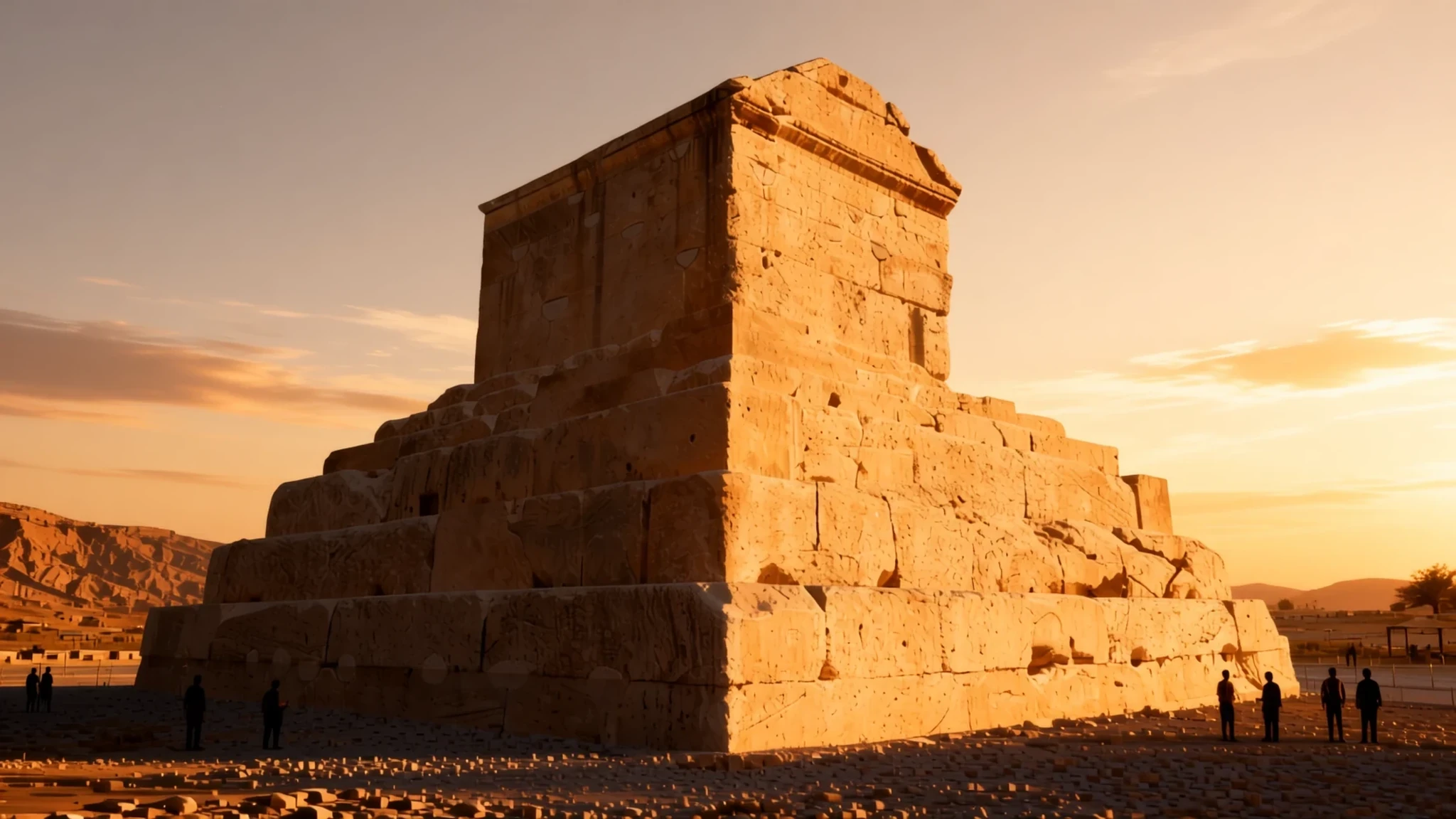
Pasargadae is the open plain where Cyrus raised his first capital, and the spare stone tomb that still marks his grave.
The place
Pasargadae stands on an open plain in Fars Province, southern Iran, a little beyond the town of Madar-e-Soleyman. Shiraz, the region's main city, lies about 90 kilometres (56 miles) to the southwest. The Old Persian name Pāθra-gadā is glossed as a club that protects, or one that stays firm; modern Persian writes the place Pāsārgād (پاسارگاد), and Pasargad is the short form people often use.
The site is an archaeological ground, not a city of streets. Column bases, stone platforms and one solitary tomb sit in grass and bare earth, while the fortified hill of Toll-e Takht rises to one side. In the years 559 to 530 BC, under Cyrus the Great, this plain was the seat of the Achaemenid Empire. The tomb that organises the view was long associated with Madar-e-Soleyman — Mother of Solomon — and only later firmly linked to Cyrus. The ruins are a UNESCO World Heritage Site.
Between the stones is the real visit. Palaces once faced a watered garden, and the lines of old irrigation can still be picked out on the ground. Shade is scarce, the sky is large, and the walk from tomb to palaces to hill is a genuine distance, not a stroll inside one courtyard. Pasargadae asks for time and a bit of imagination: the capital has to be assembled from a sparse, carefully cut plan.
Its story
Pasargadae took shape in the 6th century BCE, when Cyrus the Great set his first royal centre here and gave the Achaemenid realm a fixed home. He chose ground close to the field where Astyages, ruler of the Medes, was beaten in 550 BCE, and the place-name points back to Cyrus's clan. The capital did not stay. Darius later set the empire's ceremonial heart at Persepolis, and this older site slipped from politics into memory.
As a heritage area, Pasargadae covers 1.6 square kilometres (0.62 square miles). On that ground stand a monument widely accepted as Cyrus's mausoleum, the hill fortress Toll-e Takht, and the floors of two royal palaces set in garden. Those plots are treated as the earliest clear case of the chahar bagh, a Persian garden divided in four. The luxury was water: channels fed the beds that framed the residences.
A burial beside Toll-e Takht has been read as Cambyses II, the son who followed Cyrus, with that reading published in 2006. Gate R, a free-standing entrance to the palace quarter, is regarded as the first gateway of this independent kind on record, and the great door later built at Persepolis seems to grow from the same idea.
The tomb stays small and separate, the hill carries the defence, and the palaces are mostly outlines on the earth. Pasargadae looks like a royal camp that settled into stone, then passed the capital's role to Persepolis and lived on as memory.
What to see
- Tomb of Cyrus — south-western end of the plain
At Pasargadae the Tomb of Cyrus is a small stone chamber on a stepped podium, with a plain gabled roof and a low doorway, standing in open grass. Local memory long called it Madar-e-Soleyman, the Mother of Solomon, before it was tied to Cyrus. Scaffolding and a corrugated cover have at times wrapped the chamber, so the familiar outline can be partly masked.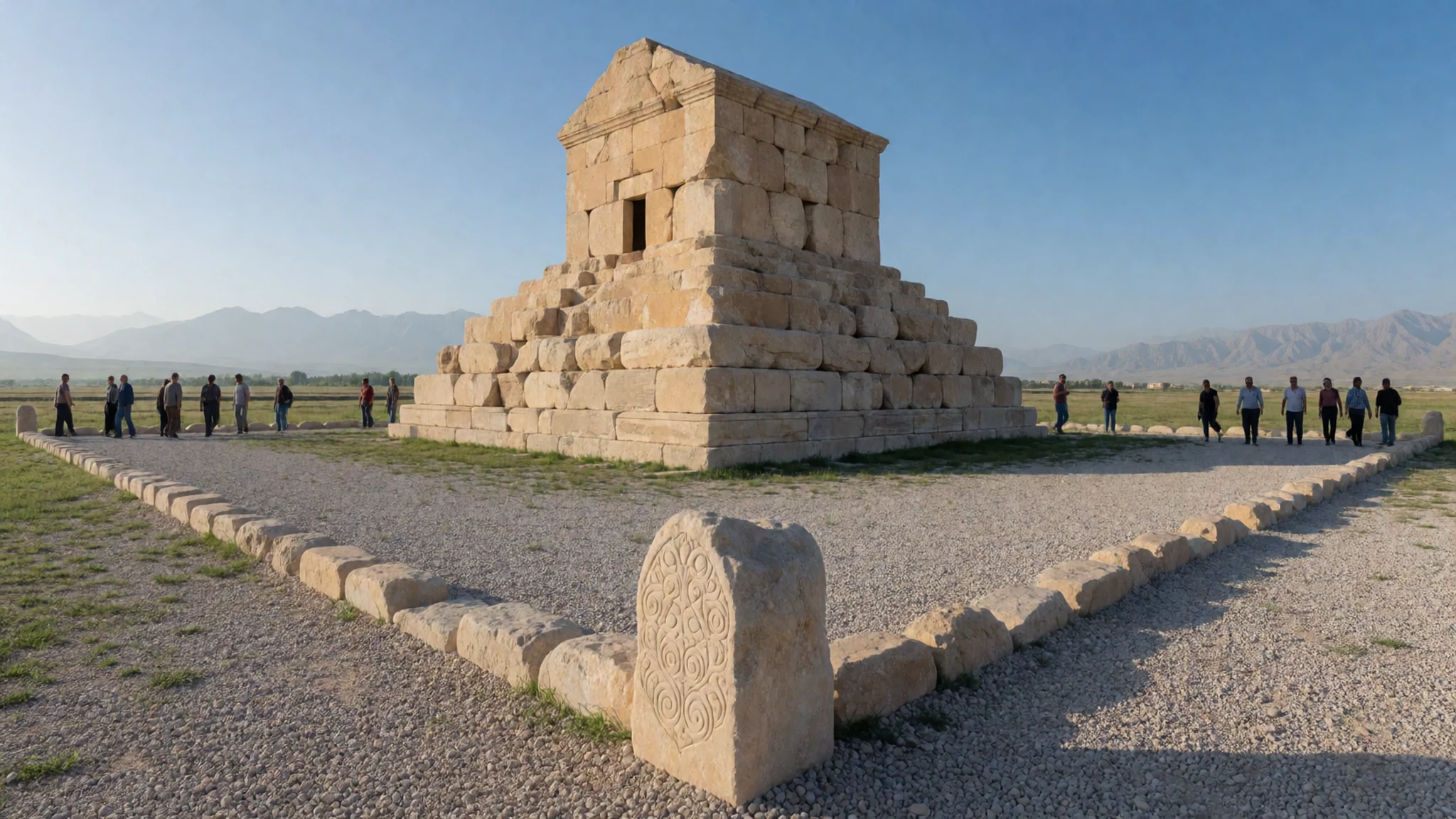
- Audience Palace — palace quarter
The Audience Palace at Pasargadae is a low stone platform and a grid of column bases, with only fragments of the upper structure still standing. It reads as a reception hall once open to a garden, the king visible across a wide floor rather than closed in a room. What survives is the footprint: bases, thresholds and stretches of cut stone.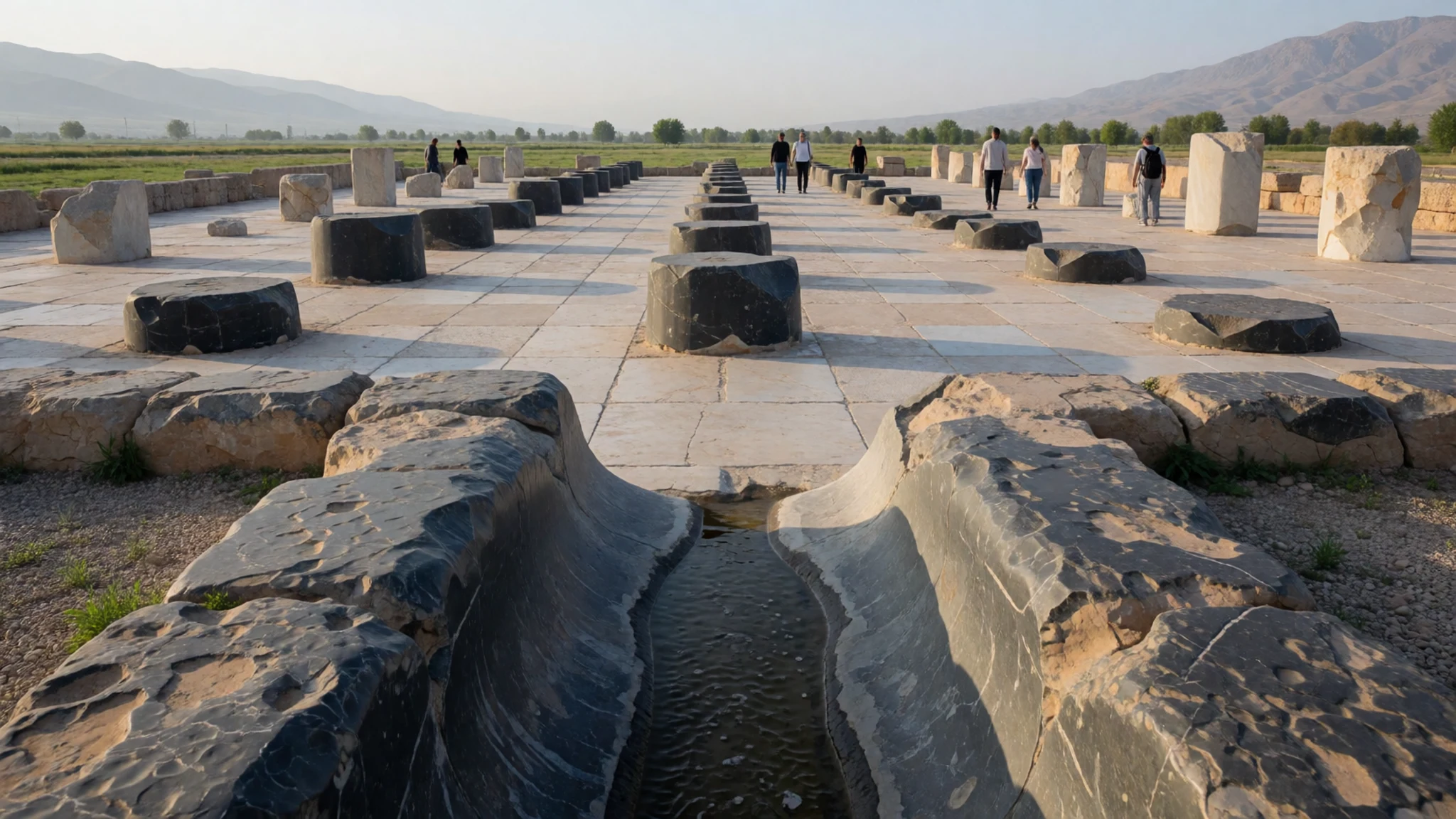
- Tall-i Takht — hill above the palaces
Tall-i Takht, also called Toll-e Takht, is the hilltop ruin at Pasargadae, nicknamed the Throne of the Mother of Solomon. A broad stone platform occupies the rise and is usually read as a fortress rather than a tomb. From the summit the rest of the site opens out, and the Tomb of Cyrus shows as a small pale block far off. The slope is uneven and almost without shade.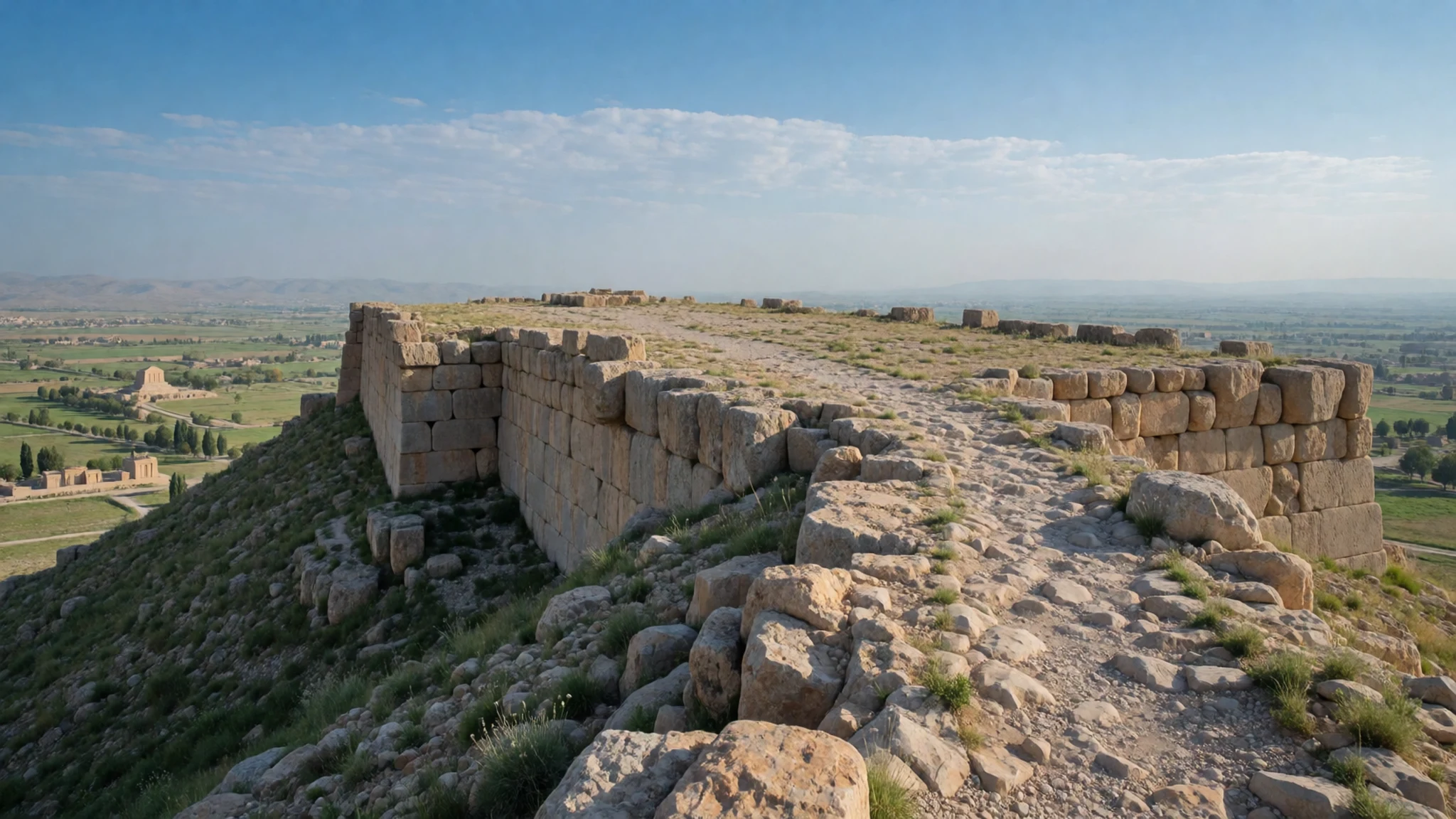
- Private palace — palace quarter
The private palace at Pasargadae stands a little apart from the audience hall, a second royal residence now reduced to low stone remains. Much less of it catches the eye than the tomb, so the stop is easy to rush past. It belongs to the same garden setting as the audience hall, and the two only make sense as a pair.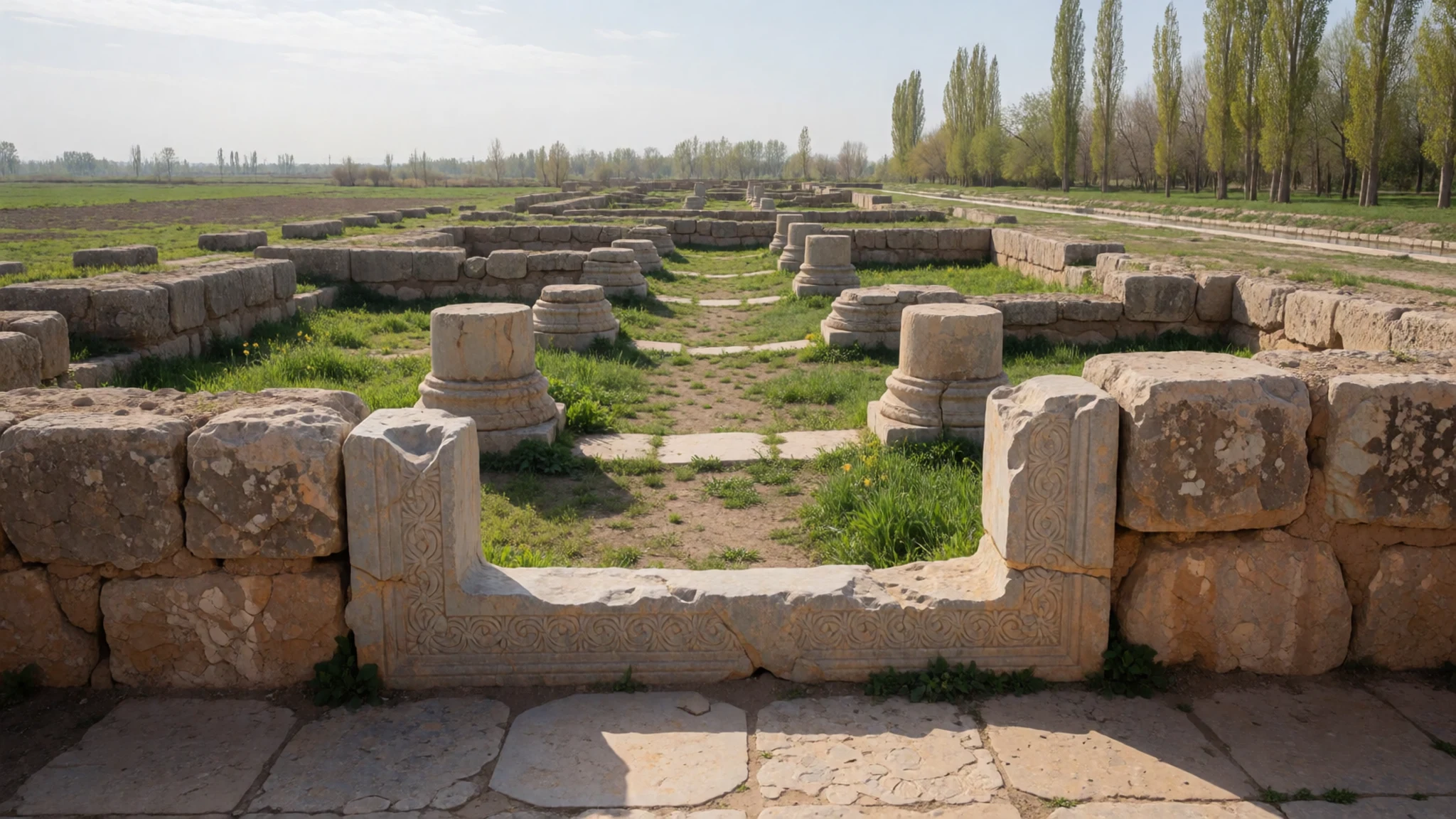
- Gateway palace — sunrise side of the palaces
The gateway palace at Pasargadae is the scanty ruin of Gate R, the entrance on the sunrise side of the palaces. Very little masonry still stands, only enough to mark a threshold that once led visitors into the royal garden. The gate is regarded as the first free-standing example of its type yet identified, and a later ceremonial entrance at Persepolis seems to follow the idea.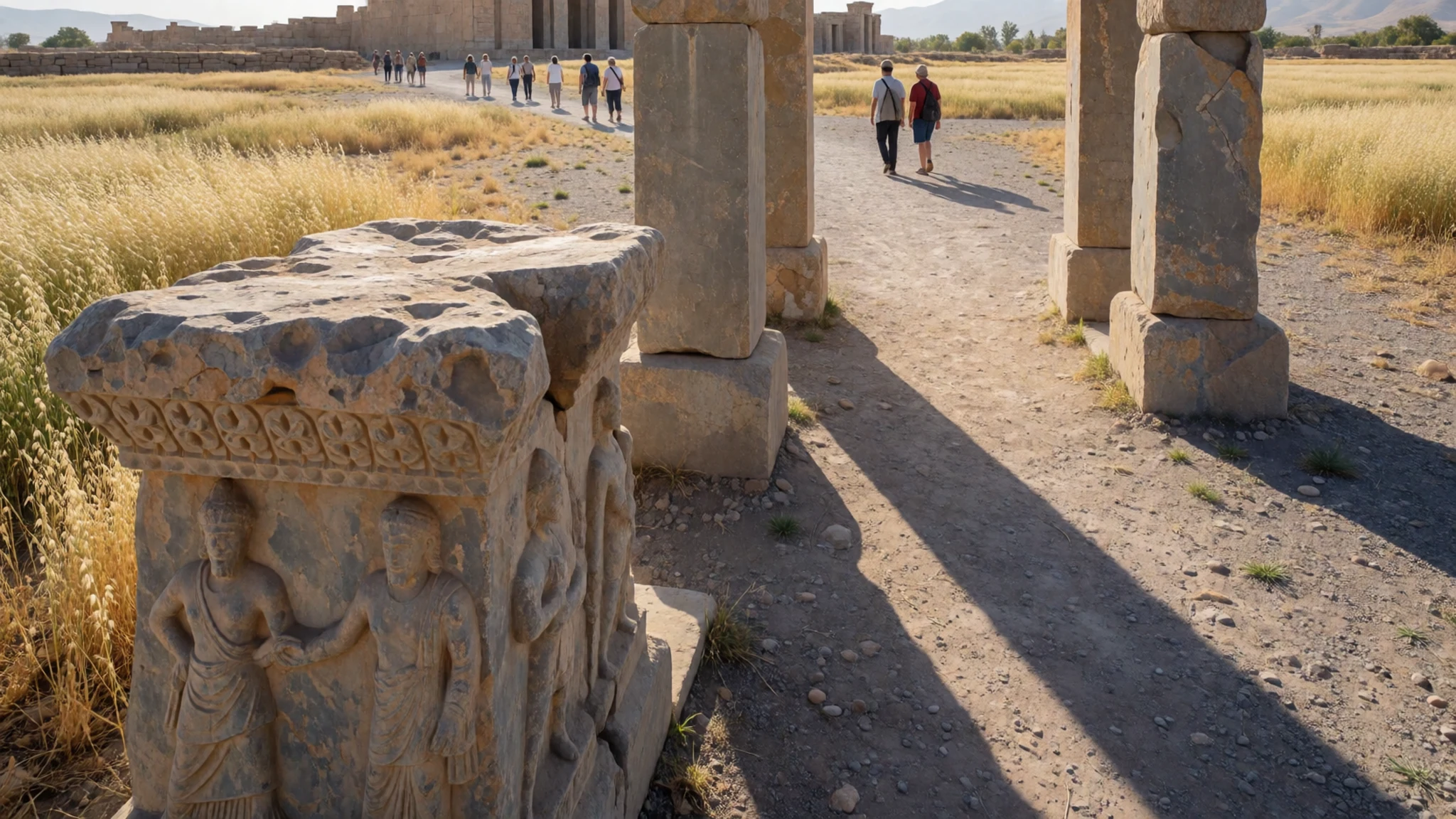
- Prison of Solomon — central ruins
The Prison of Solomon at Pasargadae is a separate ruin on the plan, distinct from the tomb and from both palaces. The title is a later popular name, kin to Madar-e-Soleyman and the Throne of the Mother of Solomon, not evidence of a real prison. Little of the building stands high. The stop keeps the circuit from shrinking to one famous grave.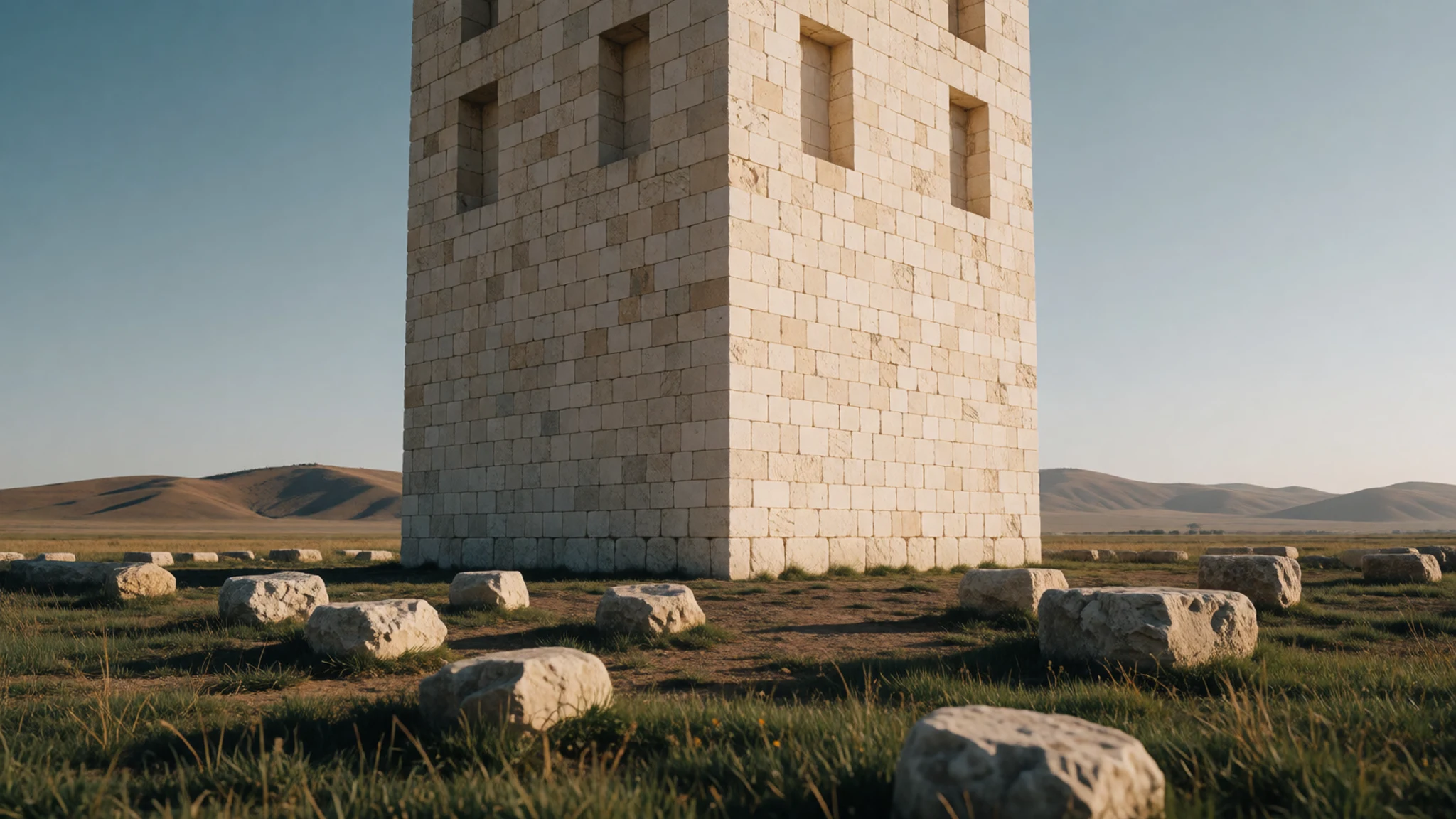
Culture
Pasargadae is a national memory laid out as ruins, not a living quarter with shops and a Friday routine. Cyrus is widely held in Iran as the founder of a Persian imperial story, and the tomb gives that story a place to stand. Families, school groups and travellers come to look and to take photographs; there is no dense cycle of ritual of the sort attached to a busy shrine. The later nicknames — Mother of Solomon, Throne of the Mother of Solomon, Prison of Solomon — show local speech folding unfamiliar Achaemenid blocks into Solomon, a figure people already knew. Staff and Iranian visitors tend to treat the tomb as a grave as well as a lesson in ancient history, which is why loud games and litter draw frowns. The fourfold garden still sits in the way people describe a proper Iranian garden: water, geometry and trees, even where the trees on this plain are few. Public holidays bring more families from Shiraz, and the grass fills without becoming a city crush. At Pasargadae, do not climb the tomb or any carved stone, and ask before you photograph people.
What to wear
Clothing at Pasargadae is modern Iranian dress on an archaeological walk, not a reconstruction of Achaemenid court costume. Court robes of the Achaemenid age survive in stone reliefs at other sites, not on this plain. In Fars, formal and rural tradition still includes the chador, a full-body drape, and among some provincial tribal families a brighter kit of layered skirts, jackets and tied headcloths kept for weddings and gatherings. What people wear now, on the bus and among the ruins, is ordinary town clothing under public modesty rules. Women wear a headscarf and a long coat or manteau over trousers; men wear shirts, jackets and full-length trousers. Shoes on the site turn practical, because the paths are gravel and the wind crosses open grass. Young visitors from Shiraz look much as they do in the city, only more covered against sun. A visitor is expected to match that public code. Women visitors need a scarf that will stay put in the wind, sleeves to the wrist, and trousers or a long tunic below the knee; a light manteau is the easiest outer layer. Male visitors should leave shorts and sleeveless shirts aside. Closed shoes with a grip suit the uneven ground better than sandals. Sunglasses and a removable layer help: the plain has little shade, and the air can cool once the sun drops.
What to eat
- Kalam polo — eateries in Shiraz or Saadatshahr
Kalam polo is cabbage rice cooked with herbs, a Shiraz favourite, often finished with small meatballs. Pasargadae has no restaurant, so the dish belongs in an eatery in Shiraz or in Saadatshahr, before or after the ruins. It tastes of home cooking, not of a snack eaten between the columns.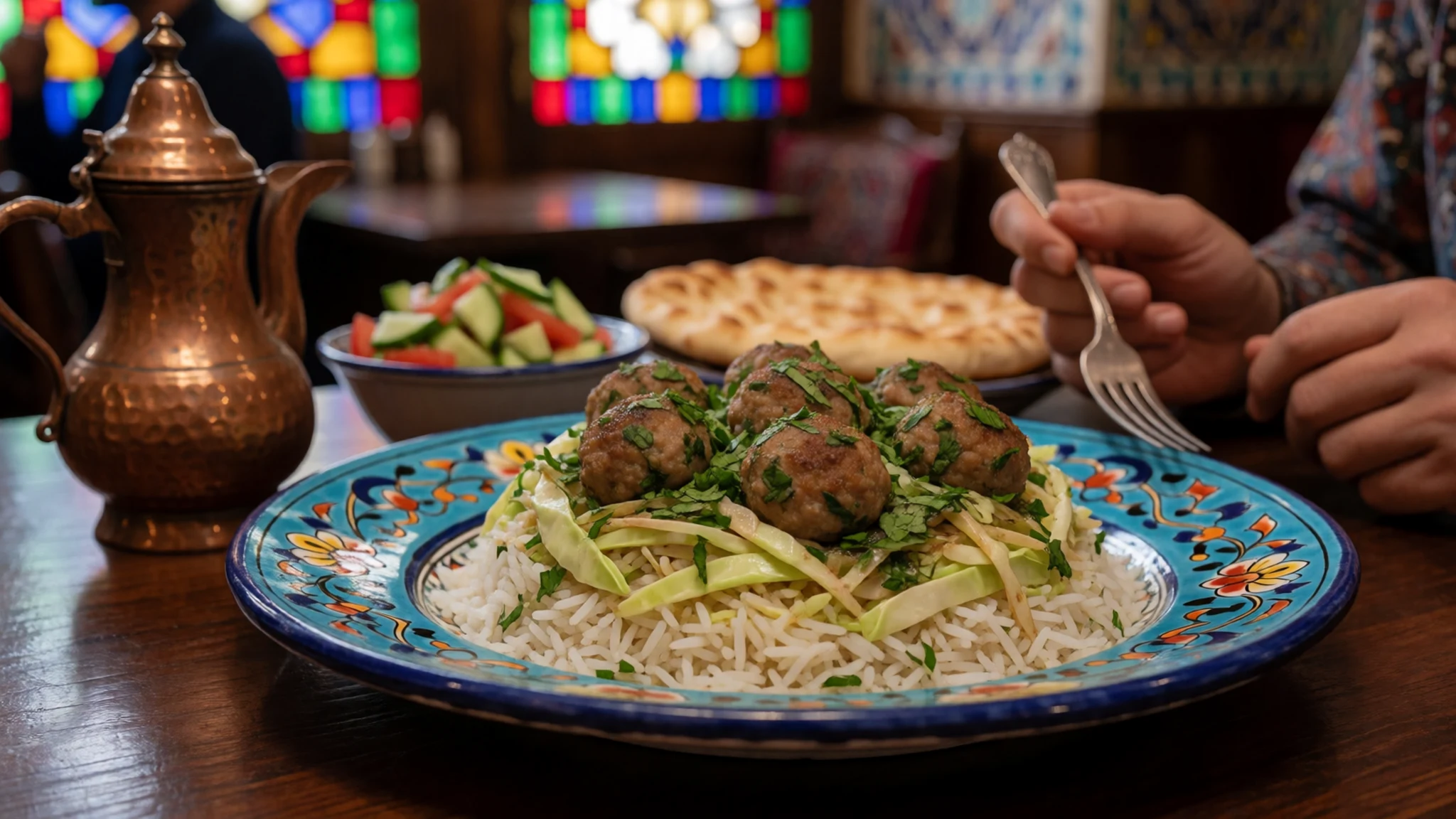
- Kabab koobideh — grill houses in Shiraz and towns on the road
Kabab koobideh is minced lamb or beef grilled on a wide skewer, the everyday plate of grill houses across Fars. It is found in Shiraz and in towns on the road to Pasargadae, never among the ruins, where no kitchen exists. Bread, grilled tomato and onion share the platter.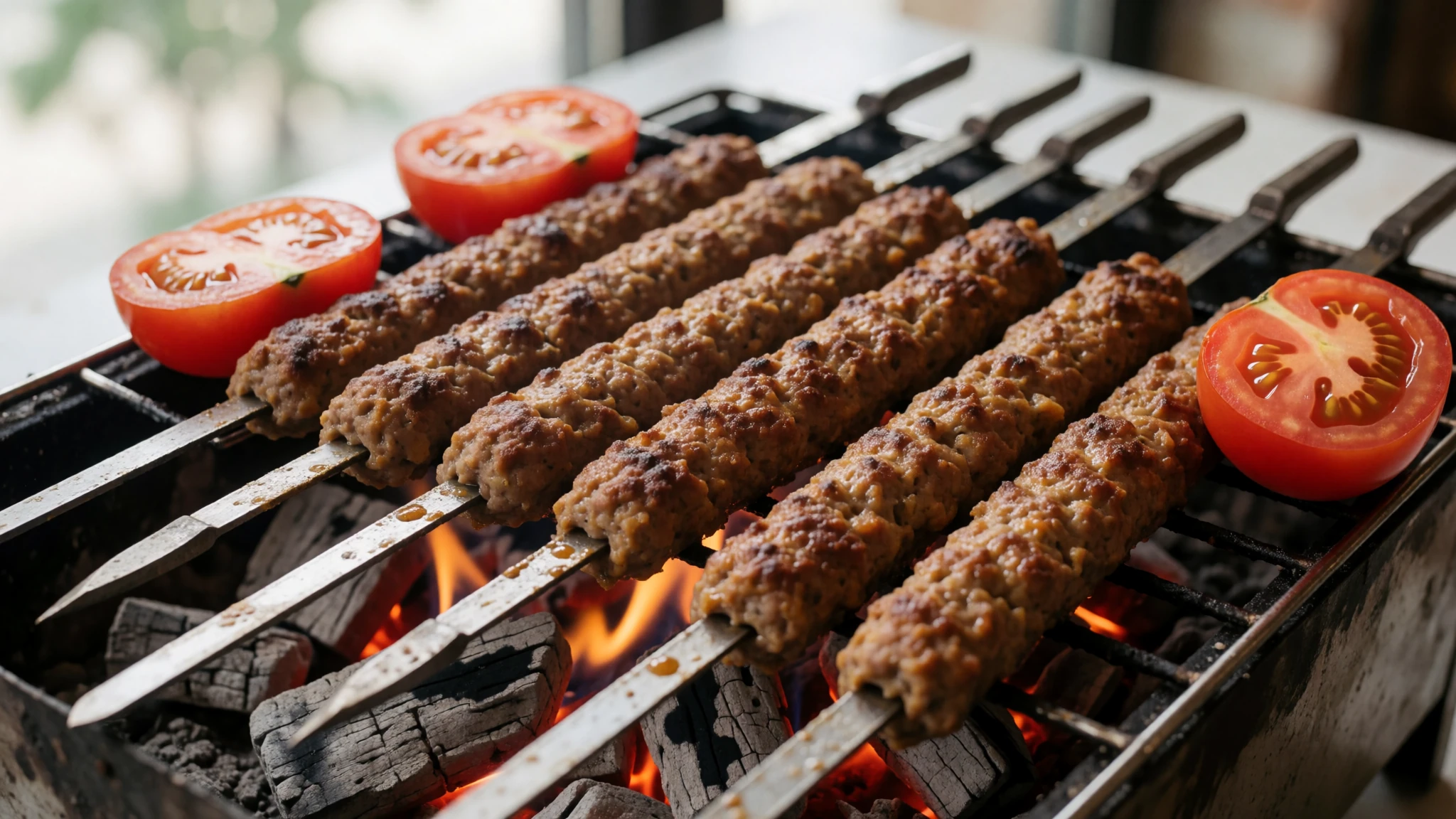
- Faloodeh — cafés and juice counters in Shiraz
Faloodeh is Shiraz's iced dessert, thin starch noodles frozen with rosewater and lime, sometimes dressed with sour-cherry syrup. Cafés and juice counters in Shiraz serve it, a wise pause in hot months after the shadeless walk at Pasargadae. The taste is cold, floral and sharp rather than creamy.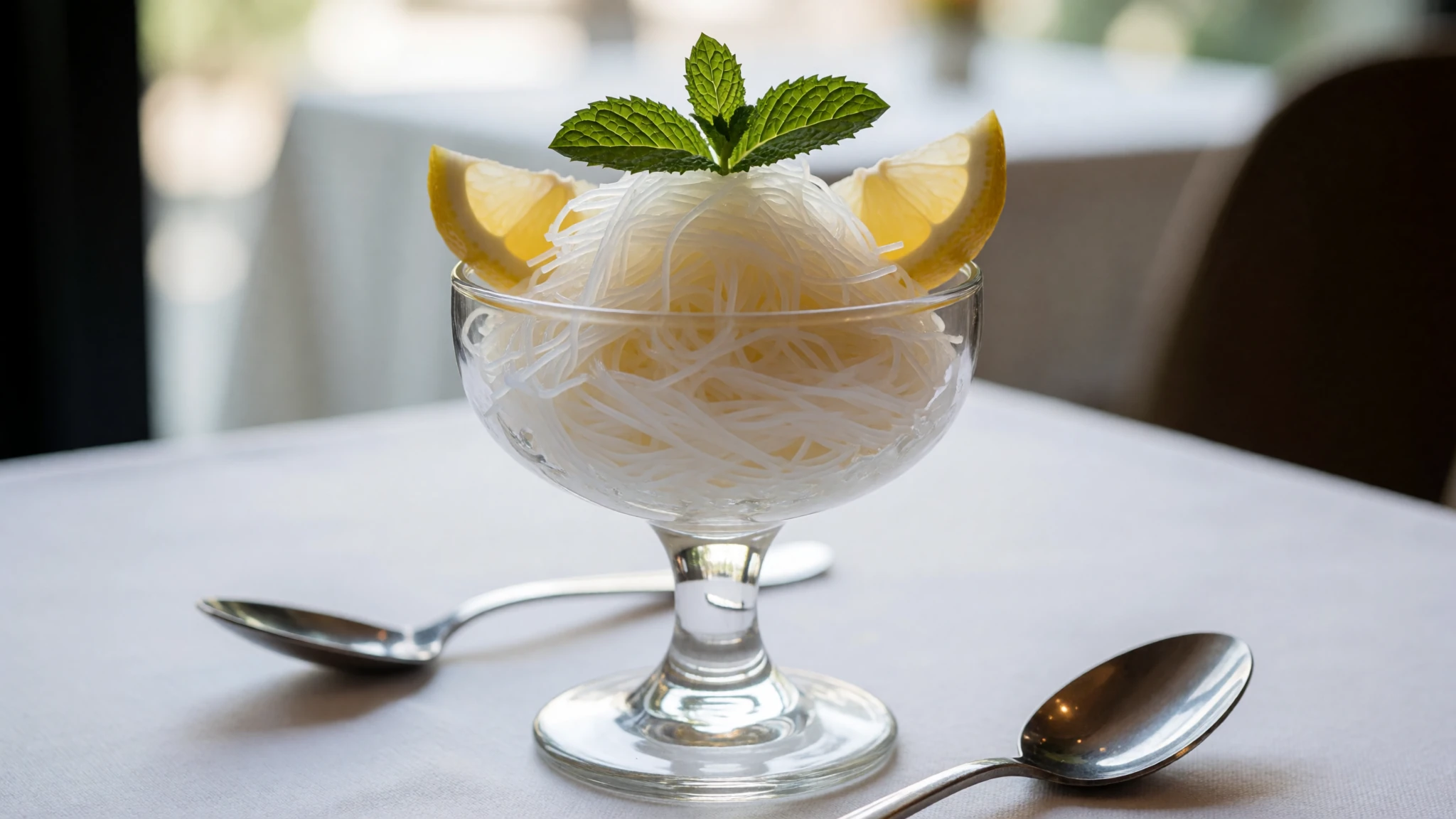
- Ash-e reshteh — home-style eateries in Shiraz
Ash-e reshteh is a thick soup of herbs, beans and noodles, finished with whey and a pile of fried onion. Home-style eateries in Shiraz ladle it out in the cooler months, which suits an evening after Pasargadae better than a picnic on the open plain. - Doogh — shops in Saadatshahr or Shiraz
Doogh is salted yoghurt thinned with water, still or fizzy and often minty, sold in shops across Fars. It belongs with a meal in Saadatshahr or Shiraz after the glare at Pasargadae. Bottled water from near the ticket office is the drink to carry on the site itself.
Plan it
Best time. March to April and October to November are the comfortable months at Pasargadae. The monuments sit on an exposed plain with almost no shade, so midsummer is a harsh walk and winter mornings can be cold. Spring and autumn make the distances between tomb, palaces and hill easier to cover.
How long. 1–2
Getting there. Pasargadae lies about 90 kilometres (56 miles) northeast of Shiraz. Travellers take a bus as far as Saadatshahr, then a shared savari taxi for the last stretch to the ruins. Persepolis, a later Achaemenid capital, lies about 60 kilometres to the south and is often visited on the same journey.
Budget. low
Tips
- Pick up drinking water at the entrance booth; the walk between monuments is dry and shadeless.
- Plan a meal in Saadatshahr or Shiraz — the ruins have no restaurant.
- Begin early; the monuments are scattered and midday sun on the plain is fierce.
- Wear shoes fit for gravel and broken stone, and keep a scarf tied against the wind.
- Carry cash for the savari and for bottled water.
Etiquette
- Do not climb the tomb or other standing masonry.
- Keep voices low beside the tomb; it is treated as a grave as well as a ruin.
- Ask before photographing local people.
- Women should cover their hair and wear loose clothing over arms and legs; men should not wear shorts.
Nearby
Sources
- Wikidata Q230025 (CC0)
- Wikipedia (rev 1381988568) (CC BY-SA 4.0)
- Wikivoyage (rev 5020153) (CC BY-SA 4.0)
- Photo photos/01-pasargadae-marv-dasht-near-shiraz-4-8-2013.jpg (CC BY-SA 4.0)
- Photo photos/02-pasargad-tomb-cyrus3.jpg (CC BY-SA 4.0)
- Photo photos/03-pasargadae-cyrusthegreattomb-22061.jpg (CC BY 3.0)
- Photo photos/04-i-am-cyrus-achaemenid-king-pasargadae.jpg (CC BY 3.0)
- Photo photos/05-passargade-by-eug-ne-flandin.jpg (Public domain)
- Photo photos/06-cambyses-i-april-2013-2.jpg (CC BY 3.0)
- Photo photos/07-pasargadae-3.jpg (CC BY 3.0)
- Photo photos/08-audience-palace-pasargadae-03.jpg (CC BY-SA 1.0)


