Nizhny Novgorod
Nizhny Novgorod, Russia
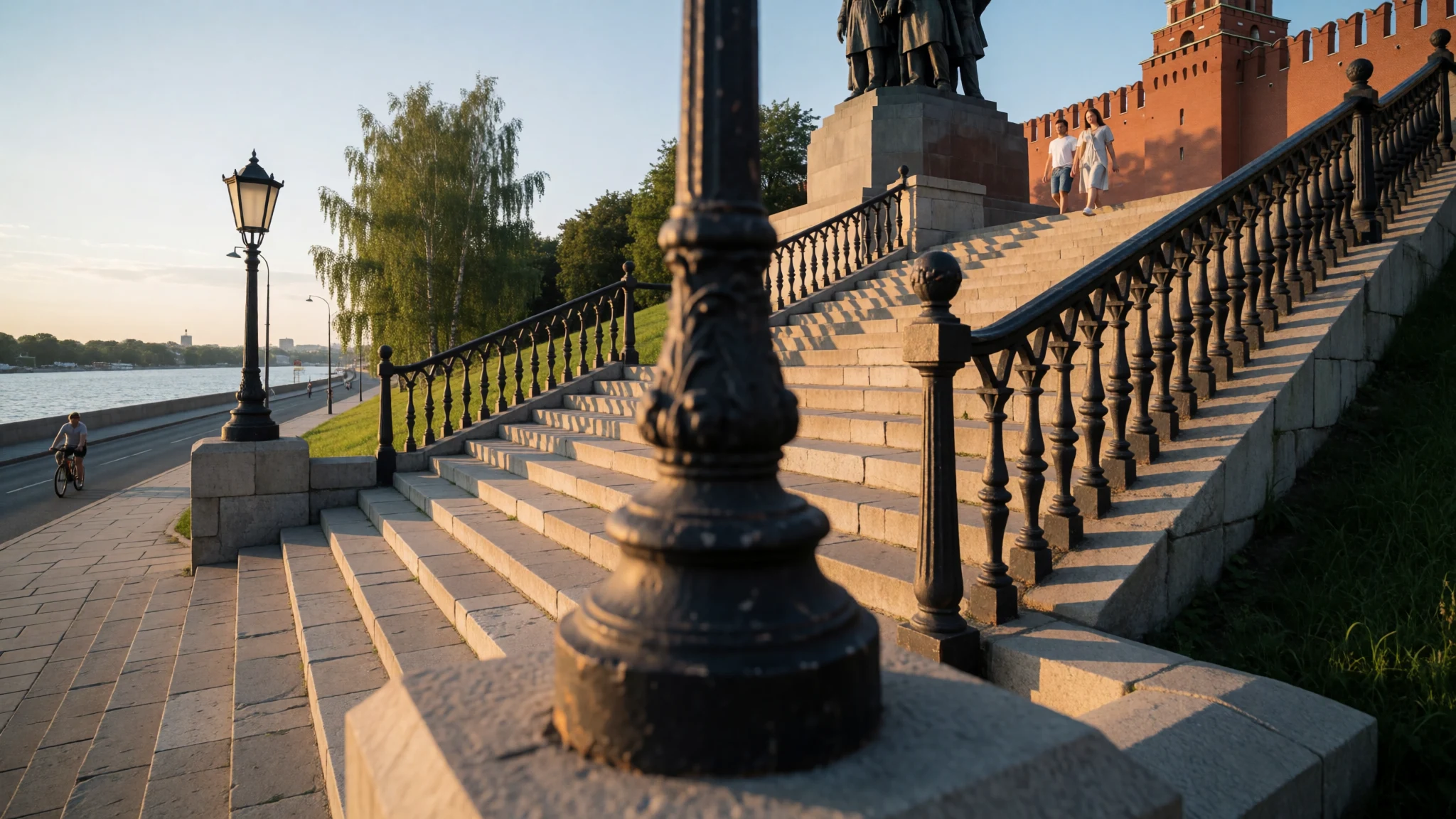
Nizhny Novgorod is a river city on a high bank, where the Oka meets the Volga, with a kremlin, merchant streets and Soviet-era industry.
The place
Nizhny Novgorod stands where the Oka flows into the Volga, in central Russia, on ground about 200 m above sea level. Locals shorten the name to Nizhny. About 1.2 million people live in the city, which is the administrative centre of its oblast and of the wider Volga Federal District. The geography explains most of what a visitor sees. The old kremlin sits on the high right bank, the upper town spreads behind it, and the streets drop away toward the water. At the foot of the slope, the point where the two rivers join is a favourite place for evening walks, with wide views across to the low far bank.
The city has worn several identities. It was a frontier fortress, then a trading town, then a Soviet industrial centre renamed Gorky, a name it dropped after the Soviet Union ended. The car plant built in that period earned the city the nickname "Russian Detroit", and the plant's gatehouse and long frontage still stand on the western side. The trade fair grounds, a legacy of the merchant era, sit near the confluence and are lit up at night.
In practice Nizhny is a walking city with a big-city rhythm. The central pedestrian street, the kremlin and the river promenades are close together, while the car plant and fairground need a metro or taxi ride. Hills make some routes steeper than the map suggests, and pavements can be uneven. Winters are long and cold, and summers are pleasant but can turn hot. Moscow is a train ride away.
Its story
Nizhny Novgorod began in 1221, when Prince Yuri II of Vladimir planted a wooden hillfort at the meeting point of the Volga and the Oka. The site was chosen for its rivers, which acted as a natural moat on two sides and carried the traffic of a growing principality. The little fortress faced raids from neighbouring peoples and was repulsed in one major attack soon after its founding. Later, after Yuri's death in battle, Mongol forces took control. The town survived the invasions that flattened larger centres, partly because it was still too small to matter, and it went on to grow under the Golden Horde and then within the Vladimir-Suzdal lands.
The event that most defines the city's pride came in 1612. A local merchant, Kuzma Minin, and Prince Dmitry Pozharsky raised a volunteer army here to march on Moscow and drive out Polish and Lithuanian forces. Their names are on the main square, and a monument to the pair stands near the kremlin walls.
Trade then took over. As a river port, Nizhny became a gathering place for merchants, and its seasonal fair drew goods and buyers from far beyond the region. In 1896 the fairground hosted an All-Russia Exhibition, a showcase of industry and technology that left a lasting mark on the city's image.
The Soviet period added heavy industry, above all the car plant that gave the city its Detroit nickname. The writer Maxim Gorky was born here, and for decades his name replaced the old one on maps. The older name returned afterwards, and the city now carries all of these layers at once.
What to see
- The Kremlin — Upper town, on the hill above the rivers
The Nizhny Novgorod Kremlin crowns the high bank above the confluence. A walk along its walls and towers gives long views over the Volga, and inside there is a church, a war memorial with an eternal flame and an art museum. Allow a slow couple of hours, and expect wind on the ramparts.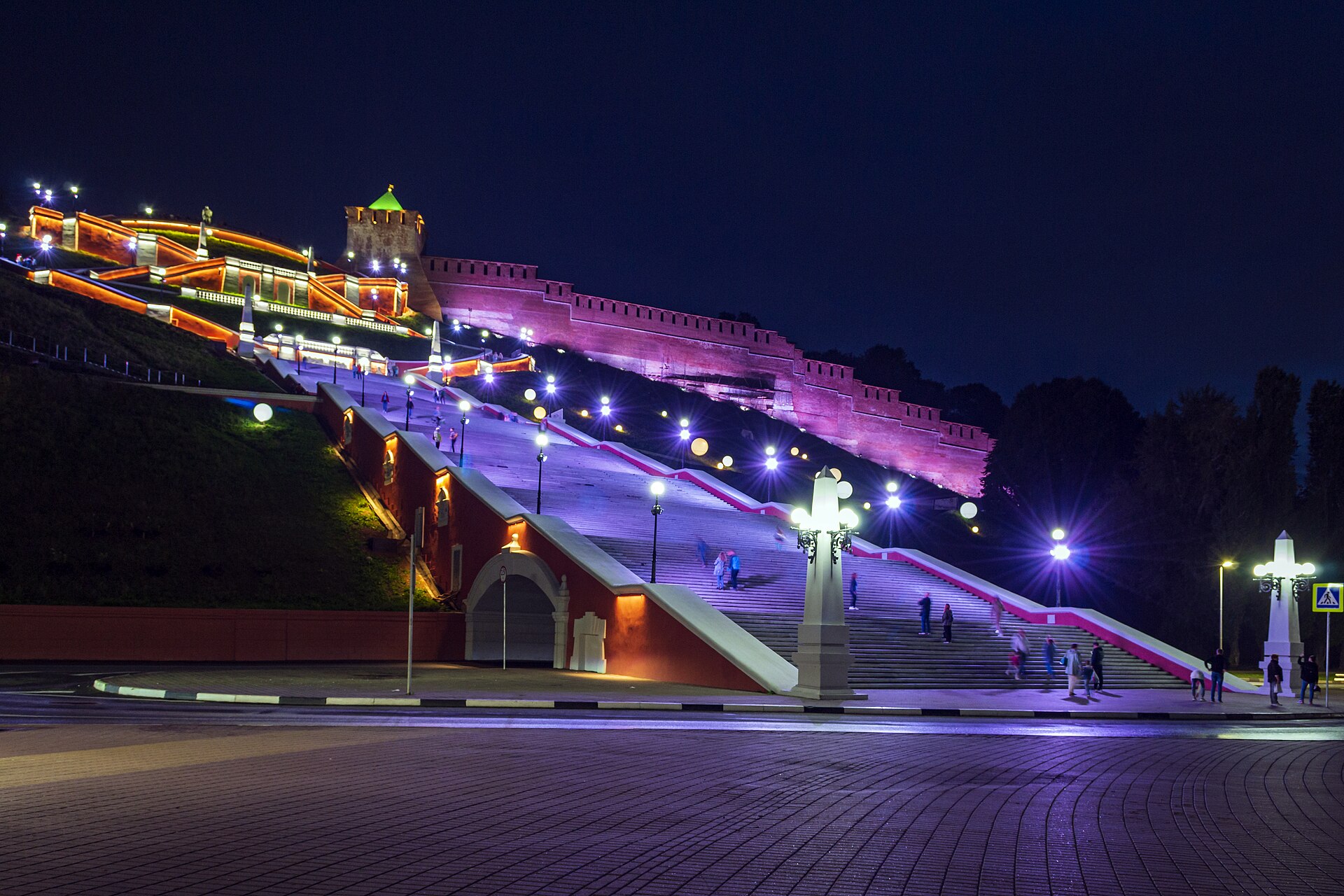
- Minin and Pozharsky Square and the Chkalov Staircase — Beside the south-east wall of the Kremlin
This is the city's main square, on the south-east side of the kremlin, named for the two leaders of the 1612 volunteer army. From the Chkalov monument a broad stairway descends toward the Volga waterfront. Climbing it back up is tiring, so many people go down and take a taxi or bus.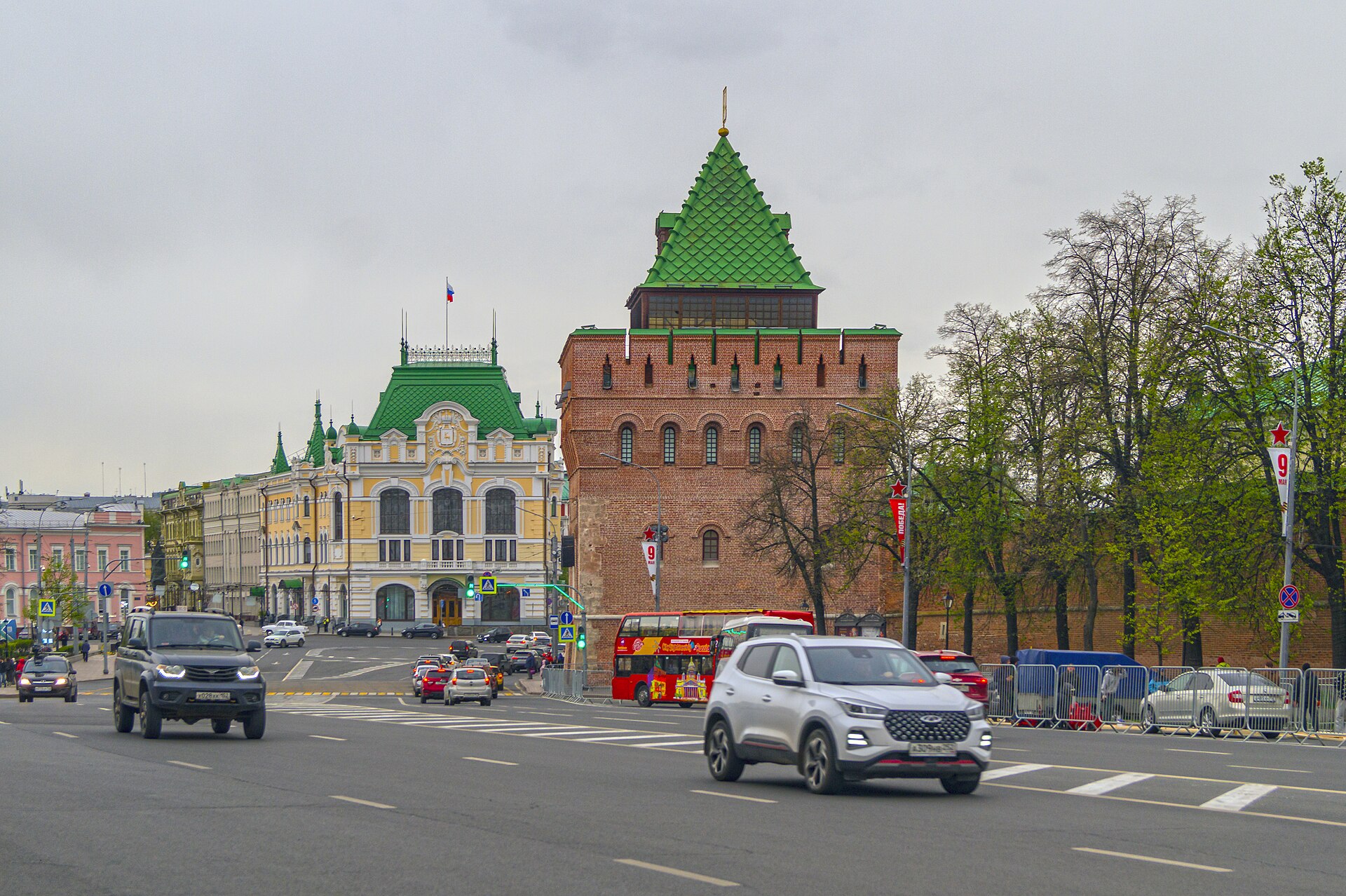
- Bolshaya Pokrovskaya Street — Central pedestrian street, south-west of the Kremlin
The main pedestrian street runs through the old centre with souvenir stalls, street performers, shops, cafés and several small museums, including one of traditional Russian art. It is busy on summer evenings and weekends. Mornings are calmer for looking at the building frontages. - Rozhdestvenskaya Street — Lower town, along the Oka
Rozhdestvenskaya runs parallel to the Oka, tucked below the hill. It keeps a good run of nineteenth-century buildings in fair condition, among them merchant houses and churches. Because it sits away from the main tourist flow, it suits a quiet wander, though pavements vary in quality. - Ilyinskaya Street — Old merchant quarter, west of the centre
Ilyinskaya preserves merchant buildings from the nineteenth century and a few older ones. Some are restored and some are plainly tired, which gives a truthful picture of the old town. The small side streets between it and its neighbours reward aimless walking more than a fixed route. - Upper Volga Embankment — Cliff-top promenade above the Volga
The Upper Volga Embankment follows the cliff top above the river from Minin Square toward Sennaya Square. It is a long, mostly level promenade with benches and wide views of the Volga and the far bank. Late afternoon light is good, and the wind can bite outside summer.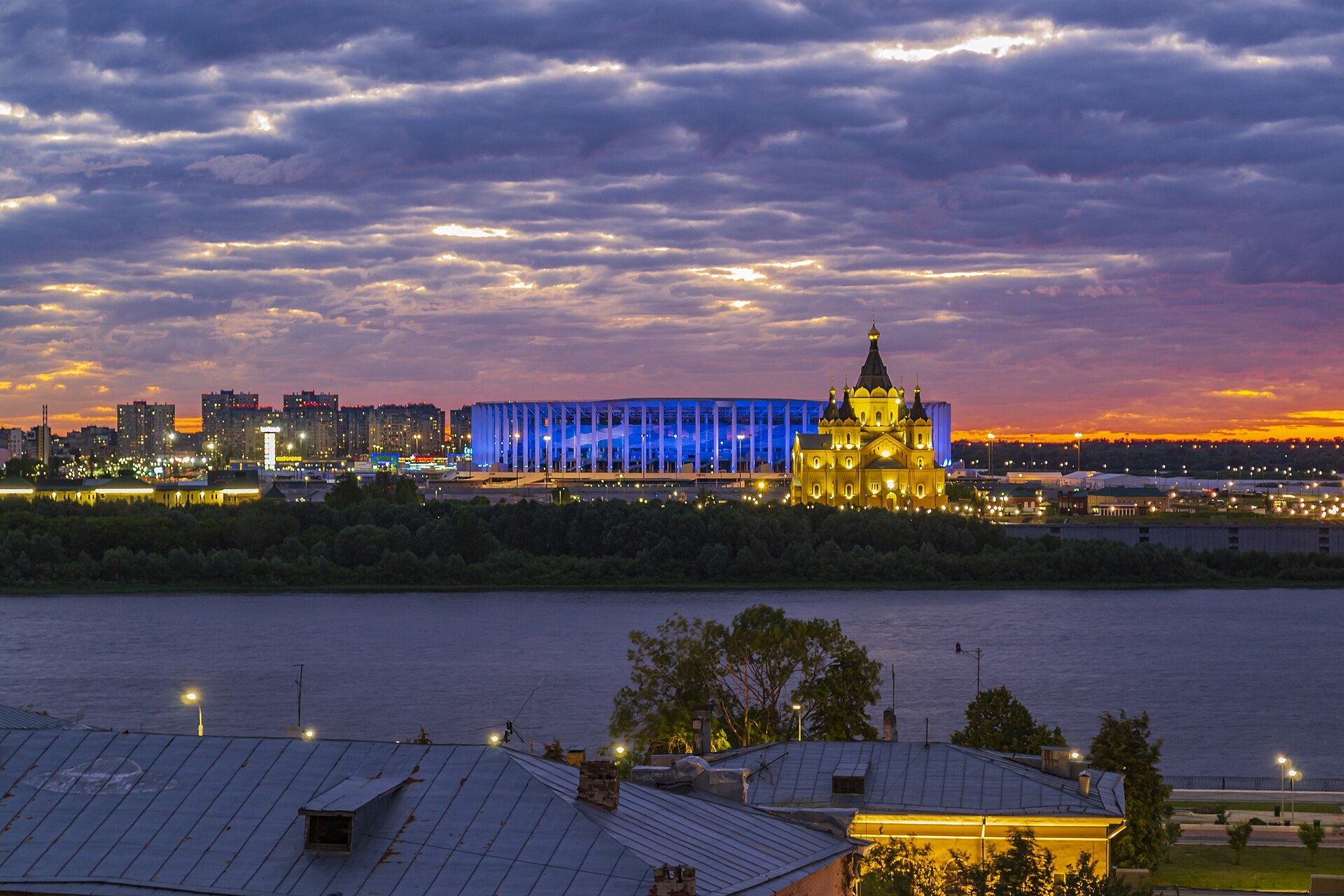
Culture
Nizhny Novgorod wears its history openly, and conversations here often come back to the rivers, the 1612 volunteer army and the Soviet years. Locals take pride in the city's role as a trading hub and in its industrial past, while also joking about their reputation as a practical, no-fuss place compared with Moscow or St Petersburg. Many streets carry the names of merchants, writers and wartime figures, and public monuments are treated seriously.
Crafts from the wider region show up in souvenir shops: painted wooden tableware in red, gold and black, and decorated wooden items from small workshops in the oblast. They are worth asking about, since sellers usually know where a piece was made.
The pace of life is brisk but courteous. Cafés and pie shops serve tea with sweet pastries, and families walk the embankments on warm evenings. Public memory of the Second World War is strong, with eternal flames and memorials around the kremlin and elsewhere. Younger residents mix this with a lively café, music and student scene, helped by the city's many universities.
Russian is the working language, and a few words of greeting and thanks go a long way, since English is not widely spoken outside hotels and some restaurants. Cards are common, but small kiosks may prefer cash. Be aware that the political situation can change quickly, so check your own government's travel advice before booking.
At war memorials and eternal flames, keep your voice low, do not sit on the monuments, and take off your hat as a mark of respect.
What to wear
Nizhny Novgorod's traditional dress follows the wider Russian pattern. Women's festival costume centred on the sarafan, a sleeveless long dress worn over a linen blouse, often finished with an embroidered apron and a decorated headdress such as the kokoshnik. Men wore a belted linen or cotton shirt, called a kosovorotka, with loose trousers and boots. Fabrics were mainly linen, wool and cotton, with embroidery and woven patterns marking regions and occasions. Today these outfits appear mostly at folk festivals, on stage and in museums, though regional crafts such as painted wooden ware keep the old colour schemes in everyday sight.
Everyday clothing is practical and urban. Residents dress for the weather first: padded coats, fur or knitted hats and warm boots in winter, and light layers in summer. In the city centre people tend toward smart-casual, with neat jeans, trainers or boots, and good coats. Evenings out are a little dressier than in many British or Indian cities, but rarely formal.
Visitors should plan around the season. In winter, bring a proper insulated coat, a hat, gloves, thermal layers and boots with real grip, because pavements ice over and slopes get slippery. In summer, bring light cotton or linen, a sunhat and a thin jacket for evenings by the river. Comfortable walking shoes matter all year, since the hills and cobbled lanes are hard on thin soles. For churches, cover shoulders and knees, and women may be asked to cover their hair with a scarf.
What to eat
- Shawarma (shaurma) — Takeaway counters and street stalls across the centre
Shawarma is the city's best-known fast food, and locals argue over their favourite stall. Sliced meat, salad and sauce come rolled in flatbread, ready to eat on the move. Look for busy takeaway counters in the central streets, particularly after dark, and expect a queue. - Pirogi — Pie cafés and basement tea rooms near the old centre
Pirogi are baked pies filled with cabbage, potato, meat, egg or sweet fruit. They are cheap, filling and ideal with tea. Many small cafés serve them from counters or tucked-away cellar rooms, and a mixed plate is a good way to sample several fillings. - Pelmeni — Restaurants serving traditional Russian food
Pelmeni are small dumplings of minced meat, boiled and served with butter, sour cream or vinegar. They are a staple of home cooking and a warming choice in cold months. Most restaurants serving Russian dishes offer them, sometimes with mushrooms or fish as alternatives. - Ukha (river fish soup) — Russian restaurants near the embankments
With two major rivers on the doorstep, fish soup suits the city. Ukha is a clear, lightly seasoned broth with river fish, potato and herbs. It is a gentle, savoury dish, best on a chilly day, and is often found on menus of Russian restaurants near the embankments. - Blini with tea — Cafés on and around the main pedestrian street
Blini are thin pancakes rolled or folded around sour cream, jam, honey, cheese or savoury fillings. They make a light breakfast or afternoon snack, and are typically served with strong black tea from a pot. Cafés on the main pedestrian street usually keep them on the menu.
Plan it
Best time. June to September for long days, river walks and open-air cafés; July and August can be hot. Winter is long, cold and snowy, so go then only if you are prepared for ice and short daylight.
How long. 2–3
Getting there. Nizhny Novgorod has its own airport, so check airlines and the city's official site for current links. By rail, the main station is in the northern part of the centre near the Metromost bridge and is on the metro line. From Moscow, fast Sapsan trains take a few hours, and slower overnight trains cost less. Trans-Siberian services from Moscow also stop here. Search RZD timetables under the spelling "Nizhniy Novgorod".
Budget. mid
Tips
- Book train tickets in advance, since they are generally cheaper that way
- Wear shoes with good grip, because the hills and steps are steep and icy in winter
- Carry a card and a little cash for kiosks and small cafés
- Visit the embankments in the late afternoon for the best light over the rivers
- Check the city's official site, https://admgor.nnov.ru/, and your government's travel advice before you go
Etiquette
- Stay quiet and respectful at war memorials and eternal flames
- Cover shoulders and knees inside churches, and take off hats
- Ask before photographing people, especially at memorials and in churches
Nearby
Sources
- Wikidata Q891 (CC0)
- Wikipedia: Nizhny Novgorod (rev 1382870515) (CC BY-SA 4.0)
- Wikivoyage: Nizhny Novgorod (rev 5412653) (CC BY-SA 4.0)
- Photo: Minin and Pozharsky Square, AlexTref871 (CC BY-SA 4.0)
- Photo: The Spit of Nizhny Novgorod at sunset, Алексей Трефилов (CC BY-SA 4.0)
- Photo: Unity Square and the Minin and Pozharsky monument, Алексей Трефилов (CC BY-SA 4.0)
- Photo: Gorky Automobile Plant main entrance, Алексей Трефилов (CC BY-SA 4.0)
- Photo: Chkalov Staircase and St George Tower at night, Алексей Трефилов (CC BY-SA 4.0)
- Photo: Nizhny Novgorod trade fair at night, Алексей Трефилов (CC BY-SA 4.0)
- Painting: Appeal of Minin, Konstantin Makovsky (Public domain)
- Photo: Residents of Gorky hear the German surrender announcement, unknown author (Public domain)


