Messina
Messina, Italy
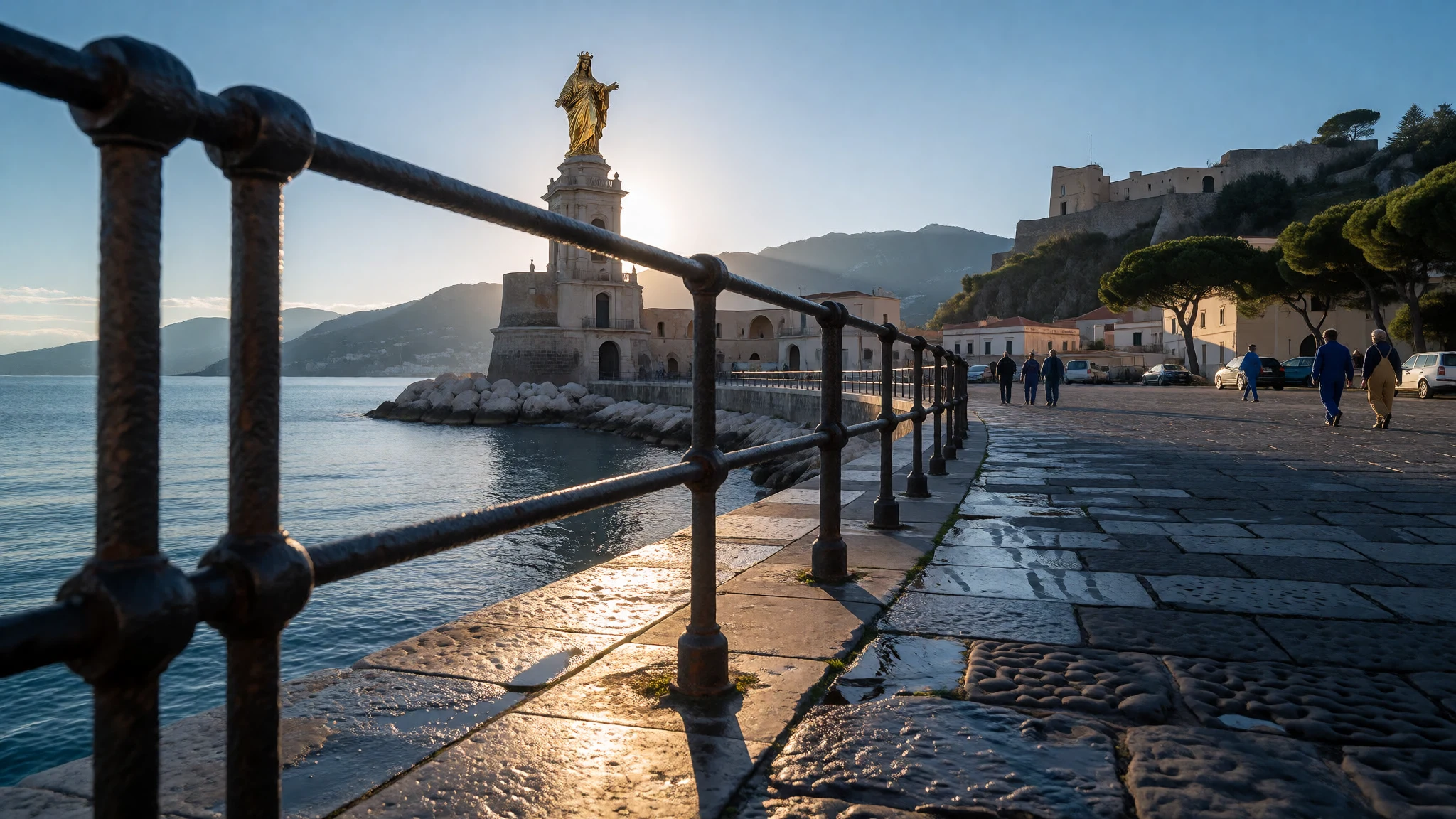
Messina is a working Sicilian port that was rebuilt after a catastrophic earthquake, with a golden Madonna, a Renaissance fountain and very good swordfish.
The place
Messina sits at the north-eastern tip of Sicily, on the Strait of Messina, with the Calabrian coast of mainland Italy close enough to read as a second shoreline. It is a working port first and a visitor stop second, and that shapes the whole city. Ferries run through day and night, goods trains are loaded onto boats, and lorries queue for the crossing. Many travellers use it only as a gateway to Taormina, Etna or the Aeolian Islands, and some never leave the quay. The city does little to change their minds. With about 219,000 residents it is a proper working city, with traffic, a university and the usual Sicilian paperwork, not a museum piece. The centre lies only about 3 metres above sea level and was largely rebuilt after the earthquake of 1908, which is why the streets are broad and regular and why older buildings are scattered rather than clustered. The sickle-shaped harbour curves around the waterfront, and a gilded Madonna on a tall tower watches the entrance. Walking between the main sights is easy, the weather is kind outside high summer, and prices and pace feel gentler than in the island's better-known resorts. Expect plain streets, good seafood and a handful of sights that repay an unhurried half-day, rather than a city built for postcards.
Its story
Messina began as a Greek colony around the eighth century BC, and its first name, Zancle, came from a Greek word for a sickle, a reference to the curved natural harbour. A legend offers a rival origin in a king called Zanclus. In the early fifth century BC a ruler from Rhegium, across the strait, renamed it Messene after a city in Greece, and the Latinised form Messana lasted through Roman times. The modern name, Messina, arrived in the Byzantine period. The early centuries were violent. Carthaginians sacked the city, Dionysius of Syracuse took it back, and in 288 BC a band of mercenaries called the Mamertines seized it by treachery, killing the men and taking the women as wives. They used it as a base for raiding the countryside, which drew in Syracuse and Carthage and, eventually, Rome. The city shrank under Byzantine and Arab rule, then rose sharply under the Normans. Between the late Middle Ages and the middle of the seventeenth century it was prosperous enough to rival Palermo as capital of the Kingdom of Sicily. A revolt against Spanish rule in 1678 ended badly, with the local ruling class wiped out. An earthquake in 1783 did serious damage, and another in 1908 destroyed almost the whole city and killed about half its people. Almost everything a visitor sees was built, or rebuilt, after that.
What to see
- Madonna della Lettera — Harbour entrance, Forte San Salvatore
A tall gilded statue of the Madonna stands on the tower of Forte San Salvatore at the tip of the harbour's sickle, and is the first thing ferry passengers notice. She is venerated as Messina's patron saint. Walk out along the quay for the clearest view, ideally in morning light, when the gold catches the sun.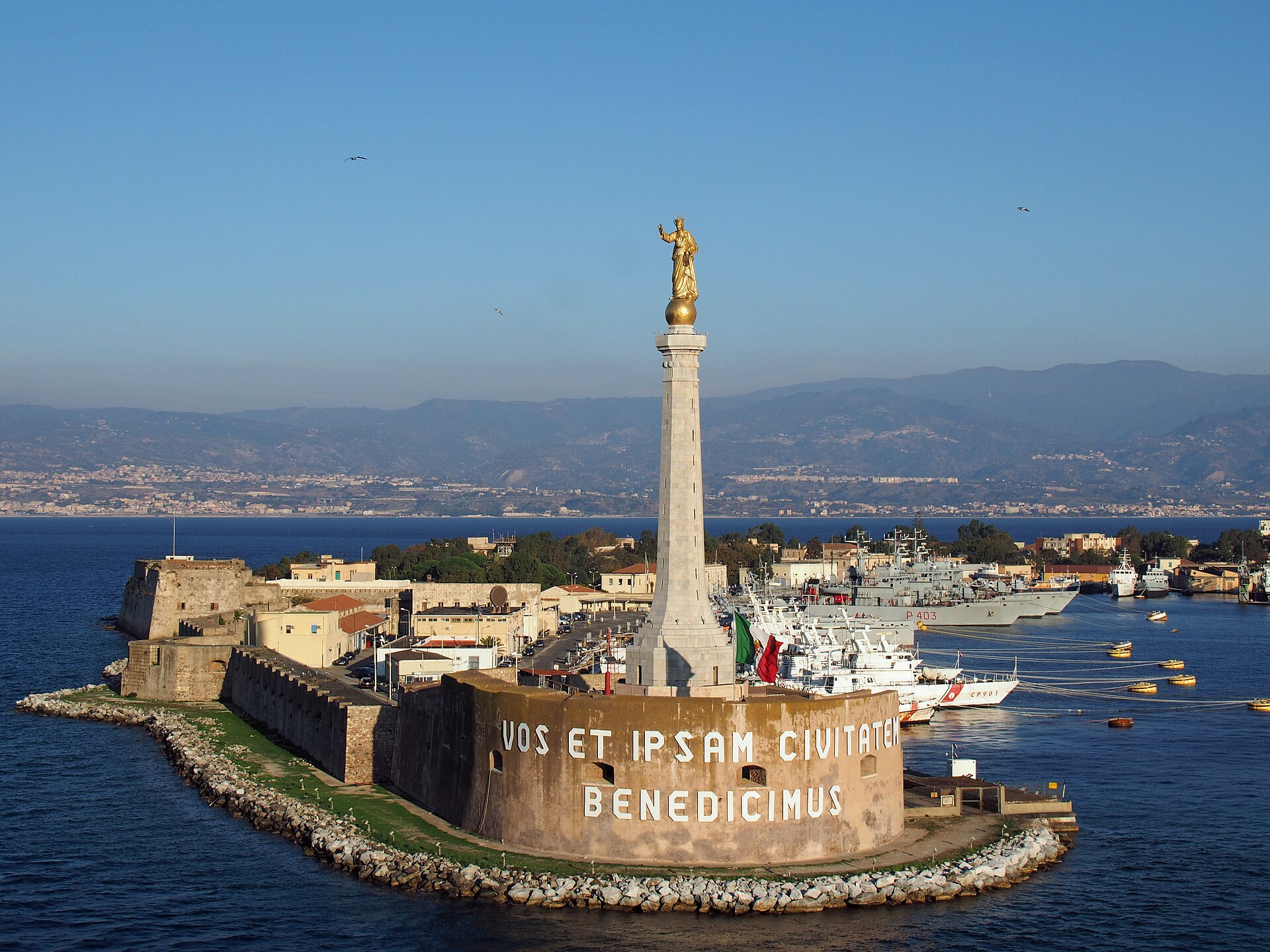
- Duomo di Messina — Piazza Duomo, old centre
The cathedral is Gothic in origin, dating to the 12th century, and stands in the old centre. The 1908 earthquake damaged it badly and it was restored afterwards, so the building is part medieval design and part careful reconstruction. Step inside for the quiet, then look closely at the carved front outside.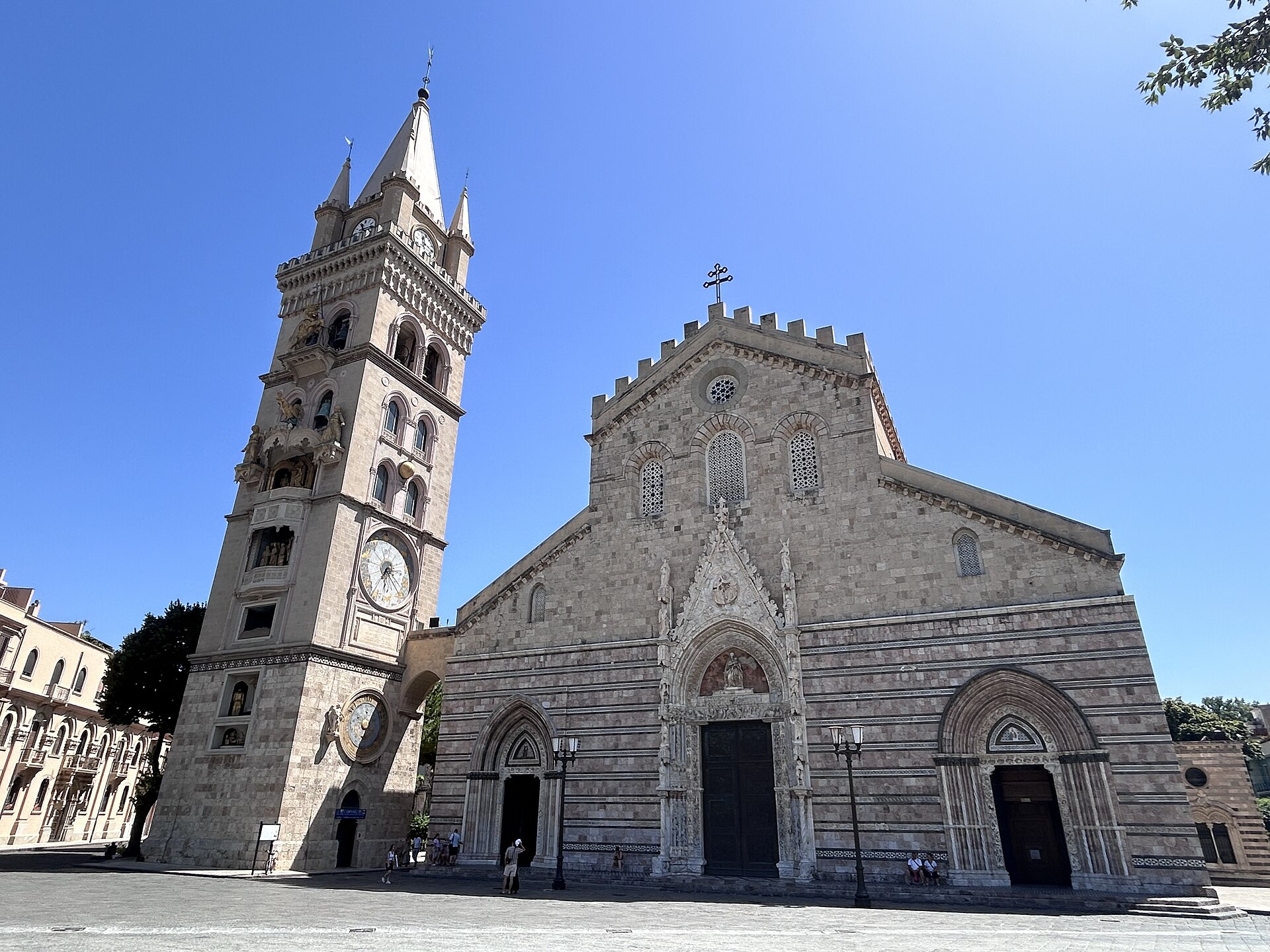
- Bell tower and astronomical clock — Piazza Duomo, beside the cathedral
Beside the cathedral, the campanile carries a large astronomical clock made by the Ungerer company of Strasbourg. Its mechanical figures perform at midday, so arrive a few minutes early. Expect a crowd of locals, school groups and passing cruise visitors on the square, all squinting upwards and holding up phones. - Fontana di Orione — Piazza Duomo
Montorsoli, a pupil of Michelangelo, made this fountain in 1547. It shows Orion, with his dog Sirius, as one of the legendary founders of Messina, surrounded by carved water figures. It stands in the cathedral square, so it pairs easily with the Duomo, and looks best when the water is running and the light is low.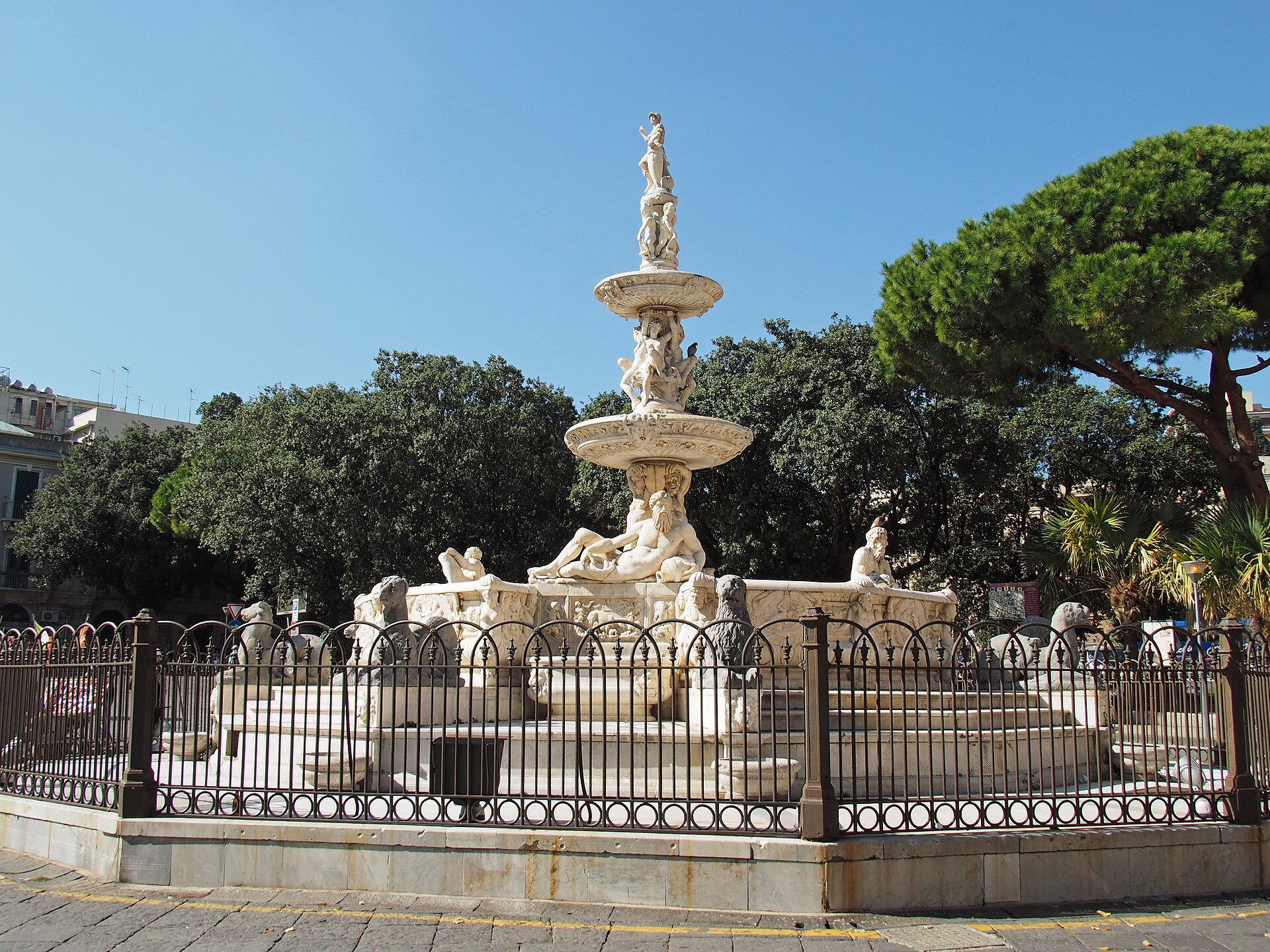
- Palazzo Zanca and Palazzo Calapaj-d'Alcontres — Waterfront and old centre
Palazzo Zanca, the town hall, is a Neoclassical building from 1924, designed under Antonio Zanca and facing the harbour. Nearby, Palazzo Calapaj-d'Alcontres is a modest 18th-century survivor of the 1908 quake. Together they show the rebuilt city beside one of the few older buildings left.
Culture
Messina carries its history lightly but visibly. The city is the setting for two Shakespeare plays, Much Ado About Nothing and The Winter's Tale, and the city council once voted to make the playwright an honorary citizen, a gesture locals mention with some pride. Religious life centres on the Madonna della Lettera, the patron saint whose gilded statue guards the harbour, and on the cathedral, rebuilt with great effort after the 1908 earthquake. That disaster still sits in the city's memory; the loss of half the population shaped families, local pride and a stubborn practicality. Daily rhythm is Sicilian: a slow morning, a long lunch, shops shutting in the afternoon, and a lively evening stroll along the main streets and waterfront. Coffee is taken quickly at the bar counter, while meals are for lingering. Conversation is warm, direct and often loud, and strangers are usually helpful if asked politely, even without a shared language. Football, church festivals and family gatherings fill weekends. Messina also sits on a busy crossing, so ferry workers, students and commuters give it a different mood from the resort towns nearby: practical rather than performative. Visitors who show curiosity about local history and food tend to be welcomed. Cover your shoulders and knees when entering the Duomo or any church, and keep your voice low during services.
What to wear
Traditional Sicilian dress around Messina is now mostly seen at festivals and in folklore groups. Men's rural clothing centred on the coppola, a flat cap of wool or tweed, with dark waistcoats and trousers of heavy cloth; women wore full skirts, bodices, shawls and aprons in wool, cotton and linen, often with embroidery or lace trim. Black was common for mourning and everyday wear among older generations. These costumes now appear at religious processions and village feasts rather than day to day. Today people in Messina dress neatly and casually, in the Italian way: fitted trousers or jeans, shirts, light jackets, leather shoes or clean trainers, and few shorts in town away from the beach. Locals dress up for church, dinner and the evening stroll. Visitors should pack light cotton or linen for the warm months, a hat and sunglasses, and a thin layer for the wind on ferries and the waterfront. Shoulders and knees need covering for the Duomo and other churches, so carry a scarf or light shirt. Pavements are mostly good but uneven in places and wet stone can be slippery, so choose comfortable shoes with grip. In winter, bring a waterproof jacket; it is mild but can be wet and windy.
What to eat
- Pesce spada (swordfish) — Family trattorie near the harbour and fish counters in the central market area
Swordfish is the classic fish of the strait, served as thick grilled steaks or as rolls baked with breadcrumbs, lemon and herbs. Order it simply and let the freshness carry the plate. Seasons matter, so ask what came in that morning. - Stocco alla messinese — Traditional trattorie in the older streets back from the waterfront
Stockfish, dried cod, is soaked and stewed with tomatoes, olives, capers and potatoes into a robust, salty dish. It is old working-port food, made to last. Expect a strong flavour and plenty of sauce, best mopped up with bread. - Braciole — Neighbourhood trattorie and butchers' grills
Braciole in Messina are made with a cut of meat unlike the rest of Italy, filled, rolled and then grilled or cooked slowly. They make a filling main course after a fish starter. Ask locals which version their family cooks. - Pignolata glassata — Pasticcerie (pastry shops) in the city centre
Small pieces of fried dough are piled into a mound and coated in a glaze, traditionally lemon on one half and chocolate on the other. It is sticky, sweet and usually bought by weight. Eat it fresh, ideally with a coffee. - Cannoli and cassata siciliana — Pasticcerie and bar counters, mid-morning or after lunch
Crisp cannoli shells are filled with sweet ricotta, with a chocolate version also common. Cassata siciliana is the sponge, ricotta and marzipan cake. Both are heavy, so share one over coffee rather than ordering a full portion each.
Plan it
Best time. April–June and September–October, when the weather is warm but not oppressive and the sea is pleasant. July and August are hot and busy with Italian holidaymakers, and winter can be wet and windy, though it is mild.
How long. 1–2
Getting there. The nearest airports are Reggio di Calabria across the strait, Catania Fontanarossa about 80 km south and Palermo about 150 km west. From the mainland, the usual last leg is the ferry from Villa San Giovanni, about 20 minutes and frequent, and intercity trains from Rome and Naples are carried over on it too. Some ferries land at a northern terminal about 4 km from the centre, so check before boarding.
Budget. mid
Tips
- Check which terminal your ferry uses, as the northern one needs a tram or local bus into the centre
- Time the cathedral square for midday to catch the astronomical clock
- Carry some cash for bars and pastry shops, though many places take cards
- Use Messina as a base for day trips to Taormina or Milazzo by regional train or bus
- Check the official city website, https://www.comune.messina.it/, for events and opening times
Etiquette
- Cover shoulders and knees in churches
- Greet staff with a buongiorno or buonasera when you enter shops and bars
- Wait to be shown a table in a trattoria rather than choosing your own
Nearby
Sources
- Wikidata Q13666 (CC0)
- Wikipedia, Messina (rev 1381923923) (CC BY-SA 4.0)
- Wikivoyage, Messina (rev 5411059) (CC BY-SA 4.0)
- Photo: Falce del porto di Messina, San Raineri (Stefano Barillà) (CC BY-SA 2.0)
- Photo: Messina im Herbst 2003 (Alexander Hoernigk) (CC BY 3.0)
- Photo: Basilica Cattedrale di Santa Maria Assunta (SonoGrazy) (CC BY-SA 4.0)
- Photo: Hafeneinfahrt in Messina with Madonna della Lettera (Hajotthu) (CC BY 3.0)
- Photo: Fontana di Orione Messina (Hajotthu) (CC BY 3.0)
- Photo: Roman coin, Messana mint (CNG) (CC BY-SA 2.5)
- Photo: Map of Messina (Public domain)
- Photo: Ingresso di Giuseppe Garibaldi in Messina, lithograph (Public domain)


