Mérida
Mérida, Spain
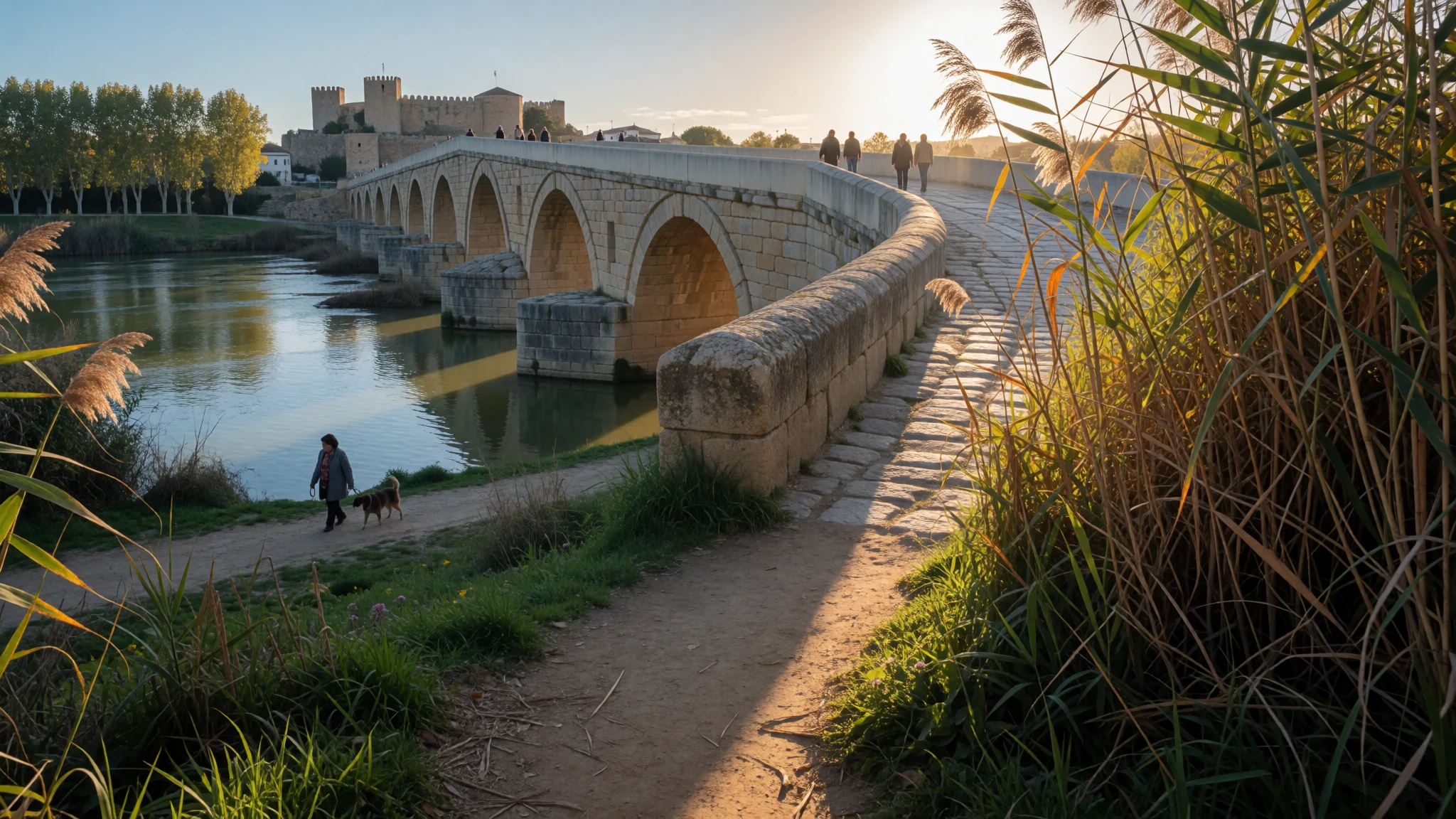
Mérida keeps a Roman provincial capital almost in working order, with theatre, bridge, aqueducts and arch scattered through an ordinary Spanish town.
The place
Mérida sits on the Guadiana river in Extremadura, the quiet western region of Spain that runs towards the Portuguese border. The modern town is low, pale and unhurried, with plane-lined avenues and a street grid that wraps around the older remains rather than clearing them away. That is the point of the place: a theatre, a temple, an arch and a bridge stand among shops, cafés and apartment blocks, and locals cross some of them on the way to work. The Roman name was Emerita Augusta, and the town was laid out as a colony for retired legionaries. The site was practical, at a river crossing where roads met, with routes running towards Lisbon, Seville, Córdoba and Toledo. Today the scattered monuments are treated as one archaeological ensemble and carry World Heritage status. Distances are short, and most of the main sites can be reached on foot across flat ground. Some are free to see from the street, while several others, including the Casa del Mitreo with its floor mosaics, need a ticket, and a combined ticket exists for the paid sites. The climate shapes any visit. Winters are mild, with temperatures rarely dropping below freezing, while summers are hot, with afternoons occasionally above 40 °C. The ruins offer little shade, so season and time of day matter more here than in most Spanish cities. Evenings are lively: terraces fill late, and in summer the Roman theatre stages classical drama under open sky.
Its story
Mérida began in 25 BCE, when the emperor Augustus founded Emerita Augusta as a home for veterans of his Cantabrian campaigns; the name itself points to retired soldiers. The colony soon became capital of Lusitania, a province covering much of what is now Portugal and western Spain, and it was equipped with public buildings, water supply and places of entertainment. By the fourth century it had risen to be the administrative centre of the whole Diocese of Hispania. Roman rule gave way to the Visigoths, and in the sixth century Mérida still counted among the important cities of their kingdom. In 713 it fell to the Umayyad Caliphate. Through the ninth century the local Christian population rose against the governors more than once, and the town gradually lost weight. Alfonso IX of León took it in 1230. After that Mérida was a modest provincial town, and that modesty helps explain why so much survives: there was little money or need to flatten the old city, so later builders simply reused its stone. The Alcazaba was raised partly from Roman wall material, and parts of the temple were folded into later structures. Excavation and restoration came much later and still turn up houses, cemeteries and floors. What visitors walk through is therefore a layered town rather than a tidy Roman set, with each period leaving its own marks on the same ground.
What to see
- Roman Theatre — Eastern edge of the old centre
The Roman Theatre at Mérida holds a semicircle of stone seating facing a stage wall of tall columns, partly rebuilt in modern times. It still hosts classical drama in summer, so an evening performance is the best way to feel its scale. By day, arrive early, because crowds and heat build quickly and the upper tiers have almost no shade.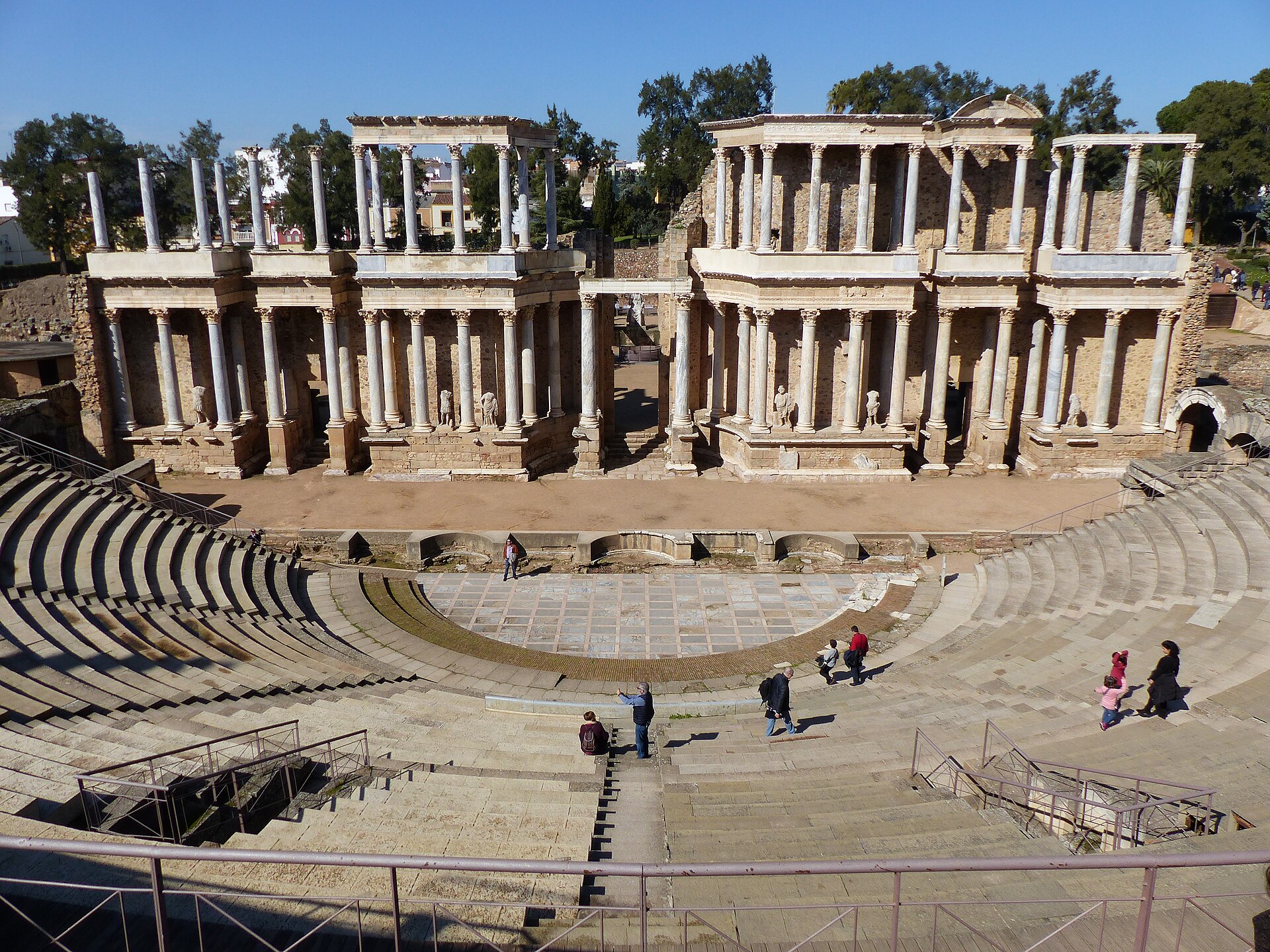
- Roman Amphitheatre — Next to the Roman Theatre
The Roman Amphitheatre stands beside the theatre and was built for gladiator combats and animal shows. Much of the seating has worn down to its foundations, but the oval arena, the entrance passages and the central pit are easy to read. Seeing it together with the theatre shows how the Romans paired drama with spectacle.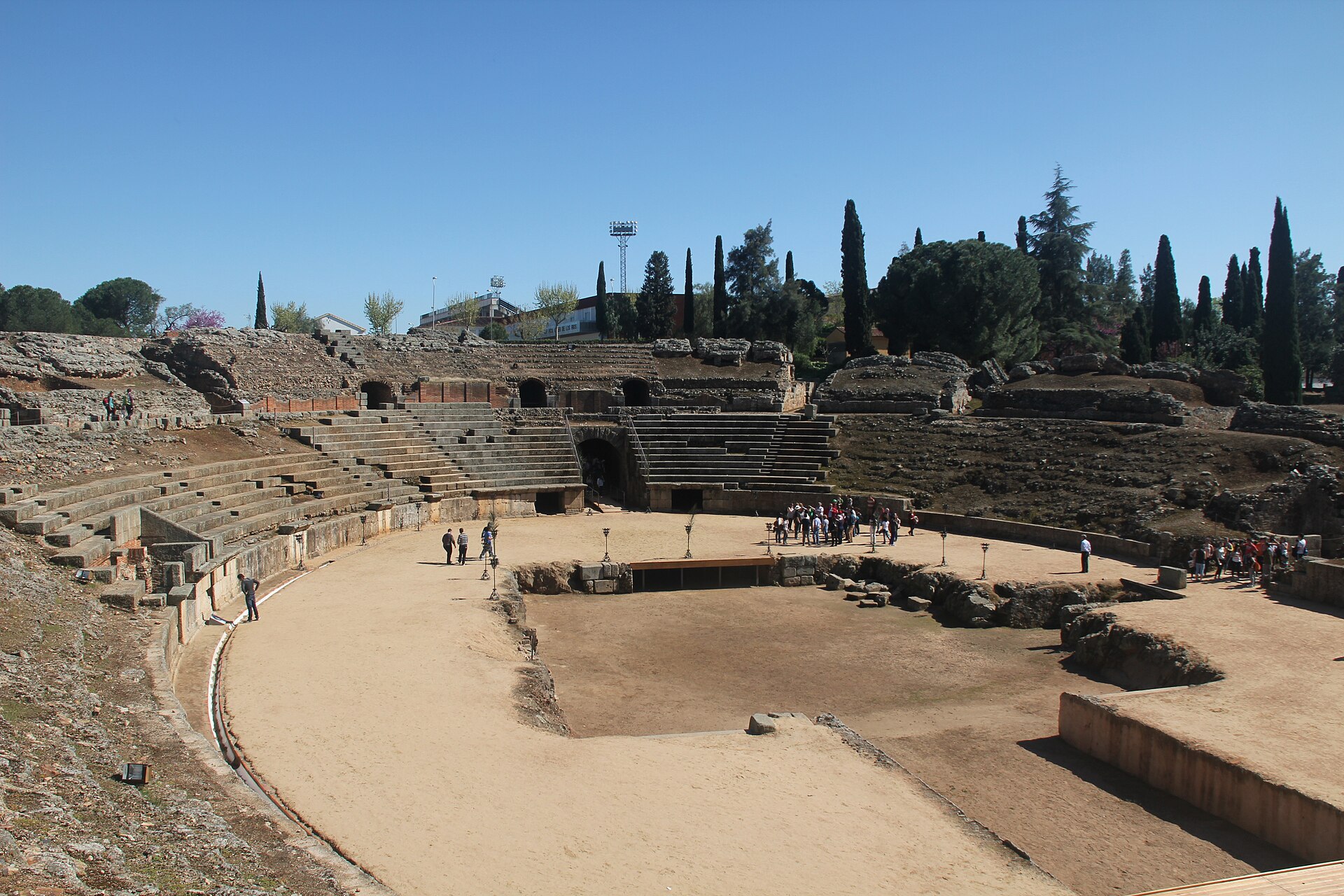
- Templo de Diana — Old centre
The Templo de Diana is a Roman temple whose tall granite columns rise from the middle of the old town, hemmed in by ordinary houses. It dates from the city's founding, and later builders reused parts of it in Moorish times and afterwards. It is easy to pass at any hour and looks best in low evening light.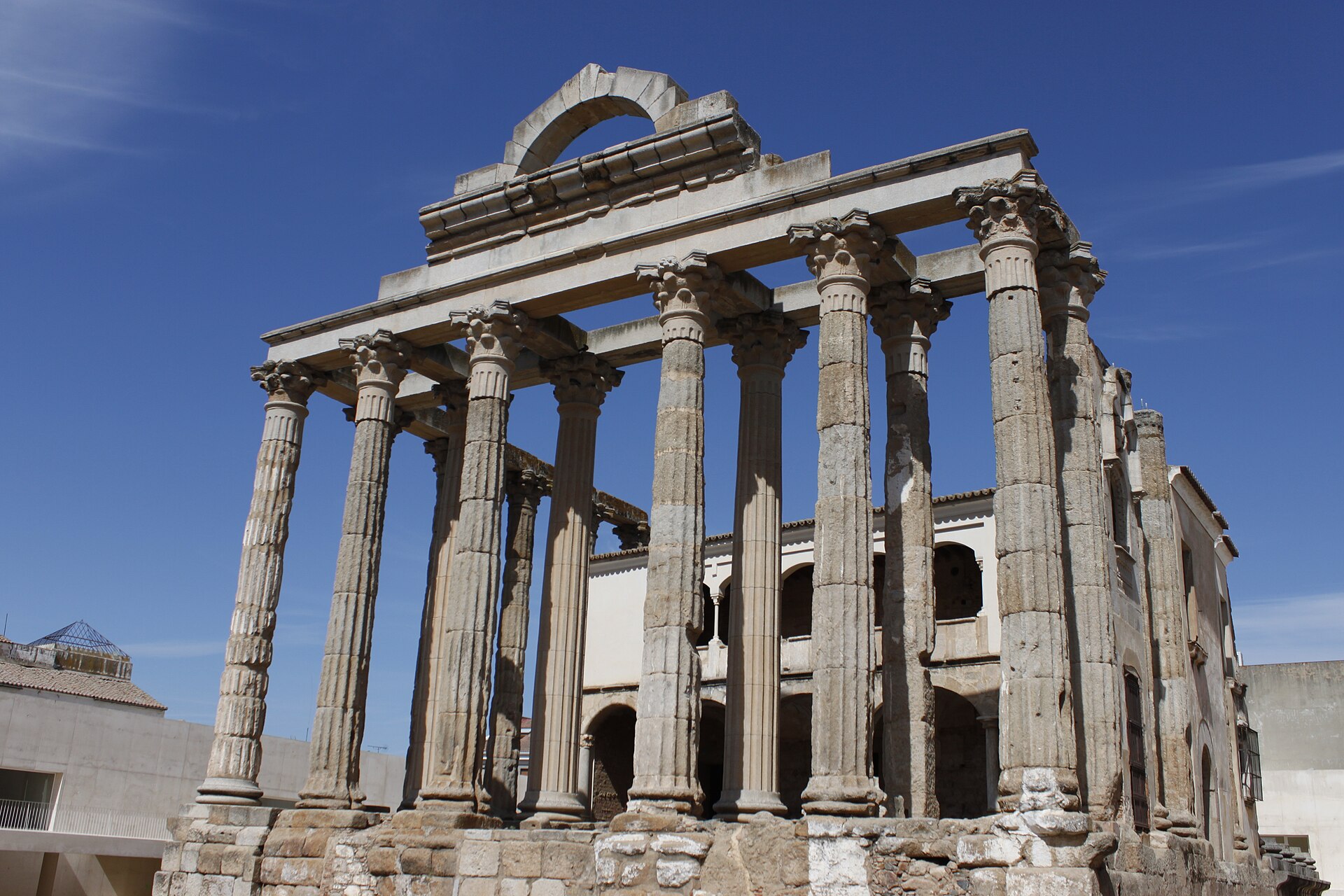
- Arch of Trajan — Old centre, near the Temple of Diana
The Arch of Trajan is a tall stone gateway that once marked one of the main entrances to the Roman city. The structures around it have vanished, so it now stands alone among traffic and modern streets. A visit takes only a few minutes, which suits a pause between bigger sights.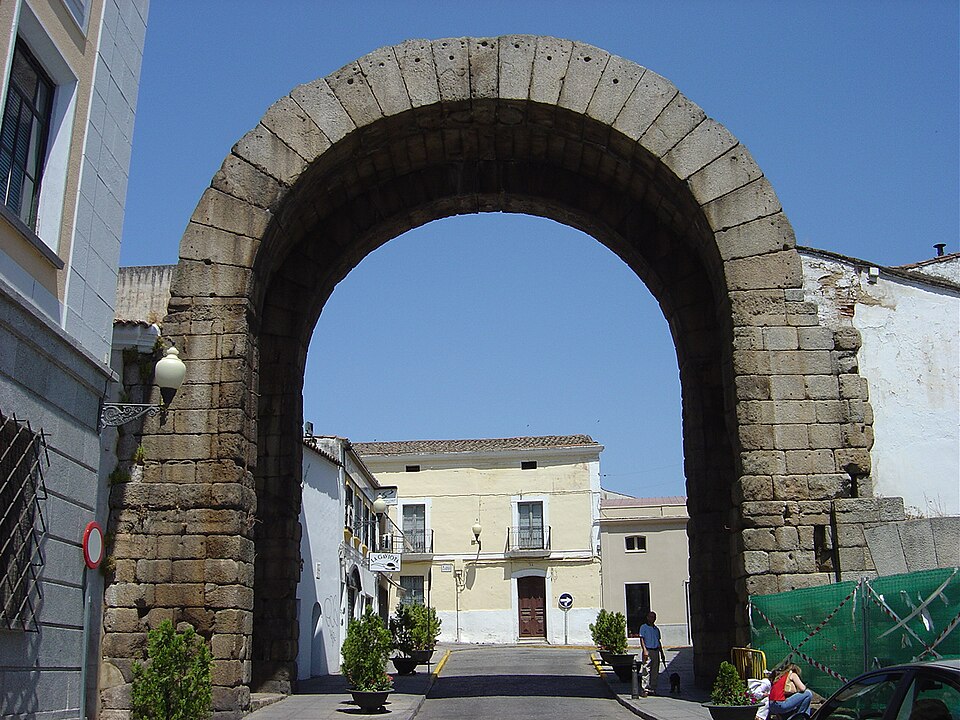
- Acueducto de los Milagros — Northern edge of the centre, in a city park
The Acueducto de los Milagros strides across a city park in three tiers of granite and brick piers. It is the most photogenic piece of Mérida's Roman water system, and storks often nest on the upper piers. The park setting means it can be seen free, and sunset gives the warmest colour.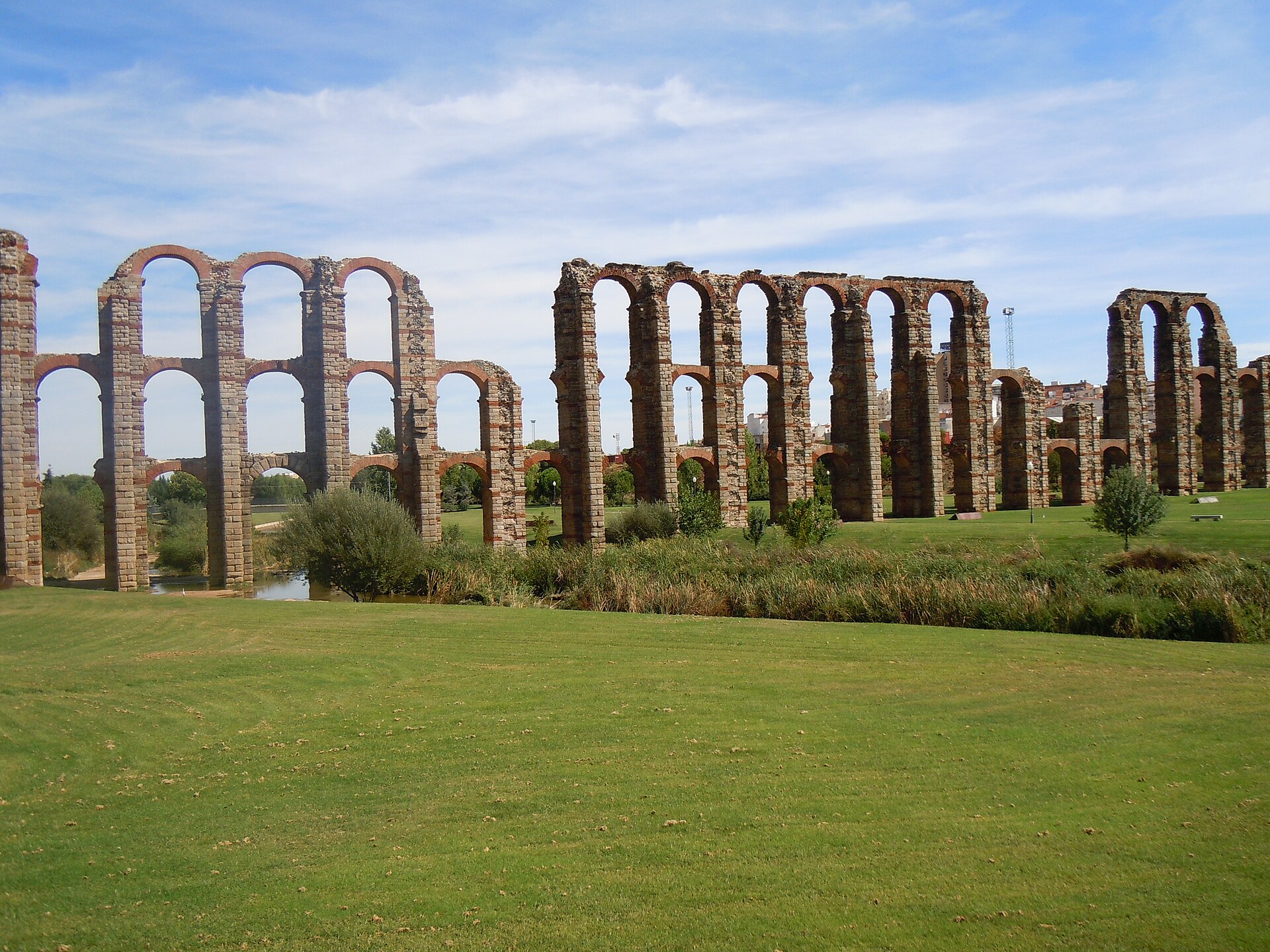
- Roman Bridge and Alcazaba — Riverfront, west side of the centre
The Roman Bridge crosses the Guadiana and is still walked daily, part original Roman work and part Visigothic repair. At its town end stands the Alcazaba, a Moorish fortress built partly from Roman wall material. A ticket lets visitors walk its outer wall for views over the river and the old bridge.
Culture
Mérida treats its Roman inheritance as ordinary civic furniture. Schoolchildren cross the old bridge, families meet under the arch, and the theatre doubles as a stage for a summer classical drama festival. Alongside the ruins, the national museum of Roman art holds mosaics, sculpture and everyday objects, and a Roman-themed festival in early summer brings costumed legionaries and gladiators into the streets. Daily life follows the wider Extremaduran rhythm. Mornings start slowly, lunch comes late in the afternoon, many shops close for a long midday break, and evenings stretch past ten o'clock, when terraces fill with families. Conversation and food matter more than sightseeing schedules. Holy Week brings solemn processions through the old streets, with brotherhoods carrying carved images and crowds standing in near silence. The region is also known for its rural traditions, from cured ham from acorn-fed pigs to sheep's milk cheeses, and many locals will happily explain where a product comes from. Extremadura is visited far less than Andalusia, so staff in small shops and bars are often pleased by any attempt at Spanish, and a greeting and a thank-you go a long way. Stay on the marked paths among the ruins and keep off the mosaics, columns and walls, even where nothing physically stops you.
What to wear
Mérida and the wider Extremadura region have a traditional dress built on practical rural cloth: heavy wool for skirts and waistcoats, linen for blouses and aprons, and embroidered shawls and lace trim for show. It appears today at village fiestas, folk dance groups and religious processions, where women may wear black dresses with a mantilla during Holy Week. In the city itself, Roman dress turns up in a different way, as togas, stolas and armour worn by performers at the summer Roman-themed festival. Everyday clothing is the same smart-casual style seen across Spain. Locals dress a little more carefully for the evening stroll than for the day, with linen shirts and light dresses in summer and jackets or knitwear in winter. Visitors should plan around sun and stone. Bring a hat, sunglasses and sun cream, because the ruins are open and shade is scarce. Wear flat, sturdy shoes with good grip, as Roman paving and marble can be uneven and polished smooth. Light, breathable cotton or linen suits the hot months, while spring and autumn evenings call for a layer. Shoulders and knees should be covered when stepping into a church, especially during Holy Week.
What to eat
- Torta del Casar — Most traditional restaurants, tapas bars and delicatessens
A soft, strongly flavoured sheep's milk cheese, usually served with its top sliced off so the creamy centre can be scooped onto bread. It is the dish most visitors are steered towards and appears on menus almost everywhere. - Stuffed red peppers — Family-run restaurants serving regional cooking
Red peppers filled with a range of mixtures, with fish, cornmeal and lamb among the fillings. The result is sweet, soft and savoury at once. Ask what the day's filling is, as it varies from kitchen to kitchen. - Paprika cheese — Cheese counters in delicatessens and local food shops
Local cheeses flavoured or rubbed with paprika, sold under many different names. The colour ranges from pale orange to deep red, and the taste is smoky and gentle rather than hot. A small portion suits a first try. - Ribera del Guadiana red wine — Tapas bars and wine shops around the old centre
The local red wine, named after the river valley where the grapes grow. It is an easy companion to the region's cheeses, cured meats and grilled dishes, and ordering it by the glass is normal at lunch. - Jamón ibérico — Bars with hanging hams, and delicatessens near the main squares
Cured ham from the dehesa, the oak pasture where Iberian pigs forage in western Spain. Sliced thin, it is rich, nutty and best eaten with plain bread. Quality varies, so ask the bar which cut they recommend.
Plan it
Best time. March to May and October to November, when days are warm and walking round unshaded ruins is comfortable. Summers are hot, with afternoons occasionally above 40 °C, and winters are mild, so the quieter months suit those who dislike heat.
How long. 1–2
Getting there. Fly to Lisbon, Seville or Madrid, then continue by train, bus or road. Trains arrive from Badajoz and Cáceres (about an hour each), Seville (about three hours) and Madrid (roughly four and a half to six hours). The bus station is across the Puente Lusitania from the central part of town, and the N-V highway links Mérida with Madrid and Lisbon.
Budget. low
Tips
- Visit ruins early in the morning or late in the afternoon in summer, as there is little shade
- Ask about the combined ticket at the first paid site, then check the official site for current opening hours and fees
- Carry water, a hat and sun cream, and wear flat shoes for worn paving
- Seek out a summer evening performance at the theatre, and check the official site for dates and booking
- Expect restaurants to serve lunch late and dinner later, and plan meals around that
Etiquette
- Keep to marked paths and do not climb on mosaics, columns or walls
- Greet staff in shops and bars with a short Spanish hello before asking a question
- Cover shoulders and knees when entering churches, and keep quiet during Holy Week processions
Nearby
Sources
- Wikidata Q1583842 (CC0)
- Wikipedia, Augusta Emerita (rev 1371658218) (CC BY-SA 4.0)
- Wikivoyage, Mérida (Spain) (rev 5412014) (CC BY-SA 4.0)
- Maqueta de Emerita Augusta, Yuntero (CC BY 3.0)
- Theatre of Mérida, Benjamín Núñez González (CC BY-SA 4.0)
- Roman Amphitheatre in Mérida, VonRalph (CC BY 3.0)
- Roman aqueduct, Mérida, Nobvonriedern (CC BY 3.0)
- Templo Romano de Diana, Mérida, dadelmo (CC BY-SA 3.0 es)
- Arco Romano de Trajano, Yuntero (CC BY 3.0)
- Columbarios romanos, Anitsircana (CC BY-SA 4.0)
- Agripina Minor (M.A.N. Madrid), unknown author (CC BY 3.0)


