Mandu
Mandu, India
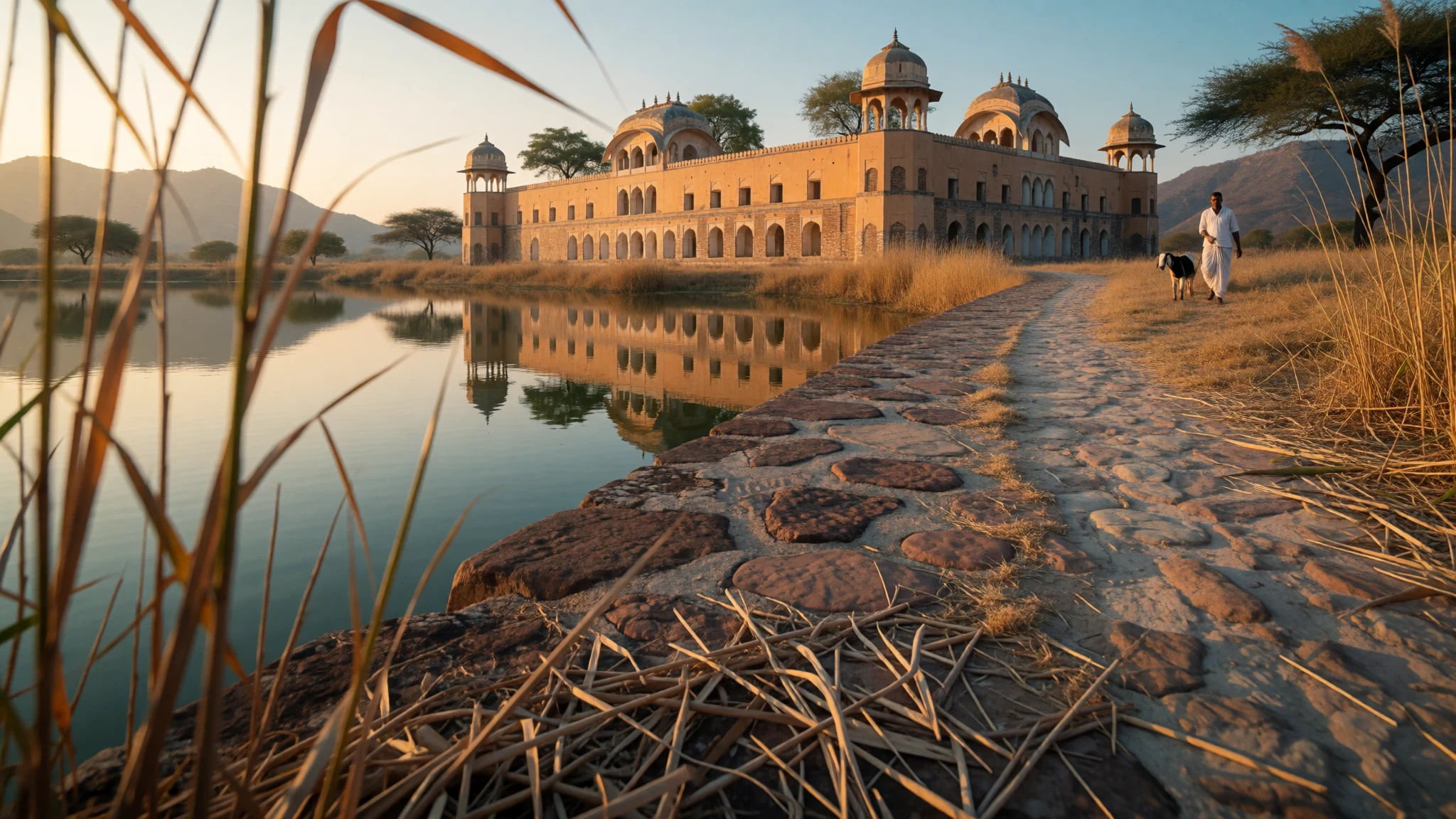
Mandu is a ruined hilltop city of sultans' palaces, mosques and lakes in Madhya Pradesh, best walked slowly and without a tour-bus crowd.
The place
Mandu sits on a spur of the Vindhya Range in the Dhar district of western Madhya Pradesh, about 35 km from Dhar town. The plateau top stands at 634 m, and along its southern edge the ground drops by roughly 305 m to the Nimar plain, with the Narmada valley beyond. A deep ravine called Kakra Khoh separates the plateau from the Malwa upland on its other sides, which explains why so many rulers wanted it as a stronghold. Nobody lives in the old city as such. It is an archaeological site of ruined palaces, mosques, tombs and gateways scattered across a wooded tableland, with a few small villages and guesthouses tucked between them. Distances are larger than a map suggests, so most visitors hop between the monument groups by car, auto-rickshaw or hired bicycle. The buildings fall loosely into three clusters: the royal enclave with its lakes and pavilions, the village group around the Jami Masjid and the tombs, and a southern group near Rewa Kund. Lying close to the middle of India, Mandu spent centuries as a frontier post between the northern plains and the Deccan, and its architecture mixes Hindu, Afghan and later Mughal-era habits. Its sultans' own name for it, Shadiabad, translates as city of joy, and in the monsoon, when the plateau turns green and the tanks fill, the name makes more sense than it does in May. Summer heat is fierce and the ruins offer little shade. Weekdays are quiet; weekends and holidays bring families from Indore.
Its story
Mandu's history starts earlier than most visitors expect. An inscription found at Talanpur, a good distance away, records a merchant installing a Jain image at a temple in a place called Mandapa Durg. The name is a Prakrit form meaning something like a hall or temple, with durg meaning fort. The date puts a working town here in the sixth century. The site rose to political importance under the Paramara dynasty in the tenth and eleventh centuries. Their older capital, Dhara, lay on open ground and was vulnerable, so a hill fortress with a ravine on one side and a steep scarp on the other was an attractive refuge as neighbouring kingdoms pressed in from Gujarat and the Deccan, and as the Delhi Sultanate's generals advanced toward their northern border. Inscriptions begin to name the hill as a royal residence. Then, in 1305, Alauddin Khalji's armies took Malwa, and a newly appointed governor was sent to remove the last Paramara king from Mandu. That moment opened the era that gave the plateau most of what survives today: sultans of Malwa, followed by Delhi's rulers and later the Mughals, treated it as a refuge and pleasure retreat, adding mosques, tombs, palaces, inns and shops inside the walls. The ruins now are mostly from that long Islamic period, though the older Hindu and Jain layers lie beneath and around them.
What to see
- Jami Masjid — Mandu village group
The congregational mosque stands on a raised platform near the village, with a broad courtyard, a row of domes and a deep, arched prayer hall. Work began under Hoshang Shah and was finished by Mahmud Khalji. Local tradition links its plan to the mosque of Damascus. Go in the morning, when the red stone is cool.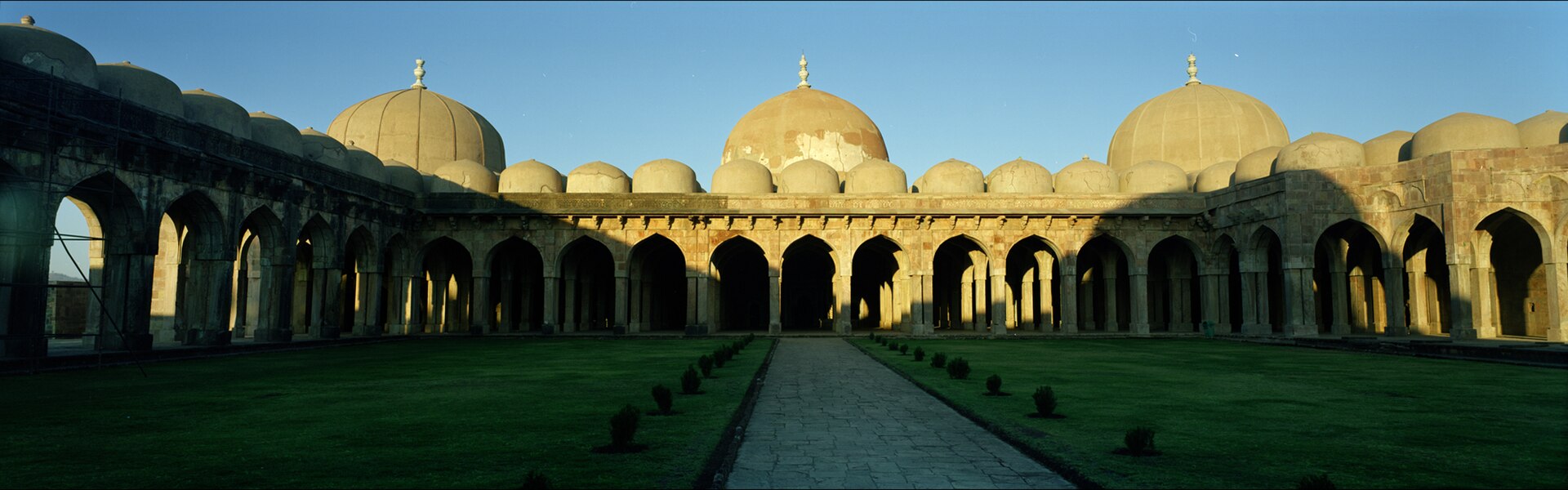
- Tomb of Hoshang Shah — Mandu village group
A compact domed tomb in white marble, completed in 1440 inside a walled compound with its entrance on the north side. A pillared hall runs along the east. It is calm and unadorned compared with the palaces, and the lattice-work and plain dome reward a slow circuit rather than a quick photograph.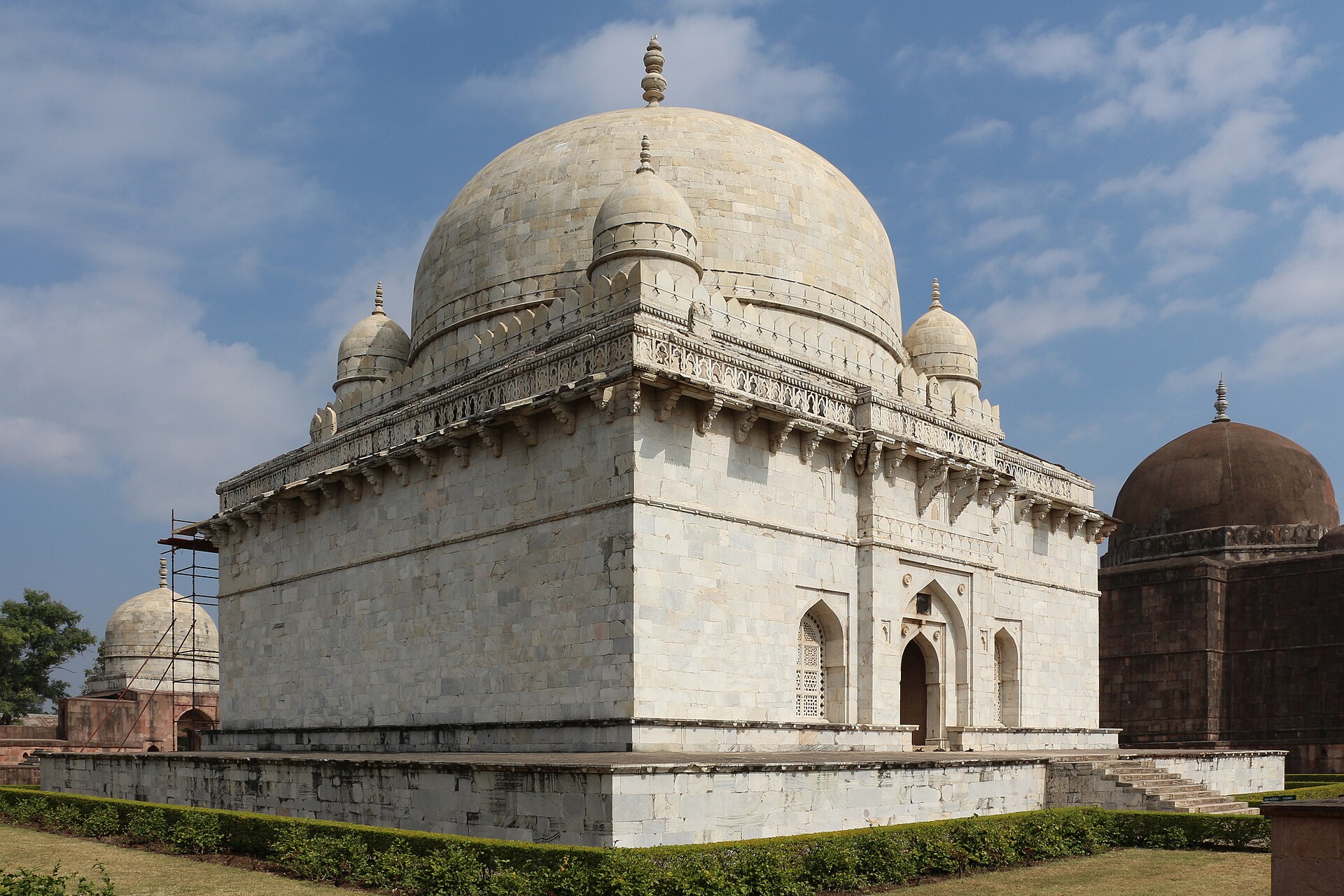
- Jahaz Mahal — Royal enclave
The Ship Palace is a long, narrow, two-storey building laid between two lakes, so water lies on both sides and the whole structure seems to float. Climb to the roof for views over the tanks and ruined pavilions. Late afternoon light suits it best, and monsoon reflections are the classic scene.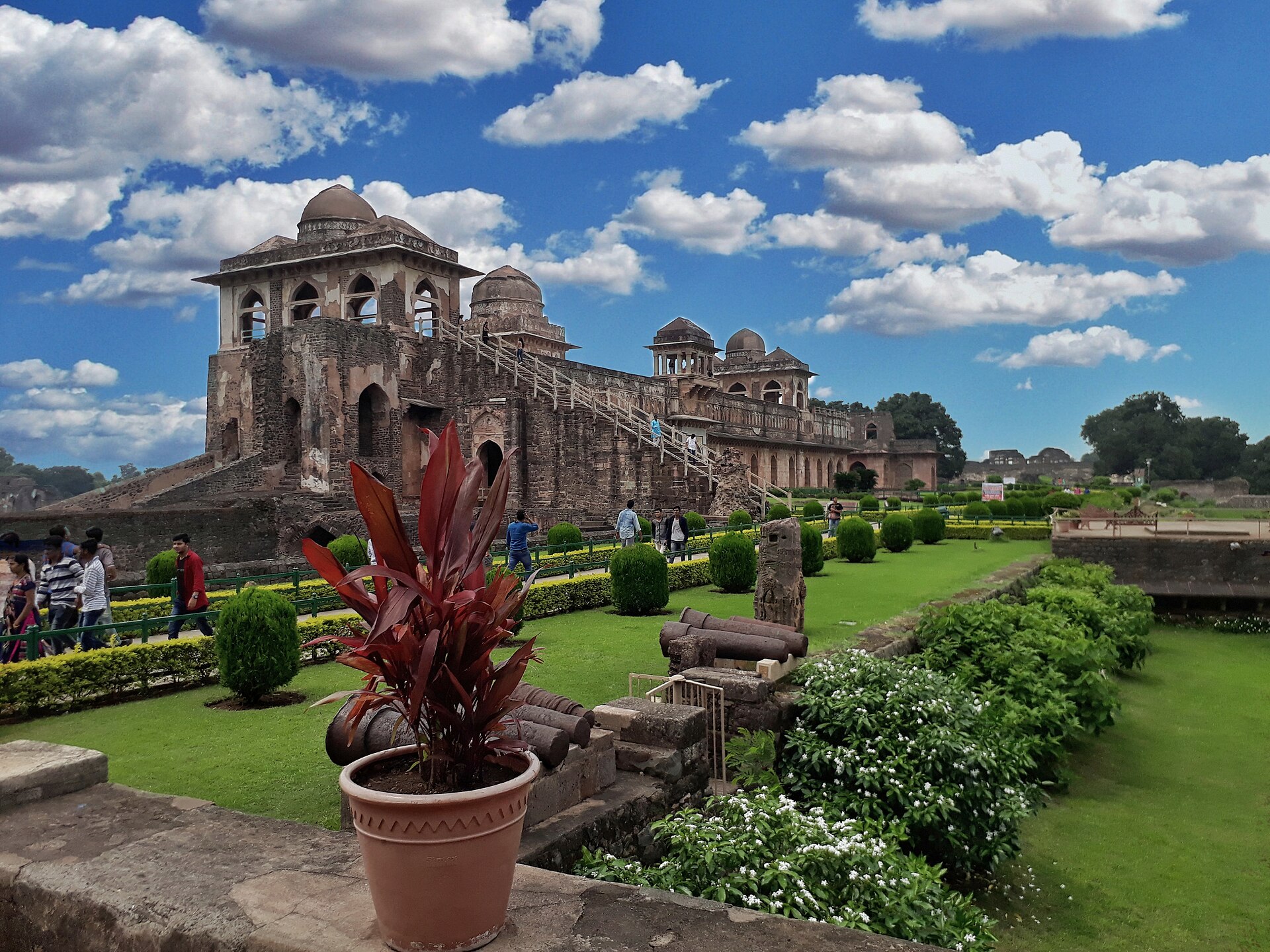
- Hindola Mahal — Royal enclave
The Swinging Palace takes its name from its steeply sloping, buttressed walls, which lean inwards and give the T-shaped hall an odd, tilted look. It probably served as an audience hall for a fifteenth-century sultan. The scale is the point: tall arches, bare stone and plenty of quiet space to stand in. - Baz Bahadur's Palace — South of the royal enclave
A courtyard palace with a big open court, tanks and roof terraces facing the plateau's edge. Named after the last sultan of Malwa, it is easy to explore at an unhurried pace and often has fewer visitors than the big mosque. Its terraces make a good place to rest out of the sun.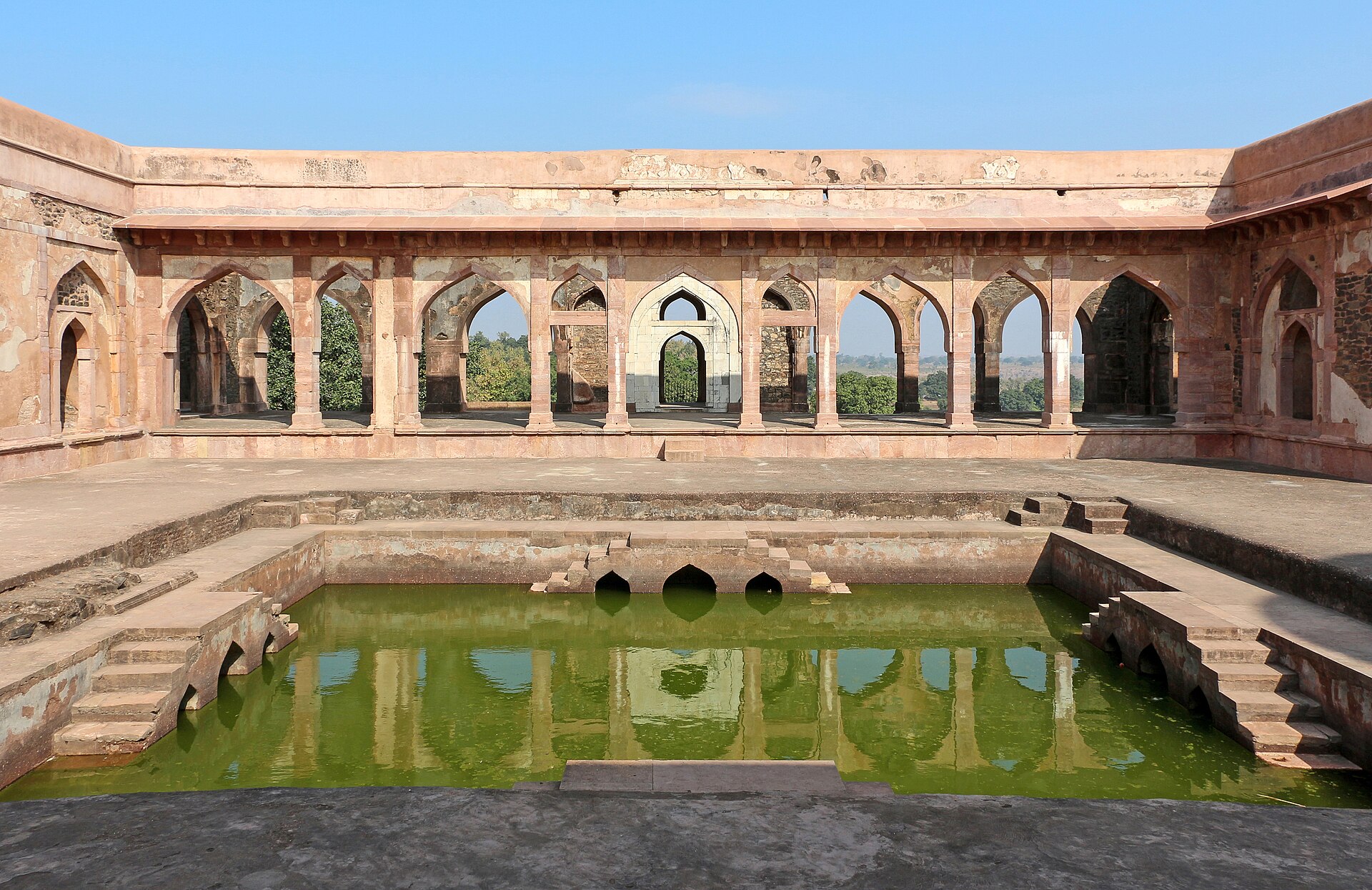
- Rupmati's Pavilion — Southern edge of the plateau
A hilltop pavilion on the plateau's southern lip, linked in local stories to the singer Rupmati and her devotion to the river. The views over the Nimar plain are the draw, especially at sunrise or in clear post-monsoon air. Expect a short uphill walk and plenty of monkeys.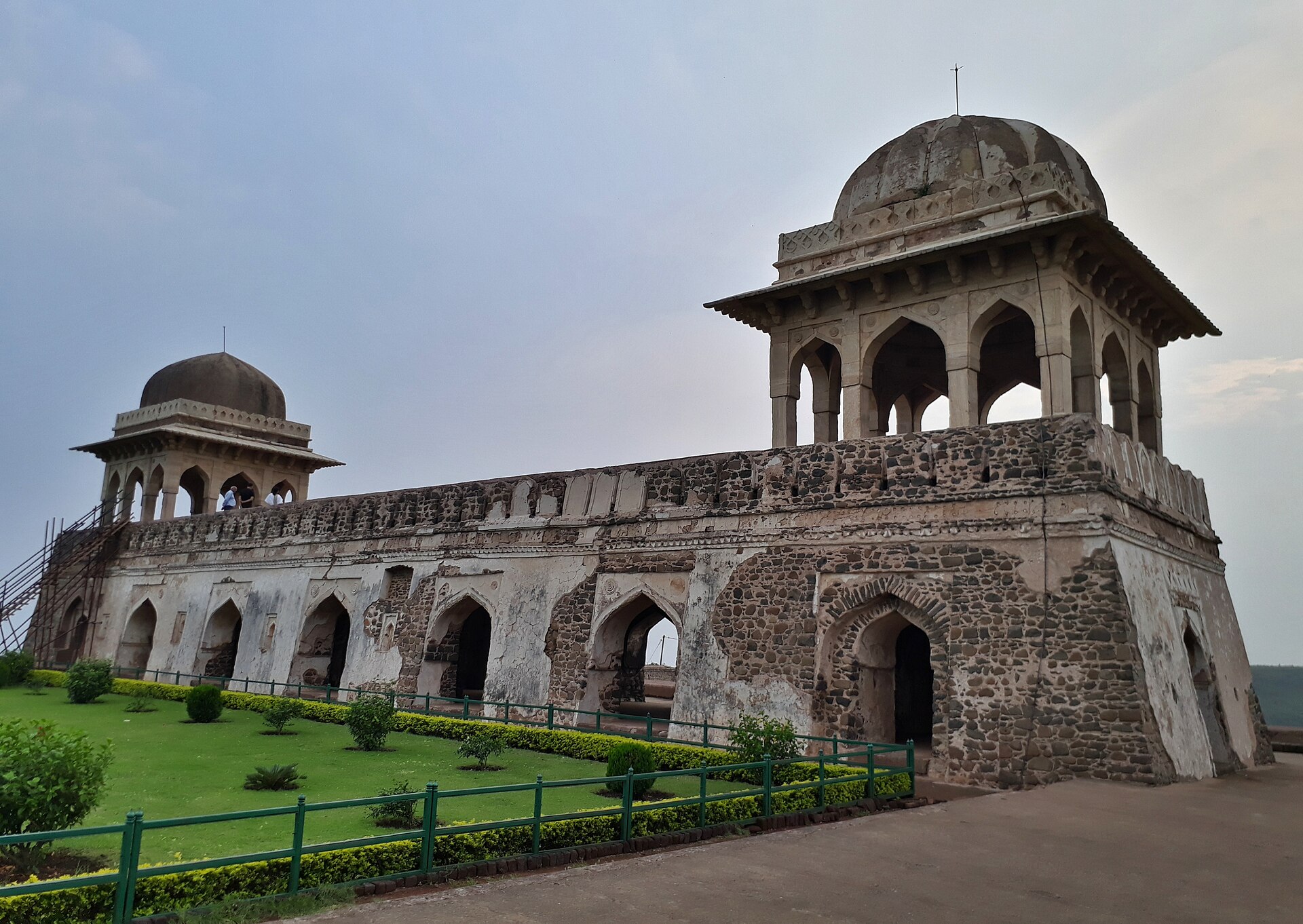
Culture
Mandu's living culture is quieter than its monuments. The old city is empty, but the villages around it are part of the wider Malwa and Nimar region, where Malvi is spoken and where farming, the monsoon and local fairs set the rhythm of the year. Visitors will meet Hindu and Muslim families, and a Jain temple that still draws pilgrims, so the plateau remains a place of worship as well as a ruin. The ruins record a layered past. Paramara kings, sultans of Malwa and later rulers each built here, often reusing earlier stone, so mosques and tombs sit near older Hindu and Jain remains. Popular memory rests more on stories than dates: the romance of Baz Bahadur and Rupmati is told in local songs and guides' patter, and travellers will hear it more than once. Guides are licensed at the main sites and well worth paying for if the history matters to you, though agree the arrangement before starting. Evenings are early and quiet, with little nightlife; people tend to eat, talk and turn in. Monsoon visits bring a festive, domestic mood as families come up for the greenery. Take off your shoes before stepping onto the prayer floor of the Jami Masjid or any active shrine, and stay clear of the prayer areas whenever worshippers are present.
What to wear
Mandu itself has no single costume, so the traditional dress to know is that of the wider Malwa region. Rural women often wear the sari or a long skirt with an odhni, a light cotton head-and-shoulder cloth, in strong colours; men wear dhoti or kurta-pyjama, with a pagri (turban) at weddings and festivals. Cotton is the everyday cloth, and the nearby town of Maheshwar is known for its handwoven cotton-and-silk saris. Chanderi, from the same central Indian belt, is another well-known fine weave. Day to day, most people now wear what they would in any small Indian town: shirts and trousers for men, salwar kameez or saris for women, with jeans and T-shirts common among younger visitors from Indore and beyond. For a visitor, practicality comes first. The plateau is exposed, hot for much of the year and cool on winter mornings, so light cotton layers, a hat, sunglasses and sunscreen suit well. Shoulders and knees should be covered at the mosque, tombs and any temple, so carry a scarf or light shawl. Footwear matters more than anything else: the ruins involve uneven stone, steps, gravel and long walks, so wear closed, grippy shoes or sturdy sandals that slip off easily. In the monsoon, add a light rain jacket and shoes that tolerate damp, slippery stone.
What to eat
- Dal bafla — Eateries in Mandu village and around the Jami Masjid
The signature dish of Malwa: wheat dumplings baked until firm, broken open and soaked in ghee, then eaten with spiced dal and often a sweet ball called laddu. Heavy and filling, it suits a walking day. Look for it at simple eateries in the village. - Dal baati — Near the Jain temple, and village eateries
A close cousin of bafla, with baked rather than boiled-then-baked wheat rounds, served with dal and chutney. The brief's local advice is to try it at the Jain temple's dining area; ask there about meal times, as these change with the day. - Dal paniya — Local eateries in Mandu village
A gentler Malwa dish, where dough is wrapped in leaves, cooked over a gentle fire and served with dal. It is less commonly found than bafla, so ask a local eatery whether it is being made that day. - Baobab fruit drink — Stalls near the main monuments and the village
Baobab trees, originally from Africa, are common on the plateau, and locals call them mandu ka imli. The dried, powdered fruit pulp has a tart, tamarind-like flavour and is mixed into drinks or sold as sweets and powder. A distinctive local souvenir. - Nimboo pani — Roadside stalls and tea shops across the plateau
Indian-style lemonade, freshly squeezed with salt or sugar and cold water, sold everywhere in Mandu. In the heat it is the easiest drink to find and the most welcome after a long walk between ruins. Ask for it with bottled or boiled water.
Plan it
Best time. October to February is the most comfortable stretch, with clear skies and cooler days for walking. July to September turns the plateau green and fills the lakes, though rain can make paths slippery. March to June is hot, with little shade among the ruins.
How long. 1–2
Getting there. Fly to Ahilyabai Holkar Airport in Indore, which is also the nearest main railhead, about 95 km away. Ratlam, on the Delhi–Mumbai main line, is a second rail option. From Indore the last leg is by hired car or by bus via Dhar, roughly three hours by road; check current bus times locally.
Budget. low
Tips
- Stay at least one night on the plateau so you can see the monuments early, before the heat and day-trippers
- Hire a bicycle or auto-rickshaw for the day, since the sites are spread over a large area
- Carry cash, drinking water and sun protection, as stalls and shade are limited
- Check ticket details and opening times on the Archaeological Survey of India's official site before you go
- Allow extra time after heavy rain, when paths and steps can be slippery
Etiquette
- Remove shoes before entering mosques, tombs and temples
- Ask before photographing local people, especially women and worshippers
- Do not climb on fragile walls or carve names into the stone
Nearby
Sources
- Wikidata Q147886 (CC0)
- Wikipedia: Mandu, Madhya Pradesh (rev 1381001937) (CC BY-SA 4.0)
- Wikivoyage: Mandu (rev 5330906) (CC BY-SA 4.0)
- Photo: Jahaz Mahal 03, Bernard Gagnon (CC BY 3.0)
- Photo: Jahaz Mahal Mandu, Aamin (CC BY-SA 4.0)
- Photo: Rani Rupmati Mahal, Theaaminkhan (CC BY-SA 4.0)
- Photo: Kapoor Talao, WISDOMurali (CC BY-SA 4.0)
- Photo: Baz Bahadur's Palace 09, Bernard Gagnon (CC BY 3.0)
- Photo: Rewa Kund, Mandu, Bernard Gagnon (CC BY 3.0)
- Photo: Mandu, Jami Masjid, Pavel Suprun (Superka) (CC BY 3.0)
- Photo: Hoshang Shah's Tomb 02, Bernard Gagnon (CC BY 3.0)


