Málaga
Málaga, Spain
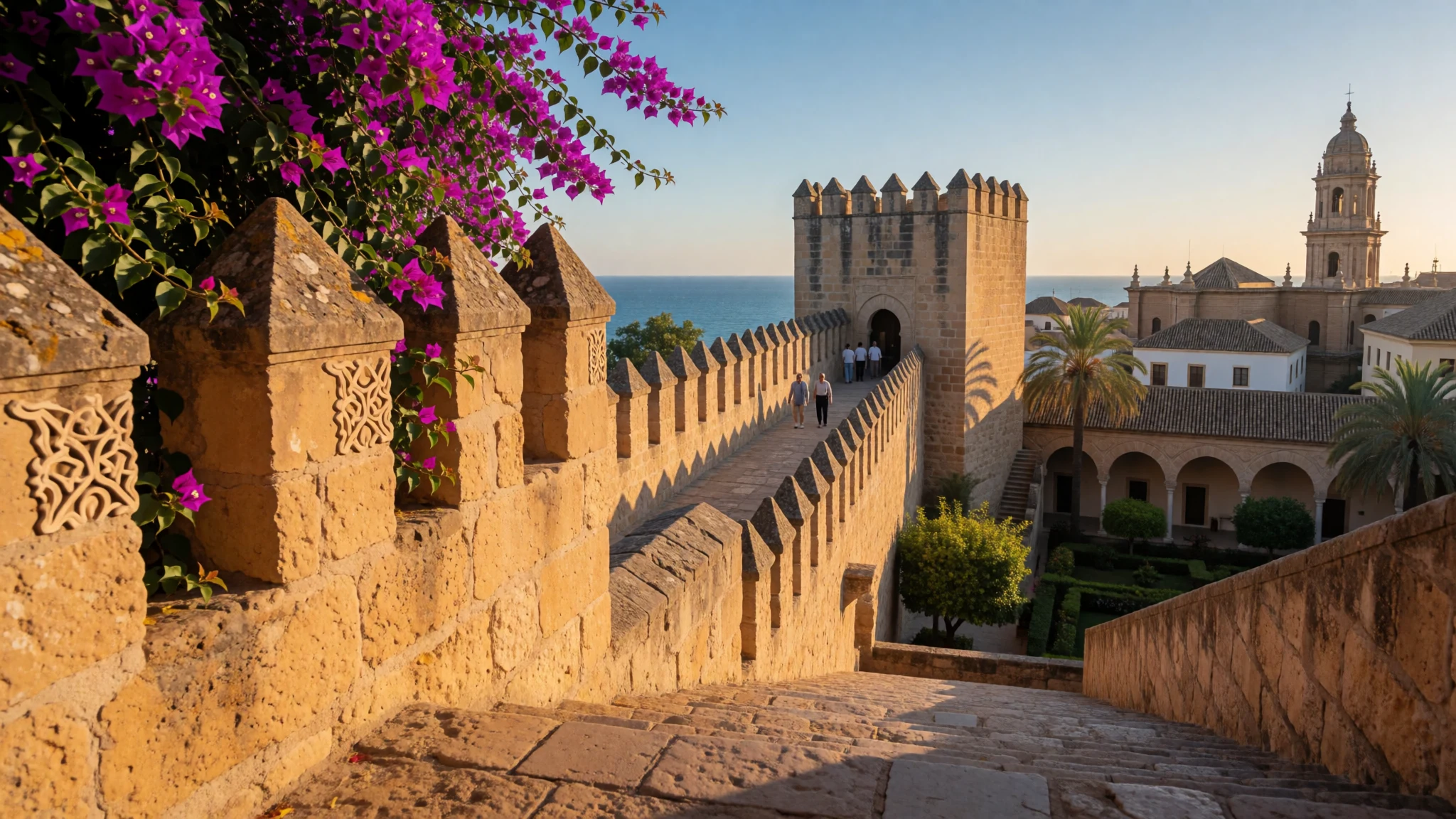
Málaga pairs a Phoenician harbour, a hilltop fortress, Picasso's museum and a long Mediterranean beach.
The place
Málaga is the Andalusian port that governs the province of the same name, on Spain's Mediterranean south. The shoreline it fronts is the Costa del Sol. Housing and industry run mainly along the Guadalhorce, on that river's left bank, while the historic streets fill the pocket between the Guadalmedina and the slope of Gibralfaro. About 603144 people live here, barely 18 metres above the sea, so beach, quays, cathedral and castle sit in one tight circuit. Tourism, construction and technology services carry the economy, with transport and logistics now widening that base. Holiday flights and cruise calls keep the waterfront busy, yet the inland streets still read as a working provincial capital: offices, a market day, a cathedral parish, not only a strip of holiday lets. La Malagueta, east of the centre, is where the city meets the sand. Westward the plain runs out towards the airport. From Gibralfaro the roofs, the port cranes and the open sea stack in a single glance. People have lived at Málaga since about 800 BCE, when Phoenician sailors fixed a town on this harbour, and the same reason for being here, a sheltered landing on a long coast, still holds. The Moorish walls, the Roman theatre beneath them, and the museum of the Málaga-born painter Picasso are the set pieces; fried fish within sight of the water is the daily one. Summer is hot and the promenades fill up; spring and autumn are easier for the hills. The centre itself is compact, but the path to the castle is a real climb. Practical civic detail sits at http://www.malaga.eu/.
Its story
Málaga began as a Phoenician harbour colony. Settlers from Tyre gave it the name Malaka, Malake in some later spellings and mlkʾ in Punic letters, around 800 BCE. Ships could turn into the Guadalmedina from here, and goods moved between the eastern Mediterranean and the Strait of Gibraltar. Like sister colonies in the far west, the town eventually came under Carthage. Rome called it Malaca. Once the Punic Wars were over, the Republic was in charge, yet in the first century BCE Strabo could still describe a Phoenician character, unlike the Hellenised neighbour Mainake. Malaca later stood as a confederated city governed by its own code, the Lex Flavia Malacitana, and a theatre was cut into the base of the hill. That theatre is the Roman building still readable in the centre. Visigothic rule followed the western empire. Around 552 the Byzantines seized the city and possibly raised either Malaca or Carthago Nova to head their province of Spania; they rebuilt the quays and leaned on a fishing and trading life already long established. Sisebut, the Visigothic king, recovered it in 615. Arab and Berber forces took Málaga in 711, or perhaps 713, and Arabic writers set the name down as Mālaqah (مالقة). Castile captured the city in 1487, in the middle of the war for Granada. Factories arrived in the nineteenth century, and the closing third of that century brought a deep social and economic slump. The centre still stacks those layers on one slope: harbour, Roman stage, Moorish fort, cathedral.
What to see
- Alcazaba — Old centre, on the hill above the Roman theatre
The Alcazaba is Málaga's Moorish fortress, built in the eleventh century on the hill that anchors the old centre. Walls and garden courts rise in terraces above the Roman theatre, and from the upper walk the cathedral and the port share one view. The fort is the surviving heart of the Islamic city, tucked into the same slope the Romans had already built on. - Castillo de Gibralfaro — Gibralfaro hill
Castillo de Gibralfaro is Málaga's higher Moorish castle, on the ridge behind the Alcazaba and linked to it by a walled corridor. Ramparts circle the crest and open onto the whole of Málaga: the harbour, La Malagueta, the cathedral and the suburbs running inland. The climb from the centre is steep and exposed, which is why the view feels earned rather than arranged. - Roman theatre — Foot of the Alcazaba
The Roman theatre of Málaga sits at the foot of the Alcazaba, where the Phoenician and Roman town once met the river. The cavea and stage are open to the plaza, so the shape of the building can be read from the street without a ticket. A closer look means stepping into the adjoining building for the interpretation space. - Málaga Cathedral — Historic centre
Málaga Cathedral stands in the middle of the old town, a short walk inland from the port and just below the Alcazaba. The contrast is the visit: narrow lanes outside, then a broad, tall nave. The square in front links the streets around the Picasso Museum to the older commercial lanes, so most walking routes through Málaga pass the doors. - Picasso Museum — Historic centre, near the cathedral
The Picasso Museum in Málaga shows work by the painter born in the city, in a historic house near the cathedral. Paintings, works on paper and ceramics sit together, so a visit can track how his manner changed without a huge building to cross. Seeing the pictures here, with the harbour and Gibralfaro just outside, ties the art to the town that produced him.
Culture
For five centuries Málaga has marked Holy Week, Palm Sunday through to Easter Sunday, as the city's central public ritual. Brotherhoods move carved Passion scenes through the streets on tronos, enormous decorated platforms, a number of them above five thousand kilograms. Hooded penitents in floor-length robes lead; behind them walk women in black, candles in hand, while brass and drums keep a funeral pace. A saeta may rise from the crowd without warning, one voice thrown at the float. Nuestra Señora de la Esperanza, the royal archbrotherhood of Our Lady of Hope, musters more than five thousand members, six hundred of them nazarenos. Some platforms stand taller than a church door, so they spend the year stored elsewhere and only meet their parish during the processions. The week shuts ordinary routes and turns night-time Málaga into a slow river of wax, cloth and music. If you watch a procession in Málaga, never cut across the path of a trono, and hold still and quiet while a saeta is sung.
What to wear
Málaga dresses for heat, and it still keeps a separate wardrobe for ceremony. In Holy Week the clothes that fill the street are the nazareno robe and the tall capirote, plus the black dresses of women carrying candles; none of that is everyday wear. The older festive costume of the region, a ruffled traje de flamenca cut in cotton or silk, sometimes with a short equestrian jacket, comes out for the summer fair and for weddings, then goes back into the cupboard. Day to day, people in Málaga dress like any warm southern city: linen and thin cotton while the sun is high, jeans and trainers, a jacket when the evening breeze picks up, and a cleaner shirt if dinner is in the centre. A visitor does well to copy that. Add a hat and breathable cloth in the hot months, and a light layer in winter, which stays mild rather than cold. Shoulders and knees should be covered in the cathedral and in smaller churches. Swimwear belongs on La Malagueta and at beach bars, not in the old town, and a climb to Gibralfaro calls for shoes that hold on steep stone.
What to eat
- Espetos de sardinas — Chiringuitos on La Malagueta and the eastern beaches
Espetos are sardines grilled on a cane spit over a wood fire, and they are the beach meal Málaga puts its name to. The skin should blister while the flesh stays soft. Chiringuitos on La Malagueta, and the bars along the eastern beaches towards Pedregalejo, cook them in the open. - Fritura malagueña — Tapas bars in the old centre and taverns near the market
Fritura malagueña is Málaga's heap of small fish and squid, floured and fried until the coating just sets. Anchovy and red mullet usually share the plate. Tapas bars in the old centre, and taverns near the market, bring it out still crackling. - Ajoblanco — Traditional taverns in the old centre
Ajoblanco is Málaga's cold almond soup, pounded with garlic, bread, olive oil and vinegar, and served when the weather is too hot for a heavy plate. Grapes sometimes finish the bowl. Traditional taverns in the old centre pour it next to a glass of sweet Málaga wine. - Boquerones en vinagre — Tapas bars in the historic centre
Boquerones en vinagre are anchovies cured in vinegar and olive oil with garlic and parsley, and they open countless meals in Málaga. The fish should look bright, almost translucent. Tapas bars across the historic centre set them out beside olives, as the first plate rather than the last. - Sweet Málaga wine — Bodegas and old taverns in the centre
Sweet Málaga wine, pressed from sun-dried Muscat grapes, is drunk cold beside savoury tapas as often as it is beside pudding. Raisin and flower sit in the glass, and the sweetness can take salty fish. Bodegas and old taverns in the centre treat a small glass as an ordinary order. - Ensalada malagueña — Centre taverns and beach eateries
Ensalada malagueña is Málaga's mix of salt cod, potato, orange, onion and black olives, sharper and brighter than a generic Spanish salad. Orange cuts the salt. Centre taverns and beach eateries with a full local menu serve it ahead of the fried fish.
Plan it
Best time. April, May, September and October are the comfortable months for walking Málaga's hills and lanes, warm without the hardest summer heat. July and August belong to the beach: the Costa del Sol is crowded and hot. Winter stays mild enough for the old town, and the streets are quieter.
How long. three or four
Getting there. Málaga is reached through its airport on the coastal plain. An airport express bus runs to Alameda Principal and Paseo del Parque, where many local buses also stop. A suburban train runs from the airport to Málaga Centro Alameda and on to María Zambrano, the station for Renfe high-speed AVE trains, with the main bus station next door. Taxis queue at the arrivals rank, and the line grows long in summer. Fares and frequencies change, so check the operator or http://www.malaga.eu/ before you set out.
Budget. mid
Tips
- Start the walk up to Gibralfaro early, before heat and coach groups arrive.
- Prefer the airport bus or the suburban train over a taxi when the arrivals queue is long.
- Carry some cash; small tapas bars and neighbourhood shops do not always take cards.
- Bring water for the castle hill, where shade is thin.
- If the visit falls in Holy Week, expect closed streets and slow walking.
- Look up current access on the city website rather than trusting a third-hand timetable.
Etiquette
- Never cross in front of a moving Holy Week trono.
- Keep silent while a saeta is being sung.
- Cover shoulders and knees before entering the cathedral or a parish church.
- Ask before you photograph penitents or singers at close quarters.
Nearby
Sources
- Wikidata Q8851 (CC0)
- Wikipedia (rev 1384628515) (CC BY-SA 4.0)
- Wikivoyage (rev 5411982) (CC BY-SA 4.0)
- Photo photos/01-malaga-2023.jpg (CC BY-SA 4.0)
- Photo photos/02-da-gibralfaro-cropped-2.jpg (CC BY 3.0)
- Photo photos/03-cenachero-edited.jpg (CC BY-SA 2.0)
- Photo photos/04-spain-andalusia-malaga-bw-2015-10-24-15-21-05-edited.jpg (CC BY 3.0)
- Photo photos/05-malaga-2009-08-12d.jpg (CC BY-SA 4.0)
- Photo photos/06-centre-pompidou-m-laga-22391487033.jpg (CC BY-SA 2.0)
- Photo photos/07-botanic-garden-la-concepcion-malaga-edited-cropped-cropped.jpg (CC BY 2.5)
- Photo photos/08-malaga-plaza-la-malagueta.jpg (CC BY-SA 4.0)


