Maison Carrée
Maison Carrée, France
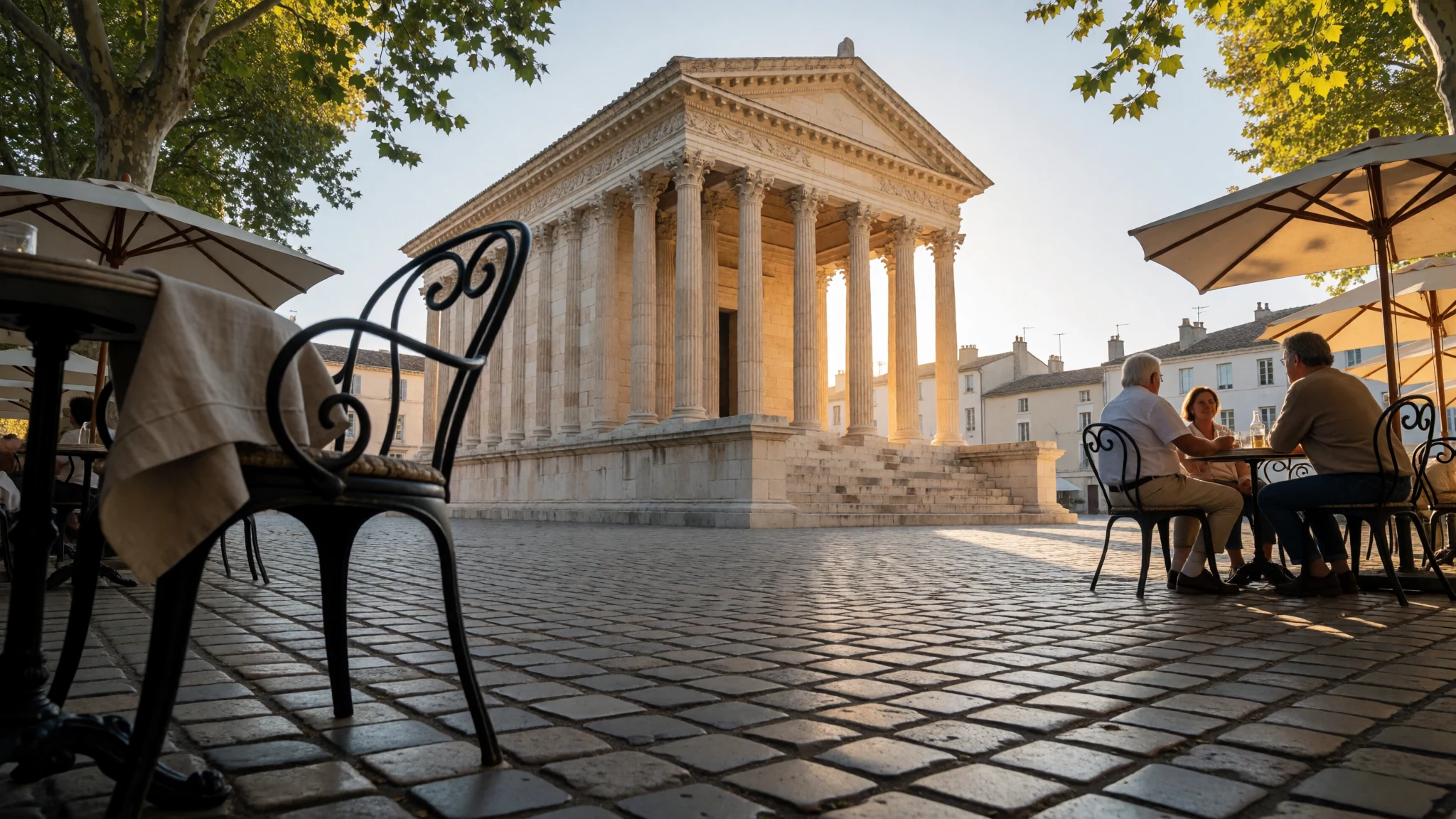
Maison Carrée gives Nîmes a Roman temple that still stands almost whole, in a lively square where a coffee and a long look cost very little.
The place
The Maison Carrée stands in the centre of Nîmes, in southern France, a few minutes' walk from the pedestrian lanes of the old town. Its name means "square house", though the plan is really a rectangle: a pale limestone temple raised on a high podium, with a deep porch of slender Corinthian columns at the front and half-columns set into the walls along the sides and back. It was built for the imperial cult, the Roman habit of honouring the emperor's family with temples in provincial towns, and it belongs to the generation of buildings put up when Nîmes was newly grand. What surprises many visitors is how ordinary its setting feels. Cafés spread across the square, people eat lunch facing the porch, and the temple works as a backdrop to daily life rather than a sealed monument. The inside is a single small chamber, so the visit itself is short; the pleasure is in walking round the exterior and watching the light change on the stone. Nîmes is also compact enough to see other Roman remains on foot, including the arena, a tower on the hill and a garden built around a spring. The temple's form has been copied far from home: the Madeleine church in Paris, a church in Rogalin in Poland and the Virginia State Capitol all draw on it. UNESCO lists the Maison Carrée as a World Heritage site. For current opening arrangements and tickets, check the official site, https://www.lamaisoncarreedenimes.fr/.
Its story
The Maison Carrée went up in the early years of Augustus's rule, when Nîmes was a young Roman colony keen to show its loyalty to the emperor. It was later given to Gaius and Lucius Caesar, Augustus's grandsons and adopted heirs. Both young men died before they could succeed him, so the building became a monument to a succession that never happened. The dedication was spelled out in individual bronze letters fixed to the stone with small pins. When the metal was stripped away in the Middle Ages, only the holes remained, and for centuries nobody could say whom the temple honoured. In 1758 a Nîmes scholar, Jean-François Séguier, studied the pattern of those holes, worked out which letters had hung where, and recovered the names of the two princes. His reconstruction is still how the inscription is read today. Across the centuries the temple was put to a variety of practical uses, and its survival owed as much to luck and reuse as to reverence. In 1785 Thomas Jefferson, then minister to France, had a plaster model of it made, and its proportions later shaped the Virginia State Capitol. In the nineteenth century a local figure, Victor Grangent, took up the cause of restoring it, and the temple slowly regained its crisp Roman outline. In 2023 it was added to the UNESCO World Heritage List, giving a very old local favourite a wider audience.
What to see
- Les Arènes — Old town, a few minutes south-east of the temple
Nîmes's Roman amphitheatre is closely preserved and still in use, with bullfighting festivals in September and concerts at other times. Walk the upper galleries for views over the rooftops, and check the official listings first, since events can close the arena to casual visitors. - Jardin de la Fontaine — North-west of the centre, below the hill
A formal eighteenth-century garden of stone balustrades, canals and shaded walks, laid out around the spring that first drew settlers here. It is a cool, free place to rest after the paved streets, and the ruined Temple of Diane stands in a corner of the grounds. - Tour Magne — Hilltop above the garden
A massive Roman tower on the hill that once formed part of the city's defences. The climb up through the garden's wooded paths is steep, but the view from the top takes in Nîmes, the plain and, on clear days, hills on the horizon. - Castellum — North of the Maison Carrée, near the hill
A small Roman distribution basin where the aqueduct from Pont du Gard once delivered water to the town. Little remains to see, but it helps explain how a Roman city of this size kept its fountains and baths running. - Porte d'Auguste — Eastern edge of the old town
A Roman gateway that once welcomed travellers on the main road into the city, with twin arches for traffic and smaller side passages for walkers. It sits beside a modern street, so it is a quick stop rather than a destination, but it ties the town's layout to its Roman past.
Culture
The Maison Carrée sits in a part of France where Roman history is a point of local pride rather than a school subject. Nîmes was a Roman colony, and the town's emblems, from the crocodile on its coat of arms to the names of cafés and shops, nod to that heritage. The temple's story of a lost inscription, pieced together from holes in a stone, is one that residents tell with some affection. The square in front of it works as a daily meeting place: people take an early coffee, meet friends in the evening and linger over long lunches, especially in the warm months. The wider region has strong Provençal and Languedoc traditions, including bull games and festivals around the arena, and these are cultural events with their own followings and debates rather than tourist shows. Local pride also shows in the care taken over the monuments, which are cleaned, lit at night and used for concerts and public events. French courtesy applies in small ways: greeting staff with a "bonjour" when entering a shop or café matters, and meals are not rushed. Sundays and holidays can be quiet, with many shops shut and the cafés around the square doing the trade. If you take a seat at a café facing the temple, order something rather than just sitting, and keep your voice low when the square is calm.
What to wear
Around the Maison Carrée, dress is shaped by Provence and Languedoc as much as by Rome. The traditional costume of the region is best known through the Arlésienne look: long, full skirts and fitted bodices in printed cotton, finished with a lace fichu and a ribbon in the hair, worn today mainly at festivals and folklore events. The printed cottons themselves, known as indiennes, grew out of a trade in colourful fabrics that shaped the south of France, and the word "denim" is often traced back to serge de Nîmes, though the town's weaving history is better told in its museums than in its shop windows. Bull-herders from the nearby Camargue wear a distinctive outfit of dark jacket, checked or plain shirt and a wide hat when they appear at fêtes. Day to day, people in Nîmes dress in the relaxed, neat style of southern France: linen shirts, light trousers, dresses, canvas shoes and sunglasses in summer, and jackets and scarves when the mistral blows in cooler months. Visitors should dress for heat and stone. Summer afternoons are hot, so light, breathable clothes, a hat and sun cream help, and comfortable shoes with grip suit the polished paving around the old town. There is no dress code at the temple, but cover shoulders and knees when stepping into the cathedral, and carry a thin layer for evening when the squares cool down.
What to eat
- Brandade de morue — Traditional restaurants and bistros in the old town
Salt cod whipped with olive oil, garlic, milk and often potato into a creamy, savoury purée. It is Nîmes's best-known dish, served warm with toast or in a gratin, and is rich enough to share as a starter. - Gardiane de taureau — Bistros serving Camargue and Provençal cooking
A slow-braised stew of bull meat from the Camargue, cooked in red wine with olives and herbs until tender. It is usually served with rice or potatoes, and it is a good dish to order at a long, unhurried lunch. - Tapenade on toast — Cafés, markets and aperitif bars
A paste of crushed olives, olive oil and garlic, sometimes with capers or anchovy, spread on toasted bread. It is the standard accompaniment to a drink in the early evening and is easy to buy in jars at markets. - Croquant Villaret — Bakeries and gift shops in the centre
A hard, dry almond biscuit that is a long-standing Nîmes speciality. It is best dunked in coffee or sweet wine, and a small bag makes a practical souvenir that travels well. - Pélardon — Weekly markets and cheese shops
A small, round goat's-milk cheese from the Languedoc hills, mild when young and sharper with age. Buy a piece at a market stall with bread and olives for a simple picnic by the garden.
Plan it
Best time. April–June and September–October, when days are warm and the cafés around the temple are pleasant to sit in. July and August can be very hot, and the mistral wind can make winter days sharp even when the sky is clear.
How long. 1–2
Getting there. Nîmes has its own railway station with regular trains from Avignon, Montpellier and Marseille, and Marseille Provence and Montpellier airports are the usual gateways for flights. From the station it is a short walk or local ride into the old town. Regional liO buses also link Nîmes with Arles and the Pont du Gard.
Budget. mid
Tips
- Visit the temple early or in the evening, when the stone is warm in colour and the square is calmer
- Check the official site before you go for current hours, tickets and combined passes with the other Roman sites
- Carry water and a hat in summer, as the paved squares have little shade
- Allow a half day extra for the arena and the garden, which are close by
- Keep a little cash for markets and small cafés, though cards are widely accepted
Etiquette
- Greet staff with a friendly "bonjour" when entering a shop, café or ticket desk
- Do not climb on the temple steps or podium where visitors are asked to keep off
- Keep voices low in the cathedral and cover shoulders and knees when entering
Nearby
Sources
- Wikidata Q677659 (CC0)
- Wikipedia: Maison carrée (rev 1361521879) (CC BY-SA 4.0)
- Wikivoyage: Nîmes (rev 5412952) (CC BY-SA 4.0)
- Photo: La Maison carrée, Nîmes, Gard, France (Rémih) (CC BY-SA 4.0)
- Photo: Maison Carrée in Nîmes, Gard, France (Krzysztof Golik) (CC BY-SA 4.0)
- Photo: Reconstitution de l'inscription de la Maison Carrée (Jean-François Séguier) (Public domain)
- Photo: Maison Carrée à Nîmes (Fabhuard) (CC BY-SA 4.0)
- Photo: Plan of the Maison Carrée at Nîmes (Richard Phené Spiers) (Public domain)
- Photo: Virginia State Capitol (Skip Plitt) (CC BY 3.0)
- Photo: Nimes, Maison Caree (H2k4) (CC BY 3.0)
- Photo: La Maison carrée (Aoudot25) (CC BY 3.0)


