Mainz
Mainz, Germany
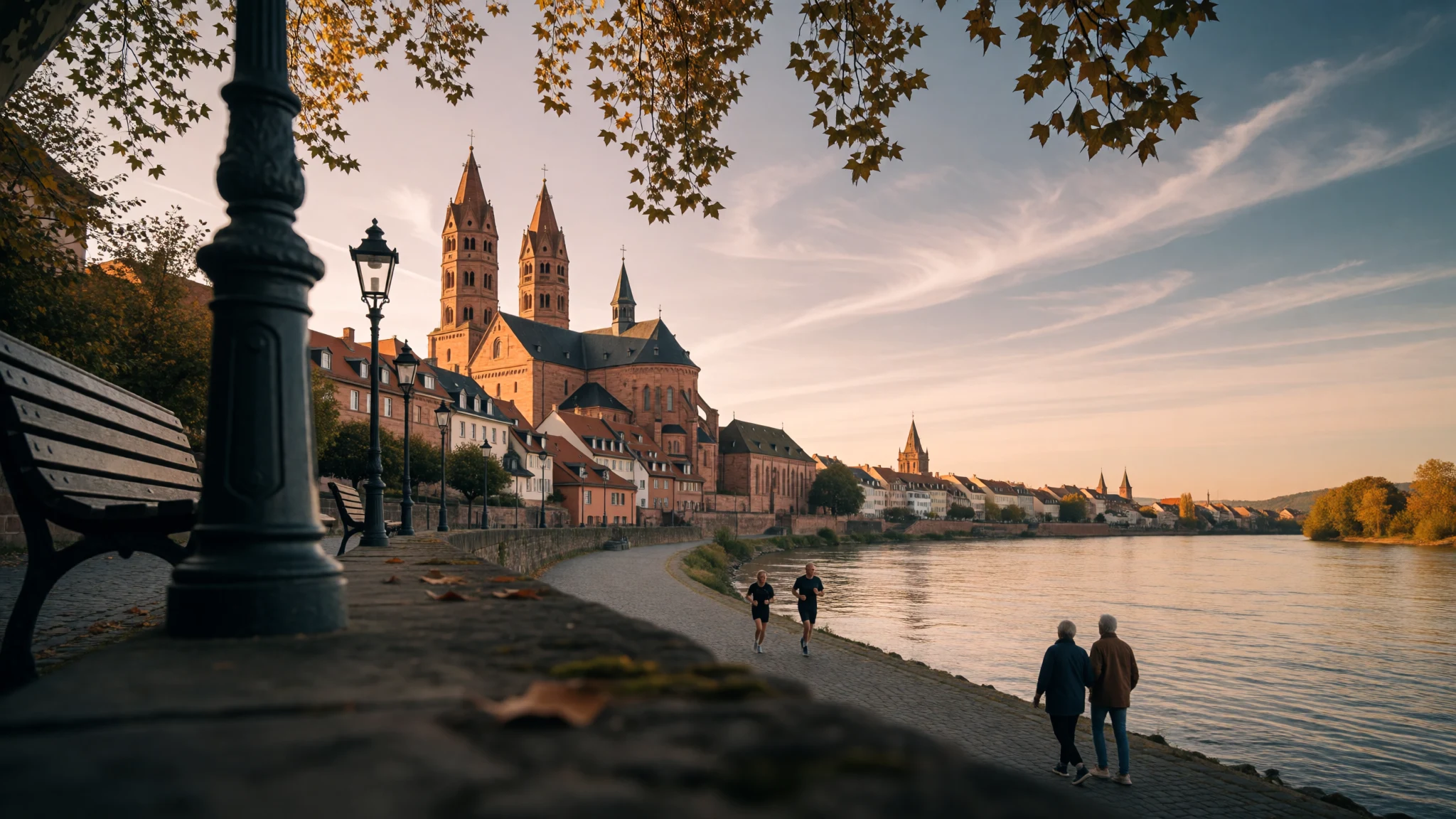
Mainz pairs a Roman frontier past and Gutenberg's printing legacy with a Romanesque cathedral, Rhine-side wine country and an exuberant carnival.
The place
Mainz stands where the Upper Rhine plain runs out in the north, on the river's western bank, about 94 metres above sea level and close to the point where the Main joins the Rhine. It is the capital of Rhineland-Palatinate, home to about 224,000 people, and part of the Rhine-Main region that also takes in Frankfurt, Wiesbaden and Darmstadt. That makes it a calm, mid-sized neighbour to a financial hub: the S-Bahn links it to Frankfurt, so it works as a day out or as a quieter base. The centre is compact. The Hauptbahnhof sits on the western edge of town, and a walk from there to the cathedral and the riverfront covers most of the old core, with half-timbered lanes, Gothic and baroque churches and squares given over to markets. It is also a university town, which shows in the cafés and the student crowd after dark. The surrounding district is Rhenish Hesse, a wine-growing area helped by a mild climate, so vineyards and wine taverns sit at the edge of the city rather than a long journey away. Across the river, districts that were once part of Mainz were split up after the Second World War, with some going to Wiesbaden and some standing independent. The ground is mostly flat and easy on the legs. Mainz feels like a working German city that happens to own a great cathedral, not a museum piece: bicycles, trams, office workers at lunch. Crowds are thin outside carnival time and market mornings, and rain can arrive in any season.
Its story
Mainz began as a Roman military camp, Mogontiacum, founded by the general Drusus around 12 BCE at the meeting of the Main and the Rhine. The site suited an army: a river highway, a frontier to watch and room for a civilian town between fort and water. Over the following centuries a succession of legions was stationed here, a river fleet had its base on the Rhine, and the settlement became the capital of the province of Germania Superior. The Roman city is still surfacing. Hulls of troop ships, along with a patrol vessel dating to the late fourth century, came out of the ground in the 1980s and now sit in the Museum of Ancient Seafaring, and a sanctuary to Isis and the Great Mother, uncovered in 2000, can be visited. After Rome, Mainz grew into the seat of the Electorate of Mainz, ruled by prince-electors whose tombs fill the cathedral. Later it passed through French hands, briefly became a revolutionary republic, then belonged to Hesse and Prussia before joining modern Germany. The twentieth century left its mark as well: the old town was rebuilt after wartime damage, which is why medieval churches stand beside postwar streets. Printing ties the whole story together. Johannes Gutenberg lived and worked here, and the city still uses his name for a museum, a university and a summer festival.
What to see
- Dom St. Martin — Altstadt, Domplatz
Mainz Cathedral is a Romanesque church with a choir at each end, a layout that gives the interior an unusual balance. It is crowded with tombs of the prince-electors who ruled the city, so a slow walk reads as a history of local power. The Domplatz outside doubles as the market square.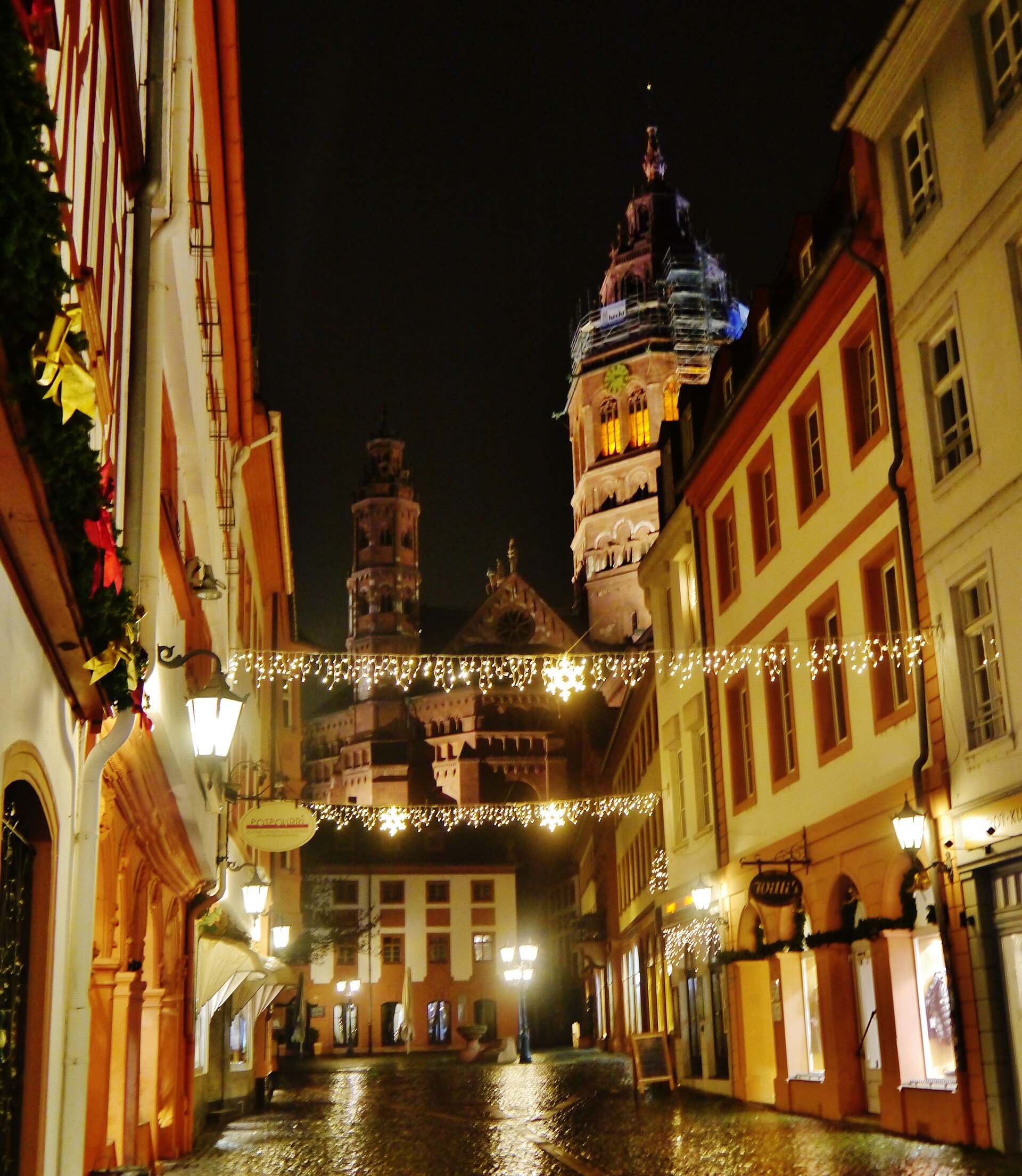
- Stephanskirche — South of the Altstadt
St Stephan's is a Gothic hall church on a rise south of the centre, worth seeking out for its double-choir plan and its stained glass, which is why many visitors come. The interior is calm and usually quieter than the cathedral. Check opening times on the parish or city site before making a special trip. - Christuskirche — Neustadt, north of the Altstadt
Christuskirche is the Protestant church north of the old town, built around the turn of the twentieth century in a Renaissance Revival style. Its large dome was designed to answer the Catholic cathedral across the skyline, and it is easy to spot from the river. Opening times vary, so check locally before visiting.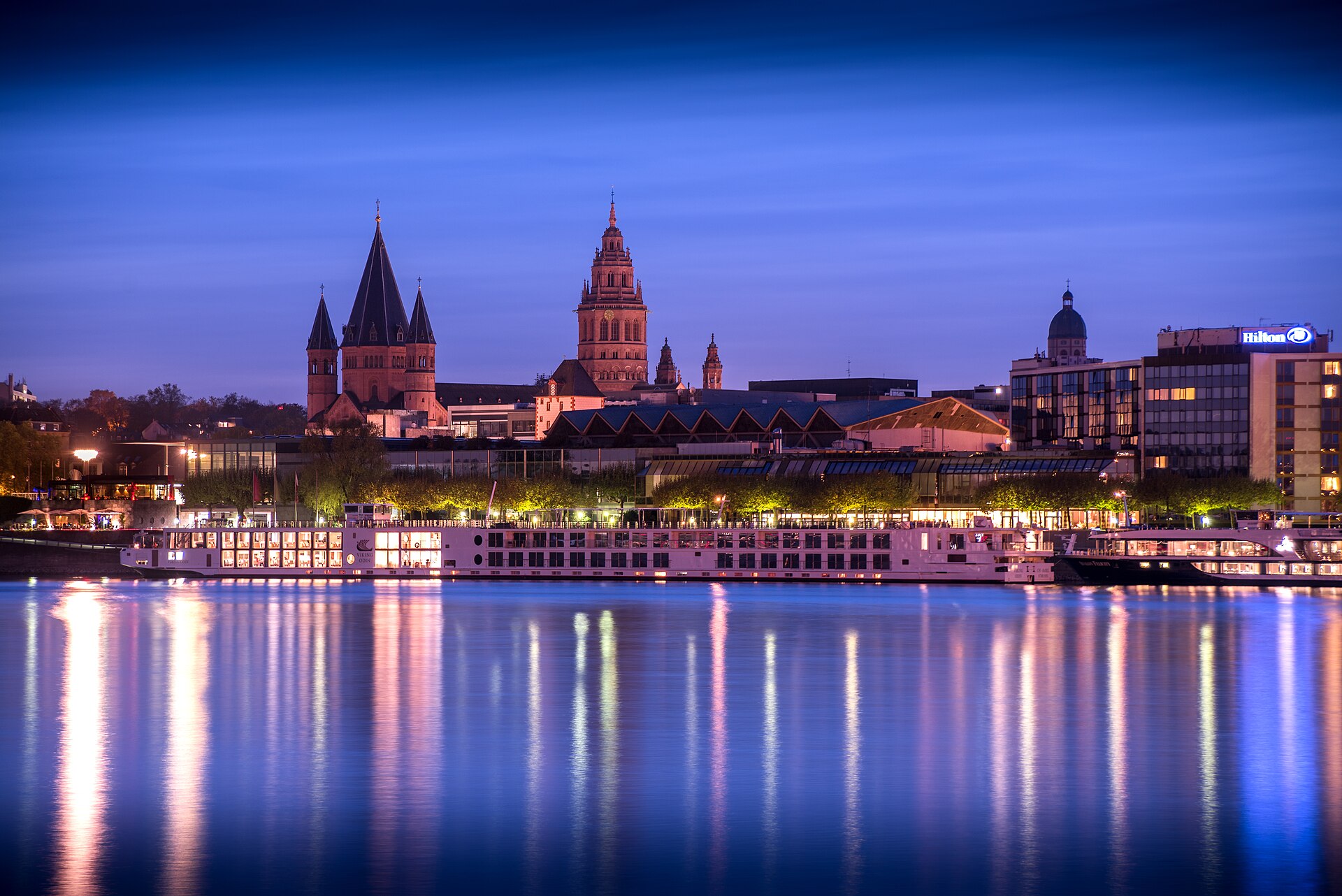
- Sankt Ignaz — Central Altstadt
Sankt Ignaz is a Neoclassical hall church of the eighteenth century, its sandstone façade modelled on a church in Paris. It stands a short walk from the cathedral, and rewards a look from the street even if the doors are closed. Pair it with the nearby Augustinerkirche for a quick comparison of styles. - Augustinerkirche — Central Altstadt
The Augustinerkirche is a Rococo church whose red stone front stands apart from the plainer streets around it. It is small, ornate and quick to visit, and a good contrast with the severe Romanesque of the cathedral. Opening hours depend on services, so look for a notice at the door. - Altstadt — Old town
The Altstadt, the old town around the cathedral, is a tangle of narrow lanes and half-timbered houses, many rebuilt or restored. The market square and the streets around it suit aimless wandering, with wine taverns and bakeries on the way. Early morning is quietest; market days are livelier.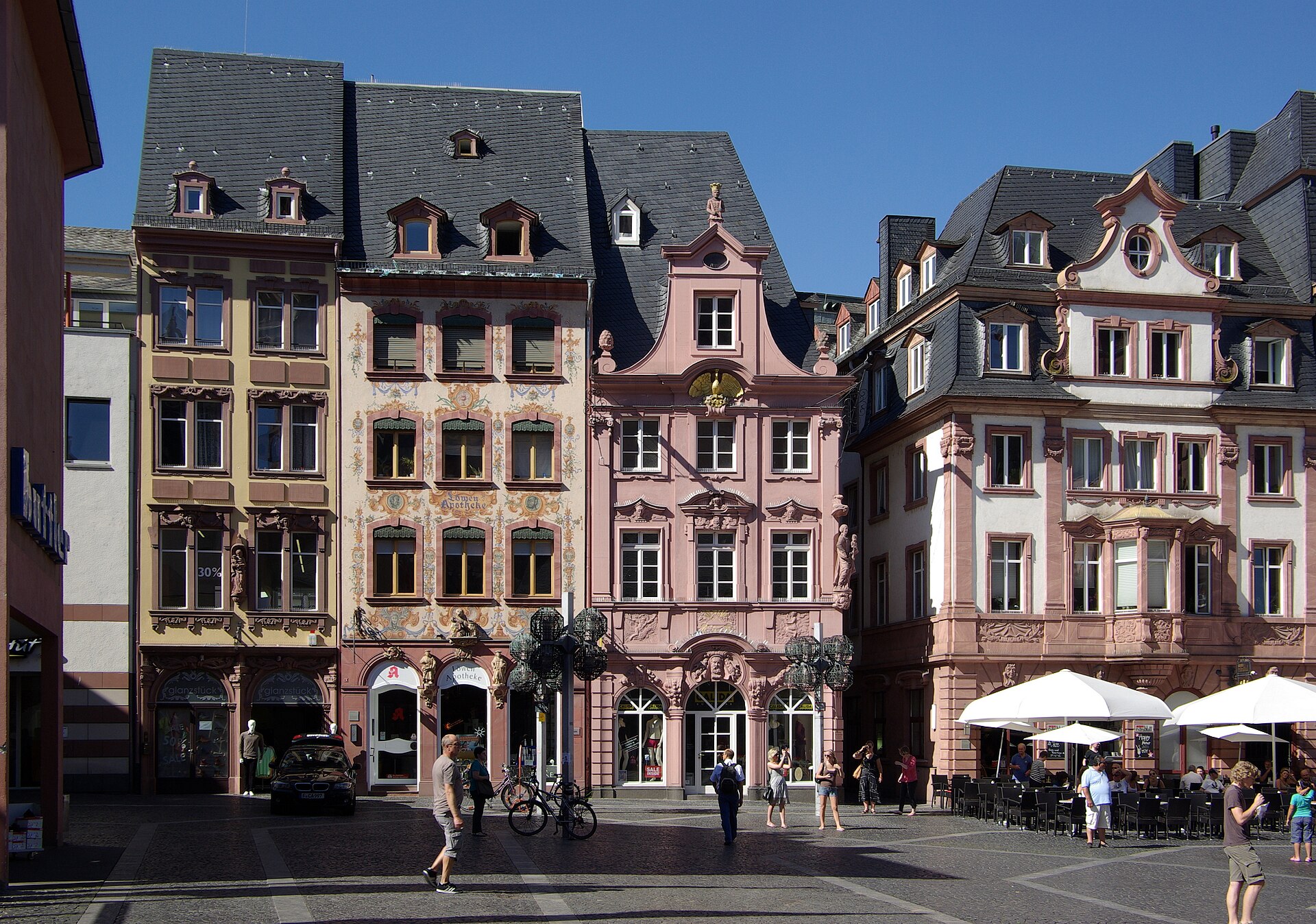
Culture
Mainz is a city with a strong sense of itself, and that identity rests on carnival and on printing. The carnival, known locally as Fastnacht, took shape from the early nineteenth century as a way to mock injustice and authority from behind a jester's cap and bells. Many clubs still wear uniforms that gently caricature the French and Prussian soldiers of earlier times, and the high point is Rosenmontag, the Monday procession, when the streets fill with a huge crowd. Outside that season the city is relaxed and unshowy, closer to a wine tavern than a spectacle. The local hero is Johannes Gutenberg, the printer behind movable type in Europe, who was born and died in Mainz. A museum, the university and the Johannisnacht summer festival all carry his name. The city also has deep Catholic roots, and the first Katholikentag, a mass gathering of German Catholics, was held here in the mid-nineteenth century. Fastnacht humour is topical and political, mostly in German and local dialect, so some jokes will be lost on visitors, but the mood is easy to join. Taverns in the wine country around the city are sociable and often seat strangers together. Anyone planning to visit during carnival should book lodging early and expect noise and closed roads. In the cathedral and other churches, keep your voice low and do not photograph worshippers or services without asking.
What to wear
Mainz has no single everyday folk costume of the kind found in Alpine regions, and visitors who expect one will be disappointed. The nearest thing to traditional dress is the carnival uniform: wool and felt tunics with braid and brass buttons, plumed hats and jester's caps with bells, worn by carnival clubs at balls and processions in the weeks before Lent. Rhineland wine festivals sometimes bring out regional Tracht, usually waistcoats, aprons and cotton prints, but this is dressing up rather than daily habit. What people wear now is plain and practical: jeans, trainers, light jackets, scarves in cooler months and bicycles everywhere. Students set a casual tone, and evenings in wine taverns are smart casual at most. During Fastnacht, costume is the norm, from full outfits to a clown wig, and locals are happy to see a visitor join in. For a visit, pack layers and a light waterproof, since the mild climate still brings rain and cool evenings. Wear comfortable shoes with some grip for cobbled lanes and riverside paths. Churches expect modest dress, so carry a scarf or light layer to cover bare shoulders before stepping inside. In summer, add a sun hat and sunscreen for market and terrace time.
What to eat
- Fischbrötchen (fish roll) — Wochenmarkt on the Domplatz
A soft bread roll filled with fish from a fish-farm stall, one of the better quick lunches at the cathedral market. Eat it standing at the stall, then carry on around the square with the other shoppers. - Currywurst — Snack counters in the Altstadt
Sliced sausage in a spiced tomato sauce, a fast-food staple across Germany. One old-town snack counter, Best Worscht in Town, offers a choice of sauces and heat levels, so say how spicy you want it. - Spundekäs — Wine taverns in the old town
A creamy, paprika-spiced cheese dip, usually eaten with a pretzel or bread alongside a glass of local white wine. It is vegetarian, light and filling, and a good first taste of Rhenish Hesse tavern food. - Handkäse — Traditional German taverns
A small, firm, sharp sour-milk cheese served in a marinade of oil, vinegar and onions, with dark bread. It is an acquired taste, so ask for a small portion first and pair it with a glass of Riesling. - Weck, Worscht und Woi — Market stalls around the cathedral
Bread roll, sausage and a glass of wine: a market-morning habit at the stalls around the cathedral. It sounds heavy for the start of the day but is best taken standing with other people, and the wine is local.
Plan it
Best time. May–June and September–October, when the mild climate suits walking, vineyards are green or in harvest and terraces are open. Carnival in late winter is lively but crowded and noisy.
How long. 1–2
Getting there. Frankfurt Airport is the nearest major airport: take the S8 towards Wiesbaden to Mainz Hauptbahnhof (at least every 30 minutes, about 30 minutes), or a regional train towards Koblenz or Saarbrücken. The Hauptbahnhof is on the western edge of the centre, and the cathedral is a walk or short tram ride away.
Budget. mid
Tips
- Visit the cathedral early in the morning, before tour groups and market crowds arrive
- Book lodging well ahead if you are coming for carnival
- Carry some cash for market stalls and small taverns, although cards are common
- Check the official city site, https://www.mainz.de/, for events and closures before you go
- Allow an extra hour for the Roman remains and the Museum of Ancient Seafaring
Etiquette
- Keep your voice low in churches and avoid photographing worshippers
- Greet staff with a quick 'Guten Tag' when entering shops and taverns
- Share a table in a wine tavern only after asking if the seats are free
Nearby
Sources
- Wikidata Q1720 (CC0)
- Wikipedia: Mainz (rev 1384592413) (CC BY-SA 4.0)
- Wikivoyage: Mainz (rev 5410214) (CC BY-SA 4.0)
- Photo: Theodor-Heuss-Brücke, Ansgar Koreng (CC BY-SA 3.0 de)
- Photo: Mainzer Dom Blaue Stunde, salomon10 (CC BY 2.5)
- Photo: Mainz Markt, Berthold Werner (CC BY 3.0)
- Photo: Kaiserdom St. Martin bei Nacht, Zairon (CC BY-SA 4.0)
- Photo: Mainz St. Peter, Berthold Werner (CC BY 3.0)
- Photo: Mainz Osteiner Hof, Berthold Werner (CC BY 3.0)
- Photo: Drususstein, Martin Bahmann (CC BY 3.0)
- Photo: Alte Universität, Mainzer Dom und Staatstheater, Simsalabimbam (CC BY-SA 4.0)


