Mahabodhi Temple
Mahabodhi Temple, India
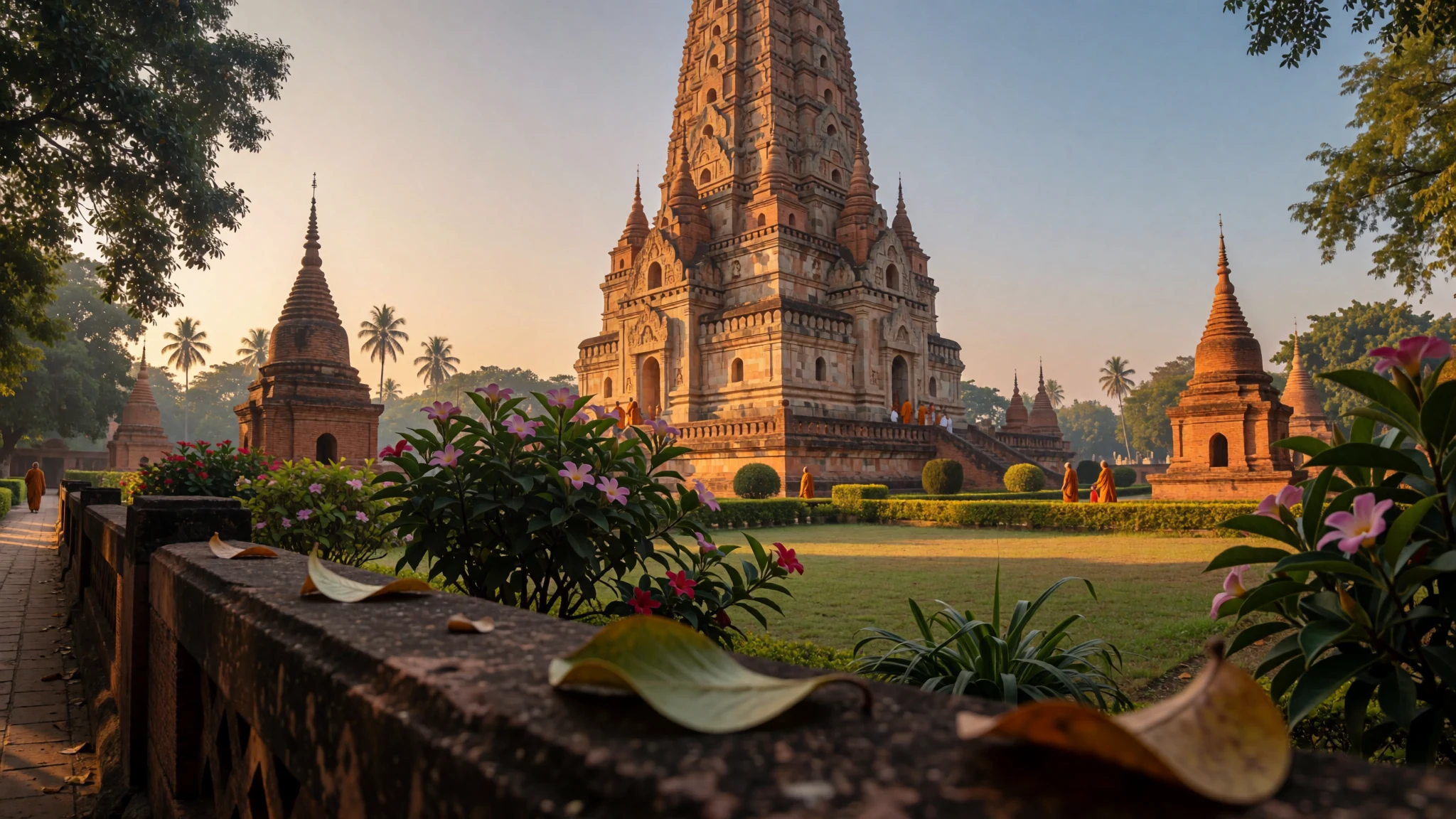
Bodh Gaya's Mahabodhi Temple is where Buddhists trace the Buddha's enlightenment, and it rewards a slow morning walk among shrines and fig trees.
The place
Mahabodhi Temple stands in Bodh Gaya, a small town in the state of Bihar in north-eastern India, and marks the place where Buddhists hold that the Buddha reached enlightenment. The name can be rendered as Great Awakening Temple. The main building is a tall, tapering tower of brick and stone rising above a broad base, set inside a walled compound that also holds smaller shrines, monasteries and gardens. Pilgrims move around the grounds in a steady clockwise flow, and many sit quietly on the lawns between the shrines. Inside the compound grows a fig tree believed to descend from the original Bodhi Tree, and the site has drawn Buddhist pilgrims for more than two thousand years. UNESCO has recognised the temple as a World Heritage Site, which adds weight to conservation work on the complex.
The visible structure is in large part the product of later rebuilding. Several of the earliest carvings were relocated to the museum next to the temple, and some of the stone railings surrounding the main shrine are reproductions. Because of this, the courtyard seems more cohesive than its actual past would suggest. The town itself is modest. Japanese and Taiwanese temples sit near the approach roads, along with Tibetan-linked monasteries, giving Bodh Gaya an international character. The early morning and late afternoon are the most comfortable times to explore the compound, when the light is softer and the crowds are thinner.
Its story
Mahabodhi Temple grew out of the story of Siddhartha Gautama, a young prince who left his comfortable life after confronting the suffering he saw around him. Tradition places this around 589 BCE. He arrived at the tree-lined shore of the Phalgu River, close to Gaya, and settled under a peepul, a holy fig tree that was later called the Bodhi Tree. Buddhist scriptures describe him meditating for days until he attained enlightenment, a freedom from suffering that Buddhists regard as the goal of their path. The tree and its spot became the focus of devotion from the beginning.
The first building on the site is usually credited to Emperor Ashoka, the Mauryan ruler who died around 232 BCE, and tradition dates a shrine there to about 260 BCE. Archaeology supports a long history of veneration: finds show that Buddhists honoured the place from the Mauryan period, and the Vajrasana, the diamond throne inside the temple, has been dated to the third century BCE. What stands today was largely shaped in the 6th century CE, though it may reuse earlier brickwork from the 2nd or 3rd century CE. Restorations since the 19th century have altered it further.
Buddhist tradition also follows the weeks after the awakening. Gautama is said to have spent seven weeks at seven spots nearby, reflecting on what he had realised. In one of them he stood gazing at the tree without blinking, and the Animeshlocha Stupa, the unblinking shrine, now marks that place north-east of the complex. A statue there shows him with his eyes fixed on the Bodhi Tree. Each spot links to a different episode, so the grounds feel less like a single monument and more like a walk through a sequence of memories.
What to see
- Mahabodhi Temple — Bodh Gaya town centre, the temple compound
The main compound is the reason most people come. Its central tower is the image visitors remember, and the grounds hold the sacred fig, the diamond throne and a series of shrines and gardens laid out for walking. Allow a few hours, take off your shoes at the inner sanctum, and move clockwise around the stupa with the crowd.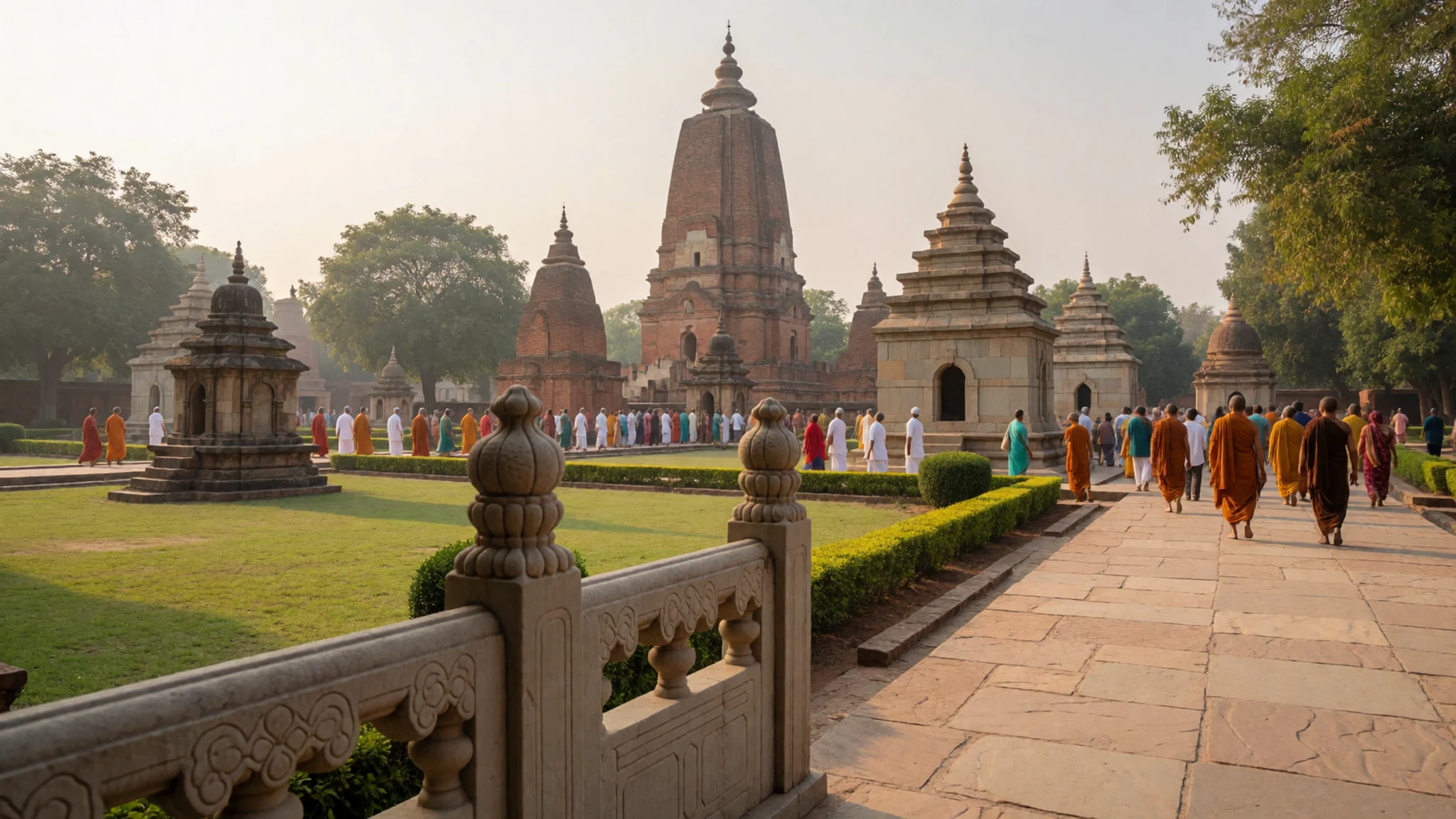
- The Bodhi Tree — Inside the temple compound, beside the main shrine
The Bodhi Tree is a peepul, the sacred fig under which tradition says the Buddha sat. The tree growing inside the compound is believed to descend from that original, and it has drawn pilgrims for more than two thousand years. Many visitors sit quietly in its shade, and a respectful distance from the railings keeps the paths open.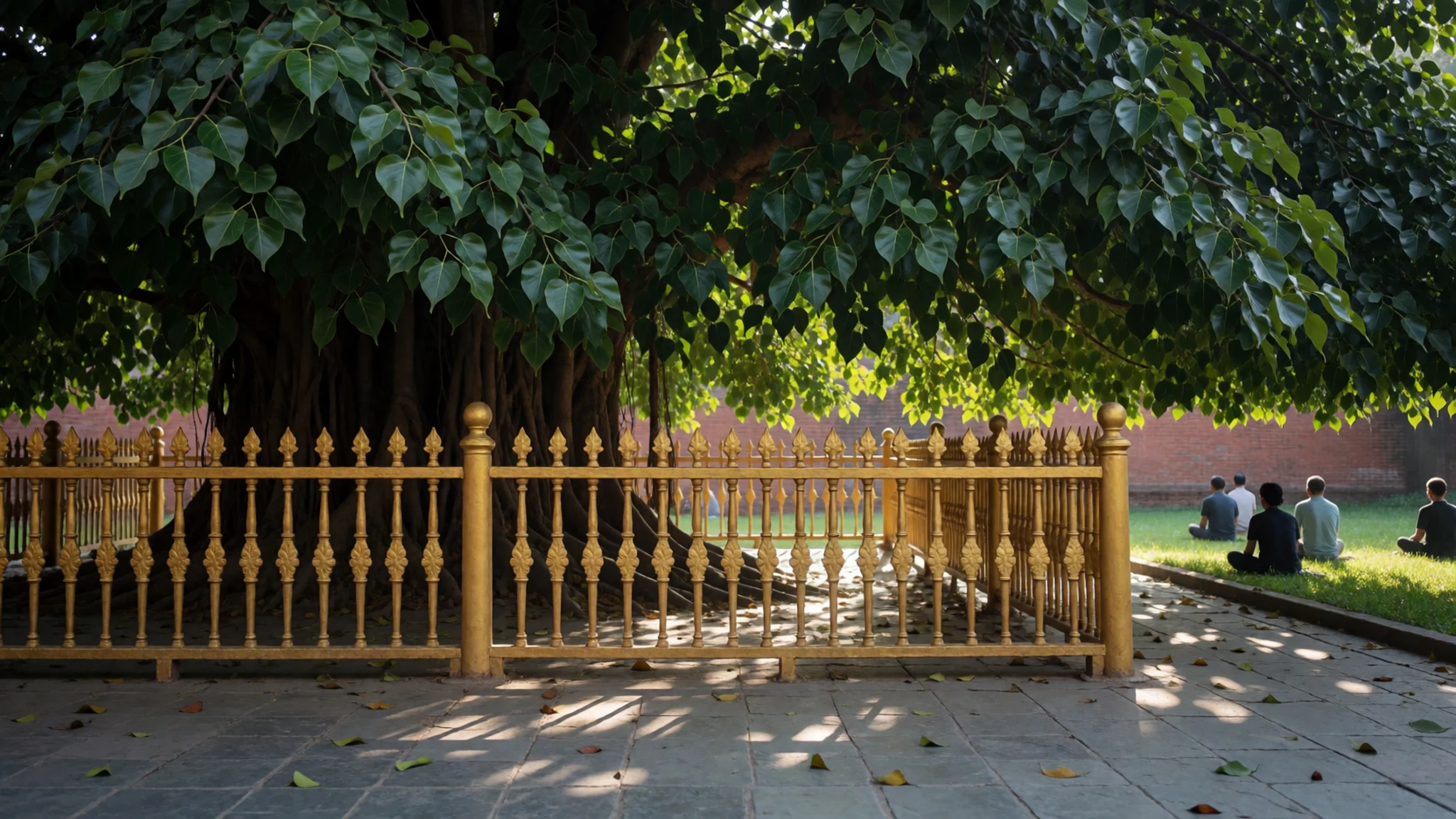
- Animeshlocha Stupa — North-east of the temple complex, within walking distance
The Animeshlocha Stupa, meaning the unblinking shrine, marks the spot where Buddhist tradition says the Buddha stood gazing at the Bodhi Tree without blinking. A statue there shows him with his eyes fixed on the tree. It is a quieter stop than the main compound, and a good place to sit for a few minutes.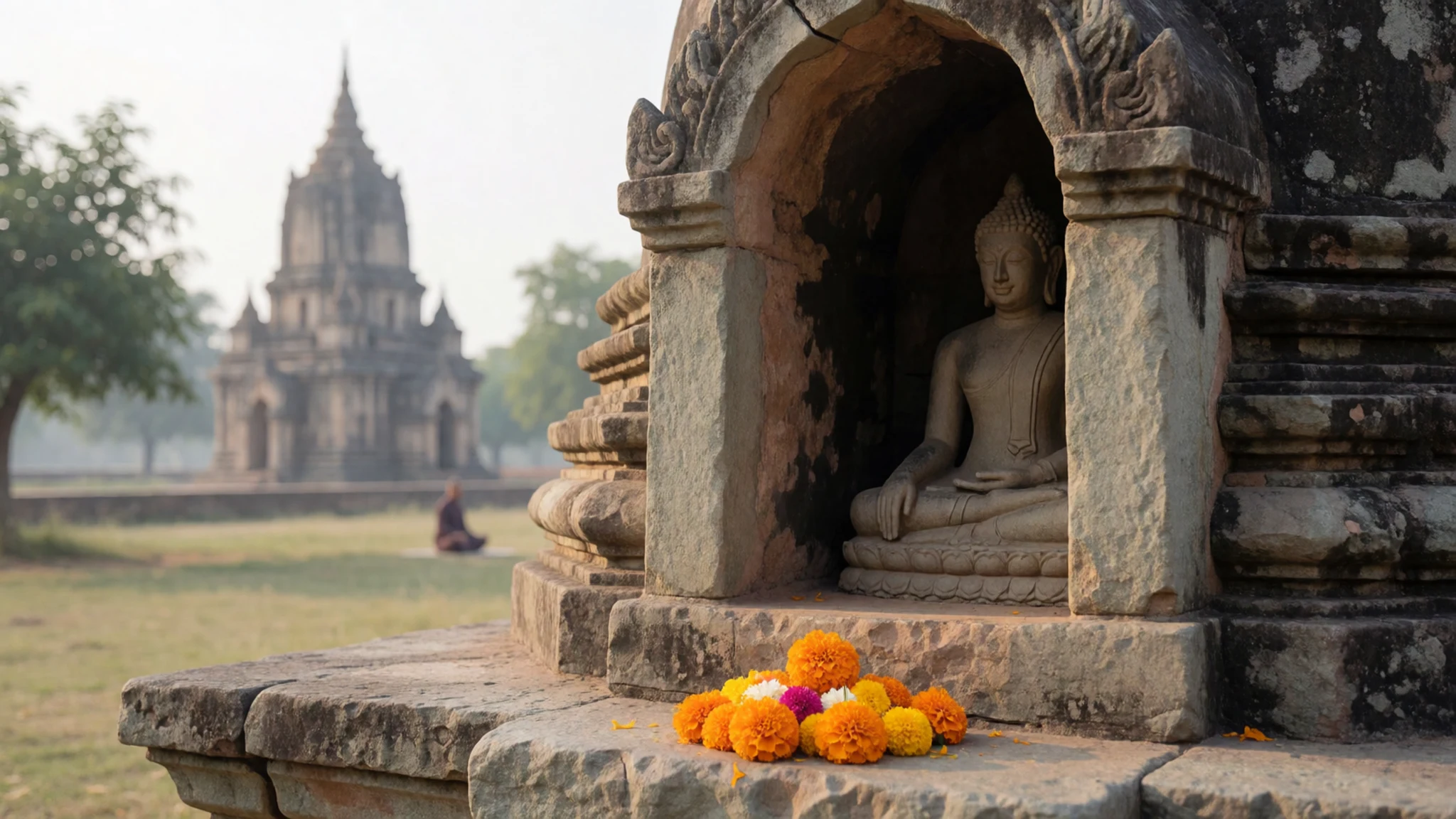
- Archaeological Museum — Immediately beside the temple compound
The Archaeological Museum beside the temple holds many of the oldest sculptural pieces from the site, moved indoors to protect them. Carved railings and reliefs show the early work that replicas now stand in for on the temple itself. Visiting before the main compound helps the carvings make sense when you walk the grounds.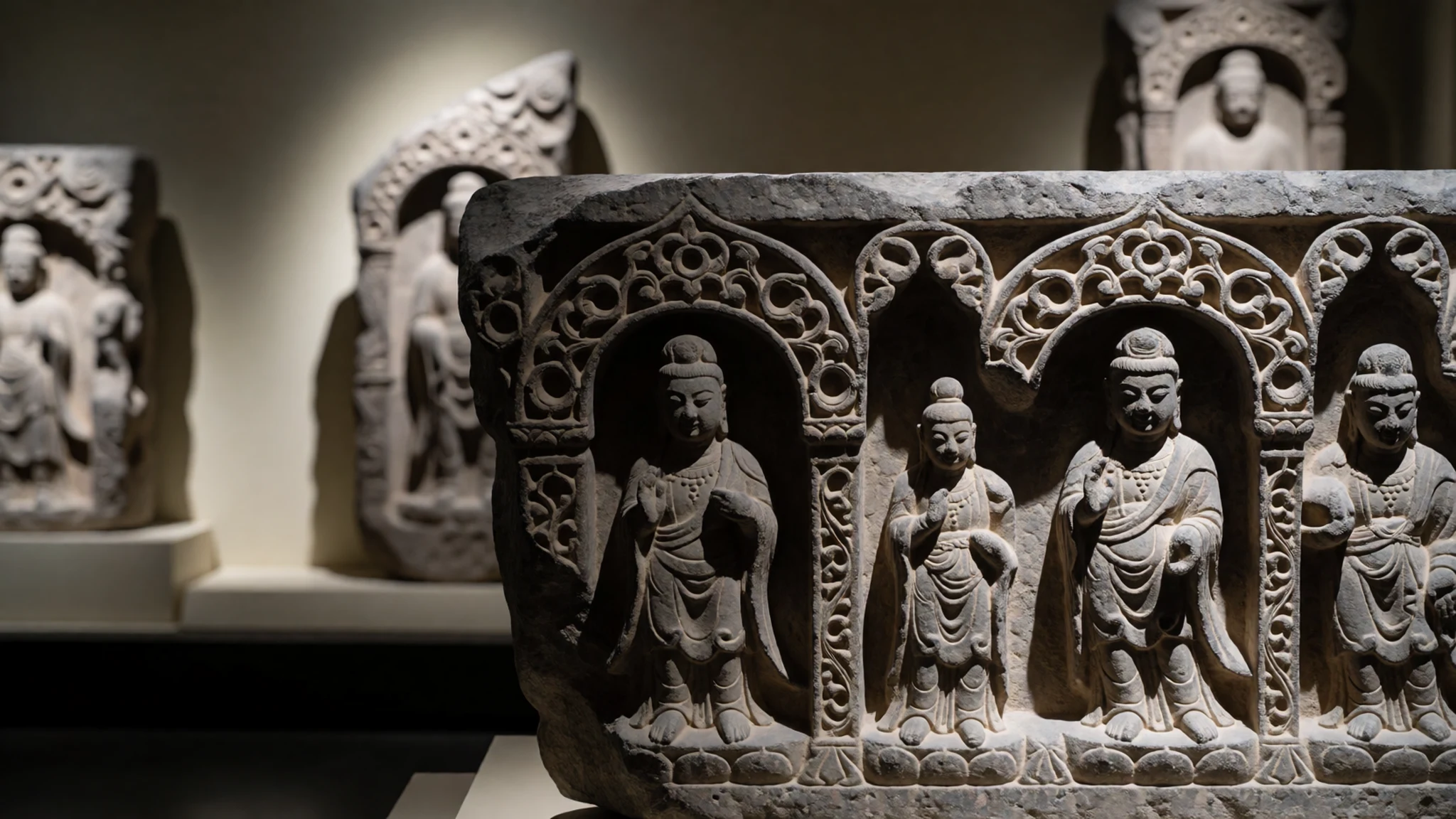
- The Great Buddha Statue — South-west of the main temple, a short drive away
The Great Buddha Statue, also called the 80-foot Buddha, stands about 25 metres tall and was built by the nearby Daijokyo Buddhist Temple in 1989. Many visitors come to see it, and its scale makes a striking contrast with the older brick temple. It is worth a visit in the late afternoon, when the light is warm.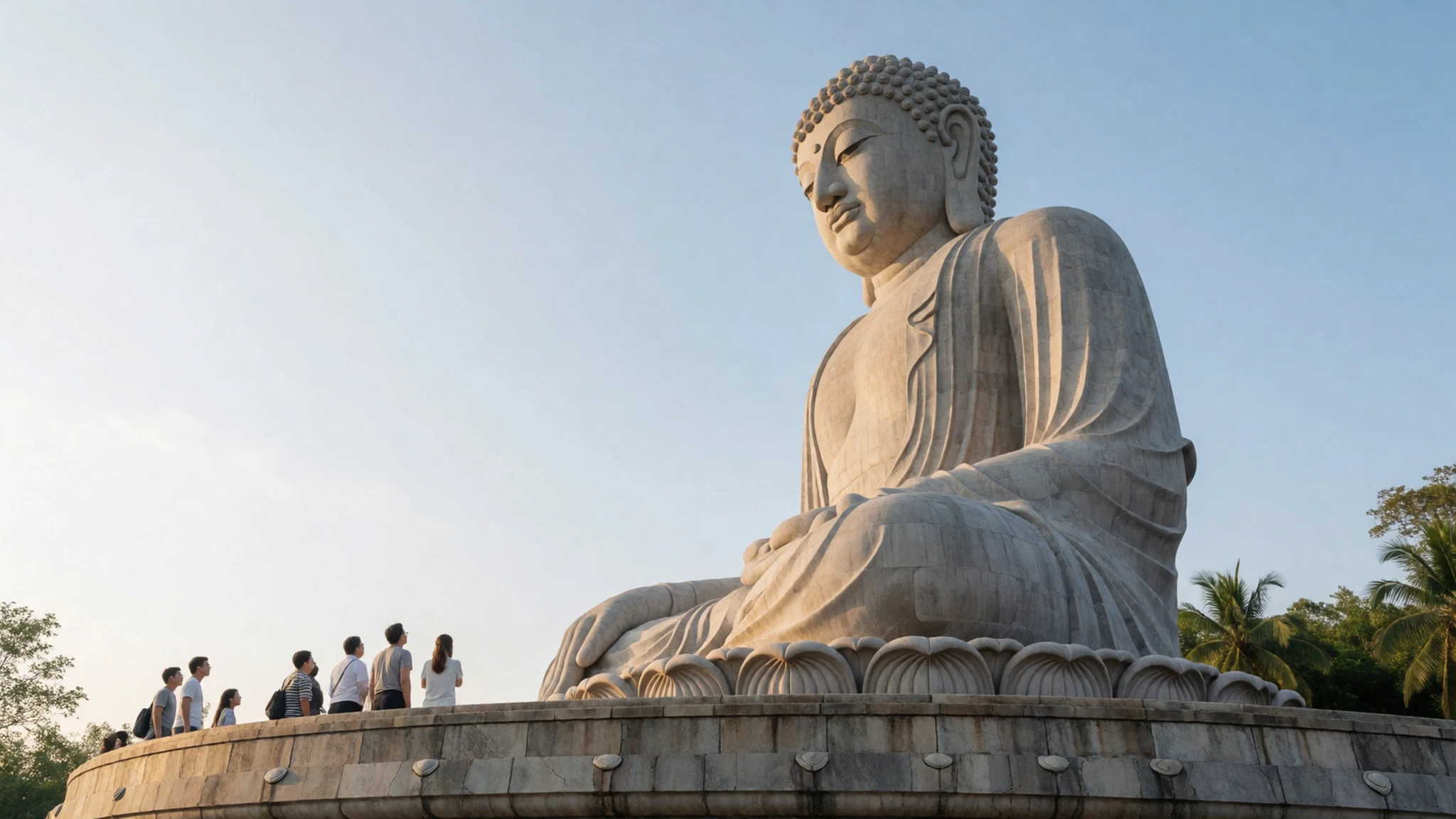
Culture
Mahabodhi Temple is a working place of worship, so the customs that apply to any Buddhist shrine apply here. Visitors remove their shoes before entering the inner sanctum, and monks and pilgrims often sit on the floor for long periods, so footwear should be easy to slip on and off. Walking around the stupa and other sacred objects is done clockwise, following traditional Buddhist practice, and many people do this slowly, some chanting or counting beads. Monasteries nearby keep their own rituals, and visitors are welcome to watch quietly from the edges.
Dressing modestly is expected in a town full of pilgrims and monks. Loose clothing that covers the shoulders and knees is the simplest approach. The approach roads attract beggars, and many visitors find this hard to face; a polite refusal with a smile is usually enough, and giving through established charities avoids drawing a crowd around one person. Keep your voice low in the shrines and let monks and pilgrims set the pace of the walk. Do not climb on statues, railings or the stupa, because doing so is considered deeply disrespectful.
What to wear
Mahabodhi Temple sits in a town where traditional Bihari dress, modern clothing and monastic robes all share the same streets. Traditional dress in Bihar is shaped by the heat, so women commonly wear saris of cotton or silk, and the salwar kameez, a long tunic over loose trousers, is widespread. Men often wear a kurta with pyjamas, or a dhoti, the wrapped cloth. Cotton is the everyday fabric, while silk and embroidered borders are kept for weddings and festivals. Monks wear maroon and saffron robes, the clearest visual marker of the Buddhist presence around the compound.
Most people in Bodh Gaya now dress in modern clothes, with jeans, shirts and trousers common alongside kurtas and salwar kameez. Pilgrims from Buddhist countries often wear their own national or monastic dress, and visitors from abroad usually choose loose trousers or long skirts. Fashions change quickly in towns like this, but modest dress remains the norm around shrines.
For a visit, lightweight cotton or linen in a loose cut works best for the heat, particularly from March to May. A light shawl or long-sleeved layer covers the shoulders for entering the temple. Long trousers or a midi skirt suit both men and women. Footwear matters more than fashion here: slip-on sandals or shoes are ideal, because you will take them off often, and a pair of closed shoes with grip helps on the uneven paths between shrines and the market.
What to eat
- Bihari thali — Simple local eateries in the town centre near the temple road
A thali is a platter of small dishes served together, usually with rice, dal, vegetables, a pickle and flatbread. In Bihar the platter often includes a lentil dish and seasonal vegetables cooked lightly with spices. Order it at a simple local eatery where the food is freshly made.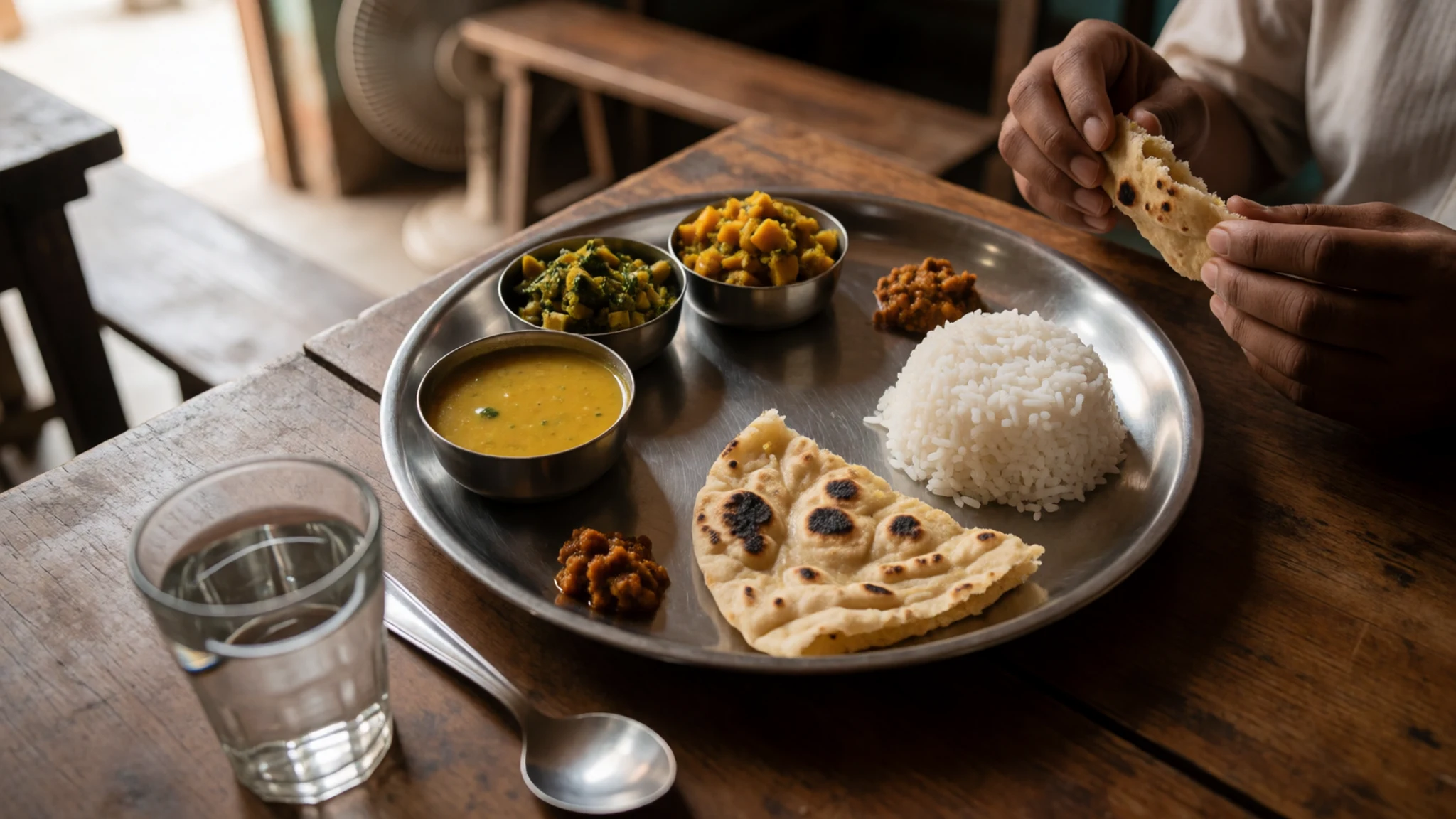
- Litti chokha — Evening food stalls on the main roads of the town
Litti chokha is a Bihari staple of wheat dough balls filled with roasted gram flour and eaten with mashed vegetables, often smoked aubergine and potato. Stalls set up on the roads of the town in the evening, and the balls are cooked over charcoal. Ask for ghee on top.
- Sattu drink — Juice stalls near the morning market
Sattu is roasted gram flour, and mixed with water, lemon, salt and a little cumin it makes a thick, cooling drink that suits the afternoon heat. Juice stalls near the morning market sell it by the glass. It is filling, so it works as a midday snack. - Momos — Cafes and stalls along the monastery road
Momos, steamed dumplings with a chilli dip, are on the menu at many cafes and stalls around the monasteries, reflecting the Tibetan community nearby. Buy them hot from a steamer and pick vegetable or chicken fillings. - Milky chai — Tea stalls near the temple gates and sweet shops on the main road
Milky chai, brewed sweet with ginger and sold in small glasses, is the easiest way to pause between shrines. Tea stalls near the temple gates keep a pot on the boil from early morning. Add a milk-based barfi from a sweet shop on the main road.
Plan it
Best time. November to January, when the days are mild and the nights cool, are the most comfortable months. March to June is hot, and the monsoon from June to September brings heavy rain and humidity.
How long. 2–3
Getting there. Gaya airport is about 10 km away and Gaya railway station about 16 km, with buses and autorickshaws covering the last leg to Bodh Gaya. Patna airport is 110 km away, and the road from Patna takes just over 2 hours.
Budget. low
Tips
- Arrive early in the morning, when the grounds are quiet and the heat has not yet built.
- Allow at least half a day for the main compound and the museum, and more if you want to sit quietly.
- Carry cash for autorickshaws, small stalls and donations, as card payment is limited in the town.
- Carry a refillable water bottle and drink often, since the heat and dust are tiring in the afternoon.
- Expect touts and beggars on the approach roads; a polite no and a steady pace usually works.
Etiquette
- Remove your shoes at the inner sanctum and keep them in one place.
- Walk clockwise around the stupa and sacred objects.
- Do not climb on statues, railings or monuments.
- Dress modestly and cover shoulders and knees.
Nearby
Sources
- Wikidata Q4513 (CC0)
- Wikipedia: Mahabodhi Temple (rev 1376910731) (CC BY-SA 4.0)
- Wikivoyage: Bodh Gaya (rev 5395443) (CC BY-SA 4.0)
- Photo: Maha Bodhi Temple, Bodhgaya (Bpilgrim) (CC BY-SA 2.5)
- Photo: Adoration of the Diamond Throne and the Bodhi Tree Bharhut relief (Ken Kawasaki) (CC BY 3.0)
- Photo: Bodhi Tree Distant View (Neil Satyam) (CC BY 3.0)
- Photo: Diamond throne discovery (Cunningham) (Public domain)
- Photo: Diamond Throne Vajrasana (detail) (Evan Lovely) (Public domain)
- Photo: Bodh Gaya pillar reconstitution (Cunningham; G41rn8) (CC BY-SA 4.0)
- Photo: Bodh Gaya Sunga railing (Garrick, 1880) (Public domain)
- Photo: Bodh Gaya Sunga railings (Garrick, 1880) (Public domain)


