Lake Lucerne
Lake Lucerne, Switzerland
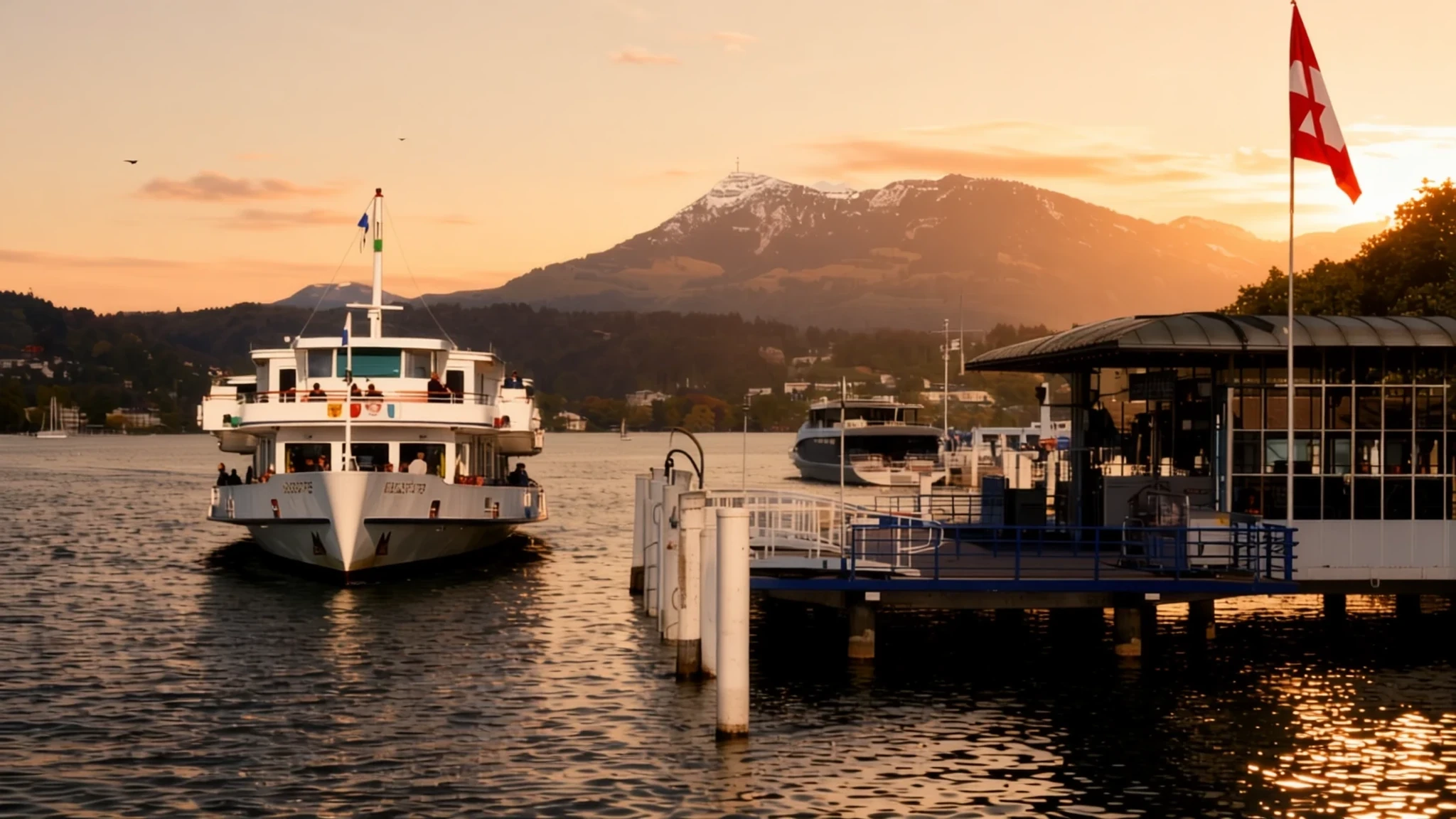
A lake of many arms ringed by steep peaks, shaped by ice and used as an Alpine route for centuries.
The place
Lake Lucerne, known in German as Vierwaldstättersee, lies in central Switzerland and is the fourth largest lake in the country. Its German name points to the four forest cantons that border it, a reminder that the shoreline has long been shared between several separate communities. The lake does not form a neat oval. Sharp bends and four long arms give it an irregular, almost crooked outline, and each of its nine sections carries its own name, from the Lake of Uri at the eastern end to the Lake of Alpnach, a near-separate arm tucked beneath the southern flank of Pilatus. The deepest basin lies beside Gersau, below the Rigi massif, while the bay at Lucerne city takes in the outflow of the Reuss. Mountains rise steeply from the water on almost every side, so boats often seem to travel up a valley rather than across an open lake. Villages such as Brunnen, Vitznau and Stansstad sit where the slopes meet the shore, and paddle steamers still link them. Because the lake lies on a natural route through the Alps, the shoreline is busy in summer, but early mornings on the still water remain its most convincing quality.
Its story
Lake Lucerne took its present shape at the end of the last ice age, when meltwater from the Reuss Glacier filled the hollows that the ice had gouged out. Similar lakes formed across central Switzerland in the same way, and the steep, shadowed sides of its basins still reflect that glacial origin. Human activity is older than the written record once suggested. Underwater surveys made while a pipeline was being laid across the lake-bed uncovered traces of a prehistoric lakeside settlement, and the finds pushed back the date of the first occupation of the area. Travel followed the Alps. After the Gotthard Pass opened in 1230 as a route through the mountains, the lake sat at the heart of that corridor, and until 1863 it was the only water connection along the route. Goods and travellers moved by rowing boat and sail until the Stadt Luzern, the first steamer, began running in 1837 and made crossings faster and more regular. The twentieth century left a less comfortable legacy. The Swiss armed forces used the lake as a dumping ground for old munitions, and about 3,300 tonnes are thought to remain on the bed. Switzerland's defence ministry has put up 50,000 Swiss francs for a secure way to get rid of them, but how the clean-up will be handled is still undecided.
What to see
- Mount Pilatus — Alpnach, south of the lake
Pilatus rises above Lucerne and the Alpnach arm, and its summit can be reached by cable car and a steep cog railway. From the top the lake spreads out below like a map, with the Stanserhorn and the Alpnachersee visible on the far side. The views are at their clearest in the morning, before cloud builds over the peaks in the afternoon.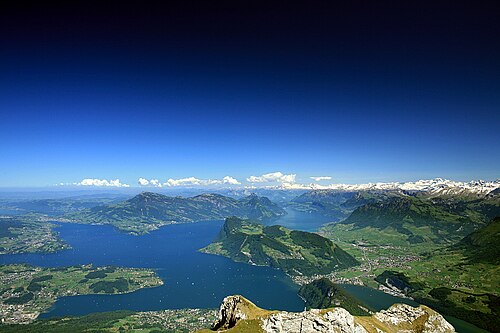
- Mount Rigi — Vitznau and Weggis, east shore
The Rigi massif sits beside the deepest basin of the lake, and its slopes rise in steps of meadow and forest. Trains climb from Vitznau and Arth, and walkers can follow marked paths down through pasture and woodland. The summit gives a wide view over the water and across to the peaks of central Switzerland. - Chapel Bridge — Lucerne old town
The covered wooden Chapel Bridge crosses the Reuss where the river leaves the lake, and the painted panels under its roof show scenes from local history. The Water Tower stands beside it, a relic of the city's old defences. Walk across early in the morning, when the bridge is quieter and the light on the water is soft. - Rütli meadow — Urnersee, between Brunnen and Seelisberg
A small meadow above the eastern shore of the Urnersee, tied to the founding legends of the Swiss confederation. The site has more legend than documented history, so most visitors come for the setting rather than for any single monument. Boats call at the landing, and the path up from the water is short but steep in places. - Bürgenstock — above Vitznau, east shore
The Bürgenstock plateau lies between the Rigi and the Stanser Trichter, reached by a funicular from the lake shore. Its terraces and paths look out over the Vitznauer Bucht and the surrounding peaks. It is a quieter alternative to the busier viewpoints, with walks through pine woods and open meadows.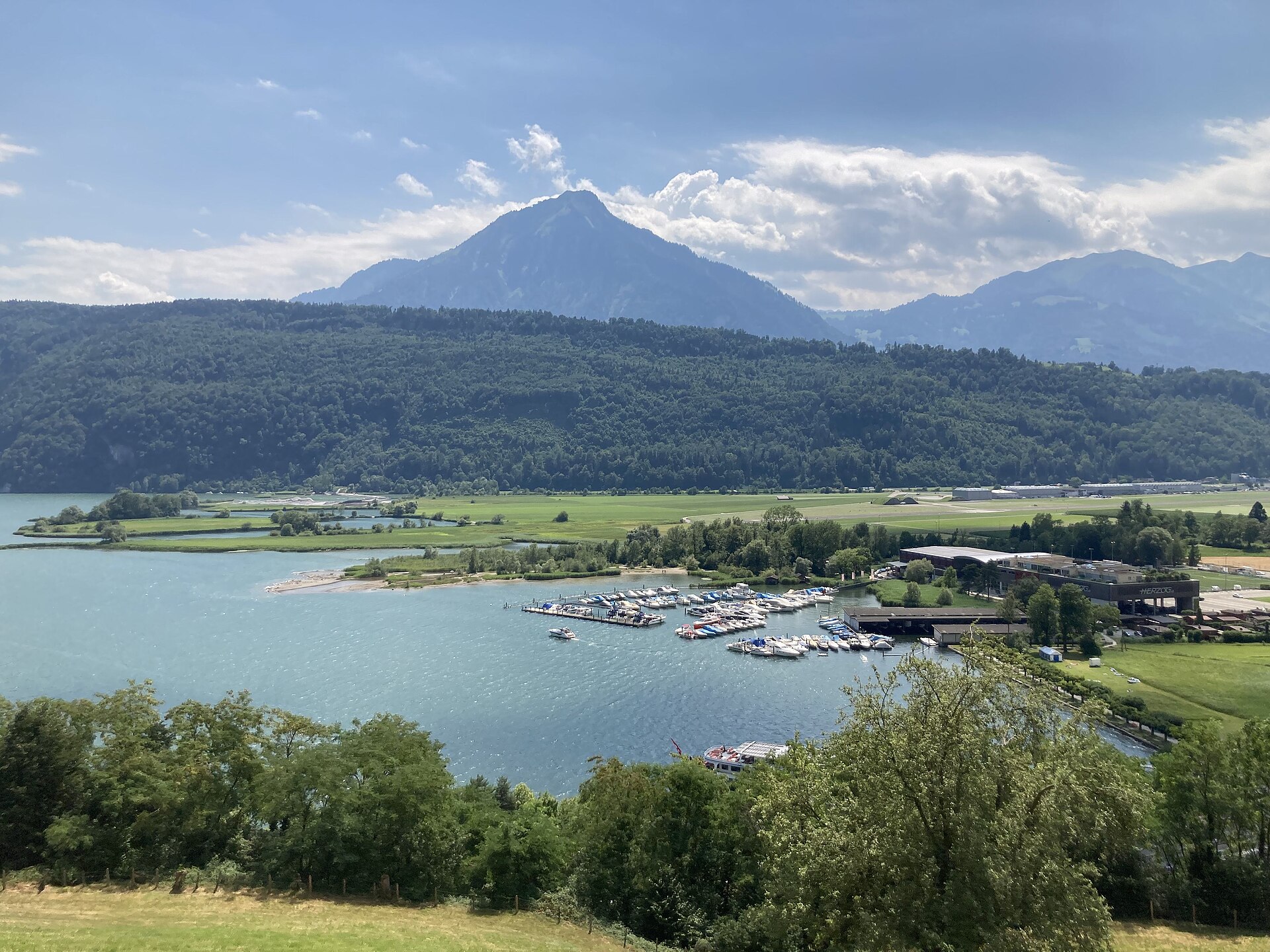
Culture
Around Lake Lucerne, Swiss values are often described as placing weight on cleanliness, organisation, integrity and responsibility, and these show up in tidy promenades and well-kept boat landings. Manners vary from canton to canton. Speakers of German, who make up most of the lake's shoreline communities, tend to be more direct and formal than French or Italian speakers, so a polite greeting and a clear question are well received. Privacy matters a great deal here. Swiss people generally do not welcome questions about personal background, religion or politics unless they know the person well, and conversations on crowded boats and trains stay low-key. Punctuality is expected on trains, boats and cable cars, and queues are respected at the piers. Keep to the queue at boat landings and speak quietly on board, since fellow passengers value calm and privacy.
What to wear
Around Lake Lucerne, traditional dress belongs mostly to festivals, folk groups and museums rather than to everyday life. Central Swiss costume, known as Tracht, varies from valley to valley, but it usually combines dark wool or linen, embroidered bodices and aprons, and a white blouse with full sleeves for women. Men's dress often includes wool waistcoats and felt hats decorated with ribbons. Silver clasps and brooches were a common finish in the past. Today most people in Lucerne and the lakeside villages wear contemporary, city-ready clothes such as jackets, jeans, trainers and sturdy outdoor layers, and the hiking look is popular on Pilatus and Rigi. For a visit, dress for changeable weather, since a warm morning on the boat can turn cold and wet on the mountain. Pack a windproof, waterproof jacket, a fleece and footwear with good grip for rocky paths and wet cable-car platforms. Sun protection matters at altitude. Churches in Lucerne expect shoulders to be covered, so a light scarf helps. Shorts and beachwear suit the lakeshore but feel out of place in the old town cafés.
What to eat
- Fondue — traditional restaurants in the Lucerne old town and mountain huts above the lake
A pot of melted cheese, with bread cubes dipped on long forks. Two or three cheeses are blended with white wine, garlic and kirsch, and the classic moitié-moitié uses equal parts Gruyère and Vacherin Fribourgeois. Find it in Lucerne's old-town cheese restaurants or at a mountain hut. - Raclette — mountain restaurants and village inns on the slopes above the lake
Cheese is melted at the table and scraped onto boiled potatoes, pickled gherkins and cured meats. The name comes from the French verb for scraping. It is especially welcome in colder months, when the meal turns a lakeside visit into a warming dinner. - Swiss cheese platter — cheese shops and dairy stalls in Lucerne, or farm stalls in the hills above the lake
A board of Gruyère, Emmentaler and Appenzeller, served with bread, pears or walnuts. Switzerland makes about 450 kinds of cheese of Swiss origin, so a platter is a good way to taste several at once. Ask for local varieties rather than the most familiar ones. - Rösti — village restaurants and morning counters in the old town
Grated potato fried in butter until crisp outside and soft within, often served with fried eggs, bacon or cheese. It is a staple of German-speaking Switzerland and is at its best in plain village restaurants, where it arrives in a heavy pan. - Lake whitefish — lakeside restaurants on the Lucerne shore and the villages along the Vitznau and Weggis bays
Felchen, a whitefish from Swiss lakes, is usually pan-fried or baked with butter, lemon and herbs. Its mild flesh suits the simple cooking common along the shore, and it is often served with boiled potatoes and a green salad.
Plan it
Best time. Lake Lucerne is best from late spring to early autumn, when the slopes are green, the days are long and the mountain railways run in full. June brings long light and summer crowds, while September and October offer clearer air and autumn colour. Midsummer is the busiest time, close to the warmest, with July and August the hottest months, and winter suits only the lower shore.
How long. 2–3
Getting there. Fly into Zurich, then take a direct train to Lucerne station, where the lake is a short walk away. Boats and cable cars leave from the lakeside, and the Rigi and Pilatus railways start close to the water.
Budget. mid
Tips
- Book boat and mountain tickets ahead in summer, and check the official site for current timetables
- Start early on Pilatus or Rigi, when the views are clearest before afternoon cloud builds
- A rail pass can cover trains and some boats, so check the official site before you buy
- Carry some cash for small kiosks, though cards are widely accepted in towns
- Pack layers and water for mountain walks, because the weather on the lake can change quickly
Etiquette
- Stand clear of the boat gangway until passengers have disembarked
- Keep voices low on boats and in trains
- Do not ask people about their personal background
Nearby
Sources
- Wikidata Q14381 (CC0)
- Wikipedia: Lake Lucerne (rev 1366230130) (CC BY-SA 4.0)
- Wikivoyage: Switzerland (rev 5375951) (CC BY-SA 4.0)
- Photo: Lake Lucerne from Pilatus (Ttrainer) (CC BY 3.0)
- Photo: Map of Vierwaldstättersee (Tschubby) (CC BY 3.0)
- Photo: Uri arm near Morschach (GabrielleMerk) (CC BY-SA 4.0)
- Photo: Lake Uri, canton of Schwyz (Plattens) (CC BY 3.0)
- Photo: Passenger ship MS Europa (Ad Meskens) (CC BY 3.0)
- Photo: Nauen Fritz (Gustav Broennimann) (CC BY-SA 3.0 ch)
- Photo: Stanserhorn beyond Alpnachersee (Mattsjc) (CC BY-SA 4.0)
- Photo: Lake view (Thomas Woodtli) (CC BY-SA 2.0)


