Knidos
Knidos, Turkey
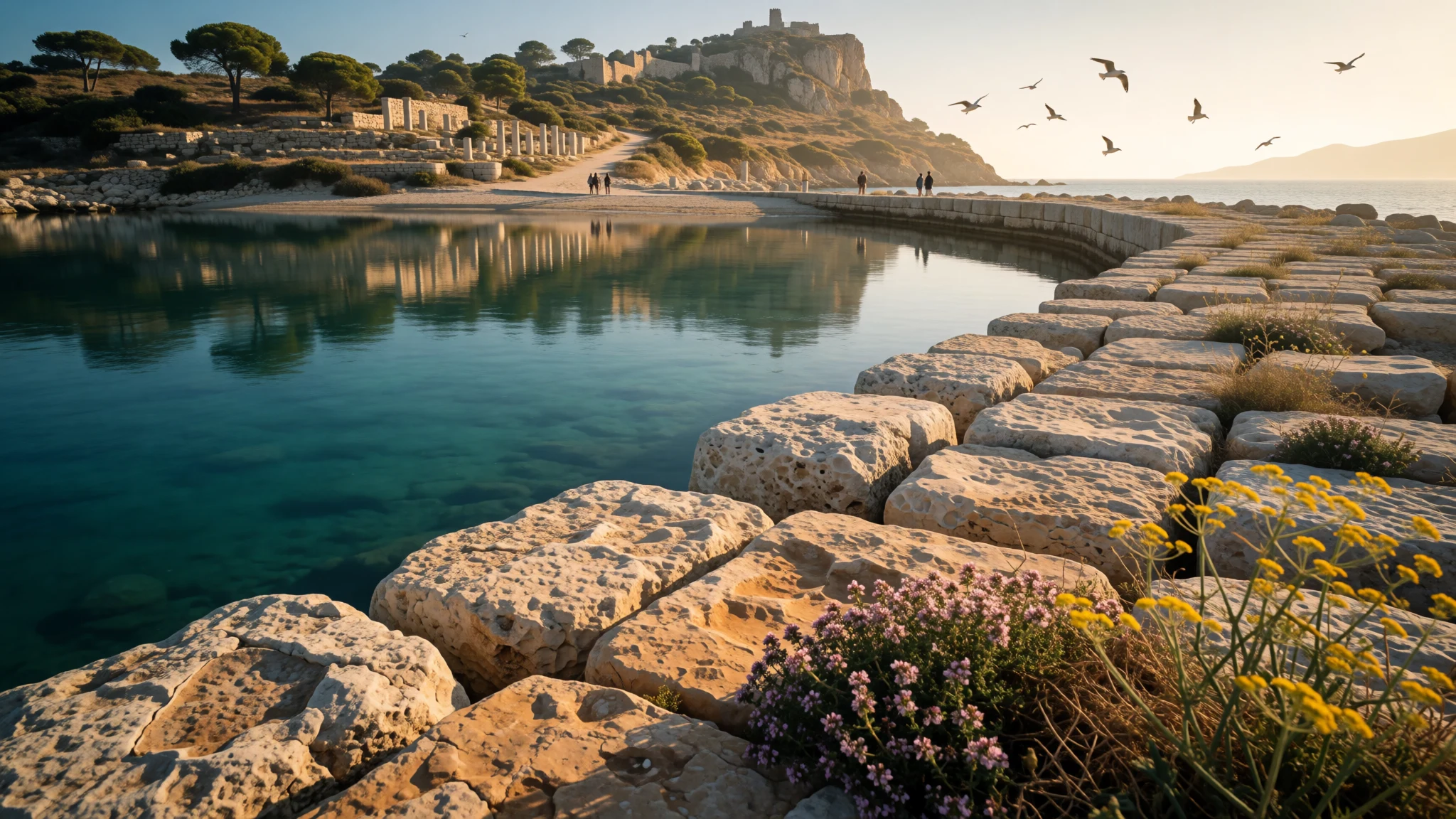
Knidos is an ancient Greek port at the tip of a quiet Turkish peninsula, where ruins, two old harbours and open sea share one long, sunlit slope.
The place
Knidos lies at the far western end of the Datça peninsula, a long finger of land in south-western Turkey that divides the Gulf of Gökova from the open Aegean. In antiquity it was a Greek city of Caria, and it spread across two kinds of ground: terraced slopes on the mainland and a rocky headland that a causeway once tied to the shore. A narrow sandy isthmus now does the same job. Between them the old engineers gained a pair of harbours, and the larger one, facing south, was shielded by heavy breakwaters that survive in large part. The ruins cover a wide area, climbing from the waterline to an acropolis in the north-east, and the city walls can be followed almost all the way round, standing tallest near that high point. The nearby village is Tekir, and an earlier settlement is thought to have stood further along the peninsula, close to today's town of Datça. What the site offers is space rather than spectacle: broken columns among thyme and scrub, goat bells, a great deal of sun and the sea in nearly every view. It is far quieter than Ephesus, partly because the road down the peninsula is slow and winding. Many people arrive by boat from yacht moorings along the coast. The official museums page, http://www.muze.gov.tr/knidos-en, is the place to check current opening arrangements before setting out.
Its story
Knidos was founded around 1100 BCE, and ancient writers argued over who the founders were: Spartan settlers, Argives, or a mixture of Dorian Greeks. Whatever the truth, the city became part of a league of Dorian communities that met on the Triopian headland to hold games for Apollo, Poseidon and the nymphs, and a sanctuary of Aphrodite stood nearby. Trade made the Knidians wealthy. Their harbours sat on sea lanes between the Aegean and the eastern Mediterranean, and they sent out colonists as far as an island off Italy and a settlement in the Adriatic. Politically the city bent with the powers of the day, submitting to Cyrus of Persia and later belonging to the Athenian sphere. Its fame, though, rests on people and a statue. The sculptor Praxiteles made an unclothed Aphrodite for the city, and travellers sailed in just to see it; the original is lost and is known only from Roman copies. Knidos was also known for medicine, and the astronomer Eudoxus is linked with the place. The city carried on under Rome and then Byzantium before slowly emptying, and later builders helped themselves to its stone. Sculpture recovered by excavators, including a colossal marble lion, now sits in London.
What to see
- The two harbours — Below the main ruins, either side of the isthmus
Knidos is best read from its harbours. The larger southern basin still shows traces of its protecting moles, while the smaller northern one lies beside the isthmus. Standing on the shore, it is easy to picture galleys queuing between them. The water is clear for swimming, though the stone is slippery, so water shoes help.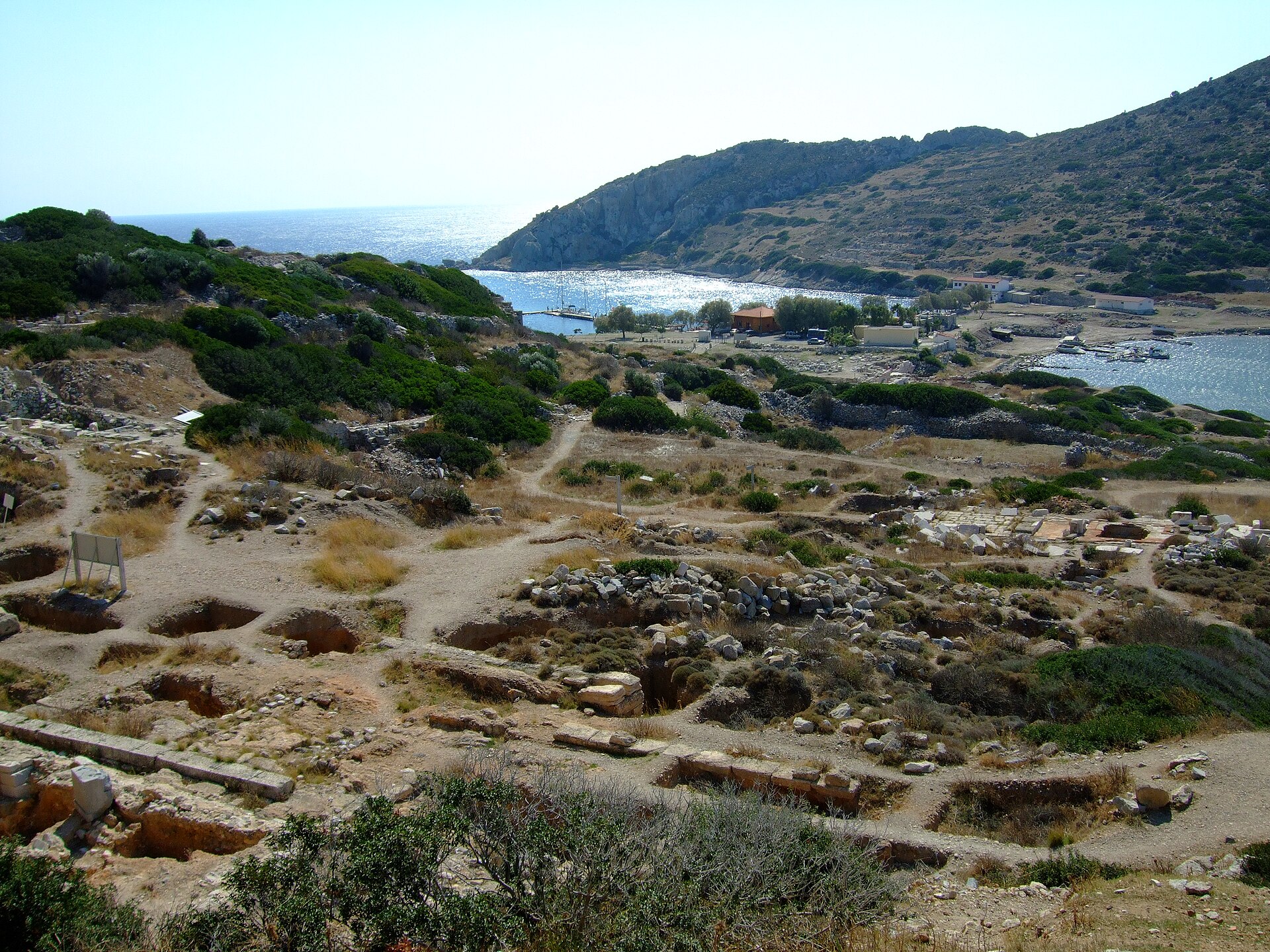
- Acropolis and city walls — North-east corner of the ancient city
The acropolis rises at the north-east corner of the city, and the walls around it are well preserved. A steady climb brings wide views over the gulf and the island headland. Go early or late: there is almost no shade, and the stones hold the heat well into the afternoon.
- Theatre and terraces — Hillside above the harbours
The theatre is cut into the slope above the harbours and faces the sea, with part of its seating still in place. Around it, terraces carry foundations of houses, shrines and colonnades. A panoramic view shows how the city stepped down the hillside, and the top rows make that layout easy to grasp.
- The round temple site — Upper terrace of the city
A circular temple base on an upper terrace is often linked to the cult of Aphrodite and Praxiteles' lost statue, though scholars debate the attribution. Little remains beyond the base and scattered column drums. It is a quiet spot to think about how a single sculpture drew visitors across the water. - The lion tomb ridge — Hillside on the south-western edge of the site
On the ridge outside the main city stood a tomb monument crowned by a colossal marble lion, carved from one block. The lion was taken away long ago and is now in the British Museum. The base remains on the hillside, a short walk that rewards with sea views and silence.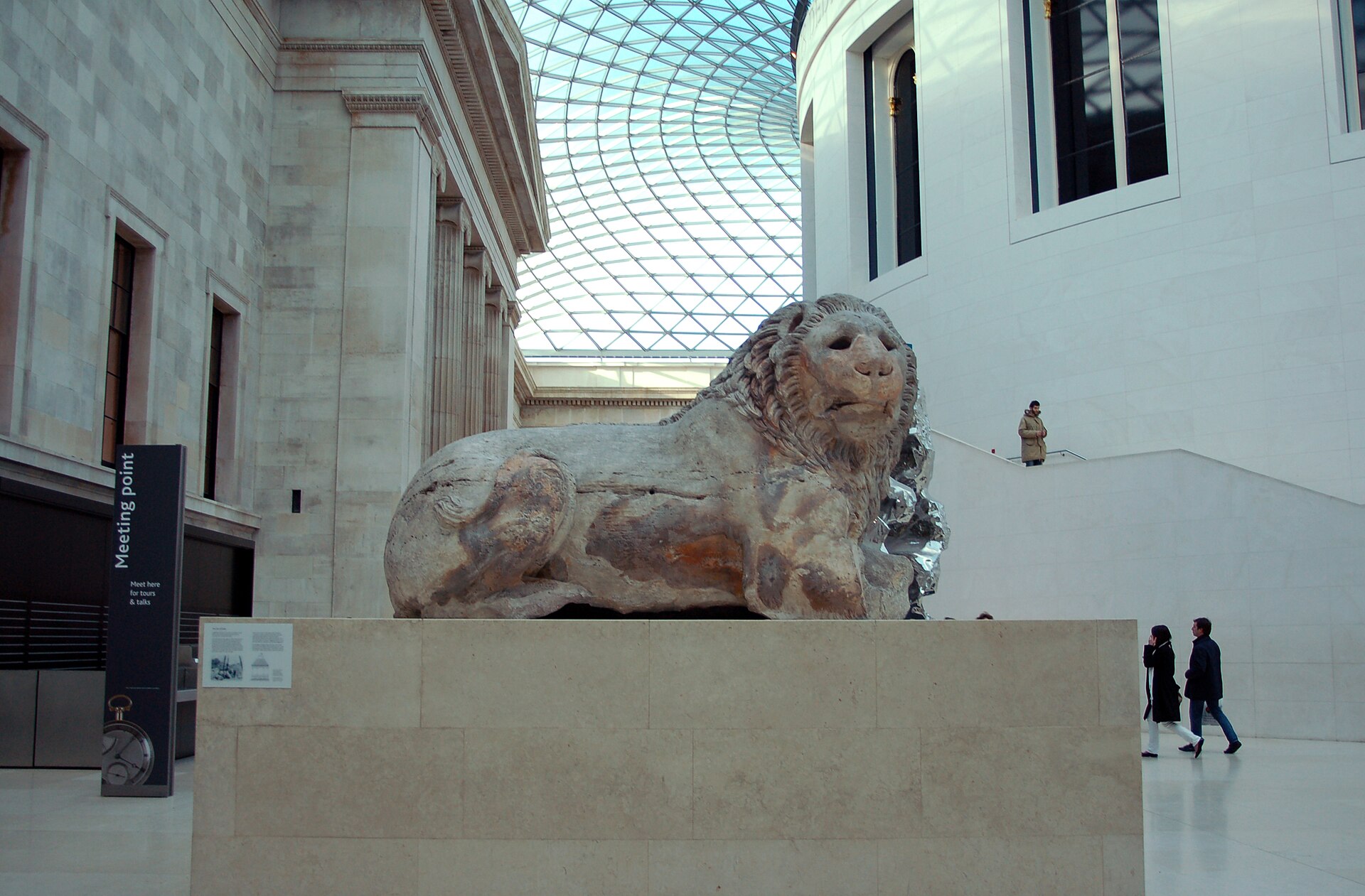
Culture
Knidos sits in a part of Turkey where daily life still moves at a village pace. The Datça peninsula is farmed and fished more than it is toured, and hospitality is taken seriously: a stranger who stops at a café or a roadside stall is likely to be offered tea before any business is mentioned. Accepting is polite, and a few words of Turkish, such as thanks and good morning, go a long way. Families here are traditionally proud of their almond groves, olive presses and bee-keeping, and conversation often turns to the harvest. Most people are Muslim, though practice varies, and the coast is relaxed about visitors who dress and behave sensibly. If invited into a home, bring a small gift such as sweets or flowers rather than alcohol, since many hosts do not drink. Shoes are normally left at or just inside the door, even when the host insists you need not. The ancient city is also a protected archaeological site, and the Greek and Roman remains belong to the wider history of the region. Knidos is something of a pilgrimage for people who care about classical sculpture and ancient science, and guides are often glad to share stories if asked. Do not climb on standing walls, take stones or pottery as souvenirs, or walk through fenced excavation areas, because removing or disturbing anything at the site is an offence.
What to wear
Knidos belongs to the Aegean coast, where traditional women's dress centred on şalvar, the full cotton trousers gathered at the ankle, worn with a long tunic and a waist sash. Headscarves were often edged with oya, delicate needle-made lace flowers, and fabrics ranged from plain cotton for daily work to silk-blend pieces kept for weddings and festivals. Men once wore baggy trousers with a short jacket and a sash, and these costumes now appear mainly at folk events and in museum displays. Day to day, people in Datça and Tekir dress for heat: light cotton and linen, shorts and sandals, with swimwear on the beaches and more covered clothing in village shops and mosques. Visitors to the ruins should treat the walk as a hike. Wear a wide-brimmed hat, sunglasses and sunscreen, as shade is scarce, and choose breathable long sleeves if the sun is strong. Sturdy closed shoes or trail sandals matter because the paths are rocky and uneven. Carry a light scarf or shirt to cover shoulders and knees if you visit a village mosque or a local home. Swimwear is fine at the harbours, but cover up when walking into a village. A thin windproof layer is useful on a boat crossing, even in summer.
What to eat
- Wild greens with olive oil (otlar) — Village restaurants and eateries in Datça and Tekir
Dishes of boiled wild greens, dressed with olive oil and lemon and served cool, are a signature of the Aegean coast. They taste bitter, grassy and bright, and are usually part of a mezze spread. Ask what is in season. - Grilled or baked fish — Harbourside eateries and fishing villages along the peninsula
Local boats supply bream, sea bass and red mullet, usually grilled with little more than salt and lemon. Fish is sold by weight, so ask for the species and how it is cooked, and share a salad and fresh bread alongside. - Datça almond sweets — Bakeries and shops in Datça town
Almonds are the peninsula's pride, and they turn up in biscuits, cakes, brittle and sweet spreads. A bag of fresh almonds or an almond biscuit makes a good snack for the ruins, and the shops sell them to take home. - Gözleme — Roadside stalls and village cafés, often with women rolling dough by hand
A thin, hand-rolled flatbread filled with cheese, spinach or potato and cooked on a griddle. It is cheap, filling and easy to eat on the move, which makes it a good stop before or after the long drive to Knidos. - Peninsula honey and thyme-scented yoghurt — Weekly markets and breakfast tables in Datça
Bees feed on wild thyme and pine on the peninsula, giving local honey a distinctive aroma. It is often served with thick yoghurt or fresh bread at breakfast, and stalls at the market sell jars to take home.
Plan it
Best time. April–May and September–October. Spring is mild and green, and early autumn keeps the sea warm without the worst of the heat. Midsummer is very hot, dry and shadeless on the ruins, so visit at the edges of the day.
How long. 1–2
Getting there. Fly to Dalaman or Bodrum, then continue by road to Datça and on to Knidos; the last stretch runs down the peninsula and is slow. In season, boats and small ferries also cross the gulf, so check current schedules locally. Hiring a car is the most flexible option.
Budget. mid
Tips
- Go in the early morning or late afternoon, as there is almost no shade on the site
- Bring plenty of water, a hat and sun protection, since refreshments near the ruins can be limited
- Fill the fuel tank in Datça before driving to the tip of the peninsula
- Carry some cash for small village shops and cafés, as card machines are not guaranteed
- Check opening arrangements on the official museums website before you set out
Etiquette
- Do not remove stones, pottery or anything else from the site
- Stay on marked paths and out of fenced excavation areas
- Cover your shoulders and knees when walking through villages or into a mosque
Nearby
Sources
- Wikidata Q690575 (CC0)
- Wikipedia — Knidos (rev 1364715693) (CC BY-SA 4.0)
- Wikivoyage — Turkey (rev 5393139) (CC BY-SA 4.0)
- Photo: Die beiden Häfen von Knidos (Tischbeinahe) (CC BY 3.0)
- Photo: Roman gold vase found near Knidos (Jononmac46) (CC BY 3.0)
- Photo: Knidos Panoramic image (Nevit Dilmen) (CC BY 3.0)
- Photo: Meridiana di Cnido (Giorces) (CC BY 2.5)
- Photo: Colossal lion sculpture from Knidos (Tango22) (CC BY 3.0)
- Photo: Vue du Cap Triopium (Thérèse Gaigé) (CC BY 3.0)
- Photo: Deveboynu feneri (Nosferatü) (Public domain)
- Photo: Every rock, showing its memory (Mehmet Turaylar) (CC BY-SA 4.0)


