Jinan
Jinan, People's Republic of China
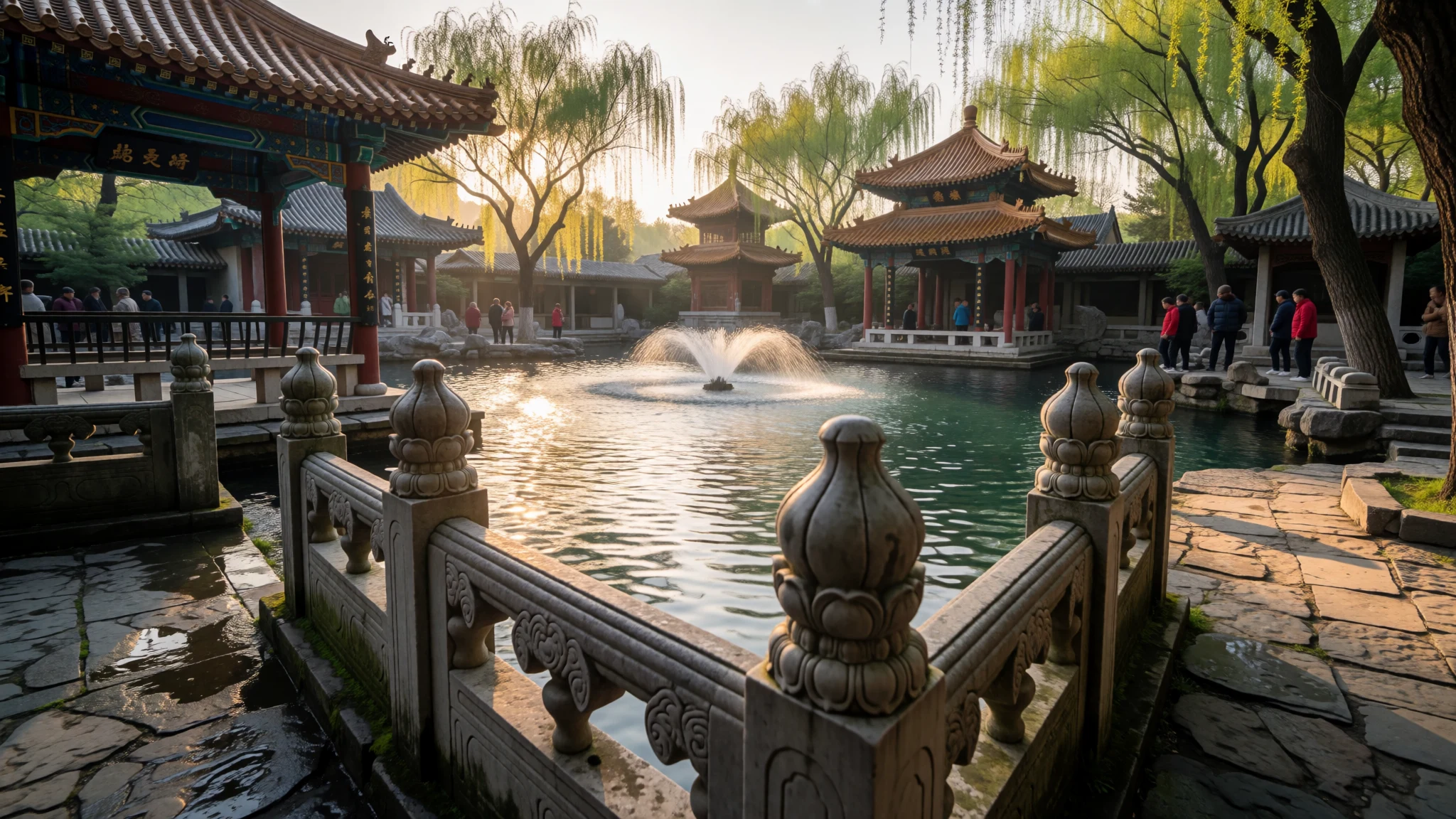
Jinan rewards curious travellers with its seventy artesian springs, profound Neolithic history, and the distinct flavours of Shandong cuisine.
The place
Jinan serves as the capital of Shandong province in Eastern China, functioning as a major administrative, economic, and transportation hub. Home to a population of over nine million residents, Jinan is widely celebrated as the City of Springs due to its famous cluster of artesian water sources that bubble up across the urban landscape. The municipality features four well-marked seasons, spanning dry springs, warm and humid summers, crisp autumns, and cold, dry winters. As a significant seat of learning and scientific research, the city hosts several prominent higher education institutions, including the prestigious Shandong University. The urban layout blends historic alleyways with modern commercial districts, towers, and parks. Visitors arriving in Jinan find an industrious capital that bridges ancient Yellow River civilisations with contemporary urban development. The surrounding topography includes mountains to the south, which shape local weather patterns and create atmospheric conditions that have long inspired poets, scholars, and travellers journeying through Eastern China. Navigating the central districts reveals a blend of traditional courtyard spaces, leafy avenues, and vibrant public squares where residents gather to socialise, practise morning exercises, and enjoy the refreshing atmosphere generated by the natural springs.
Its story
Jinan possesses a deep historical lineage rooted in the Yellow River basin, which served as a primary cultural centre during the Neolithic period. Archaeological findings show that the Jinan area has been inhabited for more than four thousand years, notably highlighted by the discovery of the Neolithic Longshan culture at Chengziya. Artisans of this ancient culture produced exceptionally refined wheel-made pottery, including the celebrated black eggshell ceramics featuring walls measuring less than a millimetre in thickness. During the subsequent Spring and Autumn and Warring States periods, the territory was divided between the states of Lu and Qi. The state of Qi initiated construction of the ancient Great Wall of Qi, portions of which still stand in the surrounding hills as open-air historical markers. Ancient legends also connect the region with foundational figures in Chinese thought and medicine, such as the legendary physician Bian Que and the philosopher Zou Yan, who formulated early concepts of Yin-Yang and the Five Elements. Following Qin unification, the territory evolved through successive imperial dynasties into established commands and kingdoms, cementing its strategic and cultural importance in Eastern China across millennia of dynastic change.
What to see
- Baotu Spring Park — Central Jinan
Jinan features this celebrated park immediately west of Quancheng Square, surrounding the legendary artesian waters known as the number one spring under heaven. Visitors can wander along landscaped water margins, observe vigorous bubbling pools, and explore classical pavilions that pay tribute to the historic poets and officials who documented the springs. - Daming Lake Park — Northern central Jinan
Jinan maintains this expansive lakeside sanctuary on the northern and western banks of a historic urban water body. The grounds encompass shaded walkways, tea houses, pavilions, a curious stone museum, and traditional architecture where travellers can embark on scenic boat excursions across the water. - Thousand Buddha Mountain — Southern Jinan
Jinan rises into hilly terrain at this scenic southern vantage point, where ancient cliff carvings and stone Buddha statues nestle among wooded paths. Climbing the slopes rewards visitors with sweeping panoramic views across the sprawling urban landscape and distant high-rise developments. - Jinan Old Town — Historic core
Jinan preserves a historic neighbourhood of winding alleys and traditional courtyard buildings situated immediately east of the local Confucius complex. Recent conservation and architectural extensions blend heritage preservation with vibrant pedestrian walkways, artisan shops, and traditional teahouses. - Confucius Culture Museum — Northern Old Town
Jinan hosts this cultural repository within the municipal Confucius Temple complex near the southern bank of Daming Lake. The exhibition halls house statues, historical records, and artefacts dedicated to ancient sages and the enduring traditions of Confucian philosophy.
Culture
Jinan residents speak a distinctive regional dialect of Mandarin that retains unique vocabulary and accents, though standard Mandarin is widely understood by younger generations and service staff. The local culture is deeply intertwined with Shandong traditions, valuing hospitality, shared dining, and literary heritage. The city has experienced demographic shifts through modern economic development, welcoming professionals from across the country while maintaining its distinct northern character. Social life frequently revolves around public parks, tea houses, and community spaces where older generations gather for traditional pastimes. When visiting local temples or traditional residences in Jinan, always speak in a moderate tone and respect designated quiet zones.
What to wear
Jinan residents dress in contemporary urban fashion, with younger generations favouring international streetwear, casual denim, and modern tailoring common across major Chinese cities. Traditional garments such as silk robes or Hanfu are rarely worn for daily activities but appear during cultural festivals, university celebrations, and heritage tourism sites. Visitors exploring Jinan should pack versatile layers suited to the continental climate, including breathable fabrics for warm summers and sturdy coats for cold winters. Comfortable walking shoes are essential for navigating stone-paved alleys, park trails, and hillside paths. When entering sacred sites or university campuses, dress modestly by covering shoulders and knees out of respect for local customs.
What to eat
- Furong Street — Old Town alleyways
Jinan maintains this famous pedestrian food alley packed with traditional canteens, bakeries, and street stalls serving regional snacks, grilled skewers, and local delicacies. - Muslim Quarter — West of Baotu Spring
Jinan hosts this vibrant neighbourhood immediately west of Baotu Spring, offering authentic regional Muslim dining, handmade noodles, and savoury lamb dishes. - Daguanyuan Food Stalls — Central commercial district
Jinan gathers an array of simple food stalls and regional Chinese eateries within this historic commercial area and shopping courtyard. - Quanjude Roast Duck — City centre
Jinan diners enjoy classic preparation of crispy-skinned roast duck served with traditional accompaniments at this well-established dining institution.
Plan it
Best time. March to April for dry spring weather, or October to November for crisp autumn conditions; summers are hot and humid.
How long. 2–3
Getting there. Jinan Yaoqiang International Airport connects to major domestic hubs; Jinan Railway Station and Jinan West Railway Station offer high-speed rail links from Beijing and Shanghai.
Budget. mid
Tips
- Visit famous spring parks early in the morning to experience local exercise routines and quieter pathways
- Carry digital payment apps, as cash is rarely used for daily transactions
- Wear sturdy footwear for exploring hillside paths and old town alleys
- Check official municipal websites for opening hours and ticketing details before visiting museums
Etiquette
- Speak in a moderate tone when visiting quiet temple halls and cultural museums
- Remove hats when entering indoor sacred spaces and exhibition halls
Nearby
Sources
- Wikidata Q170247 (CC0)
- Wikipedia (rev 1384515986) (CC BY-SA 4.0)
- Wikivoyage (rev 5405851) (CC BY-SA 4.0)
- Photo photos/01-jinanfromqianfoshan.jpg (CC BY 3.0)
