Hosios Loukas
Hosios Loukas, Greece
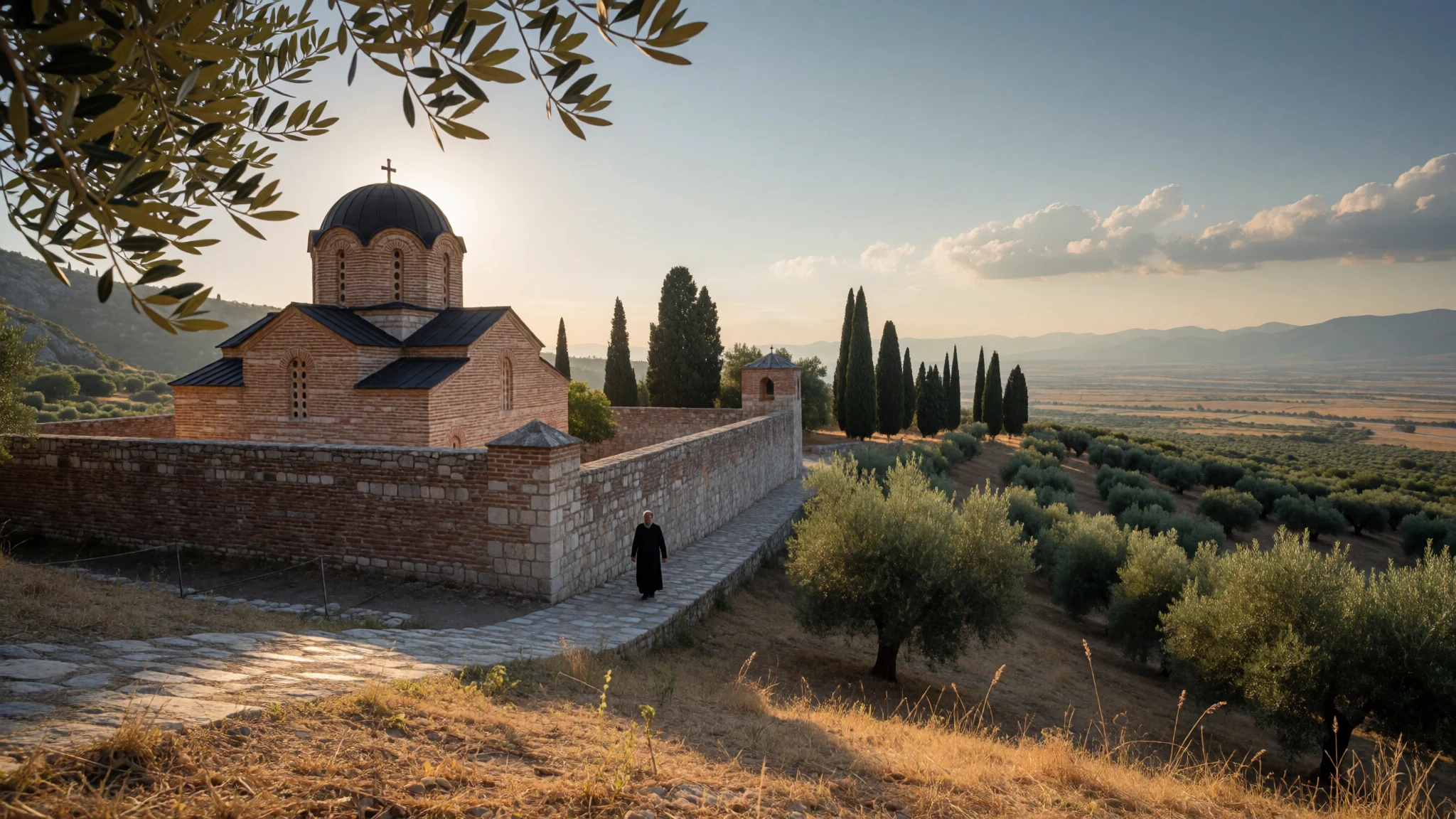
Hosios Loukas is a mountainside monastery in central Greece where gold mosaics glow inside a calm, quiet church, far from the usual island crowds.
The place
Hosios Loukas stands on a slope of Mount Helicon in Boeotia, central Greece, a walled monastery overlooking olive groves and a wide, quiet valley a short drive from the town of Distomo. It is still a monastic community as well as a UNESCO World Heritage Site, listed together with the monasteries of Nea Moni and Daphni. The complex is compact. A gate opens onto a courtyard, and two churches stand side by side and joined at one end, with the monks' buildings, a refectory and a small museum arranged around them. The larger church, the katholikon, is the main draw. Its interior is lined with gold-ground mosaics and patterned marble panelling, and the dome rests on an arrangement that spreads the load through the walls, which gives the space a close, glowing feel rather than a soaring one. Outside, the walls are layered brick and stone, with small decorative patterns set into the masonry, and the whole group looks more like a fortified farm than a grand cathedral. The setting does a lot of the work. The monastery faces open country with mountains behind, the air is cooler than on the plains, and the only sounds are bells, wind and the occasional coach. Hosios Loukas is rural in a way many Greek heritage sites are not: there is no town around it, only a car park, a few stalls and some eateries along the approach. Most visitors spend a couple of hours here, usually as part of a day that also takes in Delphi. Tour groups tend to arrive in the late morning, so early or late visits are noticeably calmer.
Its story
Hosios Loukas takes its name from a hermit, Luke of Steiris, who lived on this hillside in the early tenth century and whose reputation outlived him. He is not the Gospel writer of the same name, a confusion the monastery has long had to clear up. Luke was known locally for prophecy. The story goes that he foretold the Byzantine recovery of Crete, although the emperor who finally achieved it was not the one reigning when he spoke. After his death his followers buried him in a crypt, and a monastery grew around the grave. The money followed the miracles. His relics were said to produce myron, a fragrant oil credited with cures, and pilgrims were encouraged to sleep beside the tomb in the hope of being healed in their dreams. That steady traffic of the sick and hopeful paid for the building campaign, and the church of the Theotokos, the Virgin, is thought to date from the reign of Romanos II. Later the tomb was moved to the point where the two churches meet, so that it could be reached from both. Mosaics beside it show Luke himself and the abbot Philotheos offering the saint a model of the new church. Other characters passed through too. A local shepherd, Nicholas the Pilgrim, lived here for a while in the eleventh century until the monks sent him away for his erratic behaviour. In the early thirteenth century, under Latin rule, a papal legate gave the monastery to the canons of the Holy Sepulchre.
What to see
- The katholikon — Monastery courtyard
The main church of Hosios Loukas is where most of the mosaics survive. Gold backgrounds and saints in rows reward slow looking. Marble floors and wall panels add pattern. Stand still for several minutes and the gold starts to shift with the light.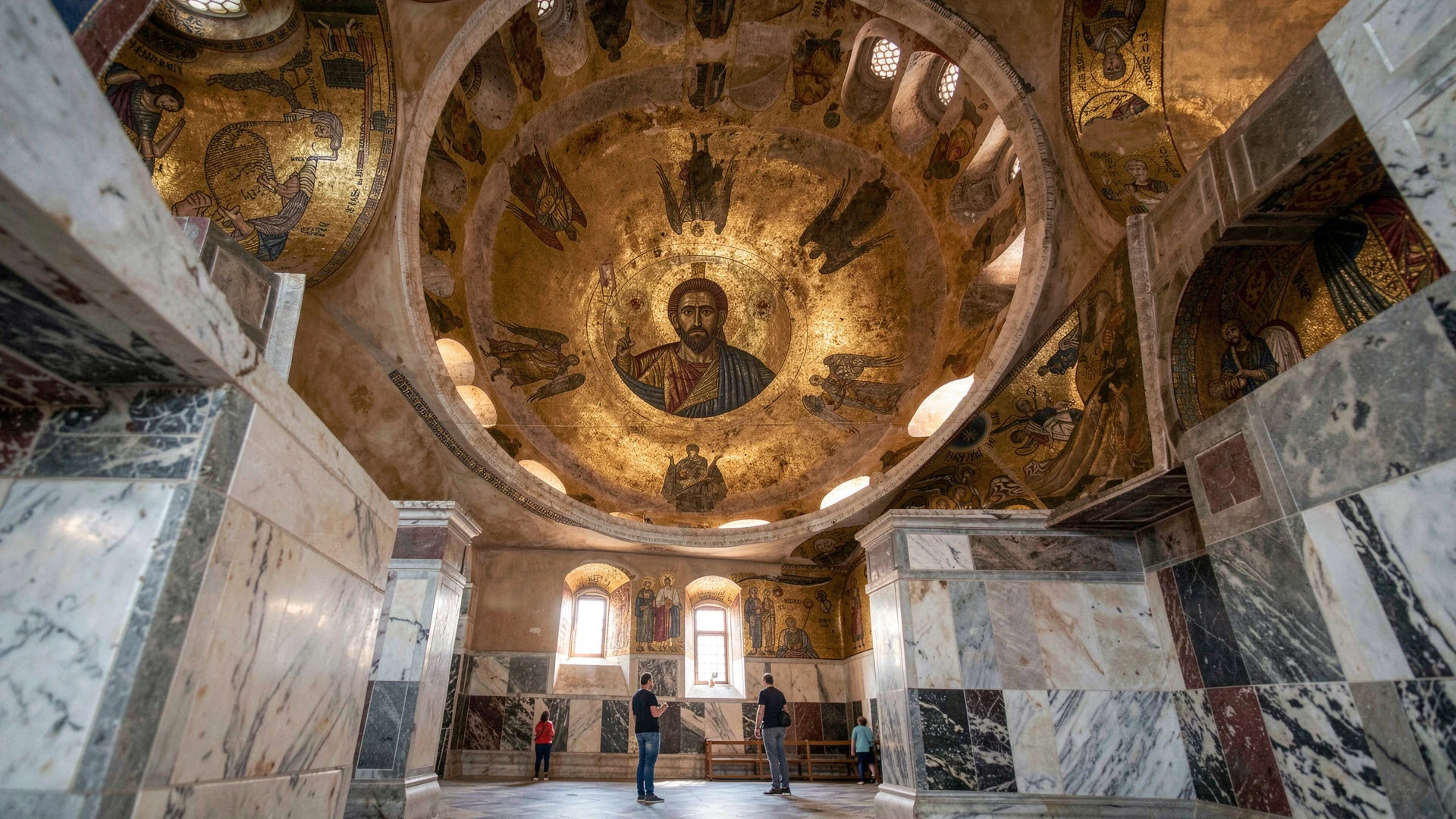
- The Virgin in the apse — Katholikon, east end
In the apse of the katholikon, the Virgin and Child sit in the half-dome against a field of gold. It is a calm, formal image, and a good place to see how the mosaicists used small stones to build soft faces and heavy robes.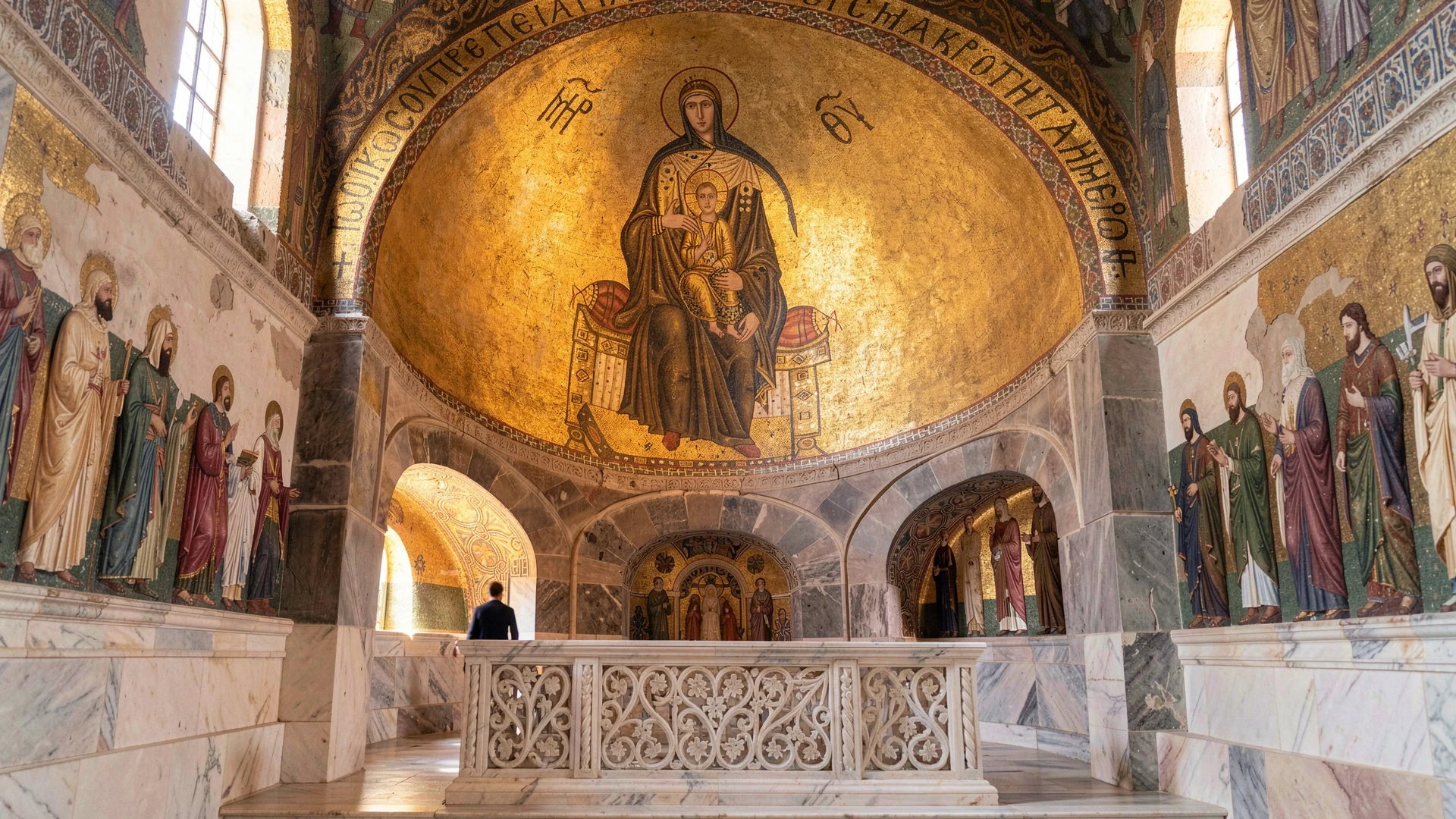
- The Baptism mosaic — Katholikon nave
High in a corner of the nave, one of the squinches carries a scene of the Baptism. It is a useful reminder that the mosaics were designed to be read from below, at a distance, with figures simplified so they carry across the space.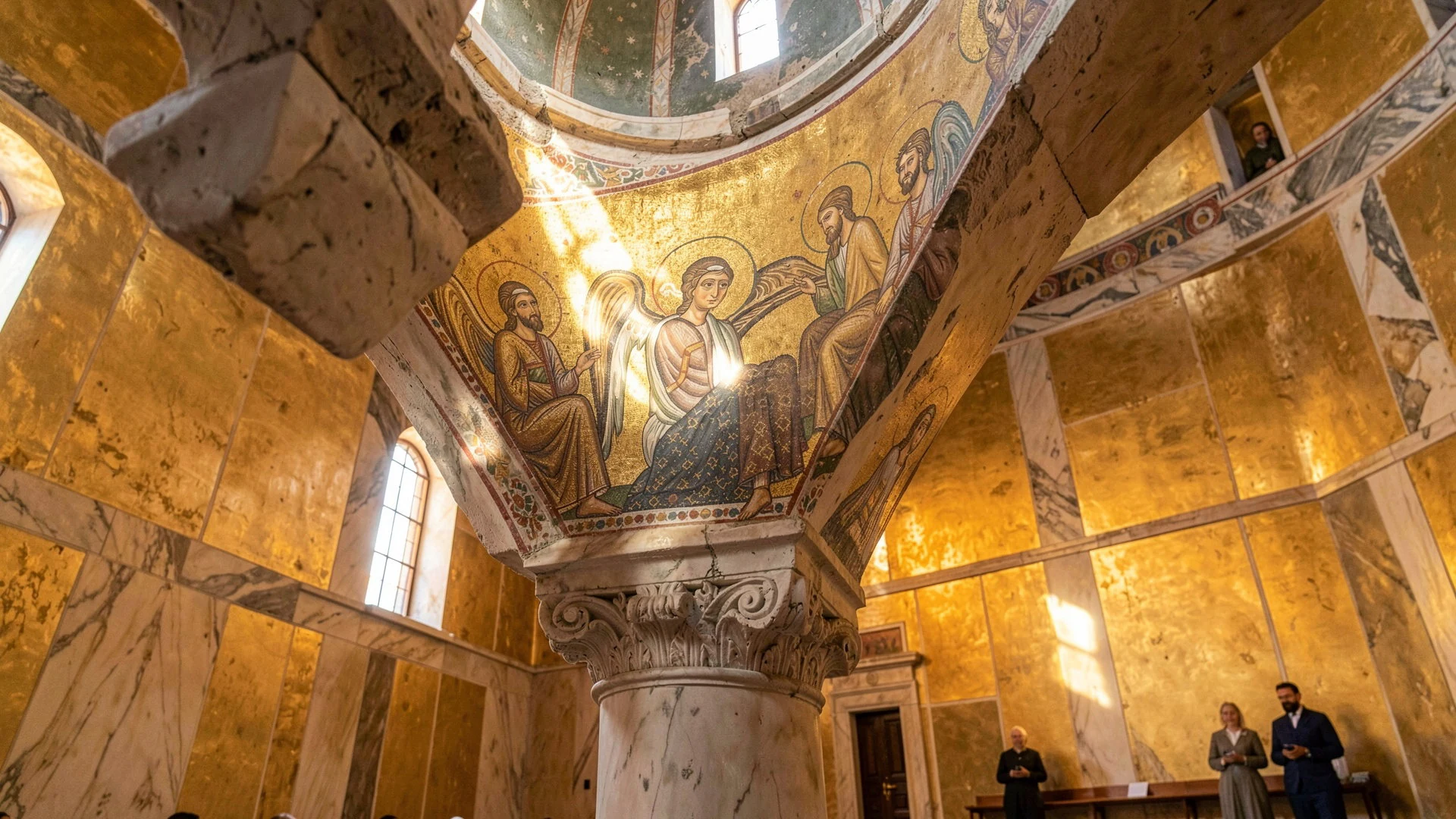
- The Church of the Theotokos — Monastery courtyard
Hosios Loukas has a second, smaller church beside the katholikon, dedicated to the Virgin. It is quieter, with less gold and more of the monastery's older stonework and carved details, and it is worth a visit for the contrast and the shorter queues.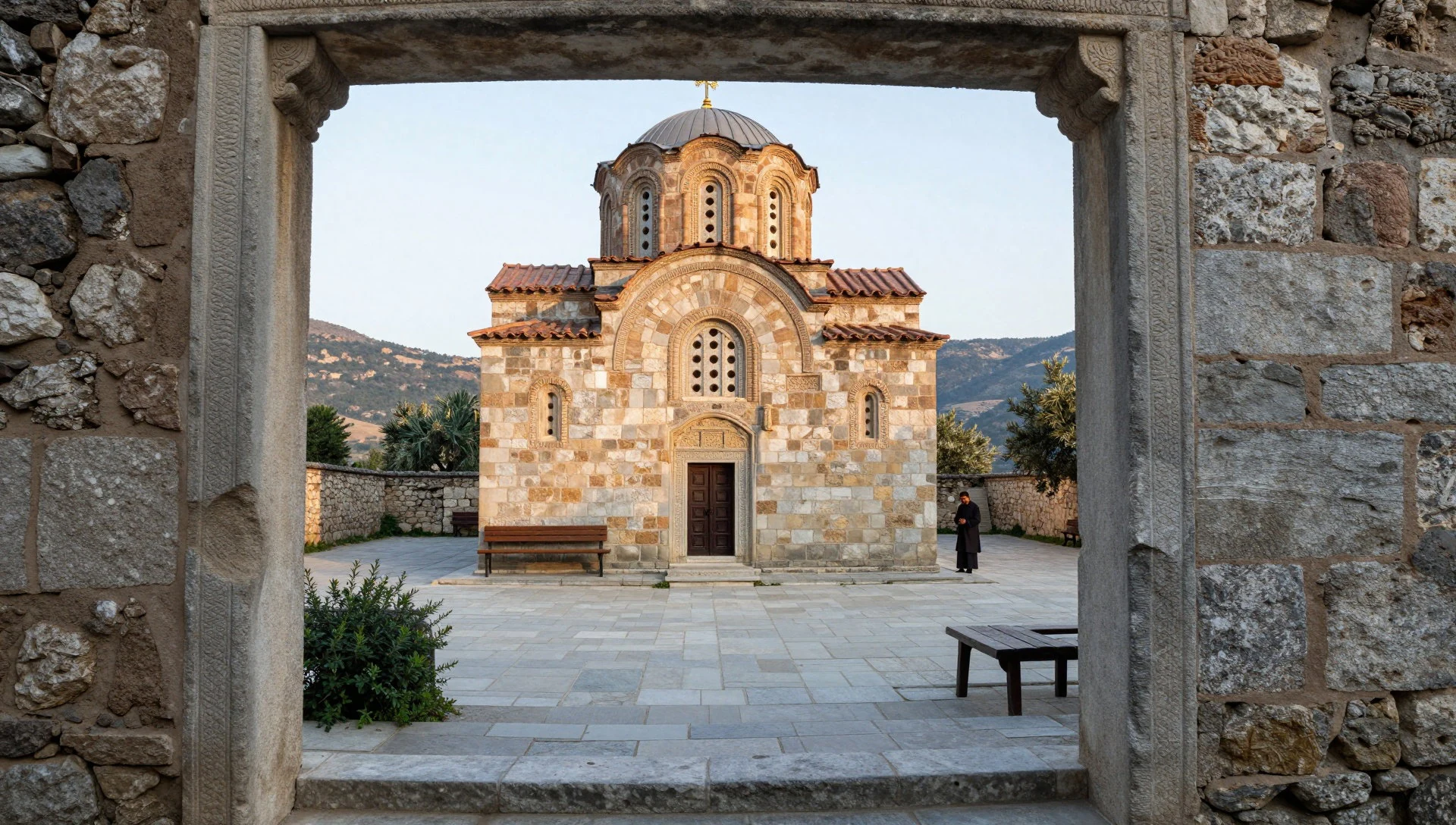
- The crypt and tomb of St Luke — Beneath the katholikon
Below the main church, the crypt holds the saint's tomb, the original pilgrimage focus. Frescoes cover the vaults and the low ceiling makes the space intimate. Pilgrims once slept here hoping for a cure, and it is still treated as a place of prayer.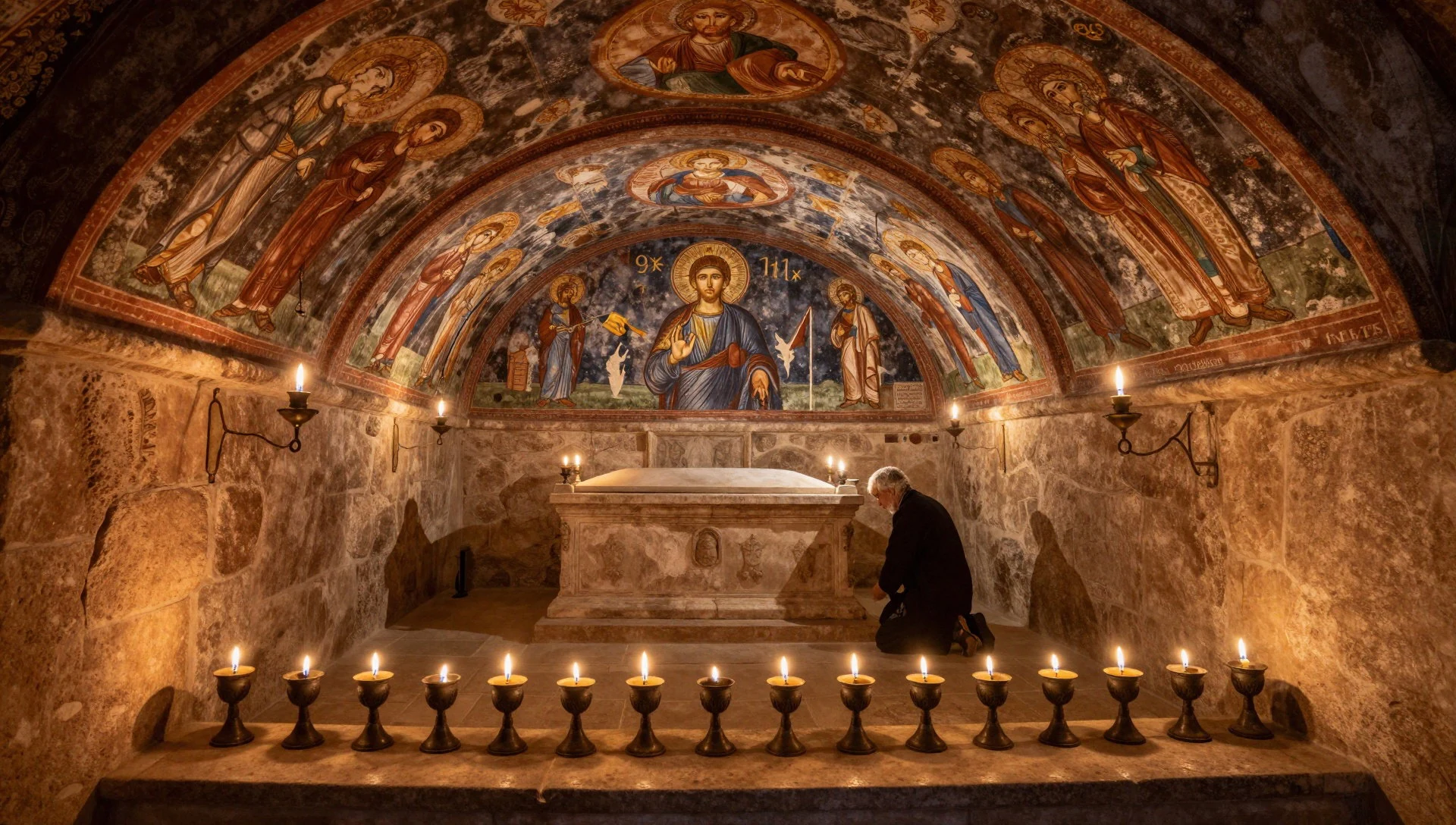
Culture
Hosios Loukas belongs to the Greek Orthodox tradition, and the culture of the place is that of a working monastery rather than a museum. Services are held in the churches, monks live on site, and the mosaics were made as devotional images, meant to be prayed in front of rather than only admired. Orthodox Christians typically light a thin candle on entering and cross themselves before an icon, and many also kiss the icon's frame or glass. Visitors often join in quietly, or simply stand to one side. The monastery keeps its saint's memory alive on his feast day in early February, and local families still visit to pray or fulfil a vow. Boeotia itself is farming country, with sheep, olives and mountain villages, and hospitality here is informal but generous. Coffee, a sweet spoon preserve or a small glass of something stronger may be offered in village cafés and shops, and it is polite to accept. Greek is the language of the monastery, but staff and guides in the area usually manage English. Pace matters: Greek visits to churches are brief and often unhurried, and the day moves slowly in the heat. Visitors who bring that attitude, rather than a checklist, tend to enjoy the place more. Dress modestly with covered shoulders and knees, speak softly inside the churches, and do not photograph monks or worshippers or use flash on the mosaics unless the monastery says it is allowed.
What to wear
Hosios Loukas sits in a part of Greece where traditional dress is now mostly a matter of festivals and folk dance, though its textiles are still worth knowing. The best-known male garment is the foustanella, a pleated kilt-like skirt of cotton or linen, worn with a embroidered waistcoat and, for the ceremonial guard in Athens, tasselled shoes. Women's costumes in central Greece used wool, linen and silk, with embroidered aprons, long dresses and decorated headcloths, and shepherds relied on thick wool cloaks against mountain cold. Today people in Distomo and nearby villages dress much as in any Greek country town: jeans, shirts, light jackets and sensible shoes, with darker, smarter clothes for church. Monks wear the black Orthodox cassock and a tall cylindrical hat, and visitors should not mistake them for costume. For a visit, dress for both the climate and the setting. In summer the courtyard is bright and hot, so choose breathable cotton or linen, a hat and sunglasses, but keep shoulders and knees covered for the churches, because shorts and sleeveless tops may be turned away at the door. Carry a light scarf or shawl for this. Footwear matters more than people expect: the stone paving and steps are smooth and can be slippery, so wear comfortable shoes with grip. In winter and spring bring a warm layer and a waterproof, as the hillside is cooler and breezier than Athens.
What to eat
- Kokoretsi — Village tavernas around Distomo and Arachova, especially on holidays
A festive grill dish of seasoned offal wrapped in intestine and turned slowly over charcoal, then sliced thin. It is strongly flavoured, usually served at Easter and on celebration days, and is a good test of how adventurous a meal is going to be.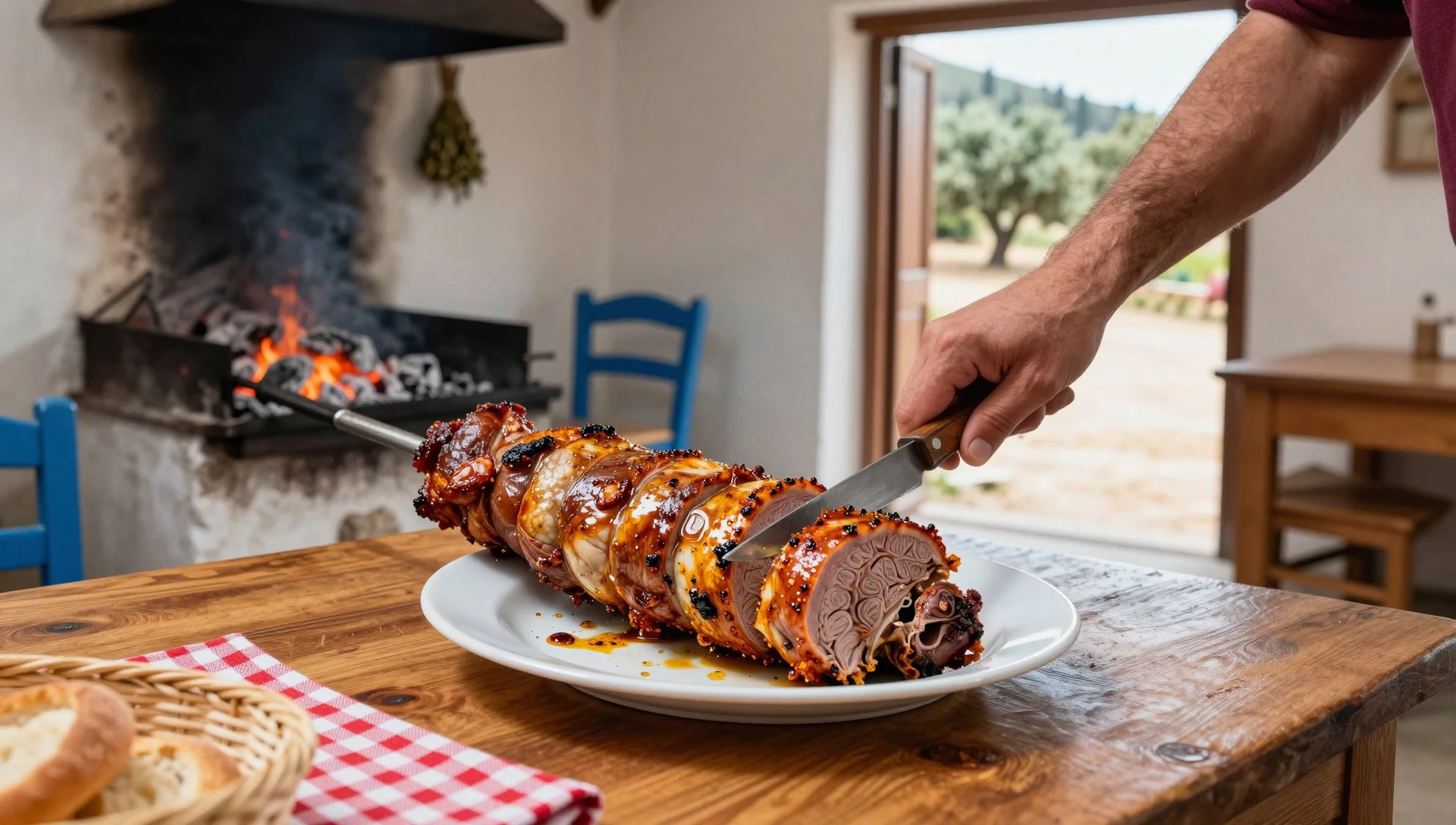
- Arnaki psito — Family-run tavernas along the roads towards Delphi
Roast lamb, cooked until the meat falls from the bone, often with lemon, oregano and potatoes from the same tray. It is the standard Sunday and feast-day meal in much of mainland Greece, and local flocks make it a natural order here.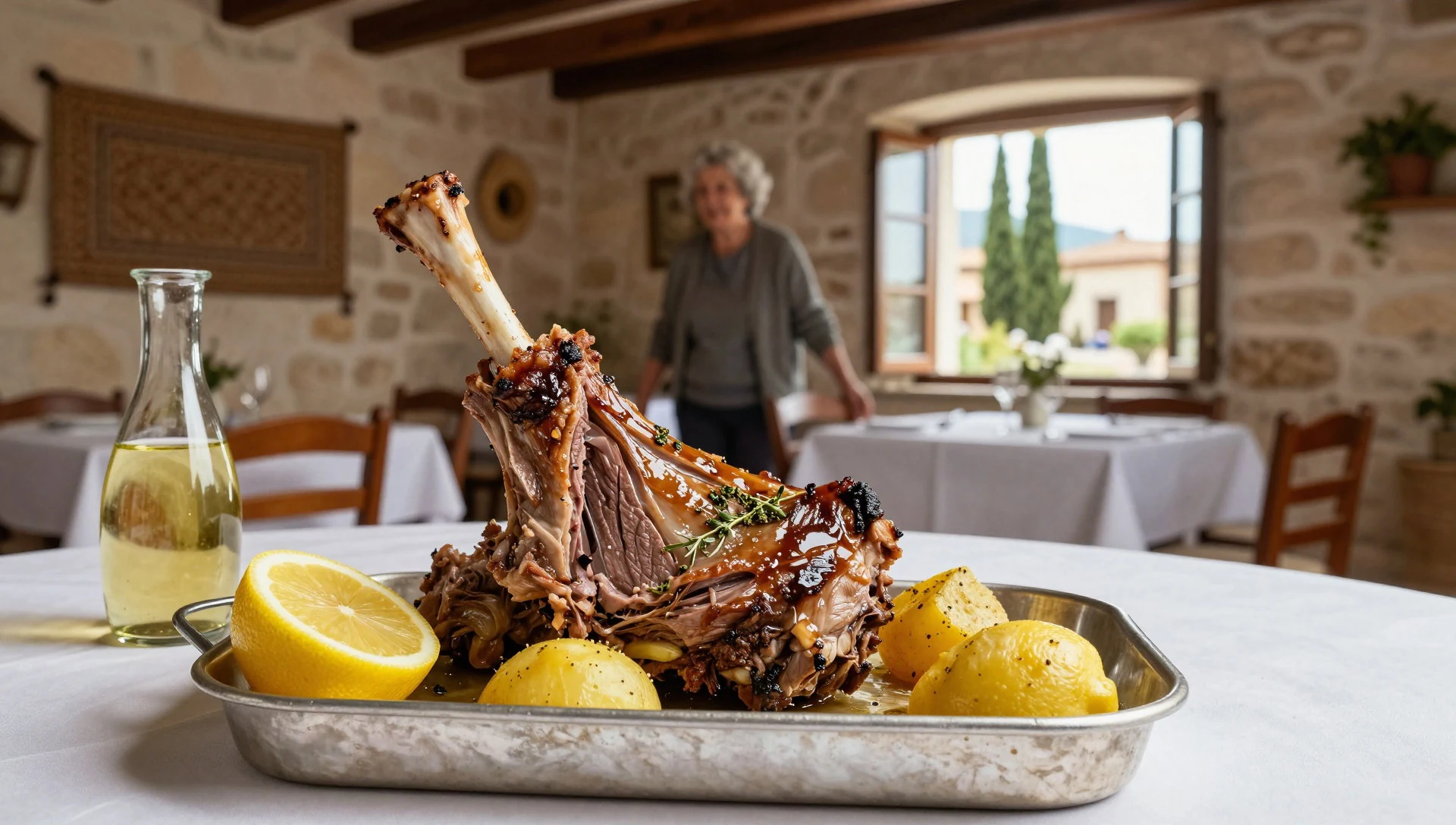
- Meze plates — Cafés and ouzeries in nearby mountain villages
Small plates of local sausages, cured meats, olives and feta, shared among the table with bread. The order is easy to build up gradually, and it is a relaxed way to try several regional products in one sitting. - Katiki and tsalafouti — Village shops, tavernas and small dairies in the region
Two soft, tangy local cheeses, spreadable and fresh, eaten with bread or alongside grilled meat. They are made from sheep's or goat's milk, and are worth asking for by name when a menu offers a local cheese. - Hortopita — Bakeries and pie shops in Distomo and nearby towns
A thin-pastry pie filled with wild or cultivated greens, sometimes with herbs and feta. It is a vegetarian standby in the hills, sold by the slice and easy to carry for a picnic by the monastery.
Plan it
Best time. March to April and October to November, when the hillside is mild and the light is good for the mosaics. July and August are hot and busier with tour groups, and winter can be bitterly cold, with nights well below freezing, damp and windy on the mountainside.
How long. 1
Getting there. Fly into Athens, then drive towards Distomo and follow signs to the monastery; a hire car is the easiest option. Intercity buses run towards Distomo and Delphi, with a taxi for the final stretch from the village.
Budget. low
Tips
- Check opening hours and any entry arrangements on the official site, http://www.osiosloukas.gr/site/, before setting out
- Arrive early or late in the day to avoid the tour-group window around late morning
- Carry some cash, as there are few services nearby beyond a few stalls and eateries
- Bring water and sun protection in summer, as the courtyard has little shade
- Combine the visit with Delphi to make a full day, and fill the tank before leaving the main road
Etiquette
- Cover shoulders and knees before entering the churches
- Keep voices low and do not use flash or tripods on the mosaics
- Ask before photographing monks or people at prayer
Nearby
Sources
- Wikidata Q844841 (CC0)
- Wikipedia: Hosios Loukas (rev 1366154401) (CC BY-SA 4.0)
- Wikivoyage: Boeotia (rev 5305355) (CC BY-SA 4.0)
- Berthold Werner, Greece, Monastery of Hosios Loukas (CC BY 3.0)
- C messier, Μονή Οσίου Λουκά (CC BY-SA 4.0)
- Jean Housen, Vue du monastère de Hosios Loukas, en Béotie (CC BY 3.0)
- Berthold Werner, Greece, Monastery of Hosios Loukas (CC BY 3.0)
- Hans A. Rosbach, Monastery of Hosios Loukas (CC BY 3.0)
- Mosaics in Hosios Loukas Monastery, Boeotia, Greece (Public domain)
- Hosios Loukas Monastery, Boeotia, Greece (Public domain)
- Jean Housen, Vue du monastère de Hosios Loukas, en Béotie (CC BY 3.0)


