Heidelberg Castle
Heidelberg Castle, Germany
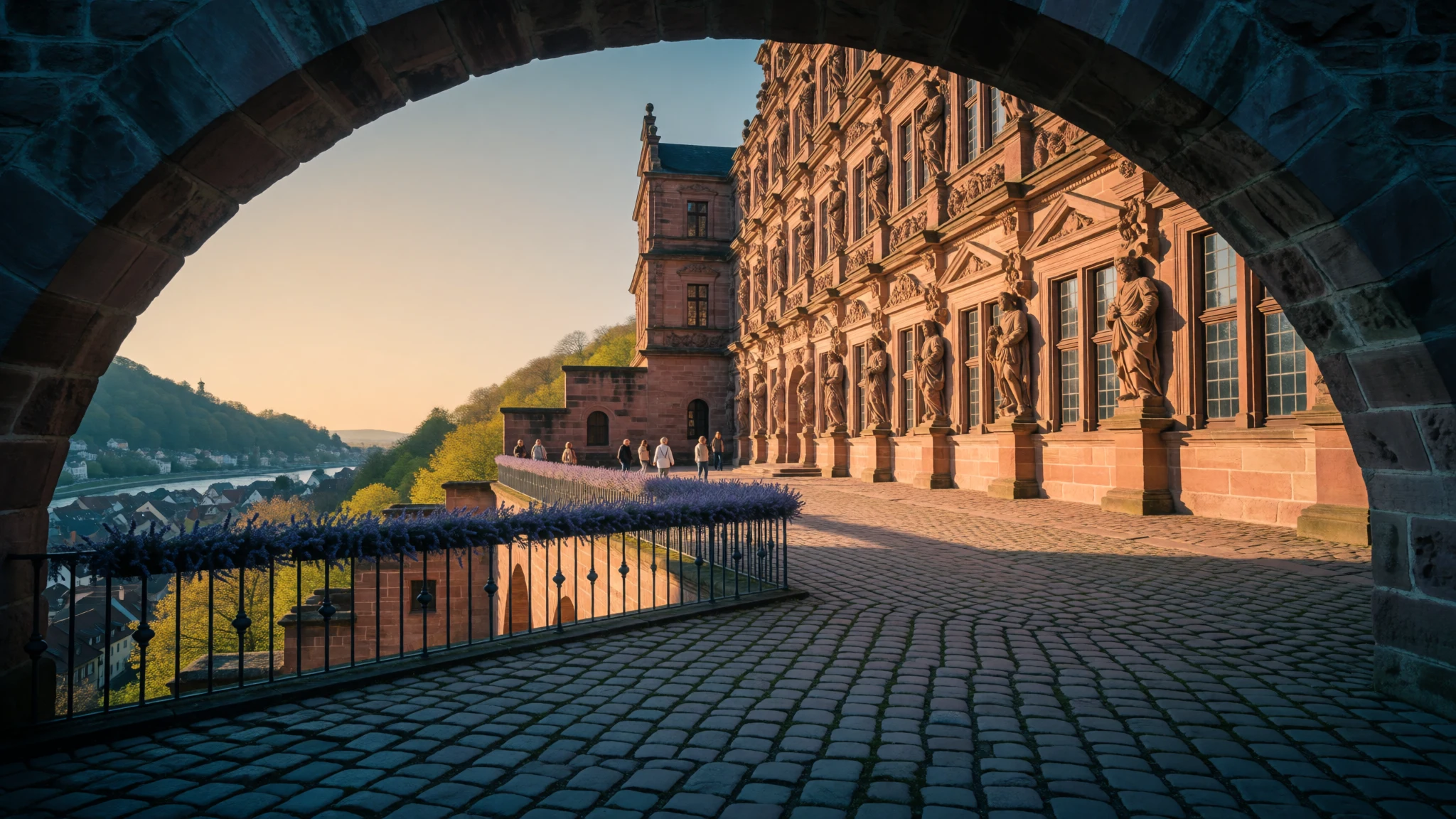
A broken Renaissance palace above a river-valley university town, where ruined walls, hillside paths and old-town lanes make an easy, atmospheric day.
The place
Heidelberg Castle is a red sandstone ruin on a wooded slope above the old town of Heidelberg, about 213 m above sea level, with the Neckar river curving past below. It is part fortress, part palace and part shell: some wings keep carved Renaissance façades, while others stand open to the sky, their window frames opening onto nothing. Rebuilding has been partial, so the site reads as layers of centuries rather than a single period.
The town lies in Baden-Württemberg, where the Neckar leaves the forested Odenwald hills and opens out towards the plain of the Rhine. That setting explains the view from the castle terraces: roofs, bridge and river laid out in one sweep, with farmland and haze beyond.
Reaching the castle is part of the visit. A funicular runs up from the Kornmarkt in the old town and stops at the castle, while a footpath of steps and cobbles covers the same climb for those who prefer to walk. The castle is also listed as a museum, so there are interior rooms to see as well as the courtyards and grounds.
Heidelberg is a university town, and students, day-trippers and tour groups share the lanes beneath. Summer weekends and the middle of the day bring the crowds, and the courtyard can feel packed; early morning and late afternoon are calmer. Much of the visit is outdoors on uneven stone, so weather and footwear matter more here than at a conventional museum.
Its story
Heidelberg Castle's story begins with the Electoral Palatinate, the territory that took shape after Conrad of Hohenstaufen was made Count Palatine in 1155 by his half-brother, the emperor Frederick Barbarossa. Historians cannot show that Conrad lived on the castle hill itself, though local tradition links the slope, called the Jettenbühl, to a seeress named Jetta, who is also tied to a nearby spring and a deep well.
The first written reference to a castle at Heidelberg comes in 1214, when Emperor Frederick II passed it to Louis of Bavaria, of the Wittelsbach family. A document of 1303 describes two castles: an upper one on the Kleiner Gaisberg and a lower one on the Jettenbühl. The lower castle, built at some point between 1294 and 1303, is the site visitors climb to today. The upper castle was lost to lightning in 1537.
Over the following century the lower castle grew into a grand Renaissance residence, reaching its fullest extent by about 1650. Then came damage from wars and fires. French troops blew up parts of it in 1693, and a lightning strike in 1764 started a fire that ruined sections which had been rebuilt. Rather than being restored in full, the castle was left to stand as a ruin, and an 1880 mention by Mark Twain already calls it one. Partial reconstruction since then has kept the broken character that draws people up the hill.
What to see
- The castle ruins and terraces — Königstuhl hillside, above the old town
The castle itself is the main sight: broken Renaissance façades, courtyards open to the sky and terraces looking over the old town and river. Allow time for the grounds as well as the rooms. The funicular stop belongs to the same site, and the stair route gives a feel for the slope. Check the official site for tickets and opening times.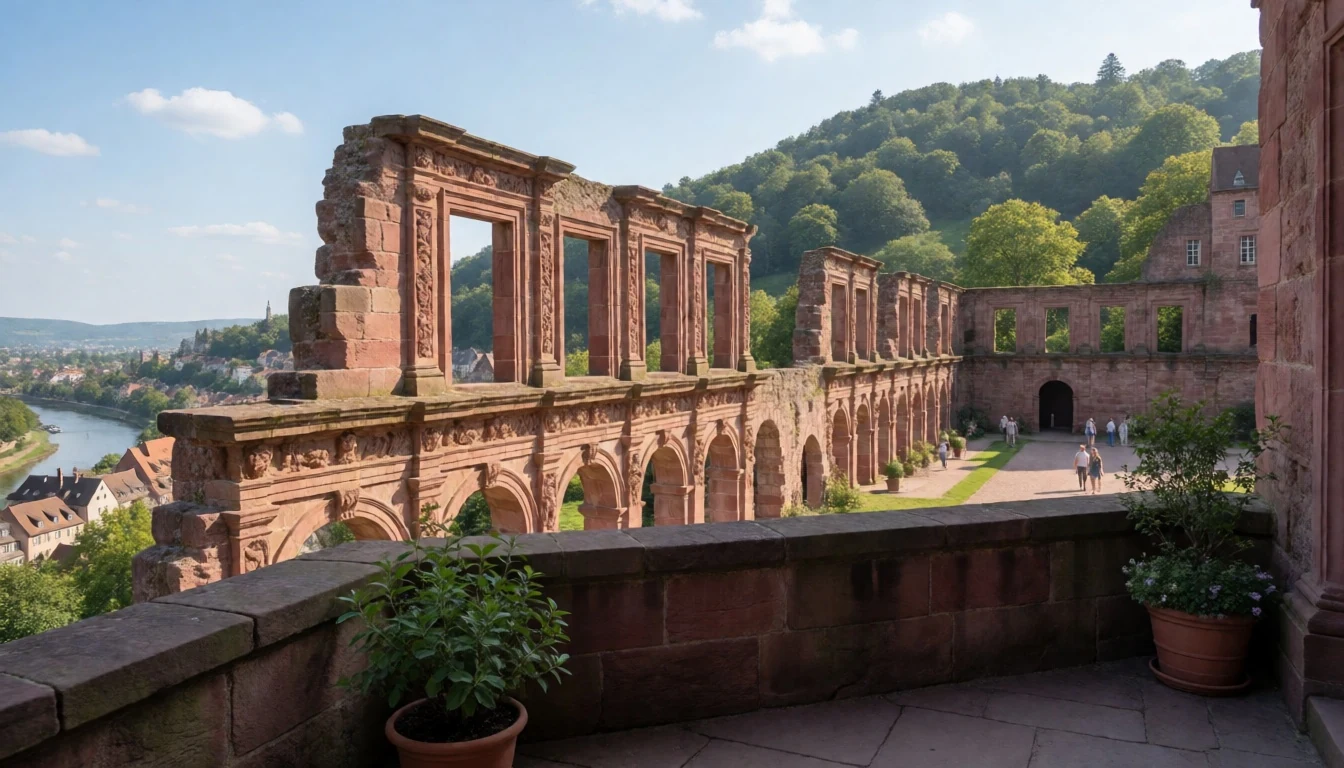
- Altstadt and Hauptstraße — Altstadt, from Bismarckplatz eastwards
The old town lies directly below the castle, and its main street, Hauptstraße, runs about 1.6 km from Bismarckplatz through the centre. It is pedestrianised and lined with shops, cafés and university buildings. It works best as a slow walk down from the castle, ducking into side lanes when the crowds thicken.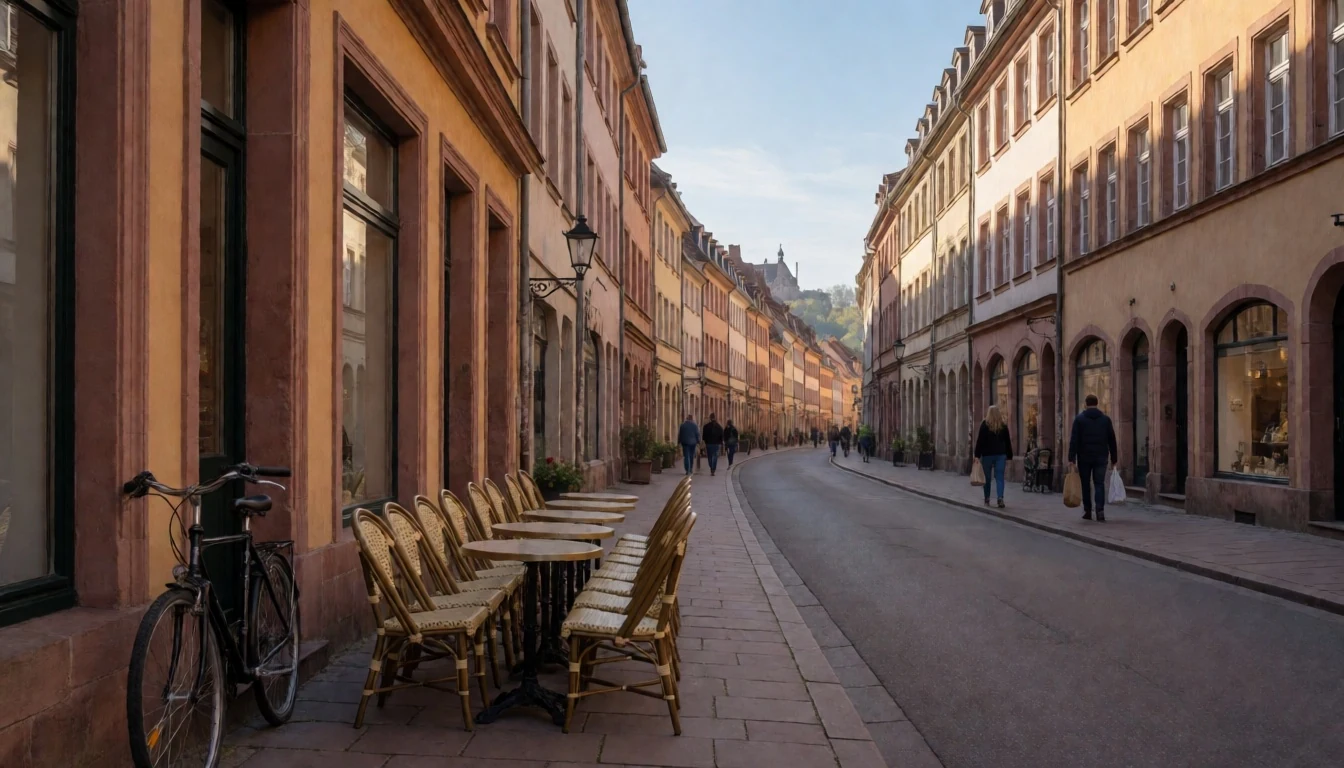
- Philosophenweg — Northern bank of the Neckar, Neuenheim hillside
Philosophenweg is a path on the north bank of the Neckar, opposite the old town. From it the castle, bridge and rooftops fall into one frame, which is why painters and engravers chose the spot, including the well-known Merian view. It is a steady climb from the river and rewards late-afternoon light.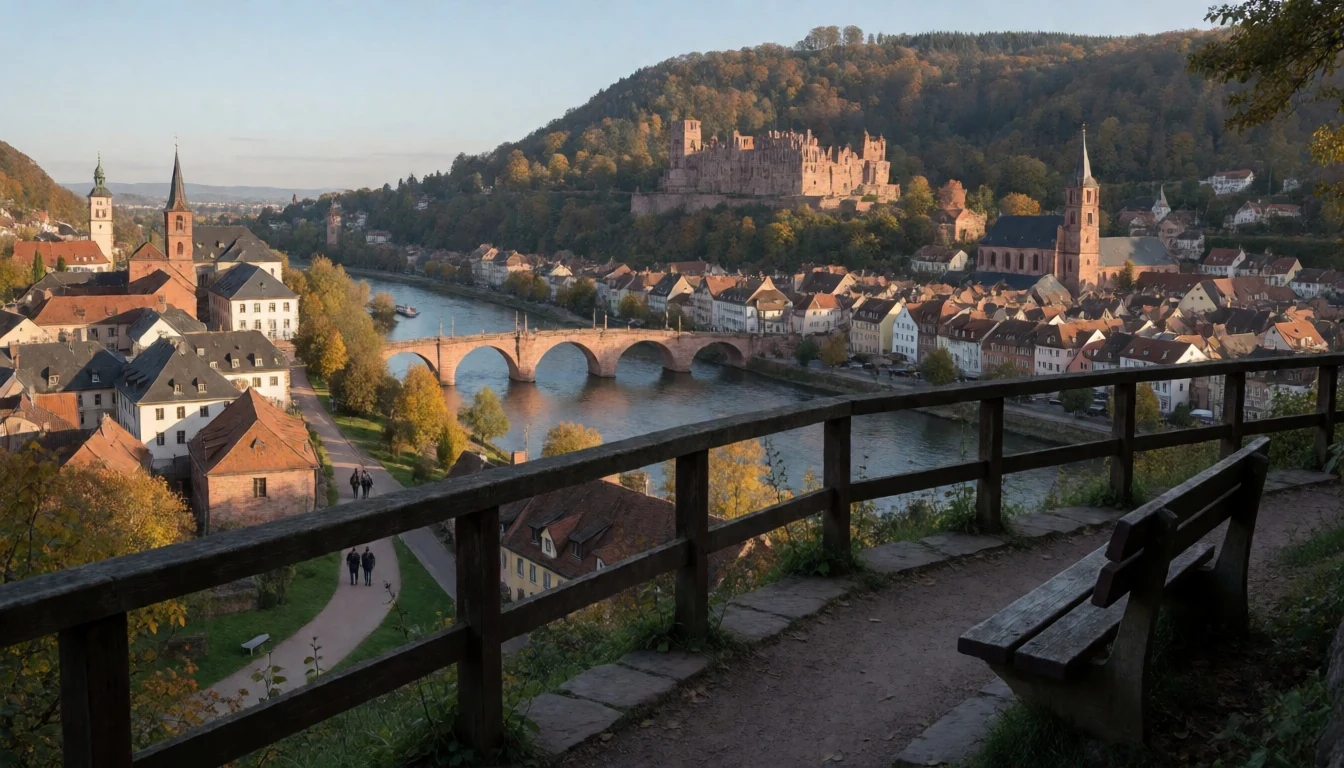
- Heiligenberg — Heiligenberg, north of the river
Heiligenberg rises north of the river and gives a second long view back over the old town. Its wooded top holds the remains of an ancient Celtic wall, a deep well called the Heidenloch, and the Thingstätte, an open-air theatre built by the Nazi regime in 1934 for propaganda events. It is a sober place and worth a quiet visit.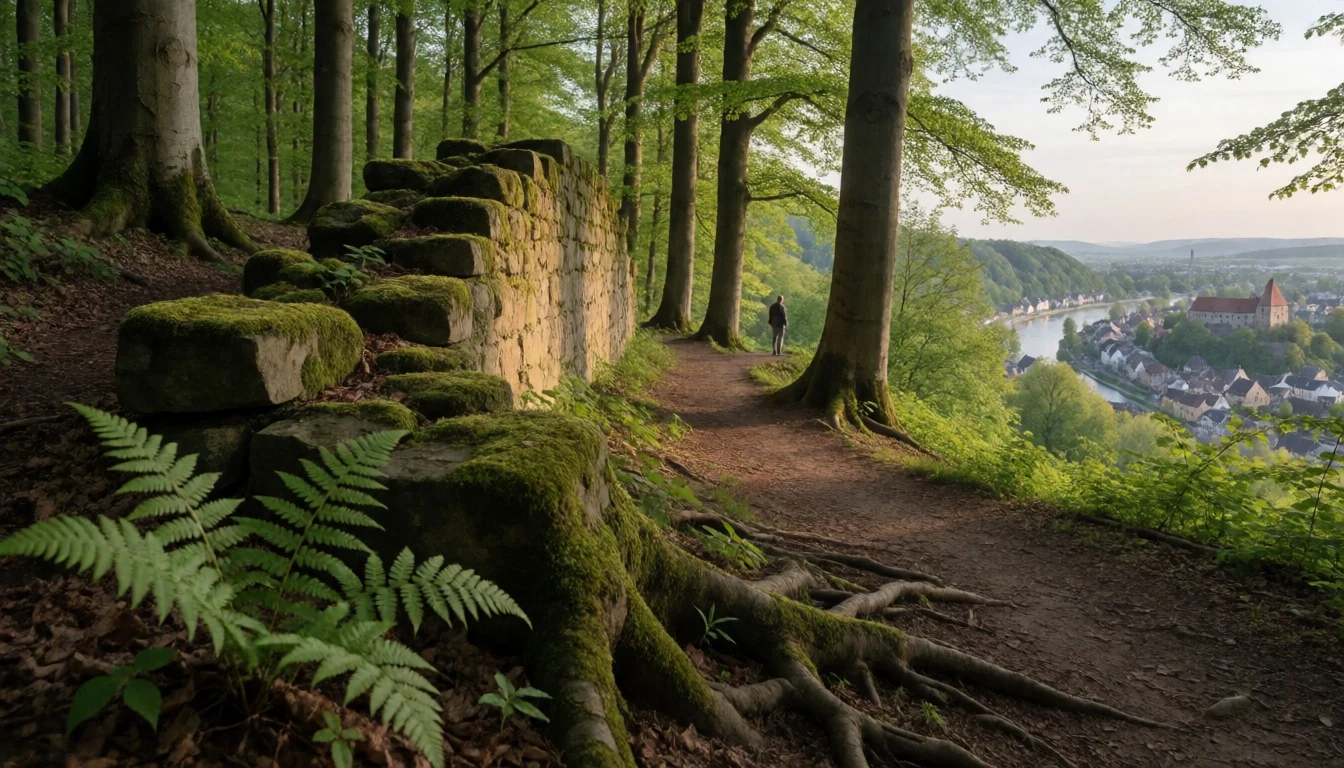
- Kurpfälzisches Museum — Old town, west of the castle
The city-run Kurpfälzisches Museum covers the area from prehistory to modern times and holds a fine-art collection. It is a good wet-weather stop and adds context on the Palatinate rulers who shaped the castle. Check the museum's own website for opening hours before going.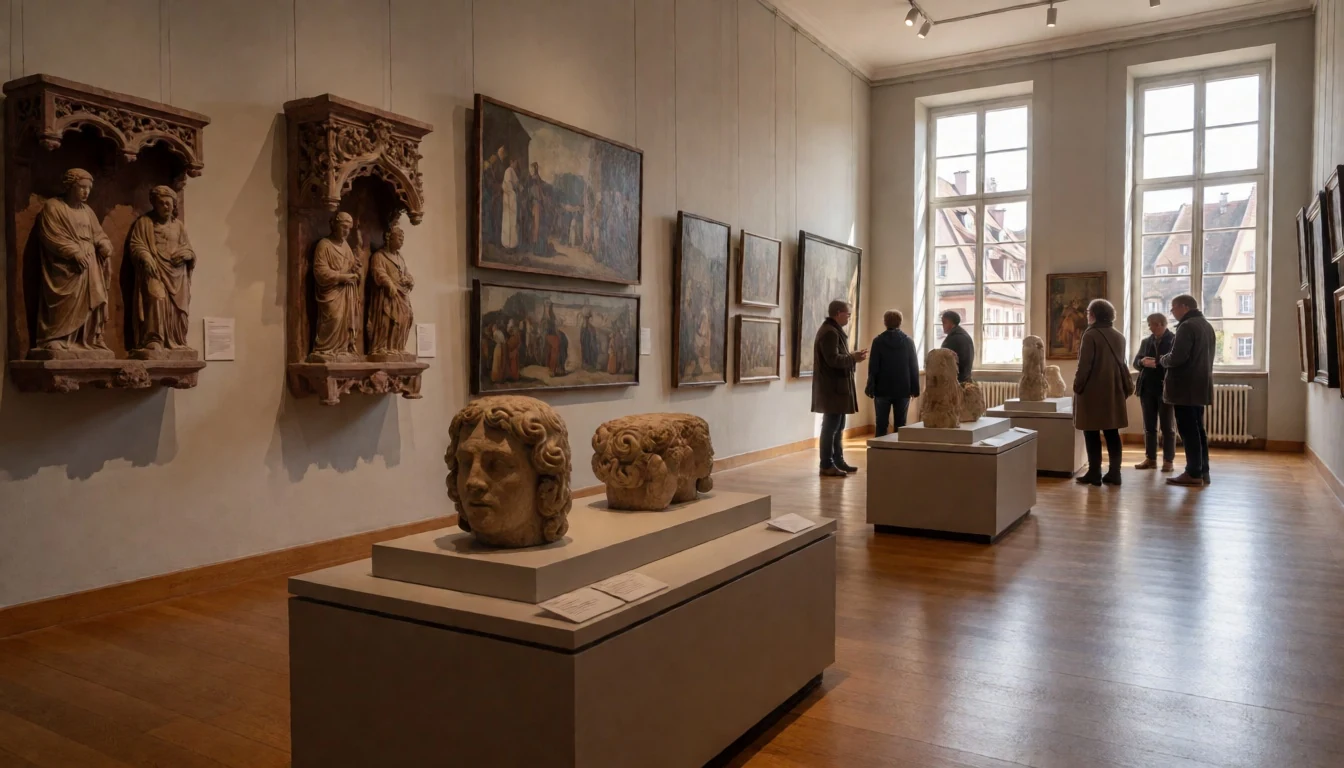
Culture
Heidelberg Castle sits in a city whose character comes as much from its university as from its ruin. The Ruprecht-Karls-Universität, centred in the old town, has about 28,000 students, so in term time the lanes below the castle fill with bicycles, lecture-goers and cheap cafés. That mix of scholarship and sightseeing gives the place a lived-in feel that many castle towns lack.
The ruin has long drawn artists and writers. Engravers fixed its outline in the seventeenth century, and nineteenth-century travellers treated its broken walls as a symbol of lost grandeur; Mark Twain was one of them. The picturesque ruin is built into how Heidelberg presents itself, from postcards to the way local guides tell the story of the lightning strikes and the wars.
The region's history sits alongside this. The Palatinate rulers were a major force in the German lands, and the castle was their seat, so the destruction that followed remains part of local memory. Not every site around the city is cheerful: the Thingstätte on Heiligenberg is a reminder of a darker chapter, and local people tend to treat it with seriousness rather than as a curiosity.
Stay on the marked paths, keep off the old walls and ledges, and lower your voice in the courtyards when a guided tour is under way.
What to wear
Heidelberg Castle sits in a region with a strong costume tradition, though the best-known regional dress, from the nearby Black Forest, is more a festival garment than anything worn locally day to day. Women's Tracht typically combines a fitted bodice, full skirt and apron in wool, linen or brocade, and the Black Forest's Bollenhut, a straw hat topped with wool pompoms, is the emblem people recognise. Men's versions use waistcoats, dark jackets and felt hats. These outfits appear at folk festivals, weddings, church occasions and heritage events rather than on ordinary days.
Everyday dress in Heidelberg is casual and practical. Students and residents wear jeans, trainers, rain jackets and scarves, and many get about by bicycle, so clothes tend to be hard-wearing rather than formal. Smarter outfits appear for concerts, dinners and university ceremonies.
For visitors, shoes matter most. The castle approach, courtyards and nearby paths are cobbled, stepped and sometimes wet, so comfortable shoes with grip are better than sandals or heels. Bring layers: the hillside can be breezy and cool even on a sunny day, while summer afternoons can turn hot on exposed terraces, so a hat and water help. A light waterproof is sensible in any season. There is no dress code at the castle, but shoulders and knees should be covered when stepping into a church in the old town.
What to eat
- Spätzle — Traditional inns and taverns in the old town
Soft egg noodles from south-west Germany, served with melted cheese, onions or as a side to meat in gravy. Hearty, filling and good after a climb to the castle. Look for them at traditional inns and taverns in the old town.
- Flammkuchen — Wine taverns and casual restaurants in the old town
A thin, crisp base spread with sour cream, onions and bacon, baked fast in a very hot oven. It is made to share and goes well with a local white wine. Wine taverns and casual restaurants around the old-town lanes usually have it.
- Studentenkuss — Confectioners and chocolate shops along Hauptstraße
A local sweet whose name means student's kiss: a chocolate with a soft filling, created for a town of students. It makes a portable gift or a small treat on a walk. Look in confectioners and chocolate shops along the main street. - Brezel and bakery cakes — Bakery-cafés across the old town
Salted pretzels and slices of cake are the standard quick breakfast or afternoon stop here. Bakery-cafés in the old town serve them with coffee and fill up with students and shoppers in the morning. Cheap, filling and easy to eat on the move. - Barbecue and beer on the Neckarwiese — Neckarwiese, northern bank of the Neckar, west of Bismarckplatz
On sunny summer days the riverside meadow fills with people grilling and drinking beer, with the castle in view. Visitors need to bring their own grill, food and drinks; disposable grills are sold at a do-it-yourself store near Bismarckplatz. - University canteen lunch — Marstall, on the river side of the old town
The Zeughaus-Mensa in the Marstall is a university canteen in a historic building, with a beer garden and low prices by the standards of the old town. It is a good way to eat where students do. Check current access for visitors on the official site.
Plan it
Best time. April–June and September–October for cooler, more comfortable days and green or golden hillsides; July and August are hottest, with highs near 39 °C, and busiest, while winter is bitterly cold, with lows near -20 °C, and grey, but far quieter.
How long. 1–2
Getting there. Fly to Frankfurt Airport, the nearest intercontinental airport, or to Stuttgart for European flights; both have train stations in the terminal. Take an ICE train to Heidelberg, which may need one change at Mannheim, Stuttgart or Frankfurt Central. From the old town, ride the funicular from the Kornmarkt or climb the steps to the castle.
Budget. mid
Tips
- Go early in the morning or late afternoon to avoid the busiest tour-group hours.
- Check the official site (http://www.schloss-heidelberg.de/) for ticket and opening details; the funicular is covered by the castle ticket.
- Wear shoes with grip, as the approach and courtyards are cobbled, stepped and often wet.
- Carry a rain layer, since most of the visit is outdoors.
- Walk Philosophenweg in the late afternoon for the view back at the castle.
Etiquette
- Stay on marked paths and keep off the old walls and ledges.
- Keep voices down in the courtyards when a guided tour is under way.
- Treat the Thingstätte on Heiligenberg as a historical site, not a photo backdrop.
Nearby
Sources
- Wikidata Q327265 (CC0)
- Wikipedia: Heidelberg Castle (rev 1384019276) (CC BY-SA 4.0)
- Wikivoyage: Heidelberg (rev 5403861) (CC BY-SA 4.0)
- Heidelberg castle, total view from NNW — Pumuckel42 (Reinhard Wolf) (CC BY 3.0)
- Heidelberger Schloss — Motatcho (CC BY-SA 4.0)
- Heidelberg Castle in 1620 (redrawing from 1902) (Public domain)
- Obere Burg und Dicker Turm — Sebastian Münster, 1527 (Public domain)
- Heidelberger Schloss Innenhof — Johann Ulrich Kraus (Public domain)
- Heidelberger Schloss im 16 Jh aus Thesaurus Pictuarum (Public domain)
- Befestigungsplan des Heidelberger Schlosses 1622 (Public domain)
- Hortus Palatinus und Heidelberger Schloss — Jacques Fouquier (Public domain)


