Hashima Island
Hashima Island, Japan
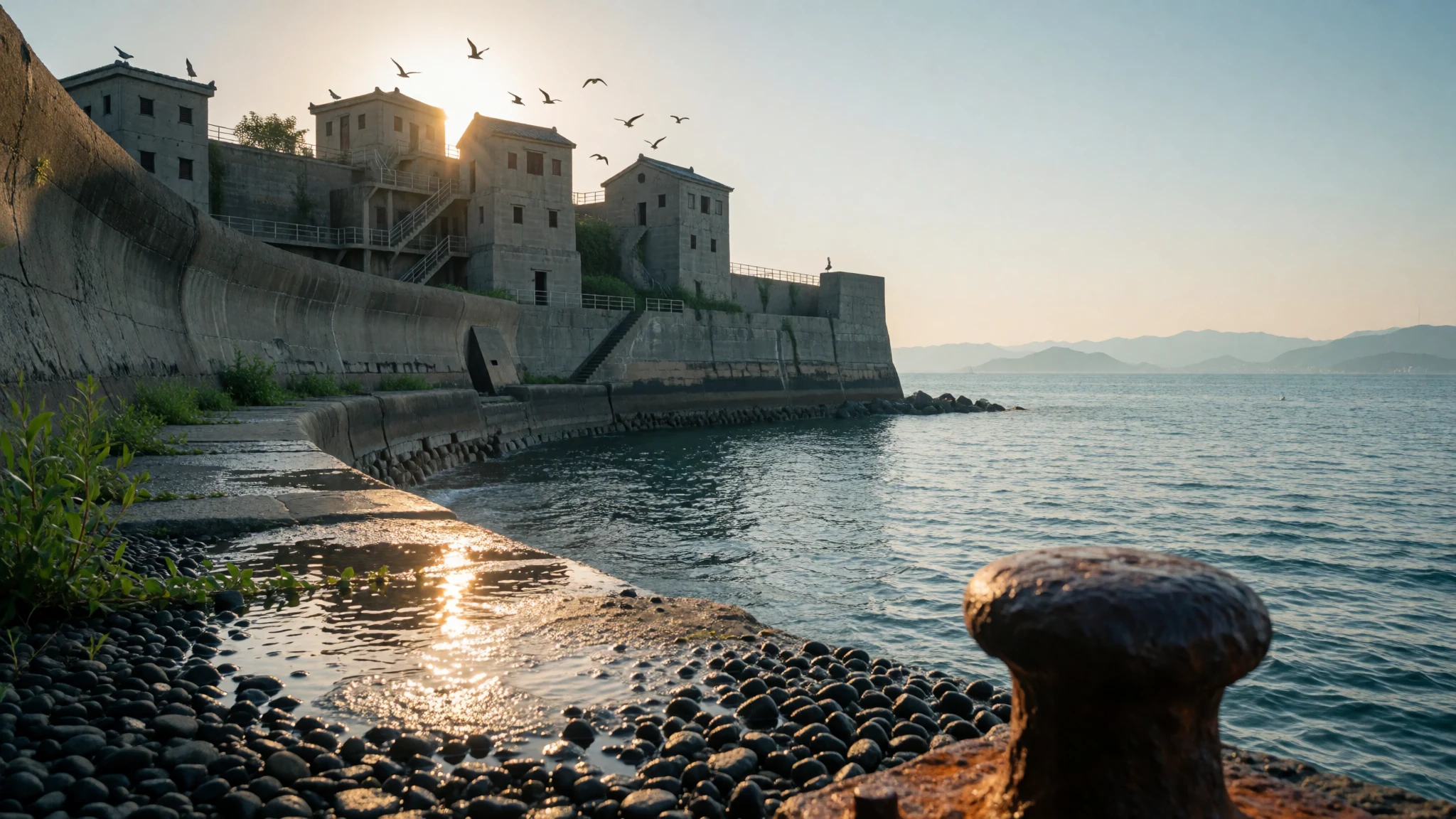
Hashima Island is a tiny concrete coal-mining island off Nagasaki, left to the weather since 1974 and now reached by licensed tour boat.
The place
Hashima Island lies in the sea about 15 kilometres from Nagasaki and is known to almost everyone as Gunkanjima (軍艦島), 'Battleship Island', because its sea wall and crowded towers look like a warship from the water. The island is tiny, a little over six hectares, and every part of it was once put to use: flats, a school, a hospital, shops and gardens on the rooftops. Today nobody lives there. What remains is a dense mass of grey concrete blocks with stairwells open to the sky, rusted pipework and a sea wall that still keeps the waves off the ruins. Nature is slowly taking over, with weeds growing from window frames and salt eating into the concrete. Some collapsed walls have been shored up so that visitors can be landed, but most of the island is seen from fenced walkways rather than explored freely. Hashima is one of hundreds of uninhabited islands in Nagasaki Prefecture, yet it is the one people cross the water to see. Its meaning is mixed. It stands for the speed of Japan's industrialisation, and it also stands for the forced labour of Korean civilians and Chinese prisoners of war before and during the Second World War. Many visitors find the mood quieter and more sombre than the photographs suggest. The coal mine is part of the Sites of Japan's Meiji Industrial Revolution World Heritage listing. For landing arrangements, check the official site at http://www.gunkanjima-nagasaki.jp/.
Its story
Hashima Island had a short and intense working life. Coal was known in the area from the early nineteenth century, and undersea mining began in 1887. Mitsubishi bought the island in 1890 and sank deeper shafts beneath the seabed, while new land and high seawalls enlarged the rock to about three times its natural size. Underground it was hot and humid, hard on the men at the coal face. In 1916 the company raised a seven-storey reinforced-concrete apartment block, partly as protection from typhoons, and further blocks followed over the decades. A school, kindergarten, hospital, town hall, cinema, baths, a swimming pool and a pachinko parlour turned the rock into a self-contained town. Population rose until, by 1959, 5,259 people were living on a few hectares. From the 1930s until 1945, Korean civilians and Chinese prisoners of war were put to work in the mine under brutal treatment, and that history shaped much of the argument when the site was put forward for World Heritage status, which was approved in 2015 after long dispute. As coal reserves ran low, the mine shut in 1974 and the residents left soon afterwards. The island then stood empty for decades. Interest returned in the 2000s because the ruins had been left so untouched, and tourist landings began again in 2009.
What to see
- The landing walkways on Hashima Island — Hashima Island, off Nagasaki
The landing on Hashima Island is the heart of the trip: a short walk along fenced routes with the apartment blocks, the old school and the sea wall on either side. Only a small part of the island is open, and the time ashore is set by the tour operator, so the ruins are viewed at a measured distance.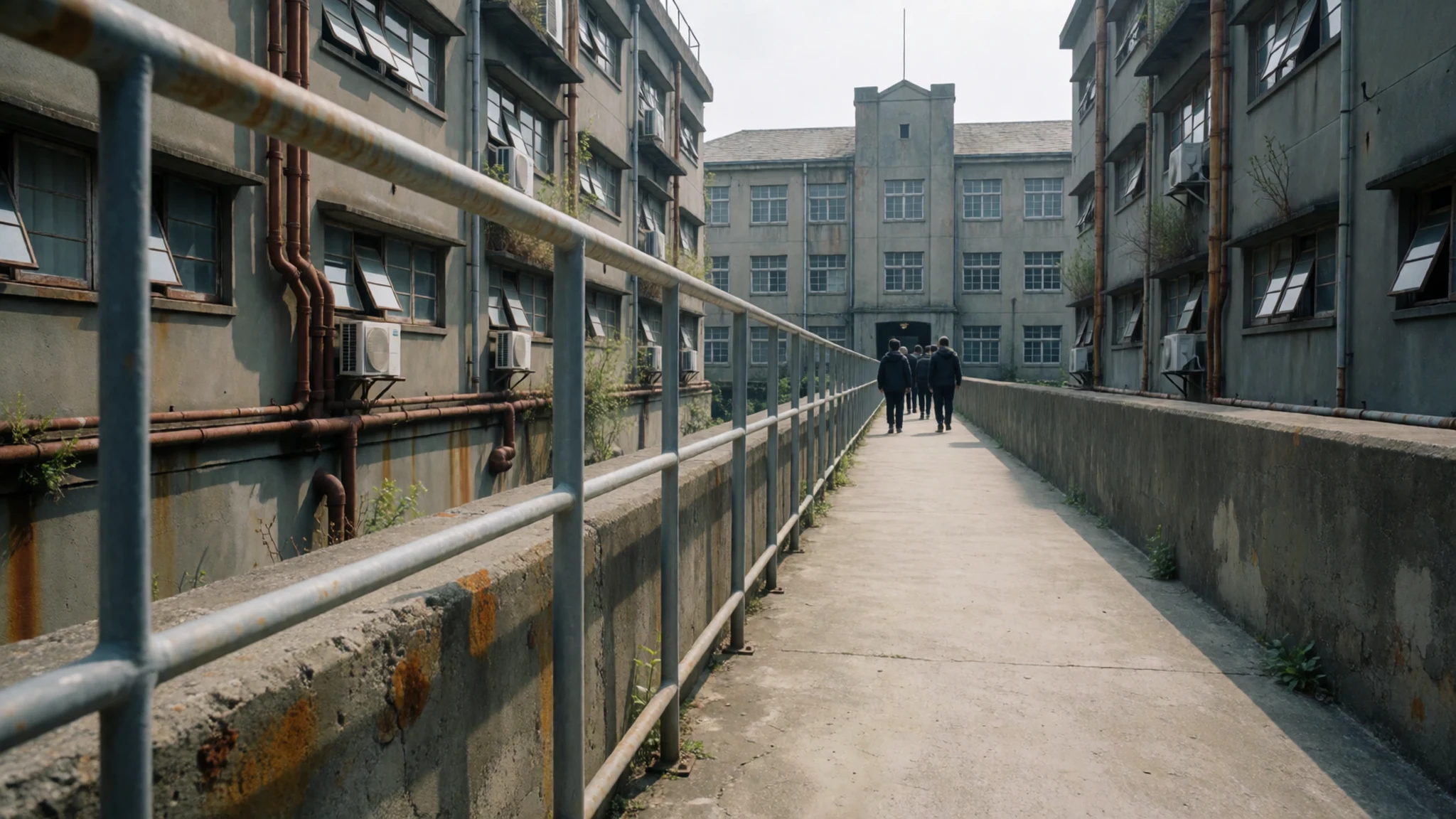
- Gunkanjima from the water — Sea around Hashima Island
Seen from the sea, Gunkanjima earns its Battleship nickname, with packed towers rising behind the seawall. Many tours pass along part of the island's edge, and a clear day shows the scale better than anything on shore. The view from the south-west gives the classic whole-island outline.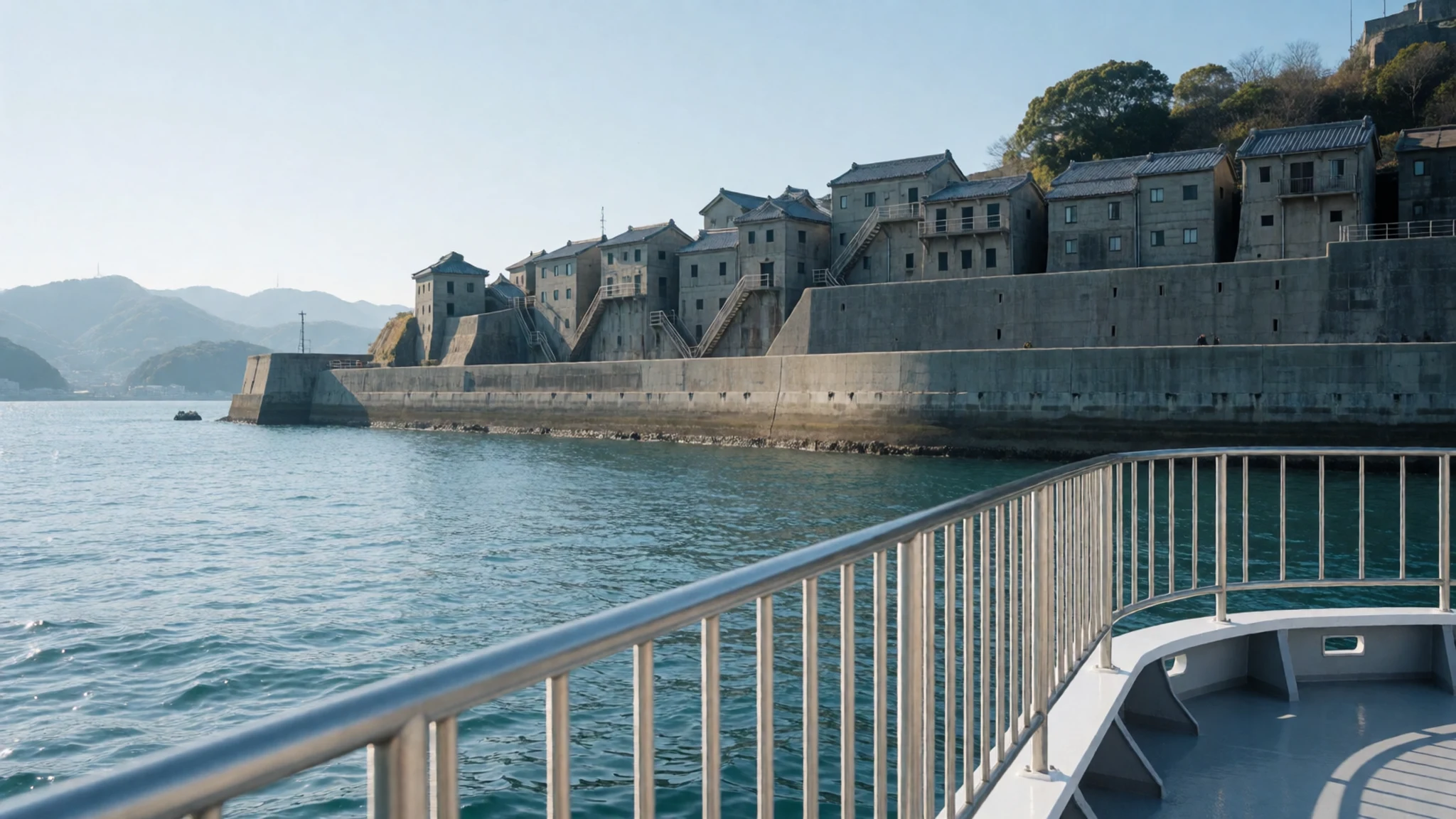
- Nagasaki Peace Park — Urakami district, Nagasaki
Nagasaki Peace Park is a solemn memorial near the point over which the atomic bomb exploded on 9 August 1945. The Peace Statue is its centre, and the park is a quiet place to sit and reflect before or after the lighter business of the boat trip.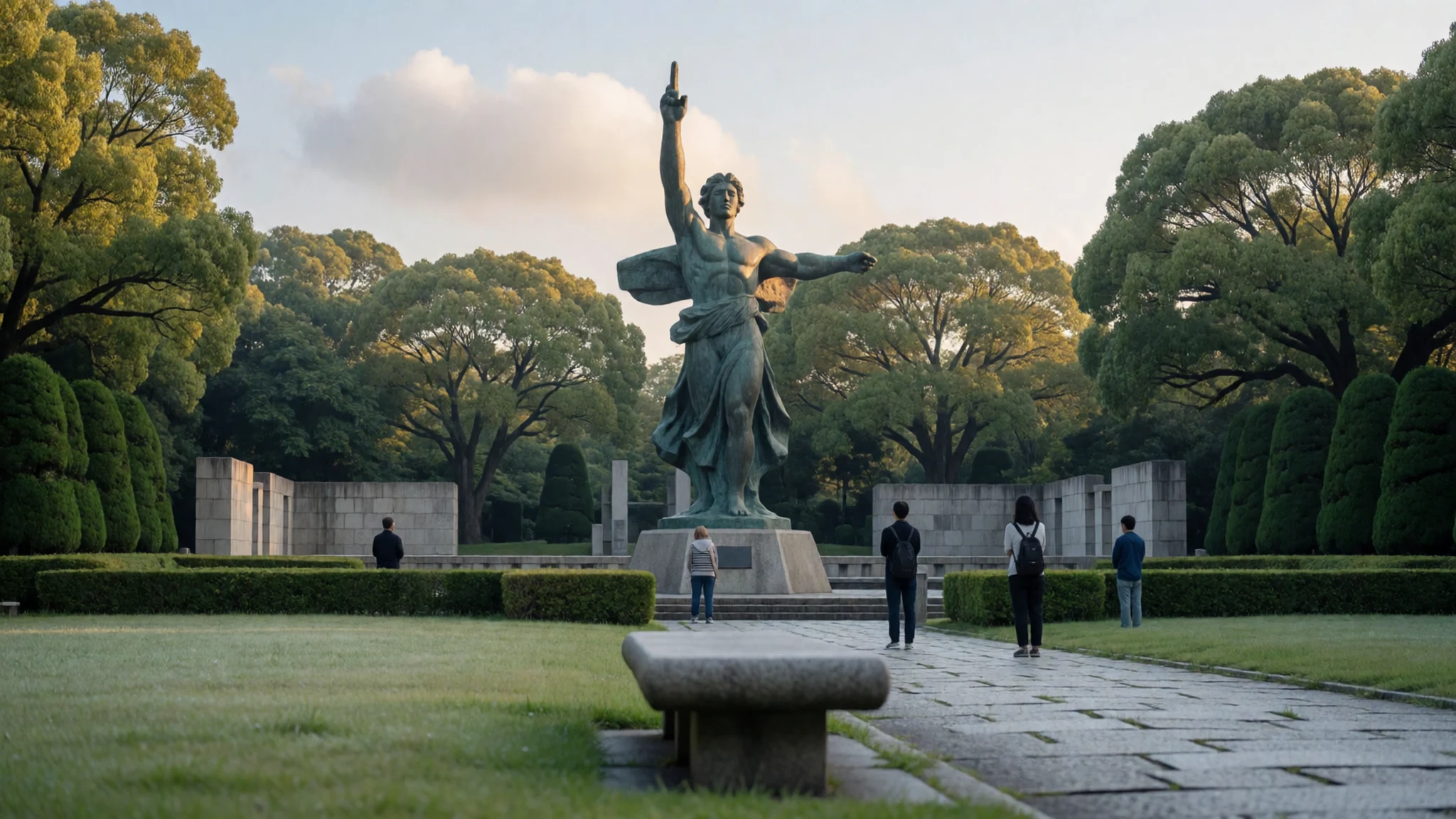
- Atomic Bomb Museum — Urakami district, Nagasaki
Nagasaki's Atomic Bomb Museum sits close to the Peace Park and tells the story of the bombing through objects, photographs and testimony. It is carefully put together and heavy going, and ends with a case against nuclear weapons. Allow enough time and avoid rushing it between other plans.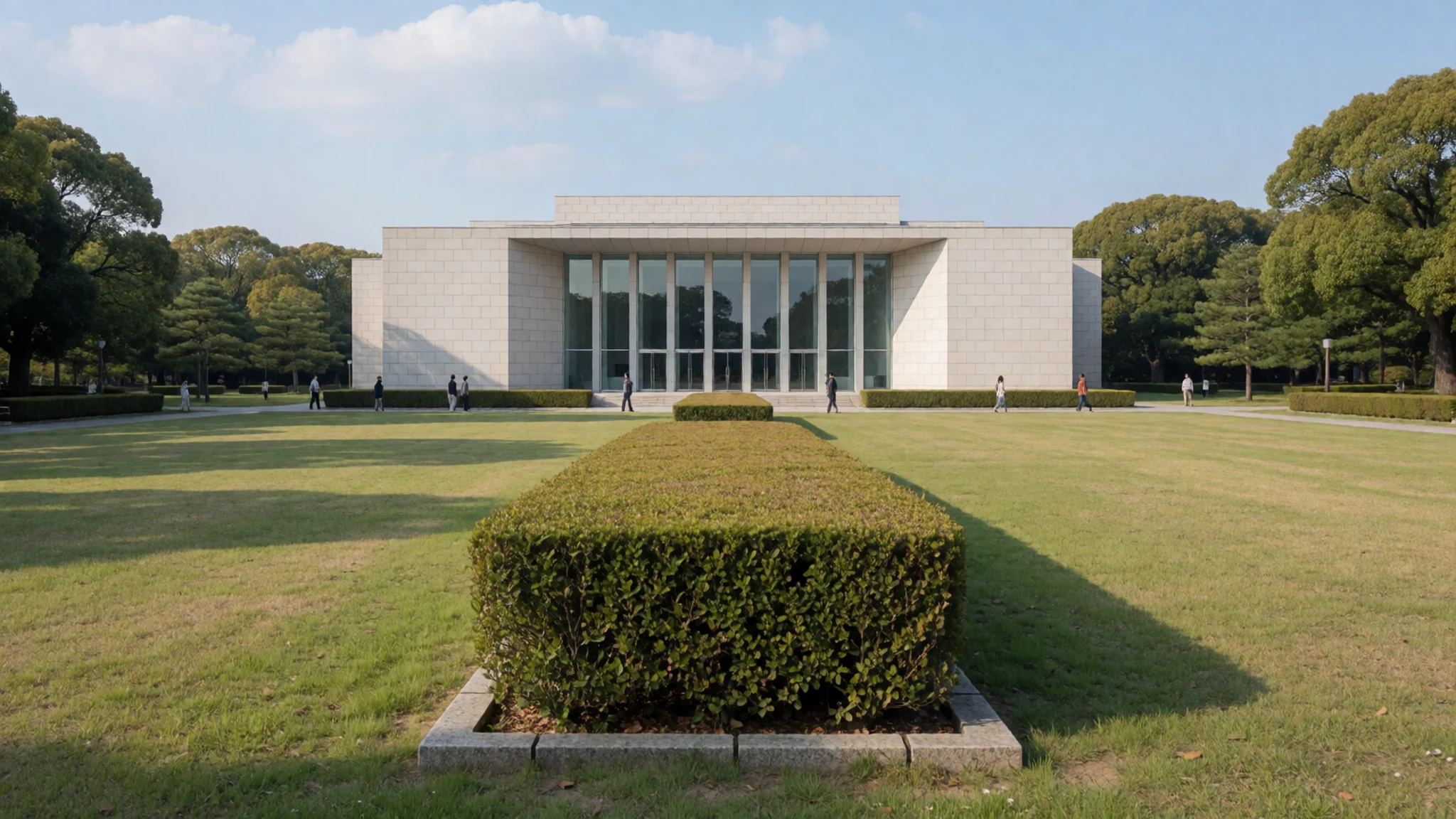
- Glover Garden — Minamiyamate, Nagasaki
Glover Garden is a hillside collection of European-style houses, moved here from elsewhere in the city, that once belonged to foreign traders and diplomats after Japan reopened to the world in the Meiji period. It is a gentler stop, with harbour views and shaded paths, and a useful contrast to Hashima's industrial story.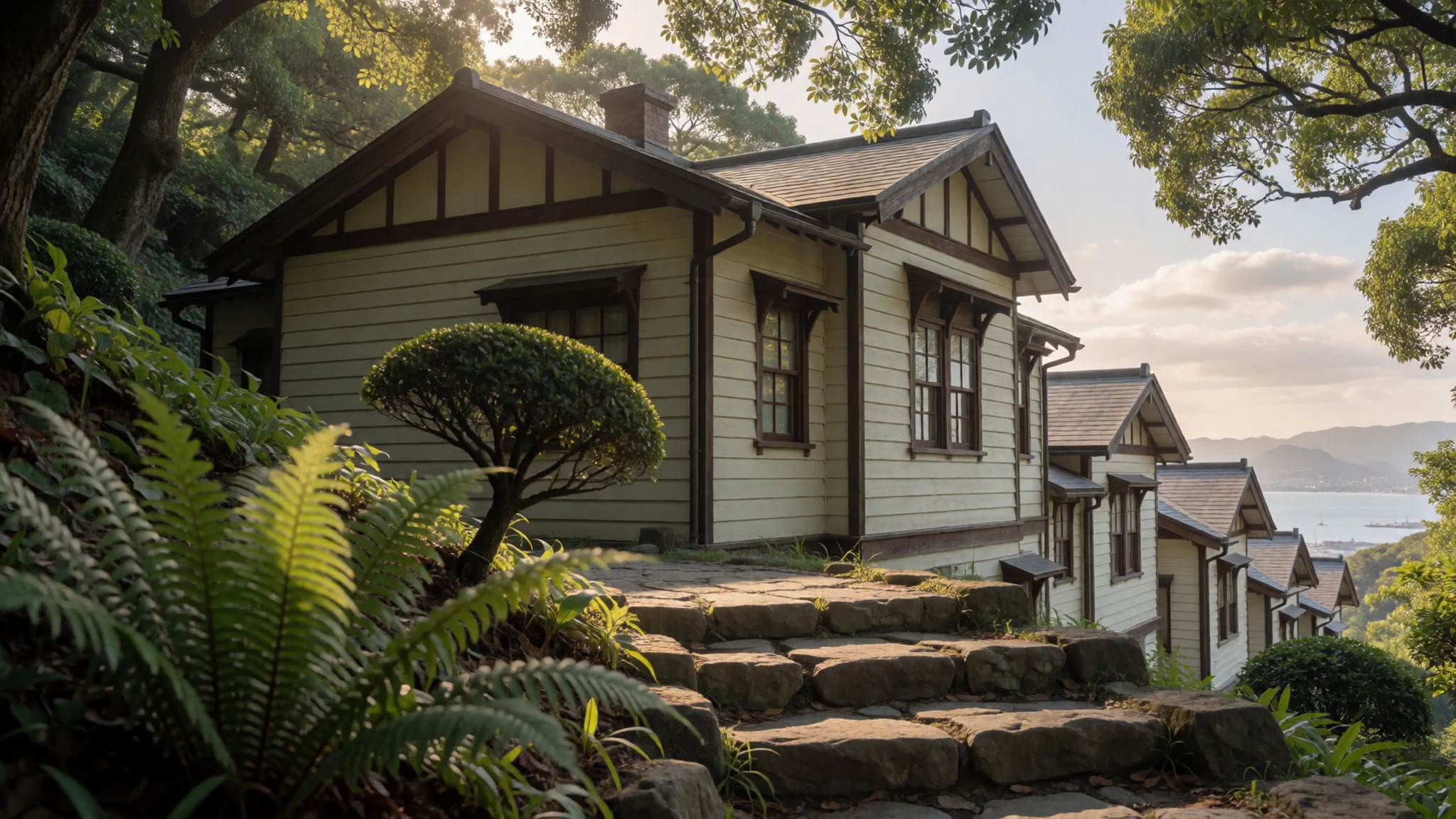
Culture
Hashima Island carries two cultural stories that sit uneasily together. One is the daily life of a mining community: families in tiny flats, children at the island's school, films at the cinema, and a company that supplied homes, baths and shops in return for dangerous work underground. Former residents and their descendants keep those memories alive, and for many of them the island is remembered as home rather than as a ruin. The other story is the forced labour of Korean civilians and Chinese prisoners of war during the war years, which remains painful and politically sensitive in Japan, Korea and China. How that history was presented was one of the sticking points in the island's World Heritage approval, and visitors will meet differing views on whether the interpretation goes far enough. A guidance centre in Tokyo, the Industrial Heritage Information Center, was set up to explain the wider group of Meiji industrial sites, and Nagasaki's own museums add context about the region's wartime past. Tours run on licensed boats and depend on the sea, so landings are cancelled when conditions are rough. It helps to treat the island as both a heritage site and a memorial rather than a film set. Stay on the marked walkways, never enter or climb the unstable buildings, and keep voices low and photography respectful, as many people regard the place as one of mourning.
What to wear
Hashima Island never had a dress tradition of its own; the families who lived there wore what the rest of Japan wore, with the kimono and the lighter cotton yukata kept for festivals, weddings and summer evenings. Kimono are traditionally made of silk, yukata of cotton, and both are tied with an obi sash. In daily island life the look was practical: miners in heavy work clothes, helmets and boots against heat, wet and coal dust, and children in school uniform. Today nobody lives on Hashima, so what people wear there is what visitors bring. In Nagasaki, locals dress in ordinary modern city clothes, and kimono are mostly seen at festivals or on tourists in rental outfits. For the trip, wear closed, flat shoes with a good grip, because the landing stage and paths are uneven and can be wet. Bring a light waterproof layer and a windproof top, since the boat crossing is exposed even on warm days, and add a hat and sunscreen in summer, as there is little shade ashore. Long trousers are sensible on rough ground. There is no formal dress code, but plain, modest clothing suits a place that many regard as a memorial. Avoid heels and open sandals, and carry a small bag so both hands are free on steps and rails.
What to eat
- Champon — Noodle restaurants in Nagasaki's Chinatown district, reached by tram to Tsuki-machi
Nagasaki's best-known dish is champon, noodles in a rich pork-based broth with vegetables, bacon, shrimp, squid and scallops. It is filling and warming, and it makes a good meal after a windy boat trip.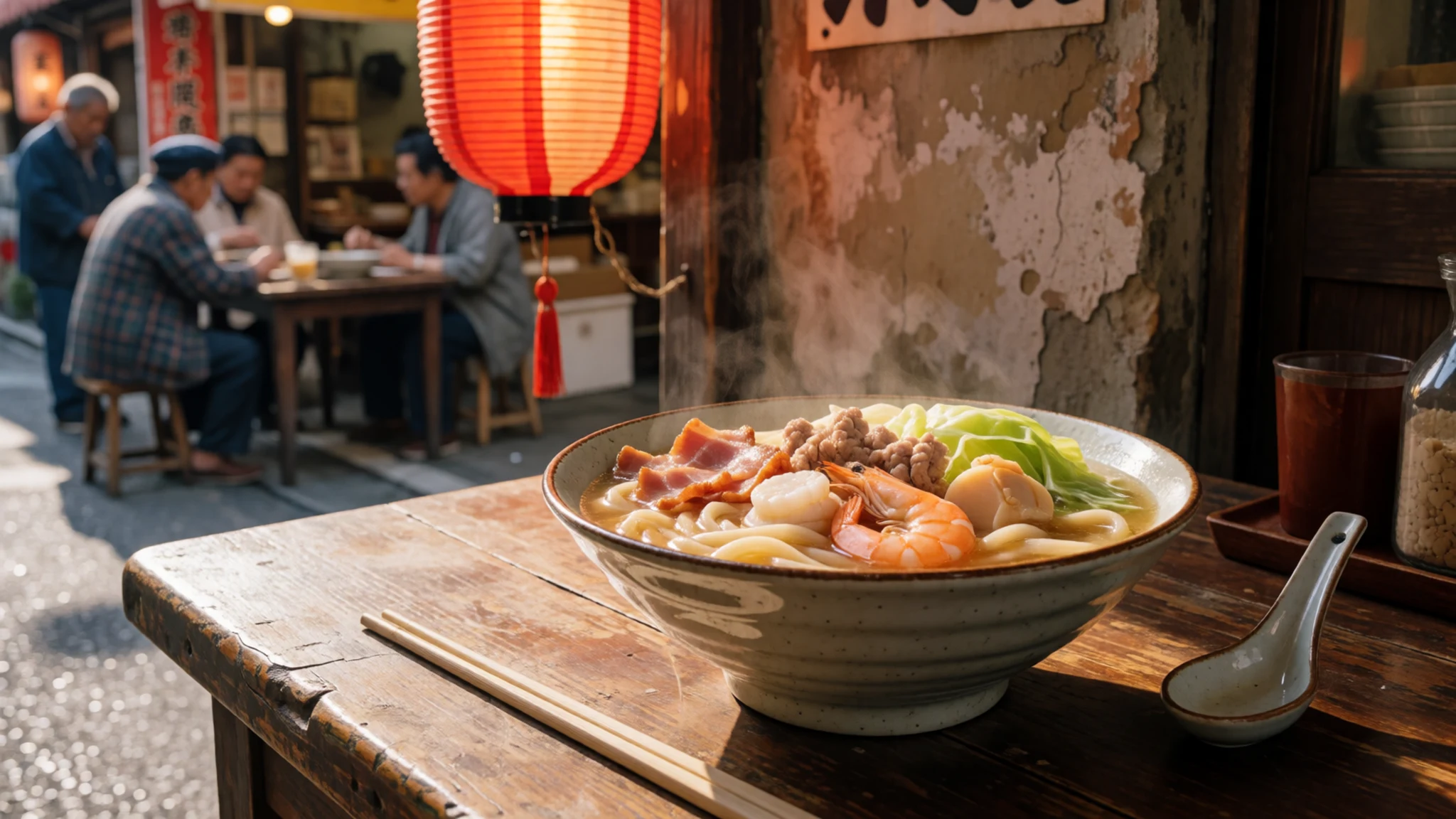
- Saraudon — Chinatown restaurants and local eateries in central Nagasaki
Saraudon uses the same meat, seafood, vegetables and sauce as champon but spoons them over crisp fried noodles on a plate (sara). The contrast of crunchy base and soft topping makes it a popular choice for those who prefer less broth.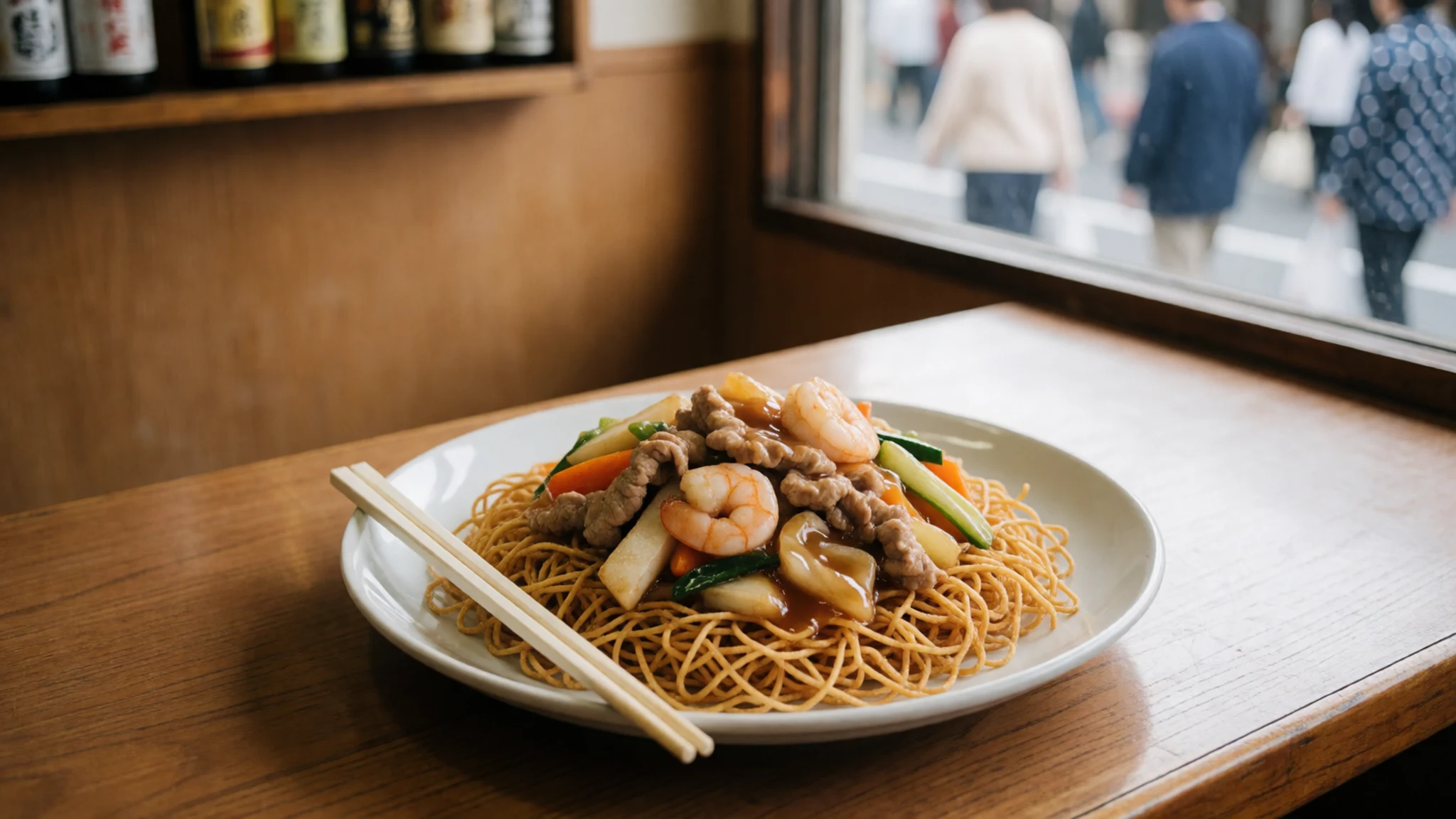
- Kakuni-manju — Street stalls and snack counters in Nagasaki's Chinatown
Kakuni-manju is braised, marinated pork tucked into a soft steamed bun. It is sold as street food and is easy to eat while walking, a handy snack between museums and the harbour. - Ebichiriman — Street food stalls around Nagasaki's Chinatown
Ebichiriman is shrimp fried in a chilli sauce and served in a steamed bun. It has a gentle kick and a sweet-savoury edge, and is among the Chinese-influenced snacks that Nagasaki's port history left behind. - Castella — Cake shops and souvenir counters across central Nagasaki
Castella is a light sponge cake first brought by the Portuguese and gradually made Japanese in texture and flavour. Today it comes plain or in honey, chestnut and green tea versions, and is a favourite gift to take home.
Plan it
Best time. April–May and October–November, when the weather is mild and the sea is more often calm enough for landings; summer is hot and humid, late-summer typhoons can cancel boats, and winter crossings can be cold and rough.
How long. 1–2
Getting there. Fly to Nagasaki Airport and take a limousine bus into the city centre, or come by train from Fukuoka, changing at Takeo-Onsen onto the Kamome shinkansen. The last leg to the island is a licensed tour boat from Nagasaki's harbour; see the official site, http://www.gunkanjima-nagasaki.jp/, for operators and landing arrangements.
Budget. mid
Tips
- Check the official site and book the boat trip ahead, as landings depend on weather and sea conditions and can be cancelled at short notice.
- Carry cash for the airport bus ticket, which is bought outside the terminal and paid for in cash.
- Pack a windproof layer, water and sun protection, as the crossing is exposed and there is little shade ashore.
- Allow a second day for Nagasaki's Peace Park, museums and food rather than squeezing everything around the boat.
Etiquette
- Stay on the marked walkways and never enter the unstable buildings.
- Keep voices low and photograph respectfully, as the island is a memorial to forced labour as well as a heritage site.
- Follow the tour guide's instructions on landing and leaving.
Nearby
Sources
- Wikidata Q285468 (CC0)
- Wikipedia: Hashima Island (rev 1383779919) (CC BY-SA 4.0)
- Wikivoyage: Nagasaki (rev 5412093) (CC BY-SA 4.0)
- Photo 01: Nagasaki Hashima 01-1 (Hisagi) (CC BY 3.0)
- Photo 02: Battle-Ship Island Nagasaki Japan (kntrty) (CC BY 2.5)
- Photo 03: Hashima Gunkan jima Nagasaki (www.ehagaki-nagasaki.com) (Public domain)
- Photo 04: Nagasaki Hashima 01 (Hisagi) (CC BY 3.0)
- Photo 05: Collapsed buildings and rubble on Hashima (NevinThompson) (CC BY-SA 4.0)
- Photo 06: Hashima Island 14 (Σ64) (CC BY 3.0)
- Photo 07: Nagasaki Hashima Gunkanjima1 (At by At) (Public domain)
- Photo 08: Industrial Heritage Information Center (Mr.Asylum) (CC BY-SA 4.0)


