Gibraltar
Gibraltar, United Kingdom
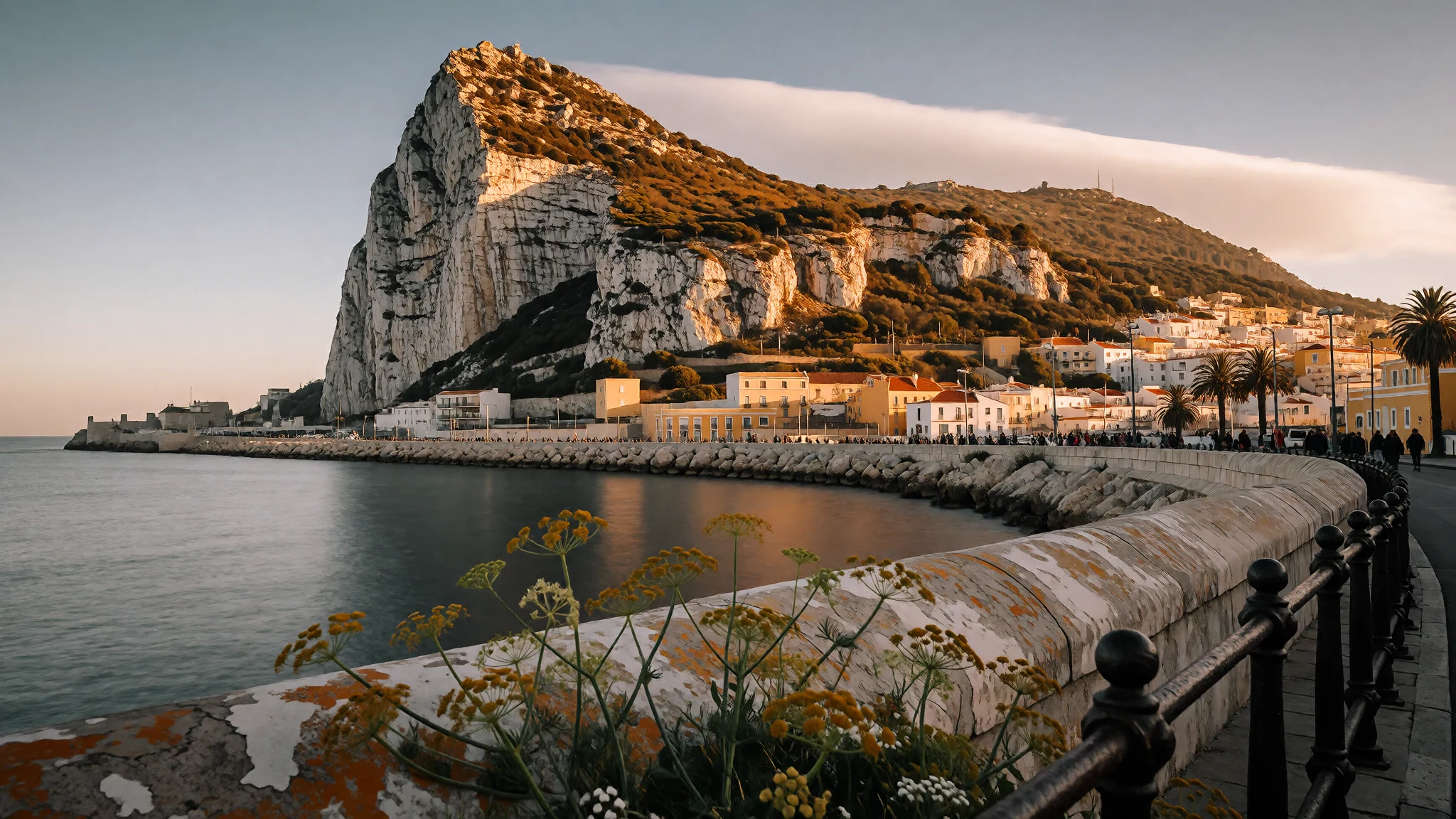
Gibraltar packs a limestone Rock, wild macaques, ancient caves and a British-Andalusian town into less than seven square kilometres.
The place
Gibraltar is a British Overseas Territory at the southern end of the Iberian Peninsula, facing the point where the Mediterranean opens into the Atlantic. Its area is 6.8 square kilometres, so everything is close: a limestone ridge, the Rock, rises straight from a crowded strip of town, and the land border with Spain lies at the northern end. About 38,000 people live here, and most call themselves Gibraltarians. The town sits only about 11 m above sea level, which makes the drop from the Rock's summit feel sharper. Streets are narrow and stacked against the slope, with Main Street running through the old centre and pubs, shops and small squares packed around it. On clear days the coast of Africa shows across the strait, and ships wait in the bay below. The mood is pleasantly mixed: red pillar boxes and English-language signs stand next to Andalusian-style balconies and Spanish chatter. Many visitors cross from the Spanish coast for the day, so the Rock's main sights fill up from late morning, especially when a cruise ship is in port. Summer is hot and the stone holds the heat. The whole territory can be crossed on foot in a morning, but the Rock itself deserves a second day, and a walk down through the town at the end of the afternoon is when it feels most like a place rather than an attraction.
Its story
Gibraltar's story begins long before any flag. Excavations in Gorham's Cave show Neanderthals living on the Rock about 50,000 years ago, and later peoples kept using the caves for tens of thousands of years, leaving hearths, stone tools and animal bones. Pottery from the Neolithic links these caves to communities across Andalusia. In the ancient Mediterranean the Rock counted as a sacred landmark. Phoenicians arrived around 950 BC and seem to have treated Gorham's Cave as a shrine, and Carthaginians and Romans followed them. The Romans called it Mons Calpe, and Greek and Roman writers counted it as one of the Pillars of Hercules, the twin markers in the myth where Heracles broke the land apart to open the strait. The Almohads set up a lasting watchtower here in 1160. Control then passed between Nasrid, Castilian and Marinid rulers until the Crown of Castile held the Rock again in 1462. The turning point for the modern place came in 1704, when Anglo-Dutch forces took it during the War of the Spanish Succession. The Treaty of Utrecht gave it to Great Britain in 1713, and it grew into a Royal Navy base that mattered in the Napoleonic Wars and the Second World War, because whoever held it watched the narrow gateway into the Mediterranean. Sovereignty is still disputed, since Spain maintains a claim, and that argument shapes politics on both sides of the border.
What to see
- Europa Point — Southern end of Gibraltar
Europa Point is the southern tip of Gibraltar, where the Atlantic and the Mediterranean meet. On a clear day the African coast stands out across the strait, and ships pass close in. It is an open, breezy spot, good for sunset, and usually quieter than the Rock's upper paths. - Upper Rock Nature Reserve — The Rock, above the town
The reserve covers the high ground of the Rock and is where the Barbary macaques live. Paths, viewpoints and old military works are spread along the ridge. Go early, because the monkeys are most active in the cooler hours, and treat them as wild animals, not as a petting zoo.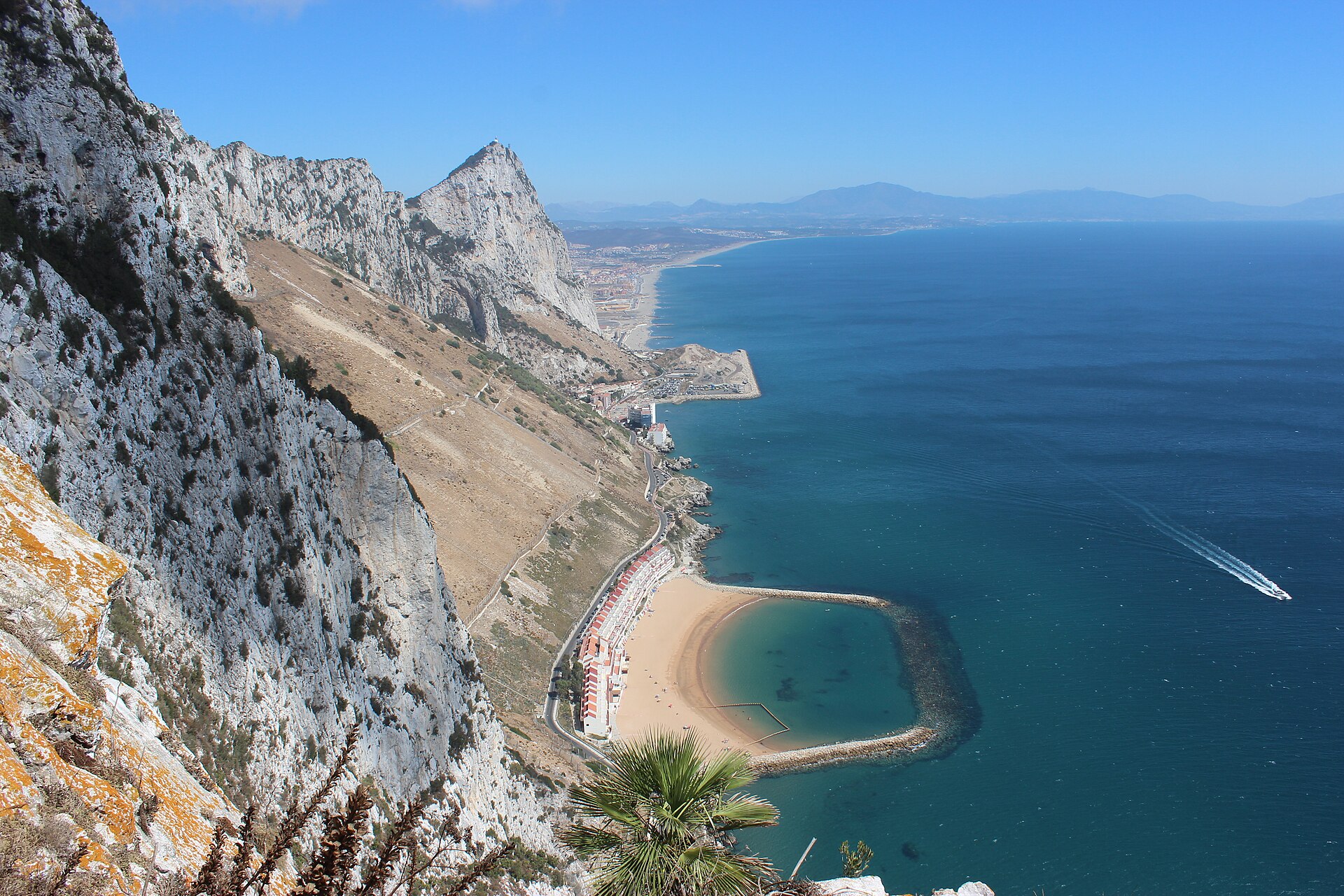
- Gorham's Cave complex — Eastern coast, below the Rock
Four caves on the Rock's eastern shore make up this complex: Gorham's, Vanguard, Hyaena and Bennett's. Gorham's Cave holds evidence of Neanderthal life and later use as a Phoenician shrine. Access is controlled, so check the official site for how to see it and what is open. - St Michael's Cave — Upper Rock, southern slope
St Michael's Cave is a large natural grotto high on the Rock, used by Neolithic people and still a dramatic space of stalactites and chambers. It is among the busiest stops on the Rock, so an early start helps. Expect damp air, uneven steps and a cool temperature inside. - The Moorish Castle — Above the old town
The Moorish Castle stands on the slope above the old town and recalls the centuries when Muslim rulers held the Rock. Its heavy walls and tower give good views over the bay and the harbour. The climb is steep in the heat, so carry water and take it slowly.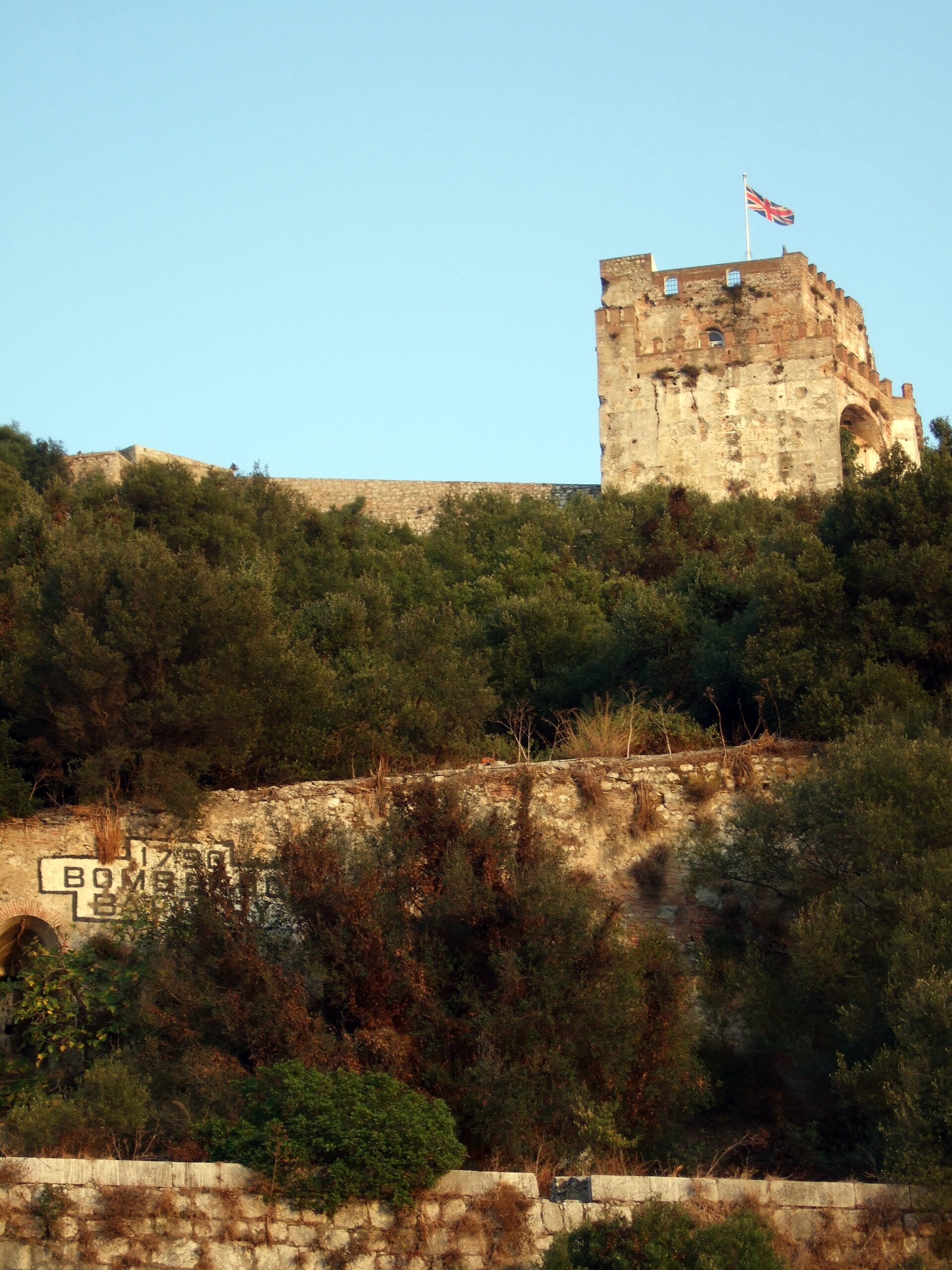
Culture
Gibraltar's culture comes from mixing. Spanish influence, largely from nearby Andalusia, and British influence are the two obvious strands, but families also trace roots to Genoa, Malta, Portugal, Catalonia, Sicily, Morocco, India and Sephardic Jewish communities. English is used in official business, schools and newspapers, while talk on the street often slips between English and Spanish within a single sentence. Places of worship of several faiths stand within a short walk of each other, and kosher shops sit beside pubs. National Day on 10 September marks the first sovereignty referendum. It is a public holiday when the streets fill with red and white, the national colours. Until 2016 thousands of balloons were released, but the custom ended because of the risk to wildlife, especially at sea. Daily life keeps British habits such as tea, pub evenings and queuing, alongside Mediterranean late dinners and long conversations in the square. The question of Spain and sovereignty can be sensitive, so listening works better than opening with an opinion. Do not feed the Barbary macaques, and keep food and open bags zipped away on the Rock, because the monkeys will grab whatever they can see.
What to wear
Gibraltar has no single traditional costume with its own named textiles, which suits a population drawn from many places. The nearest thing to national dress is colour: on National Day, 10 September, people wear red and white, from shirts to scarves. Some communities wear their own garments for festivals and worship, such as saris and kurtas in the Indian community, and head coverings in Jewish and Muslim settings. Everyday dress is British-Mediterranean: linen shirts, light dresses and sunglasses in summer, jackets and umbrellas in winter, and suits in offices. Smart-casual is normal for an evening out. Visitors should dress for sun and steep ground. Bring a hat, sunscreen and shoes with proper grip, since the Rock's paths and steps are uneven and polished stone gets slippery. A light windproof layer is useful at the summit, where it feels cooler than in town. Swimwear belongs on the beach, not in the streets. Shoulders and knees should be covered inside churches, synagogues and mosques, and a scarf kept in a bag makes that easy.
What to eat
- Full English breakfast — Pubs and cafés around Main Street and the town centre
Gibraltar's British side shows up most clearly at breakfast: eggs, bacon, sausage, beans and toast, served generously. It is a reliable start before climbing the Rock and is easy to find, with plenty of choice and cheerful service. - Calentita — Local cafés, bakeries and street kiosks in the old town
Calentita is a baked chickpea-flour flatbread, soft inside and lightly browned on top, often eaten warm with pepper. It is a local staple that reflects the Mediterranean roots of Gibraltarian cooking, and it is worth asking for by name. - Moroccan home-style dishes — Takeaway counters near the centre
Moroccan families have long been part of Gibraltar, and takeaway counters serve tagines, couscous and grilled meats. Portions are filling and the flavours are warm and spiced, which suits a lunch away from the pubs. - Kosher bakes and snacks — Kosher bakeries and minimarkets in the town
Gibraltar has kosher restaurants, bakeries and minimarkets, reflecting its long-established Jewish community. Pastries and breads are good for picnics on the Rock, though opening days around the Sabbath and festivals vary, so check before heading out. - Pub lunch and sandwiches — Casemates Square, Irish Town and supermarket counters
Hearty pub lunches, from pies to fish and chips, are the easy option, and supermarket counters prepare fresh sandwiches for hikers. Casemates Square is a pleasant place to sit outside and watch the crowd, while Irish Town has a run of pubs.
Plan it
Best time. March to May and October to November, when walking the Rock is comfortable; summer is hot and crowded with day visitors, and winter can bring wet, windy days.
How long. 1–2
Getting there. Fly to Gibraltar's own airport, or to an Andalusian airport on the Spanish coast and continue by road or bus to the border at La Línea, then walk across; the town centre is a short walk or taxi ride from the crossing.
Budget. mid
Tips
- Go up the Rock early, before cruise-ship and day-trip crowds arrive
- Carry water and a hat, as shade is limited on the upper paths
- Border rules with Spain have been changing, so check the official site, https://www.gibraltar.gov.gi, before travelling
- Keep a passport or valid ID to hand for the crossing
- Check the official site for cave access and opening times
Etiquette
- Never feed or tease the Barbary macaques, and keep bags closed
- Cover shoulders and knees in places of worship
- Avoid raising sovereignty politics unless a local brings it up
Nearby
Sources
- Wikidata Q1410 (CC0)
- Wikipedia: Gibraltar (rev 1384836150) (CC BY-SA 4.0)
- Wikivoyage: Gibraltar (rev 5402772) (CC BY-SA 4.0)
- Photo: Gibraltar aerial view looking northwest, IamRender (CC BY-SA 2.0)
- Photo: Gibraltar5, Adam Cli (CC BY-SA 4.0)
- Photo: The Moorish Castle, James Cridland (CC BY 2.5)
- Photo: Douglas DC-3 of BOAC at Gibraltar, Royal Air Force official photographer (Public domain)
- Photo: Gibraltar Naval dockyard and South Mole, John Cummings (CC BY 3.0)
- Photo: The convent in Gibraltar, Bjørn (CC BY-SA 2.0)
- Photo: Gibraltar Parliament at dusk, Certo Xornal (CC BY 2.5)
- Photo: Rock of Gibraltar from the Mediterranean Steps, Uhooep (CC BY-SA 4.0)


