Georgetown
Georgetown, Guyana
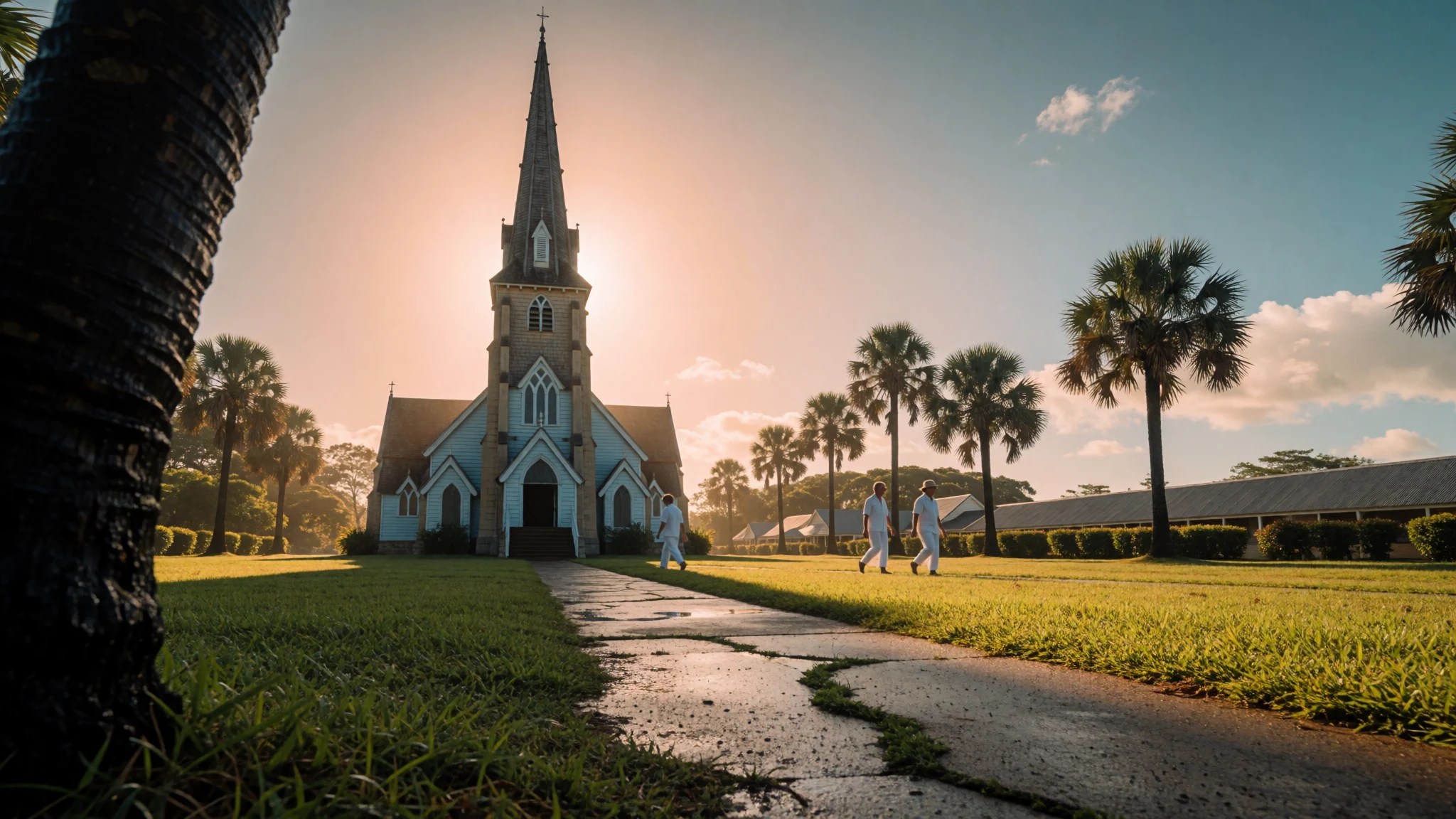
Georgetown is a low, green colonial capital of timber houses, busy markets and mixed cooking, best used as a base before Guyana's interior.
The place
Georgetown is the capital of Guyana and its largest city, built on the Atlantic coast where the Demerara River meets the sea. The ground is flat coastal plain, with cane fields, marsh and savannah to the east and south, and parts of the city lie about 2 m below high-tide level. That is why canals, sea walls and drainage shape so much of daily life here.
Government, the highest court, finance and retail are all concentrated in the city, and the secretariat of the Caribbean Community, CARICOM, is based just outside it. The result is a small, low-rise place with a serious administrative job. Ministries in brick and timber sit a short walk from Stabroek Market, where minibuses and street traders keep the centre noisy from early morning.
The look is Dutch and British colonial: wooden houses raised on stilts, white-painted verandas, louvred shutters, and St George's Cathedral, a painted-timber church that rises over the streets around it. Wide avenues, trees and open canals earned Georgetown the nickname Garden City of the Caribbean. Geographically Guyana is on the South American mainland, yet its politics, cricket and food belong firmly to the Caribbean.
The city is honest about its limits. It is hot, humid and wet for much of the year, pavements are uneven, and local advice is to avoid walking around after dark. Most visitors give it a few days for buildings, museums, markets and meals, and then head inland.
Its story
Georgetown began as a Dutch outpost. The small village began when English planters established homes around a guard post that the colonial governor constructed at the entrance to the Demerara River in 1748. Records give 1781 as the founding date for the town, and a short French occupation of the Dutch colony left it with its first name, Longchamps.
The Dutch name that lasted came next. In 1784 the settlement was renamed Stabroek, after a Dutch West India Company president, and that name survives in the famous market and in one ward of the modern city. Growth was fast. A village of a few hundred people became a town of several thousand within a generation, and American traders built a wharf that became known as American Stelling, with small settlements springing up around the main town.
British rule brought the name Georgetown in 1812, in honour of King George III. The town received official city status in 1842, during the reign of Queen Victoria. Much of what visitors photograph today, from timber houses to civic buildings, comes from this period of sugar wealth and colonial administration, built by enslaved and later indentured labour whose descendants make up the city's communities.
Disaster also left a mark. In 1945 a large fire, remembered as the Great Fire, caused widespread damage in the city. Georgetown has since become the capital of an independent country, with its government, courts and regional bodies all housed within a small grid of streets beside the estuary.
What to see
- St George's Cathedral — Central Georgetown
St George's Cathedral is a painted-timber church whose spire rises above the low skyline of central Georgetown. The wooden structure shows how colonial builders used local timber where other cities used stone. Morning light is kindest and the heat is lighter. Visiting times vary with services, so ask a caretaker or the church before planning around it.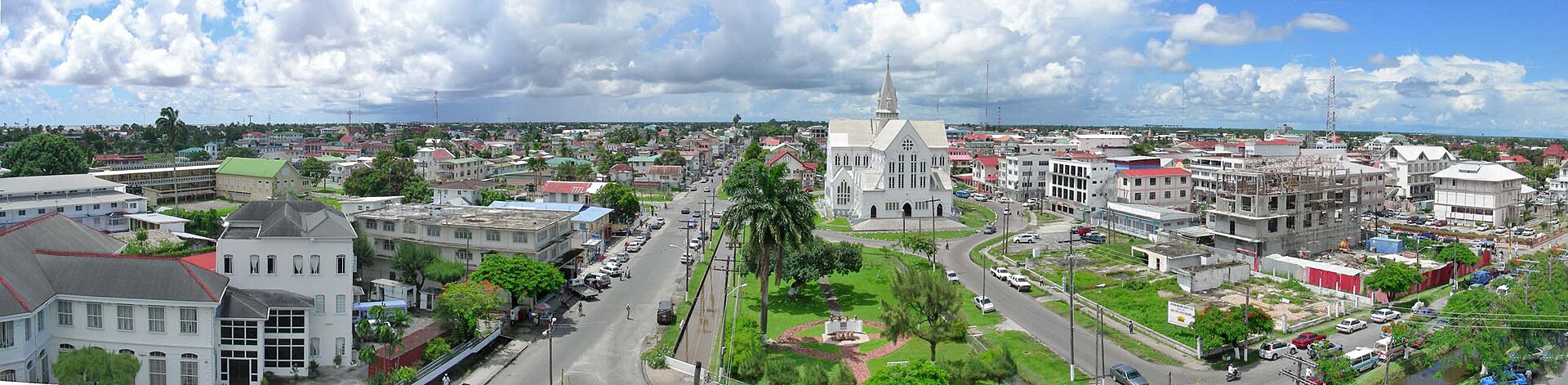
- Parliament Building — Central Georgetown
The Parliament Building is a neo-Classical brick structure completed in 1834, standing on open ground in the middle of the city. It still houses the national legislature, so most visitors admire it from the pavement. Its heavy masonry contrasts with the surrounding timber buildings. Photograph the façade, but keep clear of security posts and ask before photographing staff.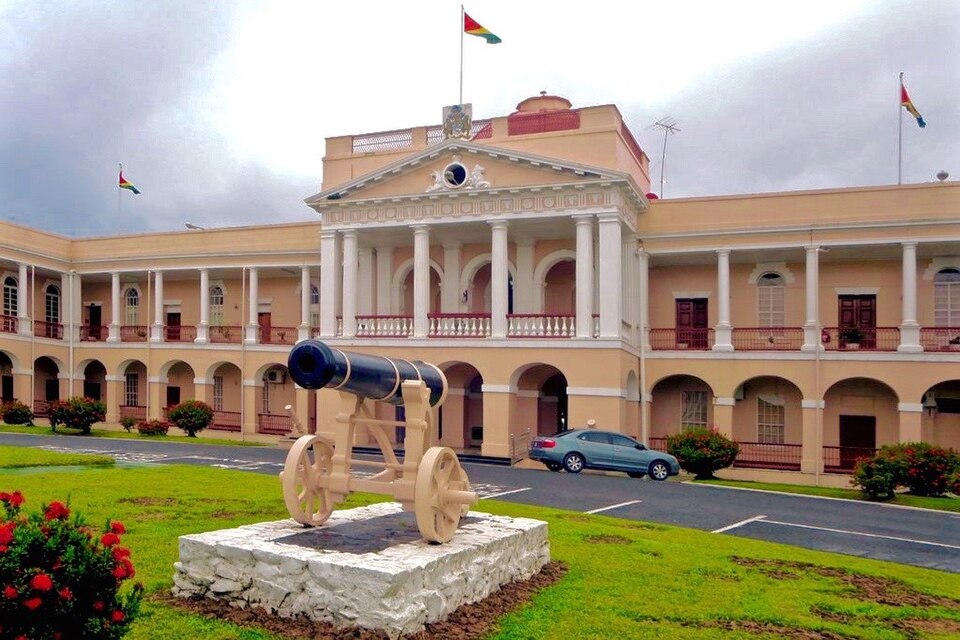
- Stabroek Market — Waterfront, near the ferry stelling
Stabroek Market is the city's main trading hall, an iron-framed building with a clock tower, with stalls spilling out into the surrounding streets. Produce, clothes, household goods and snacks change hands all day, and minibuses gather close by. Go in the morning, carry little, keep phones and wallets in zipped pockets, and leave before dusk. - Botanical Gardens — Eastern Georgetown
The Botanical Gardens are a large, free green space where families walk, picnic and meet friends, busiest on weekend afternoons. South of the zoo are ponds of Victoria lilies, Guyana's national flower, with leaves as broad as trays. The zoo is small and its cages are cramped, so many visitors skip it. - Castellani House — Near the Botanical Gardens
Castellani House is named after its architect and served as the prime minister's residence in the later twentieth century. After rebuilding it became the national gallery, and its rooms hold Guyanese paintings and sculpture. It is an easy pairing with the Botanical Gardens next door, and a cool, quiet break from midday heat. - Walter Roth Museum of Anthropology — Northern Georgetown
The Walter Roth Museum of Anthropology spreads over two floors and is devoted to the Amerindian heritage of Guyana. Displays include artefacts, costumes, photographs and archaeological finds, giving useful context for the interior of the country. It makes a good first stop before travelling inland, and it is small enough to see in an hour or so.
Culture
Georgetown is one of the most mixed cities in the Caribbean region, and daily life shows it. Indo-Guyanese, Afro-Guyanese, Amerindian, Chinese, Portuguese and mixed families live side by side, and the city's skyline carries the proof: churches, mosques and Hindu temples, including the Central Vaidik Mandir of the Arya Samaj, stand within a short ride of each other.
The calendar follows the same pattern. Mashramani, the national celebration in February, brings costume parades and music; Phagwah fills the streets with coloured powder in spring; Diwali lights up Hindu homes with lamps; and Eid, Emancipation Day and Christmas are all marked with feasts, services and family visits. Food is shared across these lines, so a Hindu festival menu may be eaten by neighbours of every background.
Cricket is a common language. Games on any open ground draw an audience, and talk of the West Indies team can start a conversation with a taxi driver in seconds. English is the national language, spoken alongside Guyanese Creole, which is fast, melodic and easy to love after a few days. Music runs from calypso and soca to chutney, and sound systems play loudly at weekends.
People are generally friendly and talkative, and a greeting before any question is expected. Politics is a sensitive subject between communities, so listening is wiser than offering opinions.
At a mandir, mosque or church, dress modestly, remove your shoes where others have left theirs at the door, and ask before photographing worshippers.
What to wear
Georgetown's traditional dress reflects its communities. Indo-Guyanese women wear saris, shalwar kameez and lehengas in cotton, silk and synthetic blends on festival days and at weddings, often with an odhni draped over the head at religious events, while men wear kurtas. Afro-Guyanese festival dress often uses African-print cotton, head wraps and bold colour, and Amerindian communities of the interior are known for beadwork and woven goods, some of which appear as costumes in the Walter Roth Museum.
Everyday clothing in the city is practical and light. Office workers wear short-sleeved shirts or blouses, trousers and closed shoes, schoolchildren are in crisp uniforms, and on Sundays many families dress carefully for church. Jeans, T-shirts and trainers are common, and nobody is surprised by a bright shirt or a hat in the sun.
Visitors should plan for heat, humidity and sudden rain. Breathable cotton or linen in light colours works best, with a thin waterproof jacket or small umbrella in the bag. Closed, grippy shoes suit uneven pavements, open drains and puddles better than flip-flops. Cover shoulders and knees at temples, mosques and churches, and carry a light scarf for the purpose. In the evening, long sleeves and insect repellent help against mosquitoes. Flashy jewellery and expensive watches are best left at home, as they attract attention in the busy parts of town.
What to eat
- Pepperpot — Family kitchens at Christmas; ask at local eateries and bakeries in the season
Pepperpot is a slow-simmered meat stew coloured and preserved by cassareep, a dark syrup made from bitter cassava, a technique with Amerindian roots. It is strongly linked with Christmas mornings, usually eaten with bread, and the flavour deepens when it is reheated over several days. - Cook-up rice — Casual neighbourhood eateries and family homes, often at weekends
Cook-up rice is a one-pot dish of rice simmered with coconut milk, beans or peas and salted or fresh meat. It is a staple of Saturday family meals and a good way to see how Caribbean and African cooking arrived on the mainland coast. - Roti and curry — Roti shops and the stalls around the main markets
Roti and curry reflects the Indo-Guyanese community. A soft paratha or dhal puri roti comes with chicken, duck or vegetable curry, often with pumpkin or potato. The roti is torn by hand and used to scoop, making it an easy, filling lunch. - Bake and saltfish — Bakeries and morning street stalls
Bake and saltfish is a breakfast of fried or baked bread served with flaked, salted fish cooked with onion, tomato and pepper. It is salty, filling and cheap to share, and bakeries and stalls selling it are busiest early in the day. - Chinese-style fried rice and chow mein — Neighbourhood Chinese restaurants, some with buffets
Chinese-Guyanese cooking is part of everyday Georgetown eating. Fried rice, chow mein and chicken dishes are found in neighbourhood restaurants, some offering buffets. Portions are generous and the seasoning often leans towards pepper sauce, so ask for it on the side.
Plan it
Best time. February to April and September to November are usually the drier months, so these are the best windows for walking around the city. Georgetown is hot and humid all year, and heavy rain is likely in the wetter seasons, when streets can flood quickly.
How long. 2–3
Getting there. Fly into Cheddi Jagan International Airport, which is a taxi or minibus ride from the city, around an hour depending on traffic. Taxis wait outside departures; cheaper minibuses run to the bus park behind Parliament near Stabroek Market. From Suriname, there are flights from Paramaribo, or an overland route by minibus, border ferry and a final minibus to the market.
Budget. mid
Tips
- Agree the taxi fare before getting in, and use a taxi for any trip after dark
- Carry some cash in small notes for markets, minibuses and street stalls
- Visit markets and the Botanical Gardens in the morning, before the heat and the crowds
- Carry water and a light rain jacket year-round
- Keep valuables out of sight in busy areas, particularly near Stabroek Market
Etiquette
- Ask before photographing people, especially vendors and worshippers
- Cover shoulders and knees and remove shoes when entering a temple or mosque
- Greet people before asking a question, as courtesy matters in daily dealings
Nearby
Sources
- Wikidata Q10717 (CC0)
- Wikipedia: Georgetown, Guyana (rev 1381242673) (CC BY-SA 4.0)
- Wikivoyage: Georgetown (Guyana) (rev 5417189) (CC BY-SA 4.0)
- Photo: St George's Cathedral, Johnldasilva (CC BY 3.0)
- Photo: Guyana Parliament Building, David Stanley (CC BY 2.5)
- Photo: Secretariat of the Caribbean Community, David Stanley (CC BY 2.5)
- Photo: Central Vaidik Mandir, J.G. de Kruijf (CC0 1.0)
- Photo: Flag of Georgetown, Georgetown City Hall (CC BY-SA 2.5)
- Photo: Wesleyan Mission Premises, George-Town, Demerara (Public domain)
- Photo: Georgetown, Dan Lundberg (CC BY-SA 2.0)
- Photo: Parliament, Georgetown Guyana, Kevin Gabbert (Public domain)


